
The long-standing assumption underpinning the robust bull case for the hard disk drive (HDD) duopoly of Seagate Technology (STX) and Western Digital (WDC) for much of 2026 was unequivocally clear: no new manufacturing facilities were being constructed. This fundamental premise, which had buoyed stock valuations to unprecedented highs, was dramatically shattered on Friday when Japanese conglomerate Toshiba announced ambitious plans to significantly boost its HDD production capacity. The revelation sent shockwaves through the market, causing shares of Seagate and Western Digital to plummet over 10% each, standing out as stark outliers on a day when the broader Nasdaq composite soared to new all-time highs, propelled by continued optimism in the artificial intelligence (AI) sector.
A Foundational Premise Undermined
For investors tracking the HDD market, the narrative had been one of remarkable supply discipline. Analysts and industry observers alike had consistently highlighted that the three primary manufacturers—Seagate, Western Digital, and Toshiba—were refraining from adding new unit capacity. Instead, the strategy focused on maximizing exabyte growth by innovating within existing frameworks, primarily through technologies like Heat-Assisted Magnetic Recording (HAMR) to cram more terabytes onto each drive. This collective restraint was seen as a bulwark against the cyclical oversupply that has historically plagued the semiconductor and storage industries, ensuring stable pricing and healthy margins in an era of exploding data demand, particularly from AI-driven data centers.
Bernstein, a prominent investment research firm, had articulated this prevailing sentiment vividly after hosting Seagate management in August. Their report underscored that "None of STX, WDC, or Toshiba are adding drive unit capacity, keeping industry-wide HDD supply structurally disciplined." Seagate’s management, according to Bernstein, indicated that their factories were operating at near full capacity, and their focus was on achieving approximately 25% Compound Annual Growth Rate (CAGR) in nearline exabyte shipments solely by enhancing capacity per drive through HAMR technology. The notion of building a new factory was explicitly dismissed, with management stating it would take "at least two years" and was not in their plans. Bernstein even designated Seagate as its top pick, precisely because "the broader industry’s inability to scale supply keeps supply disciplined."
Toshiba’s Strategic Gambit
However, Friday’s news, initially reported by Nikkei, irrevocably altered this carefully constructed market perception. Toshiba, a long-standing but smaller player in the HDD market, revealed its intention to double its hard disk drive production capacity by fiscal year 2027. This aggressive move is a direct response to the burgeoning demand for data storage fueled by the AI boom, particularly within hyperscale data centers. To achieve this, Toshiba plans to invest approximately 60 billion yen (equivalent to roughly $380 million USD) to expand its manufacturing facilities in the Philippines.
Goldman Sachs’ TMT desk, in an early morning summary of the Nikkei story, detailed Toshiba’s ambitious objectives: "The Japanese player’s share by storage capacity stands at just over 10%, but it aims to reach 30% in the medium term." This expansion in the Philippines marks Toshiba’s first major HDD investment in roughly five years, signaling a significant strategic shift. Beyond merely increasing production lines, the company also intends to introduce new products that will boost per-unit memory capacity by as much as 40%, aligning with the industry trend of maximizing storage density. This dual approach of increasing both unit capacity and per-unit memory capacity directly challenges the established equilibrium.
Immediate Market Repercussions
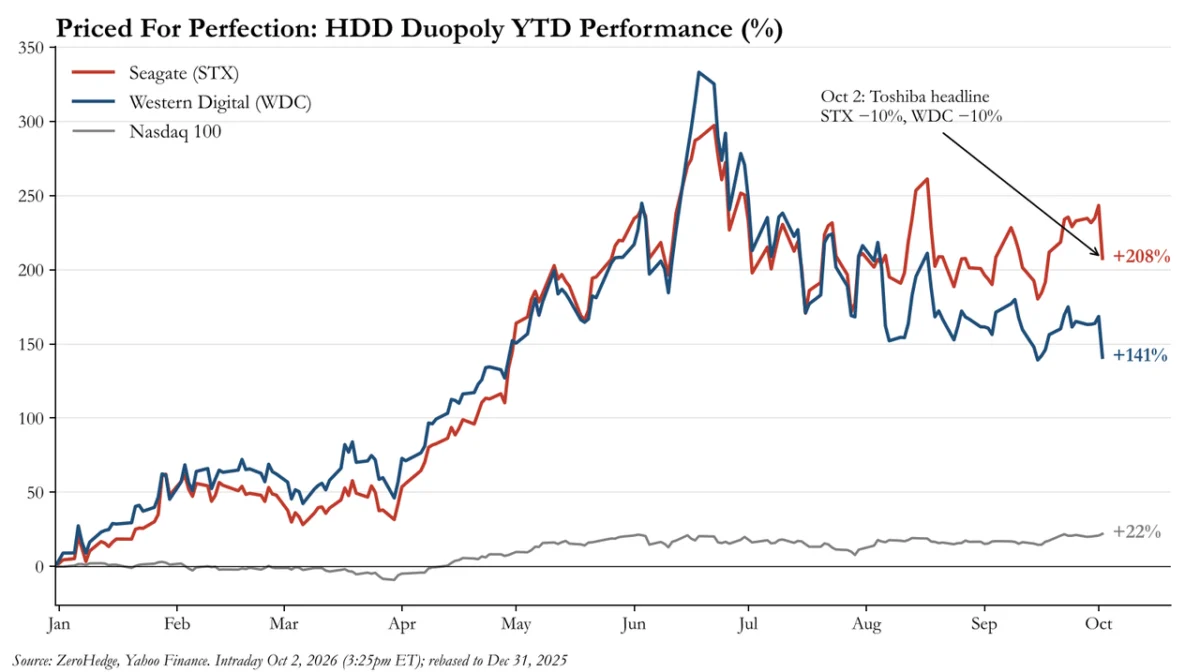
The market’s reaction was swift and punitive. Seagate (STX) shares tumbled 11.6%, while Western Digital (WDC) saw a 10.9% decline. These sharp drops made them "standout laggards," as noted by Goldman’s US equities desk by midday, especially jarring on a day when the Nasdaq 100 and bellwether AI stock NVIDIA (NVDA) were hitting record highs, with AI winners generally up 1.4%.
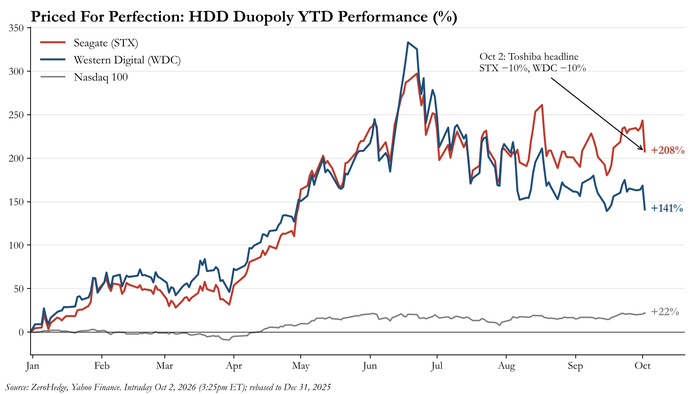
Despite the severity of Friday’s declines, it is crucial to contextualize them against the backdrop of an extraordinary bull run for these stocks. Both Seagate and Western Digital have seen their valuations triple in recent times. Even after Friday’s significant dip, Seagate remains up approximately 208% year-to-date, and Western Digital is up 141%, far outstripping the Nasdaq 100’s "mere" 22% gain over the same period. This suggests that while the 10% drop might appear substantial, it represents more of a "flesh wound" in the context of their recent spectacular performance.
However, market observers quickly pointed out that when a stock is "priced for perfection," as the HDD duopoly arguably was, the significance lies not in the magnitude of the hit, but in where it lands. The hit directly targeted the core thesis of supply discipline, which was the primary driver of their elevated valuations.

Sell-Side Defenses and Underlying Concerns
Predictably, the sell-side analyst community, which has largely maintained bullish "buy" ratings on both Seagate and Western Digital, quickly moved to mitigate the impact of the news. Their arguments typically centered on several points: that demand for HDD remains robust, the timing of Toshiba’s new capacity coming online would not immediately impact existing contracts, and that Toshiba’s expansion, while notable, might still be a "rounding error" in the grand scheme of exabyte growth.
Many analysts suggested the market reaction was "overdone," citing the immense and sustained demand from hyperscale data centers for AI workloads. They argued that even with Toshiba’s increased supply, the overall market would remain undersupplied given the insatiable appetite for data storage. Yet, the disparity between their collective price targets—sitting 50% to 90% above Friday’s closing prices—and the market’s immediate repricing highlighted a common pattern: price targets often follow price, rather than leading it.
Goldman Sachs, for its part, had already laid some groundwork for a nuanced perspective. At the previous month’s Communacopia conference, Goldman’s James Schneider summarized key takeaways from Seagate CFO Gianluca Romano’s presentation, including Seagate’s consistent market share gains in nearline exabytes, strong demand for nearline products, and the ongoing transition to HAMR technology. Furthermore, Goldman’s Korea memory team, interpreting Micron’s results, recently projected "2027 and 2028 memory S/D to be much tighter than 2026," with customers increasingly "requesting longer duration and larger supply" agreements. This suggested a backdrop of continued tightness, not a glut.
The Long Game: Hyperscalers and Negotiating Leverage
The implications extend beyond immediate stock performance, delving into the long-term dynamics of customer relationships and pricing power. Rosenblatt, another research firm, highlighted that hyperscalers are currently negotiating long-term agreements (LTAs) that stretch into 2029-2031. Toshiba’s announced expansion "introduces a credible medium-term supply risk," which, crucially, "gives customers incremental negotiating leverage." Evercore further elaborated, noting that while Seagate "has allocated the majority of its nearline exabytes into calendar year 2028," Western Digital is still "negotiating long-term agreements extending to calendar year 2031."

This distinction is critical. Pricing for 2027 and 2028 may largely be locked in, but the market is clearly repricing the "back end of the curve"—the period beyond 2028. For companies whose valuations are heavily tied to out-year earnings potential, this shift in long-term supply expectations has a profound impact. The perceived stability of a tight oligopoly has been fractured, giving major customers, who wield immense purchasing power, a new card to play at the negotiating table.
The HAMR Moat: A Differentiating Factor?
The real question remains whether Toshiba’s doubling of capacity will truly matter as much as the market reaction suggests. Some preliminary calculations offer perspective: if Toshiba, starting from "just over 10%" of industry exabytes, aims to double its share to roughly 20-30% by FY27, this would represent an addition of approximately 10-20% to the total industry exabyte supply, spread over two years. This figure needs to be weighed against Seagate’s own target of achieving a ~25% nearline exabyte growth per year purely through the advancements of HAMR technology.
In this context, Toshiba’s plan, while significant in a headline, could be seen as a "rounding error" in terms of overall exabyte contribution relative to what the HAMR transition is projected to deliver, provided Toshiba can secure the necessary head and media suppliers (a point of concern raised by Citi analysts).
This brings to light a crucial competitive differentiator: the technological lead in HAMR. Seagate is currently the only major player shipping HAMR drives at scale. As Bernstein’s analysis consistently shows, Seagate’s areal density lead directly translates into faster exabyte growth compared to Western Digital. This technological advantage is also forecast to enable Seagate to achieve gross margins that surpass Western Digital’s by fiscal year 2027, potentially climbing towards the mid-60s. If the tide of supply discipline is indeed receding due to Toshiba’s expansion, the company with the weakest areal density roadmap and slower exabyte growth is likely to be the most exposed. The market’s reaction, with Western Digital’s stock now down more from its June peak than Seagate’s, suggests that investors may be recognizing this vulnerability.
Ripple Effects: Equipment Manufacturers See Gains

Interestingly, while the HDD manufacturers were reeling, related equipment names experienced an immediate upside. Veeco Instruments, a company whose data storage business supplies ion beam deposition and etch tools essential for manufacturing HDD read/write heads, saw its shares surge by 11%. This rally directly reflects the expectation that Toshiba’s capacity expansion, or that of its suppliers, will necessitate increased investment in the underlying manufacturing infrastructure. Aixtron, another equipment provider, also rallied by 7%, although its MOCVD tools are primarily used for compound semiconductors (GaN, SiC, optoelectronics), making the direct link to HDD expansion less clear, possibly suggesting a broader sentiment uplift across semiconductor equipment.
Historical Precedent and The Future of Supply Discipline
The current scenario echoes historical patterns in commodity hardware markets. Back in May, concerns emerged when reports indicated "China Begins Flooding The Market With DRAM And NAND Chips." At that time, Seagate’s CEO had already acknowledged to JPMorgan that building new factories "would take too long," implicitly warning that if others stepped in to fill supply gaps, the tightness justifying memory ETF rallies would collapse. Chinese players like CXMT and YMTC began leveraging the tactic of "capture market share by dumping products at below market prices." This time, it’s an established player, Toshiba, in the "spinning rust" segment, making its move from the Philippines rather than Hefei.
The analysts may be correct that Toshiba’s 60 billion yen investment will not fundamentally disrupt HDD pricing through 2028, given that much of the volume is already sold and LTAs are largely in place. Moreover, Toshiba still relies on external suppliers for critical components like heads and platters, which could limit the speed and scale of its expansion.
However, the market was not merely pricing the next two years; it was pricing a decade of anticipated monopoly-like discipline within an effective oligopoly of three. The fundamental lesson from Friday’s events is one painfully familiar across global industries, particularly to European car makers who faced similar pressures in their supply chains: in commodity hardware, the cure for high prices is high prices. Sooner or later, someone in Asia will indeed build a new factory.
Whether this marks the beginning of a broader cyclical downturn for HDD manufacturers or merely a temporary, albeit sharp, correction in an ongoing AI super-cycle remains to be seen. The sell-side, which stands to benefit from a prolonged AI boom, understandably leans towards the latter. The decisive factor will be the strategic response of Seagate and Western Digital. If they react to Toshiba’s move by initiating their own capacity expansion plans, the "supply discipline" thesis, which has been the bedrock of their recent valuation surge, will unequivocally be over. If they do not, Toshiba will have shrewdly seized a significant chunk of market share at what appears to be a cyclical peak, forever altering the competitive landscape of the HDD industry.

