
An alarming and persistent surge in disability rates has been observed across both the United States and the United Kingdom since early 2021, signaling a profound shift in public health and economic landscapes. Authored by Ed Dowd, this critical analysis, originally published on his Substack "Beyond the Narrative" and supported by data from Phinance Technologies, highlights an unprecedented increase in individuals reporting disabilities, with data points from both nations corroborating a concerning inflection point that began not with the initial onset of the COVID-19 pandemic in 2020, but with the mass vaccine rollout in early 2021. This transatlantic "disability signal" has been detected through divergent data collection methodologies—the U.S. Bureau of Labor Statistics’ (BLS) Current Population Survey and the UK’s medically assessed Personal Independence Payment (PIP) system—yet both converge on the same critical timeline and magnitude of change. The implications for labor force participation, healthcare expenditures, and overall societal well-being are profound and demand urgent, unaddressed public health investigations.
The Unprecedented American Surge in Disability
The United States has witnessed an extraordinary increase in its disabled population. As reported by Ed Dowd on August 11, 2023, the BLS Current Population Survey revealed that 37,029,000 Americans aged 16 and over reported a disability in July. This figure represents a staggering increase of seven million people since February 2021, marking a 23% rise in just over two years. This escalation is not a minor fluctuation but a "3-to-4 sigma break" from the pre-2020 plateau, indicating a statistically anomalous deviation that has shown no signs of mean-reversion. Prior to 2020, while disability rates fluctuated, they did not exhibit such a dramatic and sustained upward trajectory. The consistent rise observed since early 2021 challenges conventional explanations and has prompted calls for deeper scrutiny into underlying causes.
Crucially, the timing of this surge is a central point of contention and analysis. The inflection point for this unprecedented increase in disability reports in the U.S. is identified as February 2021. This period notably aligns with the widespread rollout of COVID-19 vaccines across the nation, rather than the initial, highly virulent phase of the COVID-19 pandemic in 2020. This chronological distinction is critical, as it suggests that factors beyond the virus’s direct impact during its most severe period may be at play. Alternative explanations for such a significant and sudden shift in national health statistics are challenged by this precise timing and the sheer magnitude of the increase. The BLS survey, while comprehensive in its reach, relies on self-reported data, which, while valuable for tracking population trends, does not provide the diagnostic specificity needed to understand the nature of these new disabilities. This is where the UK’s administrative data becomes indispensable.
The UK’s Corroborating Signal: Granular Data from the PIP System
To ascertain the reality and characteristics of this U.S. survey signal, researchers have turned to the United Kingdom’s Personal Independence Payment (PIP) system. The PIP system, officially known as the Personal Independence Pension program and administered by the UK Department of Work, serves as the country’s primary working-age disability benefit. Unlike self-reported surveys, PIP claims undergo rigorous medical assessment. Decisions, referred to as "clearances," are meticulously coded by body system (e.g., hematological, musculoskeletal, neurological) and further categorized by underlying cause. This level of detail provides an invaluable lens through which to examine the nature and timing of disability trends.
The Phinance Technologies "UK Disabilities (PIP) Project" has made this granular data publicly accessible, allowing researchers, medical professionals, and concerned citizens to interact with the raw figures. This project enables users to analyze total new claims, excess new claims, percent excess new claims, and excess new claims z-scores across various body systems and underlying causes. Data can be filtered by monthly and yearly periods, as well as by age group, offering an unparalleled level of insight into the evolving disability landscape. The project was specifically designed to allow independent verification of the trends observed by Phinance Technologies in 2023, highlighting the transparency and rigor applied to the analysis.

A key aspect validating the PIP data’s reliability is the consistency of its award rate. The positive award rate for PIP claims has remained remarkably stable at approximately 40 percent. This stability is crucial, as it indicates that the observed increase in awarded claims is not due to a sudden relaxation of assessment standards or a systemic change in eligibility criteria. Instead, it strongly suggests that more individuals are presenting with legitimate, medically assessed conditions warranting disability benefits. This administrative system, with its diagnostic breakdown, offers a powerful corroboration of the "disability signal" detected in the broader, self-reported U.S. data, providing the crucial where in the body and when that the American survey cannot.
Chronology of the Transatlantic Disability Shift
The timeline of rising disability across both the US and UK presents a consistent and compelling narrative. Before 2020, both nations generally exhibited stable, albeit slowly changing, disability demographics. The initial months of the COVID-19 pandemic in 2020, despite the virus’s virulence and the imposition of lockdowns, did not trigger an immediate or significant spike in disability claims in either country’s administrative or survey data. This absence of an early surge is a critical piece of the puzzle, challenging the notion that the primary cause is merely the initial infection wave of the virus itself.
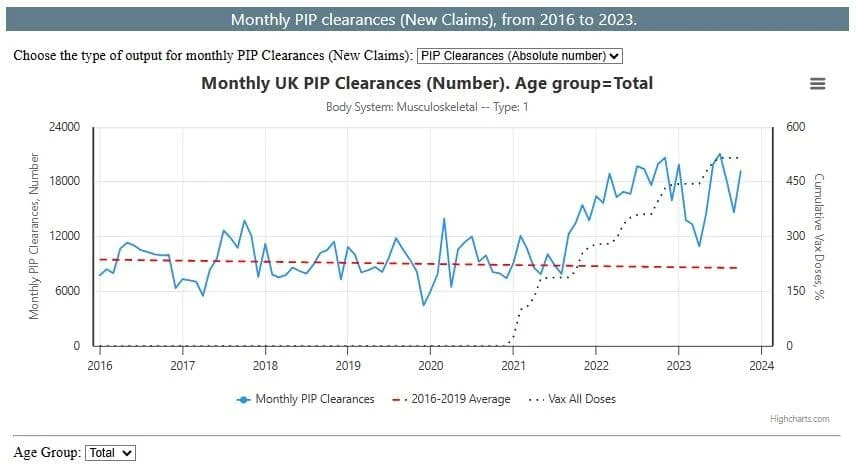
The pivotal shift occurs in early 2021. In the United States, the BLS data shows a distinct acceleration in reported disabilities starting in February 2021. Concurrently, the UK PIP system began recording anomalous increases in new claims for specific body systems. Hematological (blood) disorders, for instance, saw an early and sharp increase in new excess clearances, almost coincident with the first doses of the COVID-19 vaccine rollout in the UK. This was followed by a significant rise in musculoskeletal claims around September 2021, a period coinciding with the broader mass rollout and booster campaigns. This synchronized, post-early-2021 surge across two independent national datasets, each with its own methodology, underscores the robustness of the observed "disability signal."
Detailed Insights from UK PIP Data: Specific Body Systems Affected
The UK PIP data offers a disquieting glimpse into the specific physiological systems most impacted by this recent surge. Two body systems, in particular, stand out with dramatically elevated new claims:
Hematological (Blood) Disorders
The data for hematological disorders paints a stark picture of a "regime change." New excess clearances for conditions related to the blood system rose by approximately 217 percent in 2021. This surge further intensified in 2022, reaching an astounding 522 percent above the established pre-2016-2019 trend. While 2023 saw a slight decline from this peak, the rate remained an "absurd" 374 percent above trend. This represents over 300 percent above trend for two consecutive years, a phenomenon unprecedented in recent history. Monthly data shows that the jump in hematology claims was both early and sharp, aligning almost precisely with the initiation of the first doses of the vaccine rollout. This magnitude and timing, impacting a fundamental bodily system, should, according to the analysis, have triggered an immediate and comprehensive public health investigation. The absence of such an inquiry is a significant concern.
Musculoskeletal Claims
Musculoskeletal claims tell an equally concerning, albeit chronologically distinct, story. Throughout 2020 and early 2021, monthly clearances for musculoskeletal conditions remained near a "normal" baseline of approximately 10,000. However, around September 2021, these claims experienced a dramatic and sustained increase, remaining elevated above 18,000 per month. This surge did not coincide with the initial lockdowns or the first wave of COVID-19 infections. Instead, it manifested after the period of mass vaccine rollout and into the booster campaign phase. These conditions, often involving inflammation, joint pain, and soft-tissue diseases, are significant drivers of work absenteeism and often necessitate daily-living and mobility awards. The precise timing of this surge, following the mass intervention rather than the initial viral spread, is a critical observation that demands further investigation.

Beyond these two prominent systems, the PIP data reveals broader systemic impacts. Cardiovascular and neurological claims also demonstrated significant increases, with neurological claims reportedly printing "20 plus-sigma years"—an extraordinary statistical deviation. Breast cancer clearances showed large excesses in both 2022 and 2023, accompanied by high z-scores. The crucial takeaway is that while different body systems exhibit varying latencies and magnitudes of increase, they all converge on the same calendar timeline: the dramatic break from previous trends occurred in 2021, not 2020. This pattern suggests a common underlying factor or set of factors accelerating health deterioration across multiple physiological domains after the interventions intended to end the public health emergency.
Addressing Counterarguments and Official Silence
The observed trends have naturally invited scrutiny and alternative explanations. One common counter-argument suggests that the rise in PIP claims might be attributed to fraud or individuals "gaming the system." However, the detailed breakdown by body system effectively refutes this. A wave of fraudulent claims would not preferentially target specific physiological systems like hematology in early 2021 and musculoskeletal in late 2021, nor would it result in "20 plus-sigma years" for neurological conditions or unexplained increases in breast cancer clearances. Fraudulent activity typically disperses across categories or targets the easiest claims, not specific, medically assessed conditions with distinct chronological patterns. Similarly, arguments suggesting that "awareness campaigns" are driving the increase fail to explain the highly specific and system-dependent surges, such as those observed in breast cancer clearances.
A more significant concern highlighted by the analysis is the conspicuous lack of official public health investigations into these unprecedented shifts. Despite the statistically extreme nature of the increases in medically assessed claims for severe conditions, especially in the UK, official bodies have largely remained silent or have not initiated the type of comprehensive, transparent investigations that such a scale of adverse health events would typically warrant. This silence, as noted by the author, suggests an avoidance of the "corroborating signal no one in official public health circles wants you to see."
While direct statements from official bodies on the causation of these disability surges are largely absent, there are inferred responses regarding the implications. In the UK, the fiscal strain of rapidly escalating disability benefits is already prompting political discussions. "Claimant counts have roughly doubled since 2019," with psychiatric disorders now representing the largest single category. The soaring cost is pushing politicians to discuss the "sustainability" of the welfare system and the implementation of "tighter points tests" for eligibility. However, these discussions predominantly focus on managing the fiscal consequences rather than actively investigating why so many working-age individuals are experiencing such severe and diverse health deteriorations within the same critical timeframe. This prioritisation of fiscal containment over root-cause analysis is a recurring theme.
Broader Impact and Implications
The "disastrous disability signal" carries far-reaching implications that extend beyond individual health and immediate benefit expenditures. The economic and societal consequences are profound and will compound over time if the underlying causes remain unaddressed.
Fiscal Strain and Public Finance
The fiscal burden is already evident in the UK, where the doubling of claimant counts since 2019 has placed immense pressure on public finances. The trajectory of spending on disability benefits is unsustainable without significant policy changes or a reversal of the trends. This financial strain is an early indicator of what the United States can expect. A permanently larger disabled share of the U.S. population aged 16 and over will inevitably lead to increased pressure on social safety nets like Social Security Disability Insurance (SSDI) and Medicaid. These programs are already facing long-term solvency challenges, and a sudden, sustained influx of new claimants could exacerbate these issues, potentially requiring difficult choices regarding taxation, benefits, or eligibility.

Economic Consequences
Beyond direct government spending, a rise in disability has significant economic ramifications. A larger disabled population directly translates to lower labor force participation rates. This reduction in the available workforce can lead to labor shortages, reduced productivity, and slower economic growth. Furthermore, increased disability often correlates with higher rates of absenteeism from work among those who remain employed, further impacting productivity. Businesses and individuals will also face higher insurance costs, as the increased prevalence of chronic and debilitating conditions drives up healthcare expenditures across the board. The collective impact on a nation’s economic vitality and competitiveness cannot be overstated. As the article bluntly states, "You can ignore a chart. You cannot ignore the payroll."
Public Health Crisis and Societal Costs
At its core, this transatlantic disability signal points to an unfolding public health crisis. The rapid and systemic increase in various forms of illness and physical impairment among the working-age population represents a significant deterioration in collective health. The societal costs extend beyond economics, encompassing a decline in overall quality of life, increased demand for care services, and potentially greater social fragmentation as more individuals grapple with chronic conditions. The call for clinicians and public health experts to investigate these findings, which largely met with "crickets" in 2023, underscores a critical gap in official response. The charts, as the author notes, remain available, detailing how systems across multiple body parts deviated from trend in 2021, not 2020, following mass interventions.
Conclusion: An Unacknowledged Crisis
The parallel trends observed in the U.S. disability survey data and the UK’s medically assessed PIP system present a powerful, corroborating signal of a significant and alarming increase in disability since early 2021. This timing, following the mass rollout of COVID-19 vaccines rather than the initial spread of the virus, demands rigorous and transparent scientific investigation. The specific breakdown of affected body systems in the UK data, from hematological to musculoskeletal, cardiovascular, neurological, and even breast cancer, indicates a widespread and systemic impact on population health.
Despite the statistical anomalies and the profound implications for public health, economic stability, and social welfare, official public health circles have largely failed to acknowledge or investigate this phenomenon comprehensively. The focus, particularly in the UK, has gravitated towards managing the fiscal fallout rather than understanding the root causes of this unprecedented deterioration in health. The "great cover up," as Ed Dowd terms it, continues, and the damage, both to individuals and to national economies, is slowly compounding. The combined evidence from both sides of the Atlantic serves as an urgent, unheeded warning that demands immediate attention and a thorough, unbiased inquiry into the factors driving this disastrous disability signal.

