
The market for Treasury Inflation-Protected Securities (TIPS) is demonstrating a pronounced mean-reverting behavior, indicating a significant risk of overshooting to the downside and consequently driving a sustained increase in real yields. This trend, analyzed by Bloomberg macro strategist Simon White, points to a complex interplay of geopolitical tensions, monetary policy, and shifting capital demands that are reshaping the fixed income landscape. The recent trajectory of real yields in the United States has been notably robust, with the 10-year real yield plummeting to approximately 1.72% at the close of March before embarking on a sharp ascent to its current level near 2.43%. This represents a rally that has pushed real yields to their highest points in nearly two decades, a remarkable feat considering that crude oil prices have, on a net basis, surged by almost 70% over the identical period.
Current Market Dynamics and the Resurgence of Real Yields
The journey of the 10-year U.S. real yield from its March trough of 1.72% to its present elevation around 2.43% marks a pivotal shift in financial markets. Real yields, which represent the return an investor receives after accounting for inflation, are a critical barometer of economic health and monetary policy effectiveness. Their rise signifies either an increase in economic growth expectations, a tightening of monetary conditions, or a combination of both, alongside a potential increase in the risk premium associated with holding long-term debt. The current ascent is particularly striking given the simultaneous surge in oil prices. Historically, higher oil prices often fuel inflation expectations, which, if not fully absorbed by nominal yields, can sometimes put downward pressure on real yields by eroding the purchasing power of future fixed payments. However, the market’s response this time suggests a different dynamic is at play, where the underlying economic strength and other factors are outweighing the traditional inflationary impact on real yields.
This strong upward movement in real yields has significant implications across various asset classes. For equity markets, higher real yields can increase the discount rate used in valuation models, potentially dampening stock prices, especially for growth companies whose valuations are more sensitive to future earnings. For corporate borrowing, increased real yields translate into higher real financing costs, which could temper investment and expansion plans. Moreover, the broader bond market, beyond TIPS, also feels the gravitational pull of rising real yields, as they contribute to overall tighter financial conditions.
The Phenomenon of TIPS Mean Reversion
A central tenet of Simon White’s analysis revolves around the concept of mean reversion in TIPS’ annual returns. Mean reversion is a financial theory suggesting that asset prices and historical returns eventually revert to their long-term average or mean. In the context of TIPS, this implies that periods of exceptionally high or low returns are typically followed by movements back towards a historical average, albeit one that is decaying over time. According to White, TIPS were in an "overbought" condition leading into the recent geopolitical tensions surrounding the "Iran war." This overbought status suggested that their prices had risen too high too quickly, making them ripe for a correction. As the market subsequently adjusted, TIPS returns have now gravitated back towards their historical mean.
The crucial insight here is the "pendulum" analogy: when a financial series, like TIPS annual returns, returns to its mean after an extended deviation, it frequently doesn’t just stop there. Instead, it tends to "overshoot" in the opposite direction. If this historical pattern holds true, the current return to the mean portends a further downward trajectory for TIPS performance, which directly translates to a continued rise in real yields. This cyclical behavior underscores the inherent volatility and self-correcting mechanisms within financial markets, where extremes are often followed by counter-movements. The decaying mean itself suggests a long-term trend of diminishing returns for TIPS, which could be attributed to a variety of structural economic factors, including potentially lower long-term inflation expectations or changes in the global savings glut.

Geopolitical Undercurrents and Oil Price Dynamics
The reference to the "Iran war" context, while not implying direct military conflict, points to heightened geopolitical risks in the Middle East that have significantly impacted global energy markets. Tensions in key oil-producing regions invariably lead to concerns about supply disruptions, driving up crude oil prices. As noted, oil prices have surged by nearly 70% since late March. This dramatic increase has multiple layers of influence on real yields. Firstly, higher oil prices can directly feed into headline inflation, increasing the cost of goods and services. This inflationary pressure, if perceived as persistent, could compel central banks to maintain or adopt a more hawkish monetary stance, which typically pushes nominal yields higher.
However, the current environment presents a nuanced picture. While oil prices have risen, the market’s expectation of future real returns (as reflected in real yields) has also climbed, suggesting that the inflationary impact might be viewed as transitory or that other, more powerful forces are at play. The initial "overbought" status of TIPS before the escalation of these tensions could be interpreted as investors seeking refuge in inflation-protected assets, anticipating a surge in inflation from potential supply shocks. As the situation evolved, and perhaps the immediate threat of widespread supply disruption subsided, or other economic narratives took precedence, the market recalibrated, leading to the observed mean reversion. This highlights how geopolitical events can create immediate, sometimes exaggerated, market reactions that then normalize as the broader economic and monetary policy landscape reasserts itself.
Leading Indicators and Future Outlook
The analysis extends beyond historical patterns to forward-looking indicators. Simon White’s proprietary leading indicator for real yields reinforces the expectation of continued upward pressure. This indicator incorporates key macroeconomic variables, notably G10 excess liquidity and the Federal Reserve’s policy rate.
G10 excess liquidity refers to the surplus funds within the financial systems of the Group of Ten developed economies, beyond what is required for normal operations. High levels of excess liquidity can indicate loose monetary conditions, potentially stimulating economic activity and inflation, but also potentially suppressing yields if that liquidity is seeking safe haven assets. Conversely, a reduction in G10 excess liquidity often signals tighter financial conditions. As central banks, including the Federal Reserve, have begun to withdraw liquidity through quantitative tightening measures and higher policy rates, this reduction in excess liquidity tends to push real yields higher by making capital scarcer and more expensive.
The Federal Reserve’s policy rate, the federal funds rate, directly influences short-term nominal interest rates. Changes in this rate ripple through the yield curve, impacting long-term yields, both nominal and real. When the Fed raises its policy rate, it typically signals a commitment to combating inflation or managing an overheating economy, which can lead to higher real yields. White’s indicator, by integrating these two powerful inputs, anticipates that the 10-year real yield will experience further increases over the next three months or so. This forecast is particularly salient for investors planning their portfolios, as it suggests that the current environment of rising real rates is likely to persist in the near term, impacting decisions across fixed income, equities, and alternative investments.
Elevated Short Positioning and Investor Sentiment
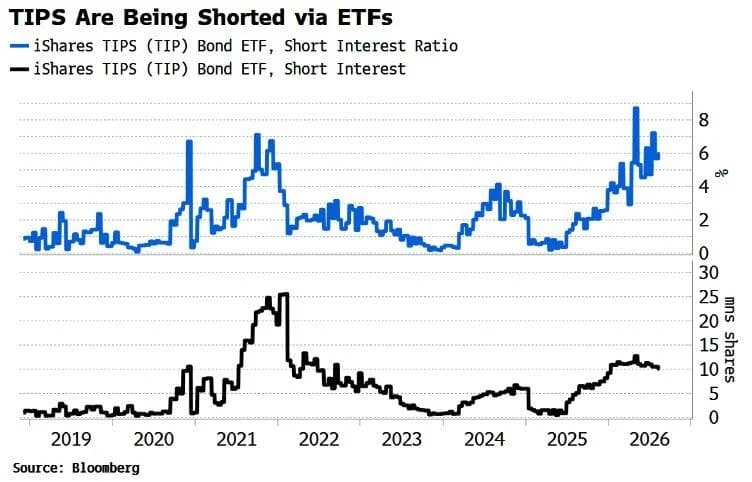
Further corroborating the bearish outlook for TIPS, and by extension, the bullish outlook for real yields, is the elevated level of short positioning in the iShares TIP ETF (ticker: TIP). The iShares TIP ETF is a popular instrument for investors seeking exposure to or hedging against movements in the TIPS market. Short interest in an ETF indicates the aggregate number of shares that have been sold short by investors, typically reflecting a bearish view on the underlying asset.

While the absolute number of shares shorted in the iShares TIP ETF may not be as high as during the peak of the inflation flare-up in 2021-2022 and the subsequent aggressive Federal Reserve tightening cycle, the short interest ratio tells a more compelling story. The short interest ratio normalizes the short interest by the total number of shares outstanding, providing a relative measure of bearish sentiment. This ratio is currently at a level comparable to that observed during the intense inflation period of 2021-2022. This suggests that a significant proportion of the available TIPS shares are being actively bet against by market participants.
The implication of such elevated short positioning is that a substantial portion of the market expects TIPS prices to fall further, driving real yields even higher. Crucially, the analysis suggests that a significant short covering event – where short sellers buy back shares to close their positions, which would typically push prices up – is unlikely to occur as long as the momentum remains firmly in favor of the "bears," i.e., those betting on rising real yields. This indicates a strong conviction among a segment of investors that the factors driving real yields higher are robust and will continue to exert influence, preventing any immediate reversal driven by technical market dynamics. The comparison to 2021-2022 is particularly insightful, as that period was characterized by rampant inflation and a central bank caught off guard, forced into rapid and aggressive rate hikes. The current drivers, while different, appear to be eliciting a similar level of bearish conviction regarding TIPS.
Evolving Drivers: Growth, Capital Competition, and Risk Premium
The underlying drivers of the current real yield surge are distinct from previous cycles. While Fed pricing played a dominant role in earlier periods, with expectations of numerous rate hikes, the current market anticipates a more modest two to three rate hikes over the next year. This suggests that the primary impetus for rising real yields is not solely aggressive monetary tightening, but a confluence of other powerful forces.
One significant factor is the rise in real growth expectations. Despite persistent inflationary pressures and higher interest rates, economic data continues to show resilience, leading investors to anticipate stronger underlying economic growth. Higher real growth prospects naturally lead to higher real yields, as capital becomes more productive and demands a greater real return. This optimistic outlook for growth, even in the face of tighter financial conditions, signals a robust underlying economy.
Another crucial driver is the intensifying competition for capital, fueled notably by the "seemingly insatiable demand" for investment in Artificial Intelligence (AI) infrastructure. The AI revolution requires massive capital expenditure in data centers, specialized hardware (like GPUs), energy infrastructure, and research and development. This demand for capital from the private sector creates a significant pull, competing directly with government bonds for investor funds. As companies raise capital to fund AI initiatives, they offer attractive returns, compelling government bonds to offer higher real yields to remain competitive and attract investment. This structural demand shift represents a powerful, long-term force on real yields, distinct from cyclical monetary policy adjustments.
Finally, a substantial portion of the year’s rise in real yields is attributed to an increasing risk premium for TIPS. A risk premium is the additional return investors demand for taking on a particular risk. In the context of TIPS, an increasing risk premium suggests that investors perceive a greater degree of uncertainty or risk associated with holding these inflation-protected bonds. This could stem from several sources:

- Inflation Uncertainty: Despite TIPS protecting against inflation, the market might be demanding a higher premium due to greater uncertainty about the path and volatility of future inflation, making even inflation-linked bonds less predictable in real return terms.
- Fiscal Concerns: Growing government debt levels and fiscal deficits could lead investors to demand a higher premium for holding sovereign debt, including TIPS, as concerns about long-term fiscal sustainability grow.
- Geopolitical Risks: Persistent geopolitical instability, even if not directly causing immediate inflation, can increase overall market uncertainty, prompting investors to demand a higher real yield as compensation for perceived systemic risks.
This combination of rising real growth expectations, fierce competition for capital from transformative technologies like AI, and an elevated risk premium paints a comprehensive picture of the forces propelling real yields higher. It also provides a compelling rationale for the observed high short positioning in TIPS, as investors position themselves for a continuation of these trends.
Broader Economic Implications
The sustained rise in real yields carries profound implications for the global economy and financial markets. For governments, higher real yields mean increased borrowing costs, potentially exacerbating debt burdens and constraining fiscal flexibility. For businesses, particularly those reliant on external financing, elevated real rates translate into higher costs of capital, which could cool investment, innovation, and job creation, especially for sectors not directly benefiting from the AI boom.
Consumers also face the ripple effects, as higher real yields can translate into higher mortgage rates, auto loan rates, and other forms of credit, impacting household spending and wealth accumulation. Furthermore, the global nature of capital markets means that rising U.S. real yields can exert upward pressure on real yields in other developed economies, potentially tightening financial conditions worldwide.
In conclusion, the current trajectory of TIPS and real yields is a multifaceted phenomenon driven by a complex interplay of market mechanics, geopolitical events, monetary policy, and structural economic shifts. Simon White’s analysis highlights the critical role of mean reversion, historical patterns, and forward-looking indicators in forecasting continued upward momentum for real yields. With elevated short positioning and a distinct set of drivers – including robust real growth expectations, intense competition for capital from AI infrastructure, and a rising risk premium – the market appears poised for a sustained period of higher real yields. This landscape necessitates a careful recalibration of investment strategies and a watchful eye on the evolving macroeconomic environment.

