
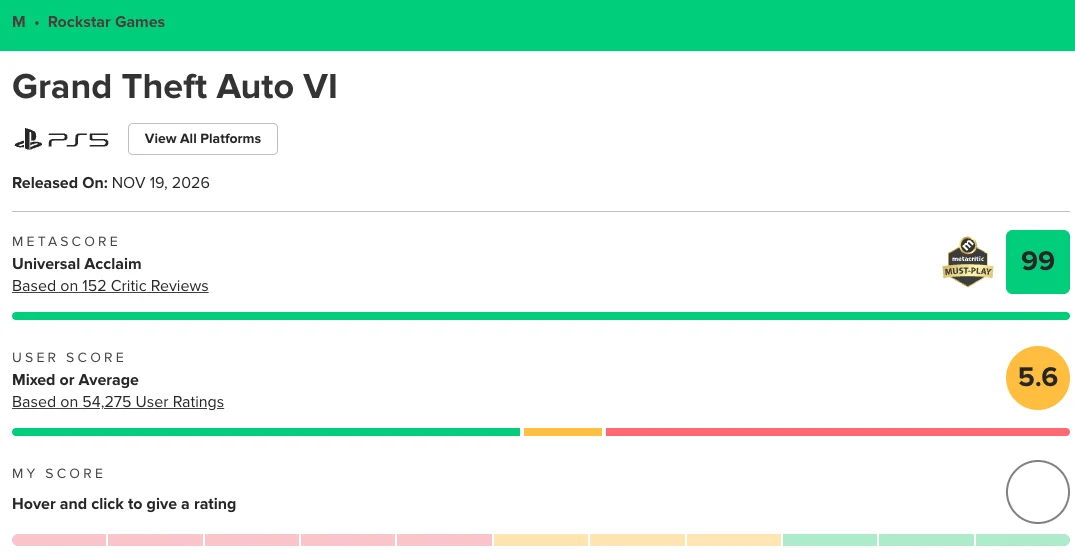
Take-Two Interactive Software announced Friday afternoon that Grand Theft Auto VI has generated an astounding $3.79 billion in worldwide sales through Thursday, marking a historic debut for a title many millennials had eagerly awaited for 13 years. This monumental financial success was underscored by JPMorgan analysts, who swiftly declared the launch the "largest entertainment launch in history," citing the game’s exceptionally high Metacritic score from professional reviewers. However, this record-breaking financial triumph and critical acclaim stand in stark contrast to a burgeoning wave of user dissatisfaction, revealing a significant chasm between professional critics and the broader player base.
A Record-Breaking Financial Juggernaut
The sheer scale of Grand Theft Auto VI’s launch is unprecedented. Take-Two Interactive reported a staggering 32.5 million units sold through presales alone, a figure that dwarfs most industry expectations and sets a new benchmark for pre-launch consumer demand. With the standard edition priced at approximately $80 and a premium package at $100, these presales translated directly into billions of dollars before the game even officially hit worldwide distribution channels on Thursday.
JPMorgan gaming analyst Bryan Smilek, in a note to clients Friday, reiterated his firm’s bullish stance on Take-Two Interactive (TTWO). "As we expected, Grand Theft Auto VI has become the largest entertainment launch in history across any medium and platform, while also receiving the highest rating of any video game in industry history (99 Metacritic score)," Smilek wrote. This assessment reflects not only the immediate financial windfall but also the critical consensus that positioned the game as a landmark achievement in interactive entertainment. JPMorgan maintained its "Overweight" rating and a December 2027 price target of $310, based on 26x 2028E Adjusted EPS of $11.73 per share, signaling strong confidence in the game’s long-term financial contributions to the publisher.
To put these figures into perspective, Grand Theft Auto V, released in 2013, famously generated over $800 million in its first day and $1 billion in its first three days, eventually becoming the fastest entertainment property to reach that milestone. Over its lifetime, GTA V has sold over 195 million units, cementing its place as one of the best-selling video games of all time. GTA VI’s initial sales surge of nearly $3.8 billion in just days suggests it is on a trajectory to not only surpass its predecessor’s initial performance but potentially redefine the commercial ceiling for the entertainment industry as a whole. Its opening performance rivals, and in some metrics, surpasses, global box office giants like "Avengers: Endgame" ($1.22 billion opening weekend) or "Avatar" ($2.9 billion total worldwide gross), illustrating the sheer economic power of the modern gaming industry.
The Enduring Legacy and Anticipation for GTA VI
The monumental demand for Grand Theft Auto VI was not an overnight phenomenon but the culmination of 13 years of intense anticipation. Following the immense success and cultural impact of Grand Theft Auto V and its enduring online component, Grand Theft Auto Online, fans had been clamoring for a new mainline installment for over a decade. Rockstar Games, the developer behind the GTA franchise, has cultivated a reputation for pushing technological boundaries, crafting intricate open worlds, and delivering satirical narratives that often reflect and comment on contemporary society.
The Grand Theft Auto series, since its inception in 1997, has consistently been at the forefront of controversial yet critically lauded gaming. Its blend of open-world freedom, compelling storytelling, and often provocative themes has garnered a loyal fanbase and significant mainstream attention. Each new installment is treated as a major cultural event, and GTA VI was no exception. Teases, leaks, and official trailers were scrutinized by millions, fueling an unprecedented hype cycle. The announcement of the game’s setting in Leonida, a fictionalized version of Florida, and the introduction of a female protagonist, Lucia, alongside male co-protagonist Jason, further piqued interest and set the stage for a new narrative direction for the franchise. The long development cycle, characteristic of Rockstar’s meticulous approach, only served to amplify the pent-up demand, creating an environment where expectations were astronomically high.

A Stark Divide: Critics Embrace, Players Rebel
Despite the universal praise from professional reviewers and the record-shattering sales, a significant and increasingly vocal segment of the actual player base has expressed profound dissatisfaction with Grand Theft Auto VI. While the game’s Metacritic score, a weighted average of professional critics’ reviews, proudly stands at an almost perfect 99 out of 100, its user score, based on 53,044 ratings as of Saturday morning, is a strikingly low 5.6 out of 10. This massive disparity signals a fundamental disconnect in perception, raising questions about the evolving landscape of game reviews and player expectations.
Professional critics have largely lauded GTA VI for its technical prowess, sprawling open world, ambitious narrative, and refined gameplay mechanics. They have highlighted the meticulous attention to detail in Leonida, the depth of character development for Lucia and Jason, and the engaging missions that blend traditional GTA anarchy with more structured storytelling. The 99 Metacritic score reflects a consensus among leading gaming publications that Rockstar Games has once again delivered a masterpiece, pushing the boundaries of what is possible in interactive entertainment.
However, the sentiment among a significant portion of the user base tells a different story. Comments across social media platforms like X (formerly Twitter), Reddit, and on Metacritic itself paint a picture of disillusionment. One gamer’s post, viewed nearly 9 million times on X, simply described the game as "boring," encapsulating a core complaint that resonates with many. Twitch streamer Asmongold controversially labeled the game a "cuck simulator," a term that has gained traction among disgruntled players. This loaded phrase, while crude, points to a perceived shift in the game’s tone and content, suggesting a departure from the "edgy" and often politically incorrect humor that characterized previous GTA titles, which some players found integral to the series’ identity.
Specific complaints cited by actual gamers include:
- Perceived Lack of Freedom: Restrictions on stealing certain vehicles or engaging in spontaneous acts of chaos, a hallmark of previous GTA games.
- Missions Involving Chores: Players have expressed frustration over missions that feel mundane or chore-like, diverging from the high-octane action they expect.
- 30 FPS Limit: The game is reportedly capped at 30 frames per second on all consoles, including the powerful PlayStation 5 Pro. For a modern AAA title, especially one released years into the current console generation, this technical limitation is seen by many as unacceptable, impacting fluidity and responsiveness.
- Narrative and Character Direction: The "cuck simulator" critique, while subjective and inflammatory, broadly suggests that some players feel the game’s narrative or character interactions have been influenced by contemporary social or political sensibilities in a way that alienates them from the traditional GTA experience.
Deeper Dive into the Disconnect: Why the Divide?
The chasm between critical reception and user feedback for Grand Theft Auto VI is multifaceted, reflecting broader trends and tensions within the gaming industry and wider culture.
One primary factor is the evolution of the player base and their expectations. The 13-year gap between GTA V and GTA VI saw significant shifts in gaming. Many players who grew up with the earlier, more anarchic titles might find the new game’s narrative or gameplay structure too restrictive or "tamed." Professional reviewers often prioritize artistic ambition, technical innovation, and narrative depth. For the average player, however, "fun factor," replayability, and the freedom to deviate from the main path are often paramount. If a game that historically offered unparalleled freedom now feels constrained, it can lead to disappointment, regardless of its technical brilliance.
The nature of review outlets also plays a role. Professional reviewers, often operating under strict deadlines and focusing on a game’s entirety, might overlook nuances that emerge after dozens of hours of play or that are only apparent to long-time fans of the series. They are also, by necessity, part of an industry ecosystem, potentially influencing their perspective. User reviews, while susceptible to "review bombing" and highly subjective, offer an unfiltered, democratic reflection of consumer sentiment. The sheer volume of negative user reviews for GTA VI, particularly those echoing similar complaints, cannot be easily dismissed as mere trolling.

Furthermore, the cultural zeitgeist surrounding the game cannot be ignored. The "cuck simulator" accusation, while extreme, is indicative of a broader sentiment among some players who perceive a shift in Rockstar’s creative direction, potentially influenced by a desire for broader appeal or to avoid past controversies. The Grand Theft Auto series has always walked a fine line with its satirical and often offensive content. If players feel this edge has been dulled, or that the game’s themes are now perceived as "preachy" or "politically correct," it can alienate a segment of the audience that valued the series for its irreverence.
Finally, technical performance remains a core expectation for any modern AAA title. The 30 FPS lock on all consoles, including the high-end PS5 Pro, is a significant point of contention. In an era where 60 FPS has become a standard expectation for smoother gameplay, especially in action-oriented titles, capping the frame rate can feel like a compromise that negatively impacts the player experience, regardless of graphical fidelity.
Implications for Take-Two, Rockstar, and the Industry
The immediate financial success of Grand Theft Auto VI is undeniable and will undoubtedly bolster Take-Two Interactive’s revenue and profitability in the short term. The game’s record-breaking launch has already solidified its place in entertainment history and validated the immense investment and lengthy development cycle. However, the emerging user dissatisfaction presents a crucial challenge for the long-term sustainability of player engagement and recurring revenue, particularly in an era where live-service components (like a potential GTA Online for VI) are critical to extended financial success.
For Rockstar Games, the developer, this feedback presents a dilemma. How do they balance critical acclaim and artistic vision with the expectations of a vocal and passionate fanbase? Ignoring user sentiment could risk alienating a core audience that has sustained the franchise for decades. Conversely, rigidly adhering to every complaint might stifle creative evolution. The disparity highlights the evolving relationship between game developers and their communities, where direct feedback channels like social media and user review platforms have empowered players like never before.
The broader implications for the gaming industry are also significant. This launch could serve as a case study in the increasing divergence between professional critical consensus and mainstream player satisfaction. It forces a re-evaluation of how games are reviewed, what metrics truly matter, and how publishers navigate the complex landscape of public opinion versus financial performance. Will this user dissatisfaction lead to a sharper drop-off in sales once the initial pent-up demand fades? Will it impact future monetization strategies or the game’s cultural longevity? These are the critical questions Wall Street desks covering TTWO are now grappling with. JPMorgan’s Smilek did not address the growing online dissatisfaction in his bullish report, indicating that for now, the financial metrics are paramount. However, sustained negative sentiment could eventually impact player retention and subsequent sales of additional content or future installments.
The Road Ahead
The narrative around Grand Theft Auto VI is far from over. While the initial launch has been a commercial triumph, the story of its reception among players is still unfolding. Rockstar Games has a track record of supporting its titles with patches, updates, and additional content. The developers will need to carefully consider the feedback, particularly the technical complaints and core gameplay frustrations, to maintain player goodwill and ensure sustained engagement.
The challenge for Rockstar and Take-Two will be to convert this record-breaking launch into enduring player loyalty and long-term revenue streams, preventing early user dissatisfaction from turning into a broader narrative of disappointment. The enduring power of the Grand Theft Auto brand is immense, but even the most iconic franchises are not immune to the shifting tides of player expectations and the growing influence of community feedback. The future success of Grand Theft Auto VI will not only be measured in billions of dollars but also in the delicate balance between critical adulation and the ultimate satisfaction of the millions who waited 13 years to play.

