
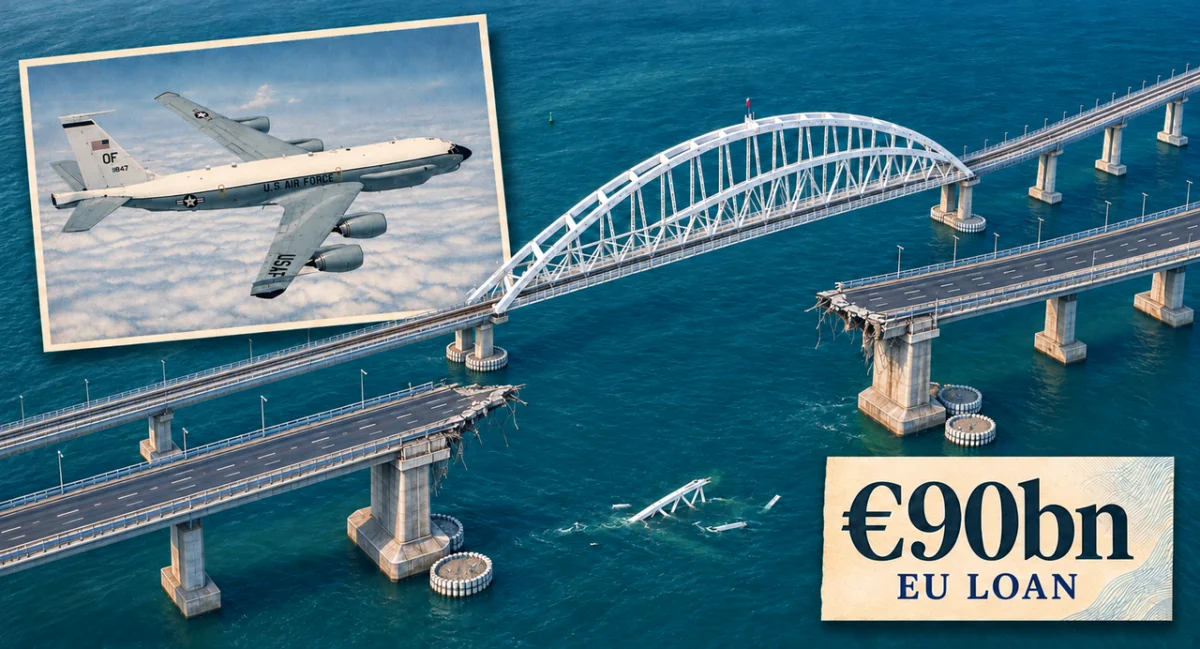
A recent strike that damaged a span of the strategically vital Kerch Bridge, a critical link between Russia and Crimea, has ignited a fierce debate regarding the extent of Western involvement in Ukraine’s military operations. Alastair Crooke, a former British diplomat, has asserted that the attack was far from a unilateral Ukrainian endeavor, instead pointing to a sophisticated, coordinated operation involving NATO and the United States. His claims, detailed during an appearance on retired Army Lt. Col. Daniel Davis’s Daniel Davis Deep Dive program, suggest a deeper level of engagement than publicly acknowledged, stirring geopolitical tensions and raising questions about the future trajectory of the conflict.
Allegations of a Coordinated Western Operation
Crooke’s analysis posits that the assault on the Kerch Bridge was not merely a Ukrainian initiative but "a massive operation of joint NATO operation with the United States." He specifically highlighted the role of an "American aircraft that coordinated the signal," suggesting advanced intelligence and operational support. This coordination, according to Crooke, involved "a whole number of European missiles and drones," estimated at approximately nine, indicating a multi-faceted attack plan.
The claims gain further traction with the public acknowledgment from Destinus, a Dutch aerospace firm, which stated that seven of its Ruta cruise missiles successfully struck the bridge on the second day of the strikes, leading to the collapse of a span. The company proudly declared its support for "the Ukrainian defence forces in their fight to defend Ukraine and Europe," a statement that seemingly corroborates the involvement of European-sourced weaponry. Ukrainian President Volodymyr Zelensky also lauded the incident as an "unprecedented operation," hinting at the complexity and scale of the attack.
Intelligence Footprint and Surveillance Activities
Further supporting the narrative of external assistance, Russian military bloggers monitoring the Two Majors Telegram channel reported significant Western surveillance activity over the Black Sea preceding the strikes. According to United24, these bloggers documented a US Air Force RC-135U Combat Sent, a highly specialized electronic-intelligence (ELINT) aircraft, conducting a surveillance mission over the Black Sea on November 16. This flight reportedly occurred shortly before the initial wave of attacks on the bridge. Days earlier, on November 10, the same sources logged an RQ-4D Phoenix surveillance drone, another advanced intelligence-gathering platform, operating in the same critical area.
The RC-135U Combat Sent is renowned for its ability to detect, identify, and geolocate signals across the electromagnetic spectrum, providing crucial insights into adversary radar systems and communications. Similarly, the RQ-4D Phoenix, a variant of the Global Hawk, offers extensive, high-altitude, long-endurance surveillance capabilities, including synthetic aperture radar (SAR) and electro-optical/infrared (EO/IR) sensors. The presence of such sophisticated assets, particularly in close proximity to the strike zone and timeframe, lends weight to Crooke’s assertion that "only the West has that sort of data capacity to monitor radars and attacking radars in and around Crimea," including "satellite, AWACS, satellite guidance up in the sky."
Geopolitical Rift: Pentagon vs. "CIA Project"
Crooke’s assertions also delve into perceived divisions within Washington regarding the efficacy and strategic implications of Ukraine’s deep-strike campaign. His comments came in the wake of a striking critique from Under Secretary of Defense for Policy Elbridge Colby, who, speaking at NATO headquarters in Brussels on November 17, expressed skepticism about the campaign’s effectiveness. Colby stated, "Our assessment is that such strikes have not been effective in driving an end to the war," even suggesting that attacks on civilian targets might "have actually probably hardened the Russian public’s resolve."
This assessment drew a swift retort from German Defense Minister Boris Pistorius, who dismissed Colby’s critique as "quite a stupid thing." Crooke interprets this divergence as a sign of internal discord within the US policy apparatus, labeling the Kerch Bridge strike as indicative of a "CIA project" that stands "at odds" with the Pentagon’s more cautious view. He suggested that Colby’s warning reflected the Pentagon’s perspective, contrasting it with the "signal that the CIA has been giving Russia." This alleged internal conflict, according to Crooke, highlights a struggle over strategic direction and the acceptable levels of escalation in the ongoing conflict.
The Strategic Debate: Symbolism vs. Impact
The military significance of the Kerch Bridge attack itself remains a point of contention. Crooke argued that the strike, while visually impactful, held limited strategic value. He claimed that Russia had previously "confined the bridge only to civilian traffic, buses and cars and trains, but no military equipment at all crosses it," due to an existing "complete road and rail system for military transportation" to Crimea. From this perspective, "Hitting [Kerch] Bridge is not a strategy," Crooke stated. "It doesn’t affect the war position at all. It’s symbolic. It’s a photo op."
However, the symbolic value of the Kerch Bridge cannot be understated. As a tangible link constructed after Russia’s 2014 annexation of Crimea, it represents a monumental achievement for Moscow and a powerful symbol of its control over the peninsula. Attacks on the bridge, therefore, serve as significant psychological blows and demonstrate Ukraine’s capability to strike deep into Russian-held territory, potentially impacting Russian morale and perceived security.
Despite the debate over its strategic impact, Crooke warned of the immediate consequences: escalation. He predicted "a war of bridges ahead," a forecast that quickly materialized as Russia initiated a series of "revenge strikes." These retaliatory actions, targeting bridges over the Dnieper River, carry the severe implication of potentially cutting off Ukrainian units operating on the river’s east bank, risking encirclement and isolating significant numbers of troops.
EU’s Financial Labyrinth: The €90 Billion "Off-Budget" Loan
Beyond the military chessboard, the financial burden of supporting Ukraine continues to be a major point of discussion, particularly within the European Union. Daniel Davis highlighted Kyiv’s request for an additional €70 billion from Europe for 2027, building on a previous €45 billion installment from the EU’s €90 billion loan package.
Crooke shed light on the unconventional nature of this substantial financial aid, revealing that the €90 billion was "off budget." He explained, "If you look at the European Union accounts, you won’t find that expenditure of 90 billion… It was done under an element called headroom." This "headroom" mechanism, agreed upon by EU leaders on December 18, 2025, involves "EU borrowing on the capital markets backed by the EU budget headroom." Crucially, the conclusions stated that the loan "would be repaid by Ukraine only once reparations are received," with a guarantee that "will not have an impact on the financial obligations of the Czech Republic, Hungary and Slovakia," which opted out of the guarantee.
This approach was adopted after Brussels’ initial plan to utilize frozen Russian assets for reparations stalled, forcing the EU to seek alternative financing methods. Crooke emphasized the fundamental nature of this financial arrangement: "The 90 billion wasn’t a grant. It was debt raised by the European Union on itself in debt instruments that have to be theoretically repaid by Ukraine one day. And all the member states had to guarantee it. Well, some wouldn’t." This implies a significant contingent liability for participating EU member states, a burden that could materialize if Ukraine is unable to repay the debt, particularly in the absence of reparations from Russia.
The request for an additional €70 billion for 2027 further complicates the financial landscape. Ukrainian President Zelensky, in October, estimated the war’s cost for the coming year at €155 billion, stressing the need for significant international contributions. While fresh joint EU debt is considered the most probable route, the ongoing internal disagreements within the bloc, exemplified by Slovakia’s Robert Fico stating that "at least two countries are indicating at this point that we will not participate in this financial mechanism," highlight the growing strain on European unity and financial resources.
Broader Implications and Future Outlook
Crooke, who previously served on EU foreign-policy chief Javier Solana’s team, underscored the challenging timing of these financial commitments. He noted that "this is coming precisely at the moment where the European Union is financially strapped," with governments across the continent facing pressures to cut domestic spending. The continued military actions, such as the Kerch Bridge strike, which Crooke attributes to the "CIA’s military actions," signify that the conflict’s intensity is not abating. "[Kerch] was just the latest one," he observed, indicating a persistent pattern of engagement.
The revelations surrounding the Kerch Bridge attack, coupled with the intricate details of EU financial support, paint a complex picture of the ongoing conflict. They suggest a more deeply interwoven Western role in Ukraine’s military operations, raising questions about accountability and the potential for wider escalation. Simultaneously, the financial architecture designed to sustain Ukraine highlights the significant economic commitments undertaken by European nations, commitments that are increasingly subject to internal debate and budgetary pressures. As the conflict evolves, the interplay between military strategy, intelligence operations, and financial stability will continue to shape the geopolitical landscape, with profound implications for all involved parties.

