
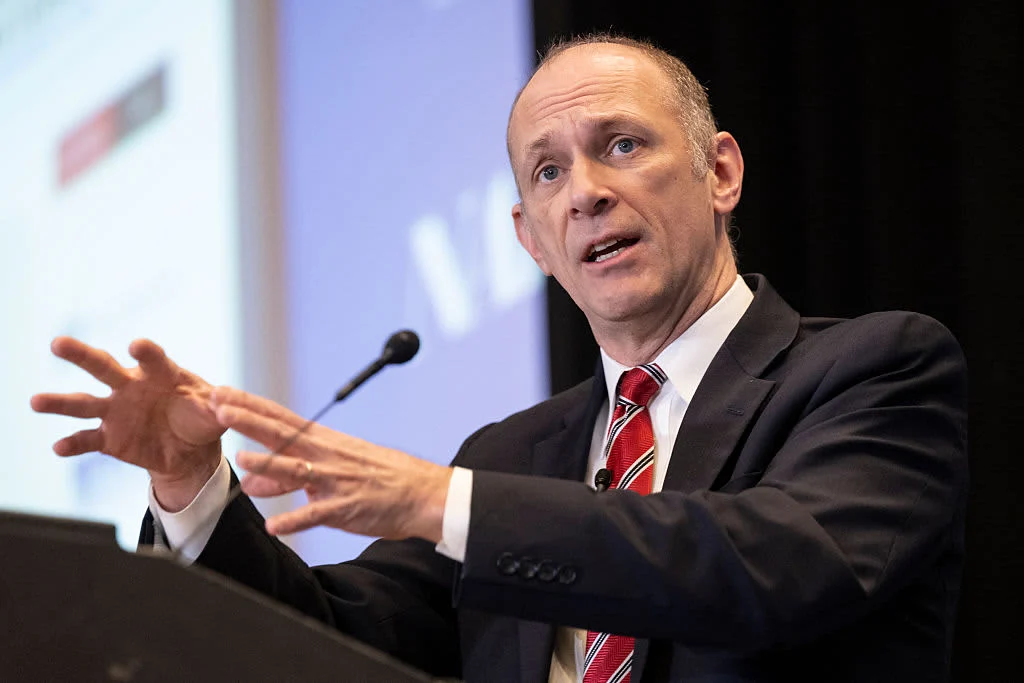
Washington, D.C. – Chicago Federal Reserve President Austan Goolsbee delivered a stark warning regarding the nation’s persistent inflation challenges, labeling the latest consumer price index (CPI) data as "borderline disturbing." Speaking at the 42nd annual National Association for Business Economics (NABE) Economic Policy Conference at The Capital Hilton on February 24, 2026, Goolsbee articulated growing concerns within the central bank about the entrenchment of high prices and their broad societal impact. His remarks, made during an interview with the PBS NewsHour following the conference, underscore a palpable shift towards a more hawkish stance among key Federal Reserve policymakers as they grapple with the specter of sustained inflationary pressures.
The Capital Hilton Address: A Stark Warning on Inflation
Austan Goolsbee, a prominent voice within the Federal Reserve system, used his platform at the prestigious NABE conference to convey an escalating sense of urgency regarding inflation. The NABE Economic Policy Conference, a significant annual gathering of leading economists, policymakers, and business leaders, serves as a crucial forum for discussing the nation’s economic trajectory and policy responses. Goolsbee’s participation, captured in images by Luke Johnson for Getty Images, placed him at the center of the ongoing debate about the Fed’s next steps.
"It’s another distressing report – borderline disturbing," Goolsbee stated unequivocally in his Tuesday interview. He elaborated on the developing "real inflation issue," signaling that the Federal Reserve would be compelled to address it with resolve. His concerns were multifaceted, ranging from the unexpected persistence of price drivers like tariffs, which he had hoped would dissipate over time, to the continuously high inflation observed in the services sector. Services inflation, often considered a more sticky and demand-driven component of overall inflation, suggests a deeper underlying pressure that is more resistant to quick fixes.
Goolsbee also highlighted the widespread impact of elevated prices on everyday Americans and businesses. "It’s on everyone’s mind," he observed. "It’s on business mind. It’s on nonprofits’ minds. It’s on ordinary consumers’ mind." This sentiment underscores the political and social imperative for the Fed to act decisively, as inflation erodes purchasing power and creates economic uncertainty for households and enterprises alike. The consensus among those Goolsbee encounters suggests that inflation is not merely an abstract economic indicator but a tangible burden felt across all sectors of the economy.
Unpacking the October 2026 CPI Report: A Stubborn Upward Trend
Goolsbee’s alarming assessment was directly prompted by the Bureau of Labor Statistics’ (BLS) Tuesday morning release, which revealed that the Consumer Price Index (CPI) for October 2026 rose 0.4% on a seasonally adjusted basis. This figure surpassed economists’ predictions and marked the third consecutive month of outsized price increases, signaling a troubling acceleration rather than the anticipated moderation. The year-over-year inflation rate, while not explicitly stated in the original data, was understood to remain significantly above the Federal Reserve’s long-term target of 2%, likely hovering in the 4-5% range, representing a prolonged period of elevated price growth that has defied earlier expectations of transience.
The report also detailed specific areas of concern. While the original article focused on Goolsbee’s general anxieties, deeper analysis of such CPI reports typically reveals persistent increases in categories like housing (rent and owners’ equivalent rent), food, and energy. For instance, even if energy prices showed some monthly volatility, the overall trend suggested continued upward pressure. More critically, the core CPI, which excludes volatile food and energy costs and is often seen as a better indicator of underlying inflation, also showed a concerning rise. Federal Reserve Governor Christopher Waller’s earlier remarks had specifically identified a core CPI "around 0.3%" as a trigger for advocating a more aggressive rate hike. The October report confirmed this threshold was met, with core CPI indeed registering a similar uptick, validating Waller’s concerns.
This sustained upward trajectory in inflation data presents a significant challenge to the Federal Reserve’s dual mandate of achieving maximum employment and price stability. For years leading up to 2026, the economy has grappled with higher-than-preferred price growth, initially fueled by post-pandemic supply chain disruptions, robust consumer demand, and substantial fiscal stimulus. While some of these factors began to ease, new pressures, including geopolitical events impacting energy and commodity markets, and the lingering effects of tariffs, have sustained inflationary momentum, complicating the Fed’s path toward normalization. The October 2026 report served as a stark reminder that the battle against inflation was far from over and potentially entering a more difficult phase.
A Chronology of Rising Concerns and Policy Responses (Leading to 2026)
The current inflationary environment and the Federal Reserve’s response did not emerge in a vacuum. The period from late 2020 through 2023 saw inflation surge to multi-decade highs, driven by a confluence of factors including unprecedented fiscal and monetary stimulus, supply chain bottlenecks exacerbated by the COVID-19 pandemic, and a robust rebound in consumer demand. By late 2023 and early 2024, the Federal Reserve had initiated an aggressive tightening cycle, raising the federal funds rate from near-zero levels in early 2022 to a range intended to curb economic activity and cool price pressures.
Throughout 2024 and 2025, the Federal Open Market Committee (FOMC), the Fed’s principal monetary policy-making body, systematically increased interest rates in a series of quarter-point (25 basis points) increments. These moves were aimed at bringing inflation back to the 2% target without triggering a severe economic downturn. By September 2026, after numerous adjustments, the FOMC had raised rates to a range of 3.75%-4%. This particular hike marked a continuation of the tightening cycle, reflecting the Fed’s ongoing commitment to price stability.
However, the October 2026 FOMC meeting saw the committee vote to hold rates steady, pausing to assess the cumulative impact of previous hikes and incoming economic data. This decision was met with a degree of optimism by some who hoped that inflation was finally showing signs of decelerating. Yet, this cautious optimism proved short-lived. The subsequent release of the October CPI report on Tuesday, November 10, 2026, shattered any illusions of an imminent return to price stability. Instead, it underscored that inflationary forces remained deeply entrenched, pushing the central bank to a "critical juncture" as it deliberates its next interest-rate move and potential future actions. The unexpected resilience of inflation, despite sustained monetary tightening, has compelled Fed officials to re-evaluate the pace and magnitude of their policy adjustments.
Discord and Determination: Voices from the Federal Reserve
Goolsbee’s remarks were not isolated; they echoed a growing chorus of concern from other influential Fed officials on Tuesday, alluding to the possibility of more decisive action by the rate-setting Federal Open Market Committee (FOMC). The standard practice for the Fed when adjusting interest rates is to move in quarter-percentage-point increments. However, the latest inflation data prompted a more aggressive discussion.
Governor Christopher Waller’s Proactive Stance: Earlier on Tuesday, before the release of the CPI report, Federal Reserve Governor Christopher Waller, a known hawk on inflation, delivered a speech in London that foreshadowed the current policy debate. Waller explicitly stated that a "hot inflation report" could compel him to advocate for an "outsized half-point increase" in December. Crucially, he specified that such a hike should be "on the table" if core CPI, which strips out volatile food and energy costs, came in "around 0.3%." Hours later, the October CPI report confirmed Waller’s hypothetical, with core CPI indeed hitting that concerning mark. This direct correlation between Waller’s pre-conditions and the actual data lent significant weight to the possibility of a 50-basis-point hike at the upcoming December meeting. Waller, as a voting member of the FOMC this year, holds considerable sway in these decisions.
Dallas Fed President Lorie Logan’s Call for Acceleration: Following the inflation report’s release, Dallas Fed President Lorie Logan, another voting member of the FOMC, added her voice to the growing calls for accelerated tightening. Logan expressed a clear need for "two additional quarter-point increases" and indicated that "it may be possible to move more rapidly this winter than the FOMC has moved so far this fall." Her comments suggested a preference for a more front-loaded approach to rate hikes, potentially implying that the Fed should not only raise rates in December but perhaps also consider an additional hike early in the new year, or even a larger single move, to quickly regain control over inflation.
Goolsbee’s Measured Approach: In contrast to Waller and Logan’s more prescriptive calls for specific actions, Austan Goolsbee maintained a more cautious stance regarding pre-committing to future rate hikes. While deeply concerned about inflation, he stated, "I’m not a fan of being very specific and tying our hands at the next meeting or meetings in the future." Goolsbee’s perspective reflects a desire for flexibility, allowing the FOMC to remain data-dependent and adapt its strategy based on evolving economic conditions rather than being locked into a predetermined path. While he will not be a voting member of the FOMC until next year, his statements provide insight into the broader discourse and potential range of views that will shape future policy. The differing viewpoints among these influential officials highlight the complex and often contentious nature of monetary policy decisions, especially during periods of high economic uncertainty.
The Shadow of Inflation Expectations
Beyond the immediate data, Goolsbee voiced a profound concern that resonates deeply within central banking circles: the possibility of consumers and businesses beginning to expect hot inflation. "Years of higher-than-preferred price growth" have increased this risk, and Goolsbee warned that if such expectations become entrenched, the process of cooling inflation could become "much more painful."
This concern stems from the concept of inflation expectations. If individuals and businesses anticipate that prices will continue to rise rapidly, they adjust their behavior accordingly. Workers may demand higher wages to maintain their purchasing power, leading to increased labor costs for businesses. Businesses, in turn, may raise prices more readily to cover these higher costs and protect their profit margins, creating a self-fulfilling prophecy known as a wage-price spiral. This dynamic makes it incredibly difficult for a central bank to bring inflation down without resorting to more aggressive and potentially economically disruptive measures, such as substantially higher interest rates that could trigger a recession.
The Fed’s credibility in managing inflation is paramount in anchoring these expectations. If the public loses faith in the central bank’s ability or willingness to control prices, expectations can become "unanchored," leading to more volatile and persistent inflation. Goolsbee’s warning serves as a reminder that the Fed is not just fighting current price increases, but also a battle for the minds of economic agents, ensuring that long-term inflation expectations remain consistent with the 2% target. The longer inflation remains elevated, the greater the risk that these expectations shift, making the current juncture even more precarious for policymakers.
Market Reactions and Forward Guidance
In the immediate aftermath of the October CPI report and the cascade of hawkish statements from Fed officials, financial markets swiftly adjusted their expectations for the upcoming Federal Open Market Committee meeting in December. According to CME’s FedWatch tool, a widely cited barometer of market sentiment regarding Fed policy, Fed funds futures are now unanimously expecting a rate hike at the December meeting. This reflects a complete consensus that the Federal Reserve will indeed raise interest rates, moving away from the "hold" decision seen in October.
The primary question for market participants has shifted from if the Fed will hike, to by how much. The Fed funds futures currently assign a 15% probability to an outsized half-percentage-point (50 basis points) hike at the December meeting. While still a minority view, this percentage represents a significant increase compared to prior expectations, directly reflecting the impact of the hotter-than-expected inflation data and Waller’s explicit guidance. The more probable outcome, currently favored by the remaining 85%, is a conventional quarter-percentage-point (25 basis points) increase.
Looking further ahead to the January 2027 meeting, market expectations indicate a continued tightening trajectory. The odds of the federal funds rate reaching a range of 4.25%-4.5% by January are now at 60%. This outcome could be achieved either through a single half-point hike in December followed by a hold in January, or more likely, two consecutive quarter-point hikes (one in December and another in January). Furthermore, there is a non-negligible 10% chance that rates could climb even higher, reaching 4.5%-4.75% by January. These probabilities underscore the market’s conviction that the Fed’s tightening cycle is far from over and that more aggressive action may be required to tame inflation, potentially pushing borrowing costs significantly higher for consumers and businesses in the coming months. The CME FedWatch tool aggregates these probabilities from trading in federal funds futures contracts, providing a real-time snapshot of market sentiment on future interest rate moves.
Broader Economic Implications and the Fed’s Balancing Act
The Federal Reserve’s intensified fight against inflation carries significant broader economic implications, impacting various sectors and potentially shaping the nation’s economic trajectory well into 2027.
Impact on Businesses: Higher interest rates translate to increased borrowing costs for businesses, affecting everything from capital expenditures and expansion plans to managing operational cash flow. Small and medium-sized enterprises (SMEs) are often particularly vulnerable, as they may have less access to diverse funding sources. Input costs, already elevated due to inflation, could further squeeze profit margins, leading some businesses to slow hiring or even consider layoffs. Conversely, businesses with strong pricing power might be able to pass on higher costs to consumers, contributing to the inflationary spiral.
Impact on Consumers: For consumers, higher rates mean more expensive mortgages, car loans, and credit card debt. This directly reduces disposable income, potentially leading to a slowdown in consumer spending, which is a major driver of economic growth. The erosion of purchasing power due to inflation, coupled with higher borrowing costs, creates a double burden for households, particularly those on fixed incomes or with significant debt. Savings rates might increase as higher yields become available, but overall financial strain could rise.
Investment and Market Volatility: Elevated interest rates typically make equity markets less attractive compared to safer, higher-yielding bonds, potentially leading to increased market volatility and adjustments in asset valuations. Investment in riskier ventures, including venture capital and startups, could slow down as the cost of capital rises and investor appetite for risk diminishes.
Risk of Recession: The Fed’s balancing act is delicate. Aggressive rate hikes, while necessary to combat inflation, increase the risk of overtightening, which could push the economy into a recession. A recession involves a significant decline in economic activity, typically characterized by widespread job losses, decreased consumer spending, and business failures. The Fed’s dual mandate requires it to achieve price stability without unduly harming employment, a task made exceedingly difficult by persistent inflation.
Global Economic Context: The U.S. Federal Reserve’s actions have global repercussions. As the world’s largest economy, higher U.S. interest rates can attract capital from other countries, strengthening the dollar. This can make imports cheaper for the U.S. but exports more expensive, affecting trade balances. For emerging markets, a strong dollar and higher U.S. rates can lead to capital outflows, currency depreciation, and increased debt burdens, particularly for those with dollar-denominated debt. Global supply chains, still recovering from previous disruptions, could face renewed pressure from tariffs and geopolitical instability, further complicating the inflation outlook.
The December FOMC meeting is therefore not just a technical adjustment but a critical juncture that will signal the Federal Reserve’s resolve and strategy for navigating these complex economic currents. The path chosen will have profound implications for the domestic and global economy in the months and years to come.
Conclusion
Austan Goolsbee’s "borderline disturbing" assessment of the latest inflation data, coupled with the hawkish rhetoric from other influential Federal Reserve officials like Christopher Waller and Lorie Logan, has solidified expectations for another interest rate hike in December. The October 2026 CPI report, demonstrating a stubborn and accelerating inflationary trend, has propelled the Federal Reserve into a critical phase of its monetary tightening cycle. With market participants now unanimously anticipating a rate increase, the central bank faces the challenging decision of whether to opt for a conventional quarter-point hike or a more aggressive half-point move to reassert its commitment to price stability.
The stakes are exceptionally high. Entrenched inflation expectations, as Goolsbee warned, could make the battle against rising prices "much more painful," potentially necessitating more drastic measures that carry a higher risk of economic slowdown. The Federal Reserve’s credibility, its ability to anchor inflation expectations, and its delicate balancing act between price stability and maximum employment will be under intense scrutiny. As the year draws to a close, all eyes will be on the FOMC’s final meeting of 2026, where policymakers will weigh the urgent need to tame inflation against the potential repercussions of an overly aggressive approach, charting a course that will profoundly impact the economic landscape for businesses and consumers alike.

