
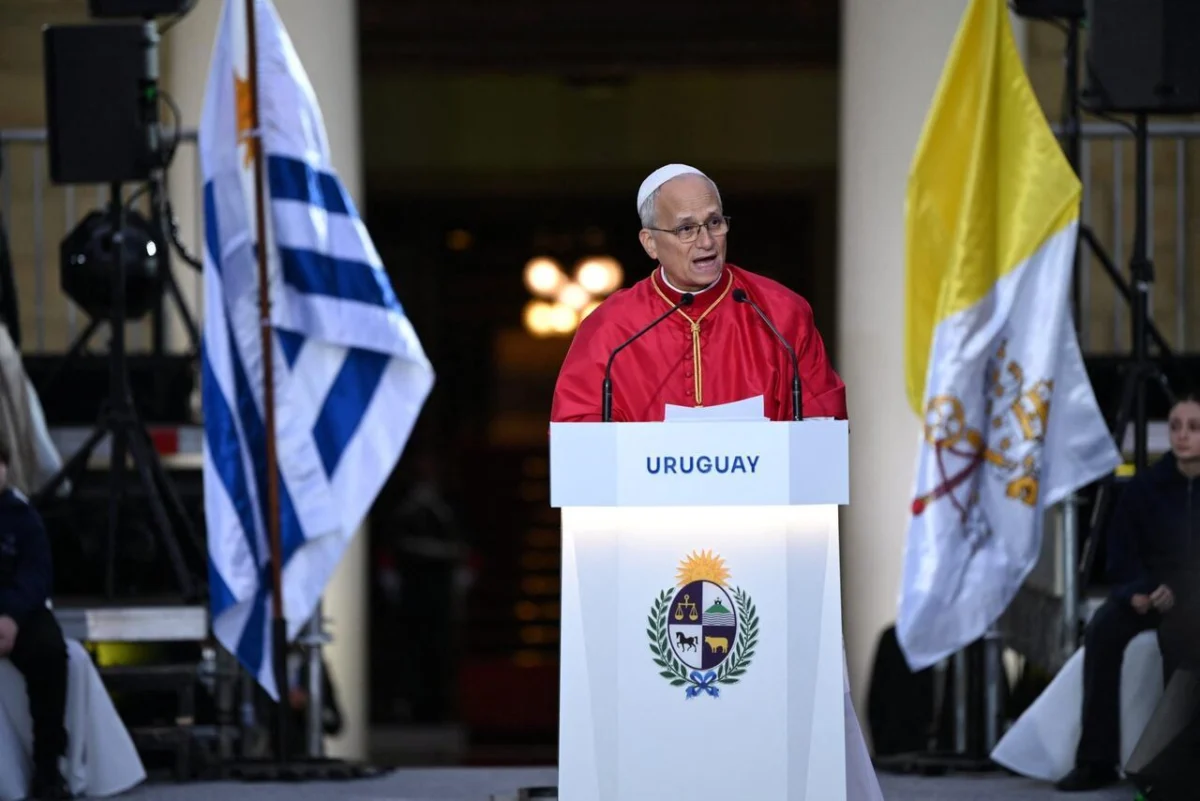
Pope Leo XIV, less than a month after undergoing surgery for lung cancer, delivered a poignant and powerful address in Montevideo, Uruguay, calling for universal healthcare "in every society." His remarks, made from a prominent platform in Independence Square to a diverse audience of Uruguayan civil and religious authorities, business leaders, civil society representatives, and the diplomatic corps, marked his first major public statement on a demanding 12-day apostolic journey through Uruguay, Argentina, and Peru. The pontiff’s personal experience with illness, revealed during his recovery, provided a compelling backdrop to his advocacy, underscoring the moral imperative for equitable access to medical care worldwide. The Vatican had meticulously cleared the extensive South American itinerary only after receiving explicit medical approval from Pope Leo XIV’s doctors, a testament to the Holy Father’s commitment despite his recent health challenges. His impassioned appeal for healthcare equity aligns with long-standing positions of the Holy See and echoes the consistent advocacy of his predecessor, Pope Francis, yet it gained a unique resonance through Leo XIV’s own recent vulnerability and recovery. This journey, undertaken by a 71-year-old pontiff still recuperating from a significant surgical procedure, not only carries profound spiritual weight but also serves as a potent symbol of resilience and dedication to the Church’s social mission.
A Pontiff’s Personal Battle and an Arduous Itinerary
The path to Montevideo was paved with a period of intense medical scrutiny and a swift recovery. Pope Leo XIV’s health concerns first emerged in early October 2026, leading to a series of diagnostic tests. On October 13, 2026, the Vatican announced that the Holy Father had undergone surgery at Rome’s renowned Gemelli Hospital. The procedure involved the removal of the lower lobe of his right lung, after doctors confirmed a diagnosis of lung adenocarcinoma, a common form of lung cancer. The surgery was reported to be successful, with the Vatican issuing regular updates on his stable condition and gradual recovery. This unexpected health challenge placed a temporary cloud over the planned apostolic journey to South America, raising questions about the Pope’s capacity to undertake such a demanding trip.
Following the operation, the pontiff spent several days recuperating, initially in the hospital and subsequently at the Vatican. Medical reports from his physician, Dr. Luigi Carbone, indicated that the cancer was localized and, crucially, required no further treatment, offering significant relief to the Catholic world and beyond. This positive prognosis was pivotal in enabling the continuation of his planned apostolic journey. On October 26, 2026, less than two weeks post-surgery, the Vatican officially confirmed that the South American trip would proceed as scheduled, a decision met with both admiration for the Pope’s fortitude and concern for his demanding itinerary.
Dr. Carbone, in a statement reported by the Associated Press, affirmed that "there’s no medical reason preventing Leo’s trip to South America," providing the necessary medical green light for the arduous journey. The itinerary is undeniably rigorous for a 71-year-old just weeks out of major lung surgery. Reuters detailed a schedule encompassing approximately 31,000 kilometers (over 19,000 miles) across ten cities, involving 36 speeches, 12 flights, and two helicopter trips. A particular concern highlighted by medical experts is the stop in Cusco, Peru, situated at an altitude of 3,399 meters (11,152 feet) above sea level, which presents significant physiological challenges even for healthy individuals. Vatican spokesman Matteo Bruni reassured the public that "The pope is in good health," while acknowledging that physicians like Dr. Antonio Passaro might advise strategic rest breaks and supplemental oxygen at high-altitude locations to mitigate potential risks. The arrival in Montevideo on November 6, 2026, marked the official commencement of this challenging yet symbolically profound journey, with the Pope’s first major address setting a clear tone for his pontificate’s social justice agenda. The tour is expected to continue through Argentina and Peru, concluding around November 18, 2026, with each stop poised to be a platform for the Pope’s multifaceted message.
The Moral Imperative of Universal Healthcare
Pope Leo XIV’s call for universal healthcare is deeply rooted in the foundational principles of Catholic social teaching, which emphasizes the inherent dignity of every human person and the concept of the common good. While his personal experience undoubtedly added a powerful and relatable dimension to his message, the Church’s advocacy for equitable healthcare access is a long-standing and consistent doctrine. The foundational texts of modern Catholic social thought, beginning with Pope Leo XIII’s Rerum Novarum (1891), have consistently stressed the responsibility of society and the state to ensure basic welfare for all citizens.
His predecessor, Pope Francis, frequently articulated this stance, often decrying the "throwaway culture" that neglects the sick and vulnerable. Francis repeatedly called for healthcare to be a universal right, not a privilege, echoing documents like the 1963 encyclical Pacem in Terris by Pope John XXIII, which explicitly listed healthcare among fundamental human rights. The Church’s teaching stresses that access to medical care is essential for human flourishing and integral to a just society. It argues that a society’s moral health can be measured by how it treats its most vulnerable members, especially the sick, the elderly, and the marginalized.
Pope Leo XIV, in his Montevideo address, powerfully articulated this continuity, stating, "Recently, I experienced firsthand the limitations imposed by illness, and I received care for which I am deeply grateful." This personal testimony resonated profoundly with his audience, transcending abstract theological arguments and connecting directly to the human experience of vulnerability. He continued, "that experience makes me think of the many men and women who lack the means to obtain a timely diagnosis or receive the treatments they need." This direct link between his recovery and the plight of the underserved transformed his advocacy from a mere policy statement into a deeply empathetic appeal, demonstrating that his conviction stemmed not just from doctrine but from lived reality.
"Ensuring that health care is accessible to everyone, regardless of their resources, is a duty that confronts every society," Leo declared, solidifying the Church’s position that healthcare is not merely a charitable endeavor but a fundamental societal obligation. This call comes at a time when global health disparities remain stark. According to the World Health Organization (WHO), at least half of the world’s population still lacks full coverage of essential health services. Furthermore, around 100 million people are pushed into extreme poverty each year because of out-of-pocket health expenses, and over 800 million people spend at least 10 percent of their household budget on healthcare, often incurring catastrophic costs. In Latin America, while progress has been made in expanding health coverage, significant challenges persist, including fragmented health systems, high out-of-pocket spending, and inequities in access between urban and rural areas or different socioeconomic groups. Data from the Pan American Health Organization (PAHO) indicates that many countries in the region struggle to allocate sufficient public funding to health, leading to reliance on private payments that disproportionately affect the poor and exacerbate existing inequalities. The Pope’s words thus carry particular weight in a region grappling with these very issues, providing a moral framework for policy reform.
Uruguay: A Secular Stage for a Universal Message
The choice of Uruguay for this seminal address was particularly significant, offering a nuanced backdrop for the Pope’s universal message. Uruguay stands out in Latin America as a profoundly secular republic, a characteristic that shapes its social and political landscape. Its history includes a strong tradition of separation between church and state, manifested in ways that are unique even within a region predominantly Catholic. For instance, the nation officially refers to Christmas as "The Family Day" and Holy Week as "The Week of Tourism," rather than their traditional religious designations, underscoring its deep-seated commitment to secular governance and a civic identity.
This secular identity extends to its progressive social policies. Uruguay was the first country in Latin America to legalize abortion, doing so in 2012. More recently, in April of the current year, its left-wing President, Yamandú Orsi, signed a euthanasia law, making Uruguay the first nation in Latin America to permit assisted dying. These legislative actions stand in stark contrast to traditional Catholic doctrine, which upholds the sanctity of life from conception to natural death and vehemently opposes both abortion and euthanasia. This ideological divergence created a complex environment for the Pope’s visit, making his message on the dignity of life and comprehensive care all the more impactful.
Against this backdrop, Pope Leo XIV’s address was a delicate balance of affirmation and challenge. He praised Uruguay’s commendable achievements, including its near-total reliance on renewable energy – a nod to the environmental stewardship championed by Pope Francis in Laudato Si’ – and its four decades of uninterrupted democracy since the end of the 1973-1985 dictatorship. These acknowledgments demonstrated a recognition of Uruguay’s societal progress while subtly creating an opening for dialogue on other issues where Church teaching might differ from state policy.
His remarks on the interconnectedness of health, family, and community were especially poignant given Uruguay’s social context. The Pope spoke of the "loneliness, anxiety and the loss of hope" that can lead individuals to question "a reason to continue living." This statement, delivered in a country that recently legalized euthanasia, carried an implicit, yet clear, message about the inherent value of every life and the need for comprehensive support systems that alleviate suffering and restore hope. America magazine reported Uruguay’s 2025 suicide rate at a concerning 19.16 per 100,000 people, significantly higher than the global average, a statistic that lends stark relevance to the Pope’s words on mental well-being and the importance of communal bonds. He asserted that "adequate health care, family ties and the closeness of the community are inseparable," advocating for a holistic approach to human flourishing that extends beyond mere medical intervention to encompass robust social, emotional, and spiritual support structures.
Furthermore, Pope Leo XIV carefully addressed the role of religion in a secular state. He articulated that while Uruguay embodies neutrality in its governance, "this neutrality does not require that the religious dimension be confined to the private sphere." This was a significant assertion in a country where religious expression has often been compartmentalized. It was a call for faith to engage with public life, contributing to the common good through its ethical frameworks and social initiatives, without seeking to impose a confessional state. This statement is crucial for fostering constructive dialogue between religious institutions and secular governments, particularly on shared goals such as social welfare, human dignity, and the promotion of a just society, demonstrating a pragmatic approach to Church-state relations.
Economic Justice and Inclusive Development
Beyond healthcare and the role of faith, Pope Leo XIV also wove in a powerful message on economic justice, linking it intrinsically to social development. He asserted that "The creation of wealth, investment and economic initiative – both public and private – are necessary for a country’s development, yet their benefits must also translate into goods and opportunities that effectively reach everyone." This statement directly addresses the pervasive issue of economic inequality, a challenge faced by many nations in Latin America and globally. The region, despite periods of economic growth, continues to grapple with some of the highest levels of income disparity in the world, leading to social unrest and persistent poverty for large segments of the population.
This economic doctrine is a cornerstone of Catholic social teaching, often referred to as the "universal destination of goods," which posits that the Earth’s resources are intended for the benefit of all humanity. The Pope’s words suggest that economic policies should not solely focus on growth metrics but must also prioritize equitable distribution of wealth and opportunities. In a region often characterized by significant disparities between rich and poor, and where the benefits of economic growth frequently bypass marginalized communities, this message serves as a moral challenge to political and business leaders. It implies that true development is not merely about accumulating capital but about fostering human dignity and ensuring that basic needs, including healthcare, education, and dignified work, are met for all citizens.
His remarks implicitly criticized unchecked capitalism that prioritizes profit over people, advocating instead for an economy of inclusion that fosters solidarity and social cohesion. This aligns with a global discourse on sustainable development goals and the need for economic systems that are both productive and just, ensuring that no one is left behind. By connecting economic initiative with universal access to goods and opportunities, Pope Leo XIV underscored that healthcare access is not isolated but part of a broader framework of social and economic justice, where economic policies are evaluated not just by their efficiency but by their ethical outcomes.
Broader Impact and Implications
Pope Leo XIV’s inaugural major address in Montevideo carries significant implications, both for his nascent pontificate and for the global discourse on social justice. His personal health battle, far from being a liability, has instead amplified the authenticity and urgency of his message. By sharing his vulnerability, he has bridged the gap between the sacred and the profoundly human, making his call for universal healthcare resonate with greater empathy and conviction across diverse audiences.
For the Catholic Church: This address solidifies Pope Leo XIV’s commitment to the social teachings of the Church, signaling that his pontificate will continue the focus on justice and the poor that marked Pope Francis’s papacy. It reinforces the Church’s role as a moral voice on global issues, particularly in areas of human dignity and social welfare. This consistent advocacy helps maintain the Church’s relevance in an increasingly complex world, demonstrating its engagement with contemporary challenges and its enduring mission to serve humanity.
For Global Healthcare Advocacy: The Pope’s explicit and personal endorsement of universal healthcare will undoubtedly energize advocacy groups worldwide. His words provide a powerful moral argument that can be leveraged in policy debates, encouraging governments and international organizations to redouble their efforts in achieving equitable healthcare access. It highlights the ethical dimension of healthcare policy, moving discussions beyond purely economic considerations to focus on human rights and dignity. Healthcare organizations like Doctors Without Borders and various UN agencies are likely to welcome and amplify this papal call.
For South American Politics and Society: The ongoing tour through Uruguay, Argentina, and Peru offers a unique platform for dialogue. While Uruguay’s secular government might view the Pope’s message on healthcare as aligning with its social welfare goals, his nuanced comments on euthanasia and the public role of religion could spark important conversations. In other, more traditionally Catholic nations on his itinerary, his words are likely to be received with greater deference, potentially influencing public opinion and political agendas related to healthcare reform and social spending. The symbolic nature of the journey itself, traversing nations with diverse political landscapes and socioeconomic challenges, underscores the universal applicability of his message and the Church’s global reach.
The Pope’s Personal Symbolism: That a 71-year-old pontiff, recently recovering from lung cancer surgery, is undertaking such a demanding journey speaks volumes. It is a powerful testament to his personal faith, resilience, and unwavering dedication to his pastoral duties and the Church’s mission. His willingness to physically exert himself in service of these ideals transforms him into a living embodiment of the compassion and commitment he preaches. This personal sacrifice lends immense credibility to his advocacy, making his words

