
BEIJING – High healthcare costs are a significant, pervasive factor driving people in China to prioritize saving over spending, a trend that could impede the nation’s strategic shift toward a consumption-led economic model, according to a comprehensive new analysis by the International Monetary Fund (IMF). The findings, detailed in the recently published book "Toward a New Economic Growth Model for China," underscore a critical challenge for Beijing as it navigates complex economic rebalancing. The report highlights how the burden of medical expenses forces households, particularly in rural areas, to accumulate substantial precautionary savings, thereby suppressing domestic consumption – a cornerstone of China’s desired future economic trajectory.
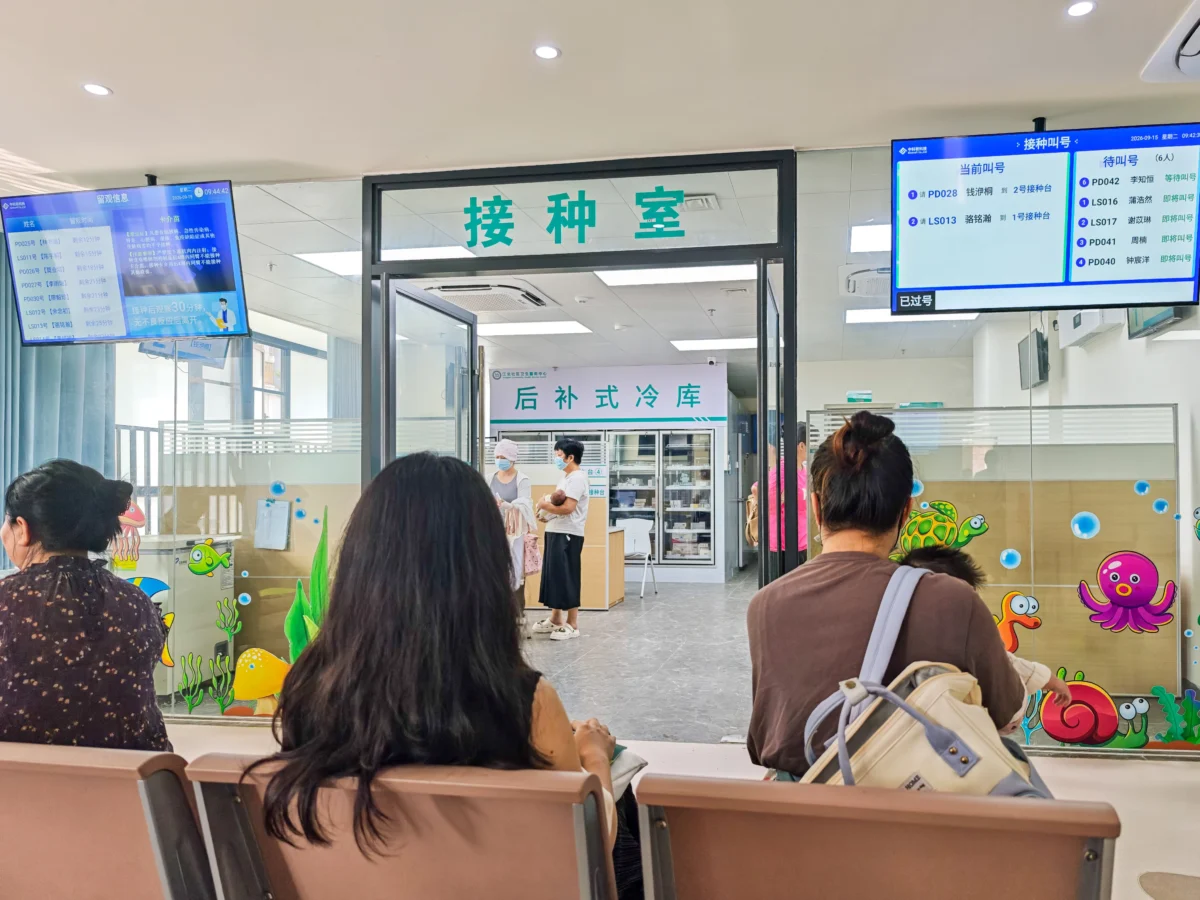
The IMF’s research draws a stark comparison of healthcare expenditure across major economies, revealing China’s considerable burden. In rural China, an estimated 8.7% of disposable income is allocated to healthcare. This figure places it second only to the United States among 20 major economies, where nearly 9.9% of disposable income is spent on healthcare, the highest globally. Urban China, while faring slightly better, still ranks third, with 5.4% of disposable income directed towards healthcare costs, marginally exceeding Canada’s expenditure. The image accompanying this report, depicting children and adults receiving vaccinations at the Jiangbei Community Health Service Center in Huizhou, Guangdong province on September 15, 2026, visually captures a routine aspect of healthcare access within this context, yet it subtly hints at the broader financial landscape individuals and families must navigate.
Contextualizing the Disparate Healthcare Burden
The percentages, while illuminating, gain greater significance when juxtaposed with the vast disparities in per capita disposable income between these nations. As of the end of last year, the United States boasted a per capita disposable income of $68,289. In stark contrast, China’s figure stood at 43,377 yuan, which translates to approximately $6,400 – more than ten times less than that of the U.S. This dramatic income gap means that even a smaller percentage of disposable income dedicated to healthcare in China represents a substantially heavier financial burden on its citizens. For instance, an 8.7% spend on healthcare from $6,400 disposable income leaves significantly less for other necessities and discretionary spending than a 9.9% spend from $68,289.
The situation is even more pronounced in China’s countryside. Despite officially emerging from extreme poverty in 2020, rural households continue to grapple with economic vulnerabilities. Official data accessed via Wind Information reveals that urban China recorded more than twice the disposable income of rural areas, with 56,502 yuan versus 24,456 yuan, respectively. This profound income disparity, coupled with high healthcare costs, exacerbates financial insecurity for rural populations and compels them to maintain elevated savings rates as a buffer against potential medical emergencies.
The Evolution of China’s Healthcare System and Policy Responses
China’s healthcare system has undergone monumental transformations over the past decades. From a largely state-funded, commune-based model under Chairman Mao Zedong, the system shifted significantly during the economic reforms initiated in the late 1970s and early 1980s. The dismantling of collective farming and the introduction of market principles led to a sharp decline in public health funding and the rise of a fee-for-service model. This period saw a dramatic increase in out-of-pocket expenses for patients, pushing many into medical poverty and eroding public trust.
Recognizing the growing social and economic implications, the Chinese government embarked on a series of ambitious reforms in the early 2000s. Key initiatives included the launch of the New Rural Cooperative Medical Scheme (NRCMS) in 2003 and the Urban Resident Basic Medical Insurance (URBMI) in 2007, aiming to provide basic health insurance coverage for rural residents and urban non-workers, respectively. These were later integrated into a unified Urban-Rural Resident Basic Medical Insurance (URRBMI) system. Additionally, the Urban Employee Basic Medical Insurance (UEBMI) covered urban workers. While these programs dramatically expanded insurance coverage – now encompassing over 95% of the population – they often feature relatively low reimbursement rates for catastrophic illnesses and significant deductibles and co-payments, particularly for hospitalizations and specialized treatments. This structure leaves a substantial portion of medical costs to be borne directly by households, perpetuating the need for precautionary savings.
IMF Recommendations and the Role of Social Spending
The IMF’s analysis points to concrete policy interventions to address this issue. Citing prefecture-level analysis, the report suggests that targeted measures to significantly raise government spending on health and social security in rural areas could effectively reduce the savings rate in rural households. This approach aligns with broader recommendations for strengthening China’s social safety net.
Yizhi Xu, an economist in the North Asia division of the IMF’s Asia and Pacific Department, and Fan Zhang, the IMF’s deputy resident representative in Beijing, explicitly stated in their section of the book that "China’s social spending is low compared with international peers, and increasing that spending would lift consumption." Their research further delineates the savings behavior among different segments of the population. They observed a savings rate of approximately 14% for individuals from rural areas working in China’s cities, often referred to as migrant workers. In contrast, people with urban "hukou" residency rights, who typically benefit from more comprehensive social welfare provisions, exhibited a lower savings rate of about 6%. The hukou system, a household registration system, has historically created a significant divide in access to social services, including healthcare, education, and pensions, between urban and rural residents, and between those with local urban registration and migrant workers.
Beyond Healthcare: Other Factors Driving High Savings
While healthcare costs are a primary driver, the IMF report acknowledges other contributing factors to China’s elevated household savings. Xu and Zhang highlighted that "declining house prices in recent years continue to weigh on consumption and contribute to elevated household savings." The volatility and recent downturn in China’s property market, which traditionally served as a major store of household wealth, have eroded consumer confidence. Many households had invested heavily in real estate, viewing it as a secure asset and a source of future financial stability. The current uncertainty in this sector has likely amplified precautionary savings as families brace for potential further losses or seek alternative forms of financial security.
Beyond property, other structural issues contribute to the savings phenomenon. China’s relatively nascent and still developing pension system, particularly in rural areas, compels many to save for old age. Similarly, the costs associated with education, especially for higher learning and extracurricular activities, are substantial and often necessitate significant parental savings. The legacy of the one-child policy, which resulted in a demographic structure where fewer children are available to support an increasing elderly population, also adds pressure on individuals to save more for their own retirement and potential elder care expenses.
Broader Economic and Social Implications
The high household savings rate, while often viewed positively as a source of investment capital, poses a significant impediment to China’s stated goal of transitioning to a consumption-driven economic model. For decades, China’s growth was fueled by exports and fixed-asset investment. As global demand fluctuates and domestic investment opportunities mature, fostering robust domestic consumption is seen as crucial for sustainable and balanced growth. If a substantial portion of household income is channeled into savings rather than spending, it dampens demand for goods and services, affecting domestic businesses and overall economic dynamism.
This economic challenge also carries profound social implications. The burden of healthcare costs disproportionately affects lower-income households and those in rural areas, exacerbating existing inequalities. When a medical emergency can plunge a family into poverty, it creates a pervasive sense of anxiety and financial insecurity, potentially undermining social stability. The disparity in healthcare access and quality between urban and rural areas, despite government efforts, remains a critical issue. Large public hospitals in major cities often offer superior care but are expensive and geographically distant for many, forcing them to incur additional travel and accommodation costs.
Government Initiatives and the Path Forward
The Chinese government is acutely aware of these challenges and has been implementing various initiatives to address them. The "Healthy China 2030" plan, unveiled in 2016, outlines a comprehensive strategy to improve the health of the population through a focus on preventative care, strengthening primary healthcare services, controlling drug prices through bulk procurement, and reforming public hospitals. Efforts are also underway to expand critical illness insurance coverage and develop long-term care insurance.
However, the scale of the challenge is immense. Implementing these reforms effectively across a vast and diverse country, ensuring equitable access, and adequately funding a comprehensive social safety net requires sustained political will and significant fiscal resources. The IMF’s recommendations for increased government spending on health and social security, particularly in rural areas, align with the broader vision of a more inclusive and consumption-driven economy. Successfully reducing the precautionary savings driven by healthcare costs will not only boost domestic consumption but also contribute to a more equitable and resilient society in China, solidifying the foundations for long-term sustainable growth and social harmony. The journey toward a truly robust social safety net and a balanced economic model remains a critical policy frontier for Beijing in the coming years.

