
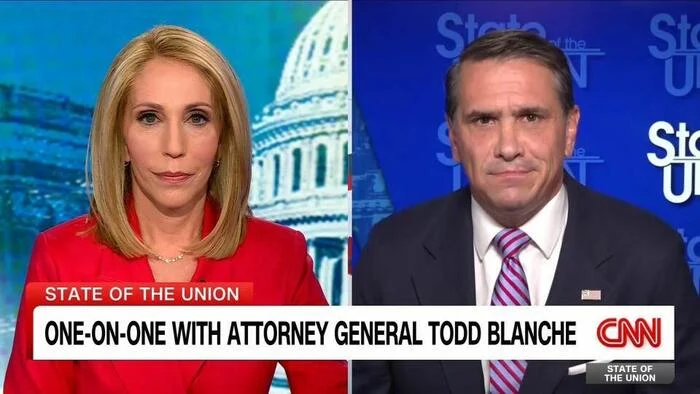
Attorney General Todd Blanche vehemently dismissed suggestions that the Justice Department’s recent lawsuit concerning Alaska’s Senate election was an attempt to lay "groundwork" for overturning election results, telling CNN’s Dana Bash to "stop it" during a contentious Sunday interview. "We’re not laying any ‘groundwork’ for the president to do that, so your premise, your question, is not true!" Blanche asserted, pushing back forcefully against Bash’s line of questioning that referenced a "doomsday scenario" and the January 6th events. The exchange underscored the heightened sensitivities surrounding election integrity and the role of federal agencies in state electoral processes, particularly in a politically charged environment.
A Tense Exchange on National Television
The interview, broadcast on CNN’s State of the Union, quickly escalated as Bash probed the Attorney General on the motivations behind the Justice Department’s filing against the state of Alaska. Bash explicitly asked whether the lawsuit was part of a broader strategy for President Trump to challenge or overturn an unfavorable election outcome. Blanche, visibly agitated, responded with a sharp rebuke, stating, "You got to stop it with that. You are not being a real person. Come on, man." Bash countered by asking, "Why are you yelling at me?" and highlighted the gravity of her concerns by adding she "would have said that ‘before Jan. 6,’" implying a parallel to the events surrounding the 2020 presidential election aftermath. Blanche dismissed the question as "crazy" and "not a real question," emphasizing his position that the DOJ’s actions were strictly within legal bounds and aimed at ensuring fair election administration, not political maneuvering. The heated exchange immediately drew significant media attention and reignited debates over journalistic questioning and executive branch accountability.
The Alaska Senate Lawsuit: A Deep Dive into the Details
At the heart of the controversy is a lawsuit filed by the Justice Department on Thursday, October 22, against the State of Alaska. The core of the complaint asks a federal court to prevent Alaska from certifying its Senate election results under specific circumstances. The DOJ’s stated objective is to investigate potential voter confusion stemming from the presence of two candidates named "Dan Sullivan" on the ballot. The incumbent Republican Senator, Dan Sullivan, is seeking re-election against former Democratic Representative Mary Peltola. The other candidate, Daniel J. Sullivan, a former teacher with no prior significant political profile, announced his candidacy in June, creating the unusual scenario of identical names for two candidates in a high-stakes federal race.
The Justice Department’s filing seeks an injunction to preserve all ballots cast in the election, particularly those for Daniel J. Sullivan, to allow for a thorough examination of whether voter intent was genuinely impacted by the name duplication. According to AG Blanche, this is a proactive measure to "put guardrails in place" to ensure the integrity of the election outcome. He stressed, as reported by the Daily Caller, that the filing "does not seek to stop any ballot from being cast or to stop the certification of Alaska’s election." Rather, on Face the Nation the same morning, Blanche told CBS’s Margaret Brennan that the suit was not "saying, ‘don’t certify,’" but rather that the state should only withhold certification if a court definitively found the race was decided "because of confusion, and not the will of the voters." He framed the action as "the Department of Justice doing our own research under the law," underscoring a commitment to understanding voter behavior and protecting electoral fairness.
Chronology of Events Leading to Federal Intervention
The sequence of events leading to the Justice Department’s lawsuit highlights a contentious path concerning the "other Dan Sullivan’s" candidacy.
- June 2026: Daniel J. Sullivan, a retired teacher, announces his candidacy for the U.S. Senate seat, filing to appear on the ballot under the same name as the incumbent, Senator Dan Sullivan.
- August 2026: Alaska election officials, citing a "determined effort and a deliberate attempt" to confuse voters, initially find Daniel J. Sullivan ineligible to appear on the ballot. This decision was based on concerns about the potential for widespread voter misunderstanding in a critical election.
- September 2026: Daniel J. Sullivan appeals the election official’s decision. The Alaska Supreme Court subsequently rules that he is eligible and must appear on the ballot, overturning the initial finding. The court’s reasoning was not immediately detailed in a full opinion, a point of contention for AG Blanche, who later expressed that the administration had hoped the court "would actually issue an opinion and explain their reasoning."
- Early October 2026: Reports surface, notably from ZeroHedge, detailing President Trump’s statements regarding "powerful legal options" against the presence of the second Dan Sullivan on the ballot. Trump is quoted as saying, "I’m the one that said, ‘do it,’" referring to a potential challenge.
- October 22, 2026: The Justice Department files its lawsuit against the State of Alaska, just 11 days before Election Day.
- October 24, 2026: Attorney General Todd Blanche clarifies the DOJ’s position on social media, emphasizing the suit’s aim to preserve ballots for investigation, not to halt certification.
- October 25, 2026: AG Blanche appears on CNN’s State of the Union and CBS’s Face the Nation, engaging in the contentious interviews where he defended the lawsuit and rejected allegations of political motives.
Alaska’s Unique Electoral System: Ranked-Choice Voting
Understanding the specifics of Alaska’s election system is crucial to grasping the potential impact of the lawsuit. Alaska utilizes ranked-choice voting (RCV) for its general elections, a system adopted by voters in 2020. Under RCV, voters rank candidates in order of preference rather than choosing just one. If no candidate receives more than 50% of first-preference votes, the candidate with the fewest votes is eliminated, and their votes are redistributed to the voters’ next-ranked choices. This process continues until one candidate achieves a majority.
The presence of a second "Dan Sullivan" becomes particularly salient in an RCV context. While Daniel J. Sullivan garnered only 2.5% of the primary vote, a seemingly negligible share, in a close general election, those votes could become critical. The lawsuit’s "trigger," as described in the original reports, is a scenario where the incumbent, Senator Dan Sullivan, loses the election but would have won had every vote cast for Daniel J. Sullivan instead gone to the incumbent. In an RCV system, voter confusion could lead to voters mistakenly ranking the "other Dan Sullivan" instead of the incumbent, or vice-versa, thereby altering the final distribution of preferences and potentially swaying the outcome. This intricate mechanism provides a legal hook for claims of voter confusion having a material impact on the election’s final determination, even with a low-polling third candidate.
Broader Political Context and Concerns Over Election Integrity
The Attorney General’s heated exchange with Dana Bash cannot be divorced from the broader national political climate surrounding election integrity, especially in the wake of the 2020 presidential election. Following the 2020 election, numerous lawsuits were filed challenging results, many of which were dismissed by courts for lack of evidence of widespread fraud. The events of January 6th, 2021, further intensified concerns about efforts to overturn election outcomes. Therefore, Bash’s questioning, referencing a "doomsday scenario" and the "January 6th callback," reflects a public and media sensitivity to any federal action that could be perceived as undermining established electoral processes or state authority over elections.
Critics argue that even if narrowly framed, a federal lawsuit seeking to potentially bar the certification of a state’s election results, particularly so close to Election Day, could set a dangerous precedent. It raises questions about the appropriate scope of federal intervention in state-run elections and whether such actions could be weaponized for political ends. President Trump’s previous remarks about having "powerful legal options" and his direct statement of having initiated the challenge ("I’m the one that said, ‘do it’") further fueled these concerns, despite AG Blanche’s claim of having "no idea" to whom the president was referring. This context is paramount to understanding why a lawsuit concerning voter confusion in a single Senate race has garnered such national attention and generated such intense scrutiny.
Reactions and Opposition from Key Stakeholders
The Justice Department’s lawsuit has not been met with universal approval, even from within the Republican Party, and has drawn strong condemnation from various political and legal entities.
- Senator Lisa Murkowski (R-Alaska): A prominent voice from the affected state, Senator Murkowski unequivocally stated, "The Department of Justice should never have filed this lawsuit." Her objection highlights concerns about federal overreach into state electoral processes and potentially undermining voter confidence.
- Senator Thom Tillis (R-N.C.): While acknowledging it was appropriate "to take a look at" the situation, Senator Tillis added a crucial caveat: "I do mind the appearance of filing a lawsuit before we even know if the facts…" This sentiment reflects a concern about the timing and potential pre-emptive nature of the federal intervention, suggesting that facts about actual voter confusion should ideally precede legal action.
- Mary Peltola Campaign: The campaign for the Democratic challenger, Mary Peltola, issued a strong rebuke, calling the lawsuit "a despicable political threat to overturn an election." This statement directly aligns with the "groundwork for overturning an election" narrative that AG Blanche so fiercely rejected, indicating the deep political polarization surrounding the issue.
- American Civil Liberties Union (ACLU): The ACLU has legally challenged the Justice Department’s lawsuit, arguing that the federal government lacks the constitutional and statutory authority over the certification of state election results, particularly under the National Voter Registration Act (NVRA). The ACLU’s intervention underscores a fundamental legal debate about federalism and the division of powers regarding election administration. They contend that the certification process is primarily a state function, and federal interference, especially without clear evidence of widespread civil rights violations, is an overstep.
Legal Precedents, Federalism, and Implications
The lawsuit plunges into complex legal terrain concerning voter confusion, federal intervention in state elections, and the principle of federalism. Historically, claims of voter confusion have been addressed through various means, including ballot design improvements, public information campaigns, and, in some instances, state-level litigation. However, a federal lawsuit directly targeting the certification process due to name confusion is relatively uncommon and raises significant legal questions.
The ACLU’s challenge regarding the federal government’s authority under the National Voter Registration Act is particularly noteworthy. The NVRA primarily focuses on voter registration access and maintenance, not the direct certification of election results or the resolution of voter confusion issues related to candidate names. Legal scholars will closely scrutinize whether the Justice Department can successfully argue that its actions fall within its enforcement powers under federal election laws or if it constitutes an undue intrusion into states’ constitutionally protected authority to administer their own elections.
The implications of this lawsuit extend beyond the immediate Alaska Senate race. If the Justice Department is successful in obtaining an injunction or influencing the certification process based on potential voter confusion, it could set a precedent for future federal interventions in state elections. This could embolden federal authorities to challenge other aspects of state election administration, potentially eroding the long-standing tradition of states primarily overseeing their own electoral processes. Conversely, if the lawsuit is dismissed or fails, it could reinforce the boundaries of federal power in this domain.
The Road Ahead: Uncertainty and Scrutiny
As Election Day approaches, the Alaska Senate race is now under an even more intense spotlight, with the outcome potentially complicated by the ongoing federal litigation. Attorney General Blanche conceded that the outcome of the legal challenge remains uncertain, stating, "We don’t know what’s going to happen yet." The federal court will now have to weigh the Justice Department’s arguments about preventing voter confusion from disenfranchising voters against the state’s authority to manage its elections and the potential for federal overreach.
The resolution of this lawsuit will undoubtedly have lasting implications for election law, the balance of power between federal and state governments, and the broader discourse on election integrity. It serves as a stark reminder of the intricate legal and political challenges that can arise in a highly polarized electoral landscape, where even seemingly minor issues like a duplicated candidate name can escalate into a national debate about the foundations of democratic governance. All eyes will remain on Alaska and the federal courts as this unprecedented legal battle unfolds.

