
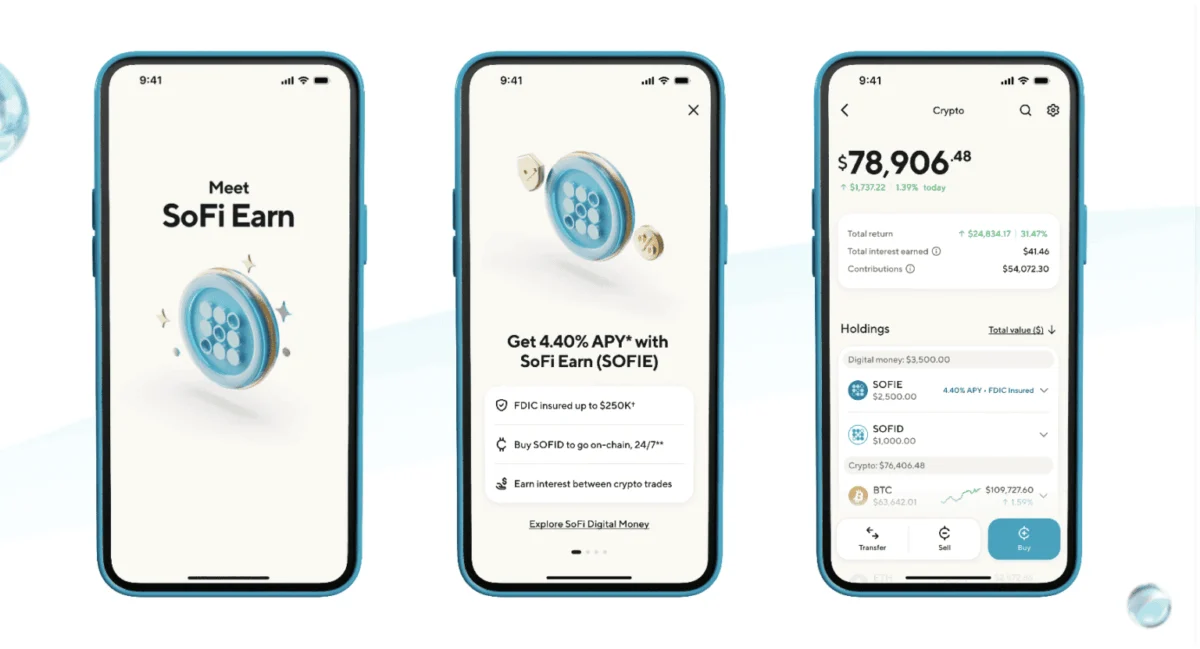
SoFi Technologies, Inc., a leading digital financial services company, has officially announced the launch of SoFi Earn (SOFIE), a pioneering financial product that represents the first and only national bank-issued tokenized deposit available to retail consumers. This strategic move marks a significant evolution in the intersection of traditional banking and the burgeoning digital asset ecosystem, allowing SoFi members to earn a competitive interest rate on their digital holdings while maintaining the liquidity and flexibility required for modern blockchain-based transactions. By bridging the gap between conventional fiat savings and the speed of decentralized finance, SoFi is positioning itself as a central hub for the next generation of digital-first banking.
The introduction of SoFi Earn (SOFIE) provides customers with a unique value proposition: the ability to hold digital dollars in an interest-bearing, tokenized bank deposit that currently yields a 4.40% Annual Percentage Yield (APY). Unlike traditional stablecoins, which often sit idle in digital wallets without accruing value for the holder, SOFIE deposits are eligible for Federal Deposit Insurance Corporation (FDIC) insurance, providing a layer of security and regulatory oversight that has historically been absent from the cryptocurrency sector. This hybrid model allows consumers to benefit from the high-yield environment of modern banking while retaining the technical capabilities to convert their holdings into SoFiUSD, the company’s native stablecoin, at a one-to-one ratio for use in blockchain-based payments or cryptocurrency acquisitions.
The Mechanics of SOFIE and the Digital Dollar Ecosystem
SoFi Earn operates as a bridge between the traditional ledger systems of a regulated national bank and the distributed ledger technology (DLT) of the blockchain. When a member deposits funds into SoFi Earn, the bank issues a tokenized representation of that deposit. This tokenized deposit is a direct liability of SoFi Bank, N.A., distinguishing it from stablecoins issued by non-bank entities. The primary advantage of this structure is the seamless integration with SoFi’s broader suite of financial products.
If a customer identifies a market opportunity in the cryptocurrency space or needs to settle a transaction on a blockchain, they can instantly convert their SOFIE tokens into SoFiUSD. This "on-demand" conversion ensures that capital is never stagnant. Once converted to SoFiUSD, the funds can be moved with the speed and finality characteristic of blockchain technology. Conversely, when funds are not needed for active transactions, they can be held as SOFIE to capture the 4.40% APY. This functionality addresses a long-standing inefficiency in the digital asset market, where billions of dollars in liquidity often remain non-productive in non-interest-bearing stablecoins or exchange wallets.
Anthony Noto, CEO of SoFi, emphasized the importance of capital efficiency in his statement regarding the launch. "Too much money in the digital asset ecosystem is sitting idle, leaving massive potential earnings on the table for millions of people," Noto remarked. "We believe your money should keep working for you until the moment you need it. SoFi Earn combines the earning power and protections of a bank deposit with the speed and utility of digital assets, giving people more value, flexibility and control over their money."
Regulatory Landscape and the Impact of the GENIUS Act
The timing of the SoFi Earn launch is particularly strategic, occurring just hours after the Office of the Comptroller of the Currency (OCC) finalized rules implementing the GENIUS Act. This legislation, which is set to take full effect on January 18, 2027, introduces strict prohibitions on stablecoin issuers paying yield or interest to holders. The primary objective of the GENIUS Act is to prevent stablecoins from functioning as unregulated "shadow banks" that compete with insured depository institutions without adhering to the same capital and liquidity requirements.
The act specifically prohibits any entity issuing a "payment stablecoin" from offering interest or yield derived from the assets backing the coin directly to the holder. This has created a significant hurdle for major stablecoin issuers like Circle (USDC) and Tether (USDT), as well as various crypto exchanges that use yield as a primary incentive for user retention. However, the GENIUS Act provides a distinct carve-out for tokenized bank deposits. Because SOFIE is a deposit at a regulated national bank rather than a standalone payment stablecoin, it falls under existing banking regulations rather than the new restrictions imposed on non-bank issuers.
This regulatory distinction gives SoFi a substantial competitive advantage. While other platforms may struggle to offer compliant yield-bearing digital assets, SoFi can utilize its bank charter to offer a product that is both legally compliant and financially attractive. The debate over the GENIUS Act continues, with critics pointing out ambiguities regarding third-party reward programs and the treatment of yield offered by intermediaries, but SoFi’s move to utilize tokenized deposits provides a clear, regulated path forward for the industry.
A Chronology of SoFi’s Digital Asset Expansion
The launch of SOFIE is the latest milestone in an aggressive 12-month campaign by SoFi to dominate the digital finance sector. The company has methodically built a comprehensive ecosystem designed to transition users from traditional finance to a blockchain-integrated future.
- Phase 1: Crypto Trading Integration: SoFi initially introduced streamlined cryptocurrency trading for its retail members, allowing for the purchase and sale of major assets like Bitcoin and Ethereum within the same app used for personal loans and stock trading.
- Phase 2: The Launch of SoFiUSD: To facilitate faster settlements and provide a stable medium of exchange, the company introduced SoFiUSD, a stablecoin fully backed by US dollar reserves and maintained under the bank’s regulatory umbrella.
- Phase 3: Big Business Banking: Recognizing the needs of corporate clients, SoFi launched the "Big Business Banking" platform. This service provides companies with a single, regulated interface to manage both fiat treasury operations and digital asset holdings, simplifying the accounting and compliance burdens for firms operating in the Web3 space.
- Phase 4: Tokenized Deposits (SOFIE): With the launch of SoFi Earn, the company has completed the loop, offering a high-yield storage vehicle that connects directly to its trading and payment rails.
This rapid sequence of product launches demonstrates SoFi’s commitment to becoming the "AWS of Fintech," providing the underlying infrastructure that allows both consumers and businesses to navigate the complexities of digital and traditional finance simultaneously.
Market Implications and the Future of Stablecoins
The introduction of an interest-bearing, bank-issued tokenized deposit raises fundamental questions about the long-term viability of traditional, non-interest-bearing stablecoins. In a high-interest-rate environment, the opportunity cost of holding assets in a vehicle that pays 0% APY is significant. If a consumer or institutional investor can hold a digital asset that earns 4.40%, features FDIC insurance, and can be converted to a payment-ready stablecoin in seconds, the incentive to hold traditional stablecoins like USDC or USDT diminishes.
Financial analysts suggest that SoFi’s move could trigger a "flight to quality" and a "flight to yield" within the digital asset space. Traditional banks, many of which have been hesitant to engage with blockchain technology due to regulatory uncertainty, are now being presented with a successful blueprint. By adopting a tokenized deposit model, banks can retain deposits that might otherwise migrate to the crypto ecosystem, while offering the modern features that digital-native consumers demand.
Furthermore, the SOFIE launch highlights a shift in the banking industry’s approach to blockchain. Rather than viewing digital assets as a threat to be mitigated, SoFi is treating the technology as an upgrade to the existing banking ledger. This "best of both worlds" approach allows for 24/7/365 transaction capabilities and programmable money features without sacrificing the safety and soundness of the traditional banking system.
Consumer Availability and Implementation
SoFi Earn is currently being rolled out to existing SoFi Crypto members, with a phased expansion expected to continue through November. The company has focused on making the user experience as intuitive as possible, ensuring that the complexities of tokenization and blockchain conversion are handled in the background. For the average user, SOFIE appears as a high-yield account with an "active" component that allows for immediate utility in the digital economy.
As the January 2027 deadline for the GENIUS Act approaches, the industry will be watching SoFi closely to see how SOFIE performs in a shifting regulatory environment. If successful, tokenized deposits could become the standard for how regulated financial institutions interact with digital dollars, potentially overshadowing the current stablecoin market and redefining the relationship between banks and their depositors.
In conclusion, SoFi’s launch of SOFIE represents more than just a new product; it is a strategic repositioning of what a bank account can be in the 21st century. By combining the 4.40% APY and FDIC insurance of a traditional bank with the agility of a tokenized asset, SoFi is setting a new benchmark for the financial services industry, challenging both traditional banks and crypto-native firms to evolve.

