

The landscape of real estate investment is significantly shaped by the regulatory environment of individual states. For property investors, understanding the nuances of landlord-tenant laws is not merely a matter of compliance but a critical factor influencing profitability and return on investment. This analysis delves into the characteristics that define a "landlord-friendly" state and identifies the top five jurisdictions that, as of 2026, offer a more permissive environment for rental property owners. While these labels are valuable, experienced investors recognize that they represent only one piece of a complex investment puzzle.
Defining a Landlord-Friendly State
A landlord-friendly state is characterized by a legal framework that simplifies the process of owning and managing rental properties, often by reducing entry and operational costs for landlords. This does not imply that tenant rights are disregarded; rather, it suggests a balance where laws are perceived to offer greater protection and flexibility to property owners. Every state maintains tenant protection laws, and adherence to these is non-negotiable for responsible landlords who recognize tenants as integral partners in their business. A positive landlord-tenant relationship is universally acknowledged as a cornerstone of successful property management.
The attributes that commonly contribute to a state’s landlord-friendly designation include:
Favorable Property Tax Rates
Property taxes represent a significant ongoing expense for real estate investors. In 2026, effective property tax rates across the United States typically fall between 0.25% and 2% of a property’s assessed value. While these taxes are often deductible, thereby reducing taxable income, higher rates in certain states directly impact a landlord’s net operating income and, consequently, their capitalization rate (cap rate). With property taxes subject to annual increases, investing in states with lower property tax burdens can lead to greater cash flow retention. For example, states with lower property tax rates can allow landlords to achieve higher cap rates, making investments more attractive from a yield perspective.
Absence of Rent Control
Rent control policies, designed to ensure housing affordability and stability for tenants, limit how much landlords can charge for rent and the frequency of rent increases. While beneficial for tenants, these regulations can stifle long-term cash flow for landlords. When operating costs such as insurance premiums, property taxes, management fees, and maintenance expenses escalate, landlords in rent-controlled markets may be unable to adjust rental income proportionally. This can lead to deferred maintenance or postponed major repairs, potentially diminishing the long-term value of the investment property due to a lack of revenue growth. For new investors, avoiding rent control can be a strategic move to ensure predictable income streams.
Streamlined Licensing and Permitting
Establishing a rental property business often requires obtaining various licenses and permits, the complexity and cost of which can vary significantly by location. These requirements can be influenced by property type, rental strategy (e.g., short-term versus long-term rentals), and local ordinances. Some states impose stringent licensing mandates that substantially increase upfront investment costs. In contrast, landlord-friendly states generally facilitate a smoother and more cost-effective setup process for rental property ventures, minimizing bureaucratic hurdles.
Uncapped Security Deposits
Security deposits serve as a crucial financial safeguard for landlords, covering potential damages beyond normal wear and tear, unpaid rent or utilities, and lease violations. When renter-friendly states impose caps on security deposit amounts, it can create a financial vulnerability for landlords. The cost of repairs or lost rent may exceed the maximum deposit allowed. Furthermore, lower security deposits might offer less insight into a tenant’s financial stability. States that do not cap security deposits provide landlords with greater protection, though it is incumbent upon them to set "reasonable" amounts that are legally defensible.
Minimal Notice-of-Entry Requirements
The ability for landlords to access their rental properties without lengthy, legally mandated notice periods is essential for various operational tasks. These include conducting necessary inspections, performing repairs and maintenance promptly, showing the property to prospective tenants or buyers, and responding to emergencies. A typical notice period in many landlord-friendly jurisdictions is between 24 to 48 hours, allowing for efficient property management without undue delay.

Efficient Eviction Processes
While landlords hope to avoid evictions, the reality of the rental market means that this process can become necessary. Eviction proceedings vary widely in duration and cost across the U.S., ranging from approximately three weeks to as long as six months from initial notice to lockout. Lengthy eviction processes can be financially burdensome, as landlords continue to incur costs such as mortgage payments, property taxes, and insurance while receiving no rental income. Furthermore, disgruntled tenants may cause additional damage during extended eviction periods. States with streamlined eviction laws help mitigate these financial and operational risks for landlords.
Additional Landlord Protections
Beyond the aforementioned characteristics, some states offer further incentives for landlords, such as unlimited late rent fees or immediate rights to dispose of abandoned property. State preemption laws, where a state government prohibits local municipalities from enacting their own rental regulations, can also contribute to a more uniform and predictable operating environment. It’s important to note that not all states exhibit every landlord-friendly trait. The designation often arises from a favorable balance of these characteristics relative to typical state laws. For instance, Texas offers advantages like no rent control and a streamlined eviction process, but this may be offset by higher property taxes compared to other states.
It is also crucial for investors to recognize that even within a landlord-friendly state, specific cities or municipalities may have their own distinct ordinances that can alter the local regulatory environment. Thorough due diligence on local laws is therefore indispensable.
The Top 5 Most Landlord-Friendly States in 2026
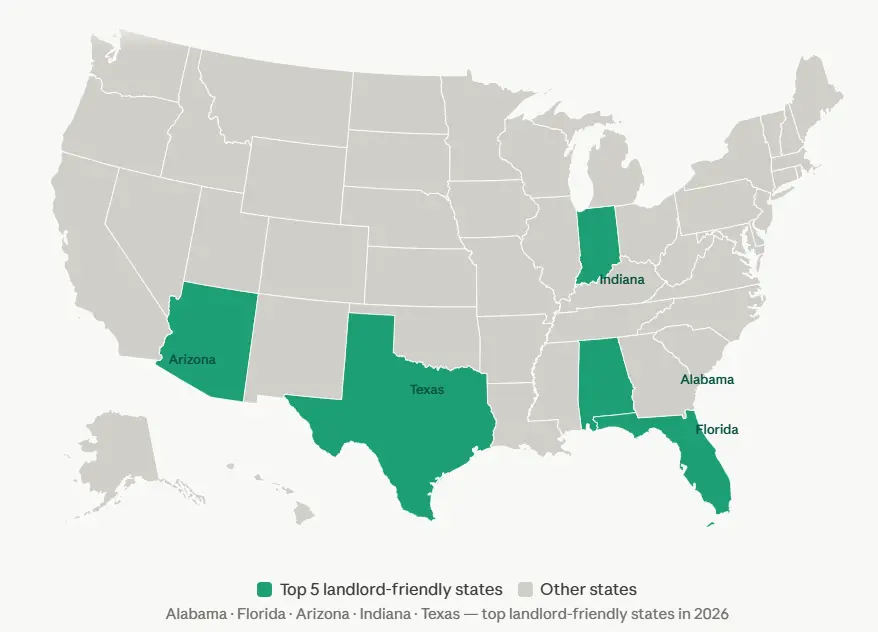
Based on a comprehensive review of state laws and regulations impacting rental property owners, the following five states stand out as particularly landlord-friendly in 2026:
Alabama
Alabama consistently ranks among the most landlord-friendly states due to its minimal regulatory burdens on individual landlords. The state generally imposes few restrictions on security deposits and provides a relatively straightforward eviction process. Property taxes tend to be moderate, contributing to better cash flow.
- Key Features: Low property taxes, minimal rent control measures, and a generally efficient eviction process.
- Top Landlord-Friendly City with High Average Cap Rate: Birmingham, known for its growing economy and relatively affordable housing market, often presents attractive cap rates for investors.
Florida
Florida’s appeal to landlords stems from its robust tenant protection laws that are balanced with landlord rights, particularly concerning evictions. The state generally lacks rent control and has a well-defined, albeit sometimes lengthy, eviction process that offers clear steps for landlords. Property taxes vary but are often competitive.
- Key Features: No statewide rent control, relatively straightforward eviction procedures, and no caps on security deposits.
- Top Landlord-Friendly City with High Average Cap Rate: Jacksonville, benefiting from population growth and a diverse economy, frequently offers competitive rental yields.
Arizona
Arizona offers a business-friendly environment for landlords, characterized by minimal rent control and a clear, efficient eviction process. The state has a relatively low tax burden on rental income and property. Its growing population and economic development further enhance its attractiveness.
- Key Features: Limited rent control legislation, streamlined eviction laws, and a reasonable property tax structure.
- Top Landlord-Friendly City with High Average Cap Rate: Phoenix, a major metropolitan area with consistent population influx and strong job growth, often provides robust investment opportunities with good cap rates.
Indiana
Indiana stands out for its exceptionally low property taxes and a legal framework that is generally favorable to landlords. The state has no statewide rent control, and its eviction process is designed to be relatively efficient. The cost of entry for real estate investment can also be more accessible here compared to other states.
- Key Features: Very low property taxes, absence of rent control, and a landlord-supportive legal environment.
- Top Landlord-Friendly City with High Average Cap Rate: Indianapolis, the state capital and a significant economic hub, presents opportunities for investors seeking consistent rental demand and favorable returns.
Texas
Texas is widely recognized for its landlord-friendly stance, largely due to the absence of statewide rent control and a notably efficient eviction process. While property taxes can be higher than in some other states, the overall regulatory environment is designed to facilitate property ownership. The state’s strong economic growth and population expansion create sustained demand for rental housing.
- Key Features: No rent control, a swift eviction process, and limited state-level regulations on rental properties.
- Top Landlord-Friendly City with High Average Cap Rate: Dallas, a major economic and cultural center with a rapidly expanding population, consistently offers attractive investment prospects with competitive cap rates.
The Strategic Decision: Landlord-Friendly vs. Tenant-Friendly Markets
While the designation of "landlord-friendly" carries significant weight, it is not the sole determinant of a successful real estate investment. Some investors actively choose to invest in tenant-friendly markets for compelling reasons. For instance, a Q4 2025 Redfin report indicated a substantial increase in investor purchases in the Milwaukee housing market, which, despite being in a generally landlord-friendly state, has recently implemented renter-focused regulations. These include measures that lengthen eviction timelines and impose stricter requirements for security deposits and inspections.
Daryl Fairweather, Chief Economist at Redfin, emphasizes that these labels, while useful, can be overly broad. "Landlord-friendly and tenant-friendly labels can be helpful, but they can be too broad to guide an investment decision on their own," Fairweather states. "What matters more is the underlying economics (fundamentals) of a market, like home prices, rent levels, job growth, and long-term demand. A landlord-friendly market with weak fundamentals can underperform a tenant-friendly market with strong population growth and tight supply, for example. I would suggest that investors should treat the regulatory environment as just one of many factors."
Indeed, landlord-friendly states are not inherently superior investment locations. Favorable regulations do not always equate to low risk. Rapid investor activity in such markets can sometimes inflate prices, compressing yields. Furthermore, risks such as overbuilding or economic volatility can exist, regardless of the regulatory climate. Fairweather cautions, "Landlord-friendly doesn’t always mean low risk. Typically in some of these markets, rapid investor activity has already driven up prices, which can compress yields. There’s also the risk of overbuilding or economic volatility. Just because regulations are favorable doesn’t mean the investment will perform well. Always start by paying close attention to fundamentals like affordability, migration trends, and local employment."
Navigating Tenant-Friendly Markets: Expert Strategies
For investors who identify promising opportunities in tenant-friendly markets, understanding how to mitigate potential challenges is crucial. Rent control, a significant concern, requires strategic financial planning. Fairweather advises, "In rent-controlled markets, cash flow starts with the purchase price. You need to buy at a basis that makes sense given future rent constraints. After that, focus on minimizing turnover and vacancy, since you might not be able to raise rents between tenants. Keeping units well-maintained and building good tenant relationships can reduce churn. I’ve seen some investors also look for properties where allowable increases like inflation-based adjustments or capital improvement passthroughs can help offset costs over time."
Additional guidance for investing in tenant-friendly states includes:
- Conservative Underwriting: Investors should project expenses and income conservatively, accounting for potential delays and lower rental growth.
- Professional Operations: This involves meticulous tenant screening, setting appropriate initial rents, and budgeting for extended timelines should issues arise.
- Deep Understanding of Local Laws: Thoroughly familiarize yourself with specific regulations concerning notice periods, eviction timelines, and rent increase rules to avoid unforeseen complications.
- Leverage Local Expertise: Partnering with a local property manager or legal expert is highly recommended, especially for first-time investors in unfamiliar regulatory environments.
Conclusion: Prioritizing Fundamentals Over Labels
The prevailing wisdom in real estate investment today suggests that while "landlord-friendliness" is a relevant consideration, it should not be the sole or primary driver of investment decisions. As Fairweather notes, "That’s increasingly true. What we’re seeing now is that investors are prioritizing fundamentals over labels. A market like Milwaukee, for example, may be considered tenant-friendly, but if it offers relatively affordable entry points and stable rental demand, it can still be attractive. Meanwhile, some traditionally landlord-friendly markets—like parts of Florida—have cooled due to rising prices and insurance costs. So today, the more important question is: ‘Does the deal make sense given the local market conditions?’ Regulation matters, but it’s not the whole story."
Ultimately, success in real estate investment hinges on a data-driven approach. A thorough analysis of market fundamentals, including property values, rental demand, job growth, population trends, and the specific financial projections of a deal, is paramount. Tools and data platforms that facilitate comprehensive deal underwriting are indispensable for identifying profitable opportunities, regardless of a state’s regulatory classification. By focusing on the numbers and understanding the broader economic context, investors can make informed decisions that lead to sustainable returns in any market.

