

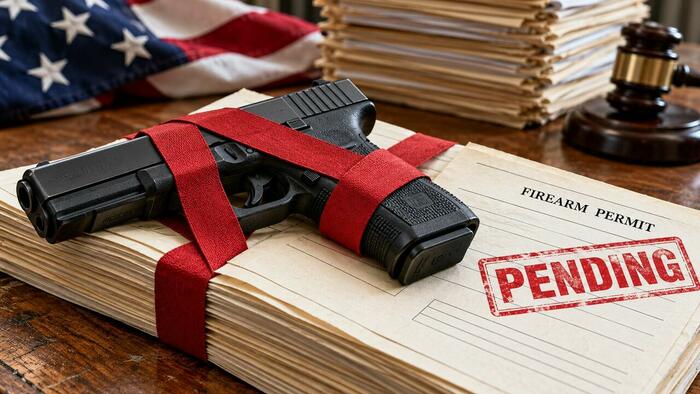
The Department of Justice’s Civil Rights Division has initiated a comprehensive investigation into the Township of Pennsauken, New Jersey, to ascertain whether the local police department’s administration of firearm permits has become so protracted that it infringes upon the Second Amendment rights of its residents. This federal intervention, announced on a recent Wednesday, marks a significant step in the DOJ’s increasingly proactive stance on gun rights enforcement, particularly following recent landmark Supreme Court rulings. The probe will examine the policies, practices, and processing times for handgun purchase permits and concealed carry permits, responding to numerous allegations of systemic delays that potentially deny law-abiding citizens their constitutional right to bear arms.
Unpacking the Federal Investigation
The investigation, spearheaded by the Civil Rights Division’s dedicated Second Amendment Section, aims to determine if the Pennsauken Police Department’s practices constitute a "pattern or practice" of violating federal law. Assistant Attorney General Harmeet Dhillon, a key figure in this new enforcement push, articulated the division’s commitment, stating, "Our investigation aims to discover if allegations of unconstitutional delays in firearm permitting are true, and if so, to fix it." She further emphasized the section’s mandate to "defend law-abiding citizens from local authorities who infringe on the right to safely carry legal firearms." The DOJ has clarified that, at this preliminary stage, it has not reached any definitive conclusions regarding Pennsauken’s compliance or non-compliance. Instead, the inquiry is a fact-finding mission prompted by reports from "individuals and groups" detailing "extensive delays" in the issuance of handgun purchase permits and other firearm-related documentation.
The specific nature of the allegations revolves around the timeliness of permit processing. New Jersey law, known for its stringent gun control measures, mandates a 30-day processing period for firearm purchase permits. However, complainants argue that Pennsauken has consistently exceeded this statutory deadline, sometimes by several months, effectively creating a de facto denial of Second Amendment rights through bureaucratic inertia. Such delays can have significant consequences for individuals seeking to exercise their right to self-defense or participate in lawful shooting sports.
The Legal Bedrock: New York State Rifle & Pistol Association, Inc. v. Bruen
This federal investigation into Pennsauken is firmly rooted in the Supreme Court’s pivotal 2022 decision in New York State Rifle & Pistol Association, Inc. v. Bruen. In Bruen, the Court, in a 6-3 decision authored by Justice Clarence Thomas, struck down New York’s "proper cause" requirement for obtaining a concealed-carry license, ruling that it violated the Second and Fourteenth Amendments. The decision affirmed an individual’s right to carry a handgun in public for self-defense, moving away from a "means-end scrutiny" test to a historical analysis of the Second Amendment.
Crucially for the Pennsauken case, Justice Thomas included a significant footnote in the Bruen opinion. This footnote explicitly stated that the Court did not preclude "constitutional challenges to shall-issue regimes where, for example, lengthy wait times in processing license applications or exorbitant fees deny ordinary citizens their right to public carry." This particular passage has become the "legal hook" for the DOJ’s current enforcement strategy, signaling that administrative burdens, even in jurisdictions with "shall-issue" permit systems (where permits must be issued if an applicant meets objective criteria), can be deemed unconstitutional if they effectively obstruct the exercise of Second Amendment rights. The DOJ’s recent actions, including the Pennsauken probe, directly respond to this judicial guidance, indicating a federal commitment to scrutinizing the practical implementation of firearm permitting systems at the local level.
New Jersey’s Rigorous Firearm Permitting Landscape
New Jersey operates under some of the most comprehensive and restrictive gun laws in the United States. Prospective firearm owners must navigate a multi-layered permitting process that begins with obtaining a Firearms Purchaser Identification Card (FPIC) and then, for handguns, a separate Permit to Purchase a Handgun (PPH). The township’s official website outlines these steps, which include:
- Submitting an online application.
- Providing two references from outside the applicant’s household, who must complete an online questionnaire.
- Undergoing a fingerprinting appointment within 90 days of applying for an FPIC.
- Paying a $50 fee for the initial FPIC and an additional $25 fee per handgun purchase permit.
Notably, the Pennsauken website does not specify a processing time for these applications, a common point of contention for applicants who often face indefinite waits. For concealed carry permits, the process is even more demanding, requiring four references and meeting specific "justifiable need" criteria, though the Bruen decision has significantly altered how "justifiable need" can be applied. The state also imposes a "one-handgun-a-month" limit, preventing individuals from purchasing more than one handgun within a 30-day period, a provision that has also faced legal challenges.
These extensive requirements, while ostensibly designed to enhance public safety, can become a bottleneck when local authorities fail to process them efficiently. The alleged delays in Pennsauken, if proven, could illustrate how even a legally robust permitting system can become constitutionally problematic through its practical application, effectively transforming a "shall-issue" system into a "may-issue" system in practice, where the issuance of a permit is subject to the discretion (or lack thereof) of the issuing authority.
The Precedent: A Federal Lawsuit Against Pennsauken’s Police Chief
While the Department of Justice’s public release refrains from naming specific individuals, the federal investigation closely mirrors a civil rights lawsuit filed against Pennsauken’s police chief in June 2024. This federal suit (No. 24-cv-7098), filed on June 18, 2024, by Christian Benton, along with the Coalition of New Jersey Firearm Owners, Gun Owners of America (GOA), and the Gun Owners Foundation, directly challenges both New Jersey’s permit system and its one-handgun-a-month limit.
Benton’s complaint specifically alleges that the Pennsauken Police Department took more than four months to process two of his firearm purchase permit applications, significantly exceeding the 30-day state statutory deadline. This direct allegation of egregious delay forms the core of the federal lawsuit, which is currently awaiting summary-judgment rulings. The timing of the DOJ’s investigation, coming just months after this federal lawsuit was filed, suggests a direct link, indicating that the Justice Department may be using the findings and allegations from private litigation to inform its own pattern-or-practice inquiry. The involvement of prominent gun rights organizations like GOA underscores the broader national significance of these local permitting disputes, framing them as crucial battles in the ongoing debate over Second Amendment rights.
The "Pattern-or-Practice" Investigation: A Tool for Civil Rights Enforcement
The specific investigative mechanism employed by the DOJ in Pennsauken is known as a "pattern-or-practice" investigation. This type of inquiry originates from a provision within the Violent Crime Control and Law Enforcement Act of 1994, which empowers the Civil Rights Division to investigate government entities for systemic violations of federal law. Historically, these investigations have primarily targeted police departments for misconduct, excessive force, or discriminatory policing practices.
However, with the establishment of the Second Amendment Section within the Civil Rights Division in 2025, the application of this powerful investigative tool has expanded to include alleged infringements on gun rights. This marks a notable shift in the division’s focus, drawing both praise from gun rights advocates and criticism from gun control proponents. The Brady Campaign, a prominent gun-control advocacy group, has publicly voiced concerns, characterizing the creation and activities of the Second Amendment Section as a "diversion of scarce resources" from what they consider traditional civil rights cases involving racial discrimination or police brutality. This divergence highlights the contentious nature of Second Amendment enforcement and the ongoing debate about the appropriate role of federal intervention in state and local gun policies.
Broader Context: DOJ’s Expanding Second Amendment Enforcement
The Pennsauken investigation is not an isolated incident but rather part of a broader, concerted effort by the DOJ’s Second Amendment Section to scrutinize and challenge local firearm permitting practices across the nation. This growing pattern of federal intervention signals a significant ramp-up in the enforcement of gun rights post-Bruen.

Los Angeles County, California: In March 2025, the DOJ opened a probe into the Los Angeles County Sheriff’s Department over severe delays in handling concealed carry permits. The department, facing what it described as a "significant staffing crisis" with only 14 personnel in its carry-permit unit, was subsequently sued by the DOJ in September 2025. The federal complaint alleged that applicants waited an average of 281 days—more than nine months—just for the processing of their applications to commence, although the sheriff’s department disputed these figures. This case reached a resolution on August 13, 2026, when the DOJ and the LA County Sheriff’s Department settled the lawsuit. The settlement mandated the department to increase staff and implement new software to streamline the permit process, with the DOJ reporting that the department is now meeting state deadlines. This successful resolution in Los Angeles provides a potential blueprint for how the Pennsauken investigation might proceed, emphasizing remediation through resource allocation and procedural improvements.
Philadelphia, Pennsylvania: Across the Delaware River from Pennsauken, the city of Philadelphia also came under DOJ scrutiny in June [implied 2026]. The investigation focuses on the Philadelphia Police Department’s practices regarding firearm permit revocations, which the DOJ has described as based on "vague" reasons. This case highlights another facet of permit administration that can potentially violate civil rights: arbitrary or unsubstantiated denials or revocations. Officials from Philadelphia’s mayor’s office, Law Department, and police department have thus far declined to comment on the ongoing probe.
San Jose, California: In September [implied 2026], the Second Amendment Section also filed a lawsuit against the city of San Jose, California. This legal action targets the city’s requirement of a roughly $1,600 permit fee and a mandatory psychological examination for concealed carry licenses. Assistant Attorney General Dhillon publicly commented on this case via social media, stating: "The @CivilRights Division sued San Jose for charging a $1,600 application fee & requiring a psych exam for a concealed carry permit. These are unconstitutional barriers and @theJusticeDept will continue to pursue cities and states blocking this right!" This case exemplifies the DOJ’s focus on both excessive financial burdens and subjective psychological evaluations as potential unconstitutional obstacles to gun ownership.
Implications and Future Outlook
The DOJ’s investigation into Pennsauken, coupled with its ongoing probes and lawsuits in other jurisdictions, signals a new era of federal oversight in firearm permitting. The implications are far-reaching:
- Increased Scrutiny for Local Agencies: Police departments and other local authorities responsible for issuing firearm permits nationwide can expect heightened scrutiny from the federal government, especially in "shall-issue" jurisdictions where administrative delays or excessive fees become de facto denials.
- Clarification of Bruen‘s Reach: These cases will help further define the practical boundaries of the Bruen decision, particularly concerning what constitutes an "unconstitutional delay" or "exorbitant fee."
- Resource Allocation: Local governments may be compelled to reallocate resources, hire additional staff, or upgrade technological infrastructure to ensure timely processing of permit applications, potentially leading to increased financial burdens on municipalities.
- Political Tensions: The federal government’s active role in challenging local gun control implementations is likely to exacerbate political tensions between states and the federal government, especially in states with strong gun control advocacy.
- Impact on Gun Rights Advocacy: This federal push empowers gun rights organizations, providing them with a powerful ally in their efforts to challenge what they perceive as infringements on the Second Amendment.
For residents of Pennsauken and beyond who believe their Second Amendment rights have been affected by unconstitutional delays or other barriers in firearm permitting, the Department of Justice’s Second Amendment Section encourages them to file complaints online through its official website. This mechanism provides a direct channel for citizens to report potential violations, further fueling the DOJ’s enforcement efforts and ensuring accountability at the local level. The outcome of the Pennsauken investigation will undoubtedly contribute to the evolving legal landscape of gun rights in America, potentially setting precedents for how states and localities manage firearm permits in the post-Bruen era.

