
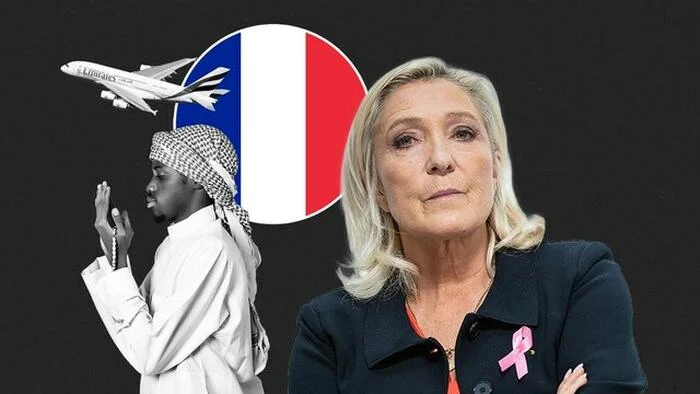
A significant new poll has revealed that nearly half of Muslim and Jewish respondents in France would consider leaving the country if Marine Le Pen secures the presidency in 2027. This exclusive Ifop survey, conducted for the magazine Marianne, underscores profound anxieties within these minority communities regarding the potential political shift and its implications for their future in France. The findings highlight deep societal divisions and fears surrounding the rise of the National Rally (RN) and its leader.
The poll’s results indicate that 46 percent of individuals identifying as Muslim would contemplate "leaving France to settle in another country" should a Le Pen presidency materialize. Alarmingly, 20 percent of this group stated they would "certainly" take such a drastic step, signifying a concrete level of intent. For context, this figure stands in stark contrast to the 21 percent of the overall French population who expressed a similar hypothetical willingness to emigrate. Parallel sentiments were recorded among the Jewish community, with 44 percent of Jewish respondents indicating they would consider leaving France under the same circumstances. This statistic is particularly striking given Marine Le Pen’s recent efforts to position herself and the National Rally as protectors of Jewish life against Islamist fundamentalism.
The Landscape of Fear and Identity
Beyond the contemplation of emigration, the survey delved into broader anxieties and potential behavioral changes. A substantial 81 percent of Muslim respondents conveyed a belief that a Le Pen victory would inevitably lead to a rise in discrimination against their community. This perception is further underscored by the fact that 27 percent said they would consider concealing their religious identity in daily life, with 18 percent specifically stating they would cease wearing the veil in public. Such findings illuminate a pervasive sense of vulnerability and a potential erosion of religious freedom as perceived by a significant portion of the Muslim population.
Similar apprehension permeated other demographic cohorts examined by the poll. Forty percent of the youngest segment of French voters, aged 18-24, indicated they would consider leaving France, reflecting a generational unease with the potential political direction. Voters aligned with Jean-Luc Mélenchon’s left-wing France Unbowed (LFI) party also showed high levels of concern, with 43 percent expressing a willingness to consider emigration. The survey additionally noted elevated support for civil disobedience among certain groups, with substantial shares indicating they would refuse to respect laws they deemed unjust, pointing to a potential for social unrest and defiance in the face of policies perceived as discriminatory.
Marine Le Pen and the National Rally: A Historical Context
To understand the weight of these poll results, it is crucial to contextualize Marine Le Pen’s political trajectory and the ideological evolution of the National Rally. Formerly known as the Front National (FN), the party was founded in 1972 by Jean-Marie Le Pen, Marine’s father. For decades, the FN was a fringe political force, largely associated with extreme nationalism, anti-immigrant rhetoric, and historical revisionism, often drawing accusations of antisemitism and xenophobia.
Marine Le Pen took the helm of the party in 2011, embarking on a deliberate strategy of "de-demonization" (dédiabolisation) to broaden its appeal and shed its most extreme image. This involved rebranding the party as the National Rally (Rassemblement National, RN) in 2018, expelling controversial figures, and attempting to shift the focus from overt racism to concerns about national identity, sovereignty, immigration control, and economic protectionism. While the rhetoric has been refined, core tenets of the party’s platform remain deeply controversial for many, particularly its stance on immigration, national preference, and French secularism (laïcité).
Le Pen has made significant strides in mainstream politics, reaching the second round of the presidential elections in both 2017 and 2022. In these contests, she faced Emmanuel Macron, ultimately losing but consistently improving her electoral performance. Her persistent presence in the final round underscores her growing popular support and the increasing normalization of her party’s ideas in French political discourse. The 2027 election, for which she currently leads first-round voting intention polls, represents a critical juncture, with the prospect of an RN presidency becoming an increasingly tangible reality.
Laïcité and its Complex Relationship with Identity
A central pillar of French identity and political debate is laïcité, the principle of secularism. While ostensibly designed to ensure neutrality of the state and freedom of conscience, its interpretation and application have become a flashpoint, particularly concerning religious symbols in public spaces. The National Rally has consistently advocated for a more stringent interpretation of laïcité, often translating into policies targeting visible manifestations of Islam.
Le Pen has indicated a desire for tighter controls on immigration, greater priority for French nationals in housing and employment, and restrictions on Islamic veiling in public spaces. While she has stated she would not impose an immediate ban on the veil upon taking office, she has committed to putting broader restrictions to a national referendum. This stance, perceived by many Muslims as targeting their religious practices and freedom, contributes significantly to the fears of discrimination documented in the Ifop poll. The debate over the veil, burkini, and other Islamic symbols has been ongoing in France for decades, reflecting a deep societal struggle over how to reconcile a secular public sphere with a growing religiously diverse population.
Previous research by Ifop has further documented rising religiosity and support for more rigorous interpretations of Islam among younger French Muslims. This includes significant shares prioritizing Islamic norms over French civil law on issues such as inheritance or ritual slaughter in certain scenarios. These findings, which Remix News reported on previously, contribute to the National Rally’s narrative of failed integration and the perceived dangers of demographic change, fueling their calls for stricter adherence to French cultural norms and secular principles.

The Paradox of Le Pen and the Jewish Community
One of the more perplexing findings of the Ifop poll is the high percentage of Jewish respondents considering emigration, nearly mirroring that of Muslims. This is particularly notable because Marine Le Pen has consciously worked to distance her party from its historical antisemitic past and has actively sought to portray the National Rally as a bulwark against what she identifies as the primary threat to Jewish life in France: Islamist fundamentalism.
In a striking statement in 2024, Le Pen declared, "The best shield for French people of the Jewish faith is the National Rally. It is the only movement that has the will, the conviction and the means to fight Islamist fundamentalism, which is the major danger facing them." This declaration, disseminated via her official social media channels, aimed to reassure the Jewish community and draw a clear distinction between her party and other political forces regarding the issue of security.
However, the poll results suggest that this message has not fully resonated. The anxiety among Jewish respondents could stem from several factors:
- Historical Memory: Despite the RN’s rebranding, the legacy of the Front National’s antisemitism and its association with far-right extremism may persist for many.
- General Xenophobia: Policies that target one minority group (e.g., Muslims) can create a climate of fear and insecurity for other minorities, even if not directly targeted. A rise in generalized xenophobia or nationalism could indirectly impact the Jewish community.
- Democratic Values: Concerns about the RN’s perceived authoritarian tendencies or challenges to democratic norms might worry those who prioritize liberal democratic values and minority protections.
- Social Cohesion: A presidency that deepens divisions between communities could lead to a less cohesive and more volatile society, impacting all minority groups.
Reactions and Interpretations
The findings of this Ifop poll are likely to provoke strong reactions across the French political spectrum and within civil society.
- National Rally: Spokespersons for the RN would likely dismiss the poll’s implications, arguing that the fears are unfounded and fueled by political opponents. They might reiterate Le Pen’s commitment to protecting all French citizens while emphasizing the necessity of their policies to combat "Islamist fundamentalism" and ensure national cohesion. They might also suggest that those who threaten to leave are either not truly integrated or are attempting to exert political pressure.
- Opposition Parties (Left and Center): Parties on the left, such as France Unbowed and the Socialist Party, would likely seize upon these results as evidence of the divisive and dangerous nature of the National Rally’s ideology. They would interpret the fears as a direct consequence of the RN’s policies targeting minorities and its perceived threat to republican values. Centrist parties, including President Macron’s Renaissance, would also likely express concern over the potential for national division and the damage to France’s international image, emphasizing the need for unity and respect for all communities.
- Religious Community Leaders: Leaders within both the Muslim and Jewish communities are expected to voice deep concern. Muslim leaders would likely highlight the anxieties over discrimination and the potential erosion of religious freedoms, calling for greater protection of minority rights and a more inclusive vision of French identity. Jewish community representatives, while appreciating Le Pen’s stated commitment to their security, would likely express reservations about the broader implications of an RN presidency for interfaith relations and societal harmony, echoing the poll’s findings regarding emigration.
- Human Rights Organizations: Groups advocating for human rights and against discrimination would undoubtedly condemn the findings as indicative of a profound crisis of confidence among minority groups. They would call for heightened vigilance against xenophobia and for political leaders to uphold principles of equality and non-discrimination.
François Kraus, director of the Politics and Current Affairs division at Ifop, succinctly captured the gravity of the situation, stating, "The arrival in power of the candidate favored by the polls risks creating significant obstacles and generates high levels of fear and a sense of insecurity." His analysis underscores the potentially disruptive impact of an RN victory on the social fabric of France.
Broader Impact and Implications for French Society
The contemplation of emigration by such a significant proportion of minority groups, even if hypothetical, carries substantial implications for France.
- Social Cohesion: Such widespread apprehension signals a profound challenge to national unity and social cohesion. A country where large segments of its population feel alienated and consider leaving faces deep structural issues regarding identity and belonging.
- Demographic and Economic Impact: While mass emigration is unlikely, even a modest outflow of skilled professionals, entrepreneurs, or young people from these communities could have economic and demographic repercussions. These communities contribute significantly to France’s cultural, social, and economic life.
- International Image: France, a nation that prides itself on its republican values of liberty, equality, and fraternity, would face international scrutiny and criticism if a substantial portion of its minority populations felt compelled to leave due to political shifts. This could impact its diplomatic standing and its soft power globally.
- Political Instability: The prospect of widespread civil disobedience or a deep sense of injustice among significant population segments could contribute to political instability and exacerbate social tensions.
The Reality of Emigration: A Nuanced View
It is crucial to acknowledge that an expressed willingness or contemplation in a hypothetical poll scenario does not automatically translate into concrete plans to leave France. As the poll itself implicitly cautions, many groups claim they will leave a country if their preferred candidate does not win an election, but actually doing so is an entirely different story. The practicalities of life often intervene: family ties, established employment, economic realities, language barriers, and the sheer logistical complexity of relocating to another country are significant deterrents.
For Muslims, potential destinations might include other European countries with larger Muslim populations or more liberal secular policies, or even countries in the Maghreb region or the Middle East. For Jewish respondents, Israel (via Aliyah), the United States, Canada, or other European nations with established Jewish communities might be considered. However, each of these options presents its own set of challenges and opportunities.
Nevertheless, the fact that such a high percentage of individuals within these communities are even considering such a drastic step reveals a deep-seated level of unease, insecurity, and disillusionment. It is a powerful indicator of the psychological impact of the current political climate and the anxieties surrounding the potential ascendancy of the National Rally. As France approaches the 2027 presidential election, this poll serves as a stark reminder of the profound divisions within its society and the critical challenges facing its future.

