

The landscape of real estate investment is a complex terrain, with state-specific regulations playing a pivotal role in shaping profitability and operational ease for property owners. In 2026, a crucial consideration for many investors centers on the designation of "landlord-friendly" versus "tenant-friendly" states. These labels, far from being mere descriptors, carry significant weight, directly impacting an investor’s cash flow and overall return on investment. This analysis delves into the characteristics that define a landlord-friendly market and examines how these factors influence investment decisions, while also acknowledging the valid considerations for investing in more tenant-centric environments.
Defining a Landlord-Friendly State
At its core, a landlord-friendly state is one where the legal and regulatory framework is structured to facilitate the management of rental properties and lower the barriers to entry and ongoing operational costs for landlords. This does not imply a disregard for tenant rights, as all states maintain laws designed to protect renters. Instead, these markets typically exhibit a confluence of characteristics that empower property owners.
Key Attributes of Landlord-Friendly Markets
Several key indicators contribute to a state’s landlord-friendly reputation:
Low Property Taxes
Property taxes represent a significant recurring expense for real estate investors. In 2026, effective property tax rates across the United States can fluctuate widely, typically ranging from 0.25% to 2% of a property’s assessed value. While property taxes are often deductible, thereby reducing taxable income, higher tax rates in certain states directly diminish net operating income and can suppress capitalization rates (cap rates), a key metric for assessing investment profitability. Furthermore, the annual increases inherent in property tax assessments can erode an investor’s bottom line. Consequently, states with lower property tax burdens offer a tangible advantage in preserving cash flow and enhancing the overall financial appeal of rental properties. For instance, a property with an assessed value of $300,000 in a state with a 0.5% property tax rate would incur annual taxes of $1,500, whereas the same property in a state with a 2% rate would face $6,000 in annual taxes, a difference of $4,500 that directly impacts profitability.
Absence of Rent Control
Rent control measures, designed to ensure housing affordability and stability for tenants, can present substantial challenges for landlords. These regulations typically cap the amount by which landlords can increase rent and dictate the frequency and conditions under which such increases can occur. While beneficial for tenants in the short term, rent control can severely hinder a landlord’s ability to adapt to rising operating costs. Increases in expenses such as insurance premiums, property taxes, property management fees, and the cost of repairs and maintenance cannot always be offset by commensurate rent hikes. In some cases, landlords may be forced to postpone essential maintenance or major repairs due to limited revenue growth potential, thereby jeopardizing the long-term value and upkeep of their investment properties. For new real estate investors, avoiding the financial constraints imposed by rent control laws is often a primary consideration, making states without such regulations more attractive.
Low-Barrier Entry
The process of becoming a landlord often involves navigating various licensing and permit requirements, which can vary significantly based on property type, rental strategy (e.g., short-term versus long-term rentals), and geographic location. Some states impose stringent licensing regulations that can substantially increase initial setup costs for investors. Landlord-friendly states, conversely, tend to streamline these processes, allowing investors to establish their rental property businesses with greater ease and lower upfront expenditures. This might include simplified application procedures, reduced fees, or fewer mandatory certifications, thereby lowering the capital required to enter the rental market.
No Caps on Security Deposits
Security deposits serve as a critical financial safeguard for landlords, covering potential damages beyond normal wear and tear, unpaid rent or utilities, lease violations, and costs associated with professional cleaning during tenant turnover. When tenant-friendly states impose limits on security deposit amounts, it can create a deficit if damages exceed the capped sum. Moreover, lower security deposits may offer less insight into a prospective tenant’s financial reliability. States that do not cap security deposits provide landlords with more comprehensive protection. While there isn’t typically a statutory cap, landlords are generally expected to set a "reasonable" amount, often determined by local market norms and state guidelines on what constitutes excessive.
Minimal or Short Notice-of-Entry Requirements
The ability for landlords to access their rental properties without lengthy, legally mandated notice periods is crucial for various operational needs. These include conducting necessary repairs and maintenance, showing the property to prospective tenants or buyers, performing routine inspections, or responding to emergencies. States with shorter notice-of-entry requirements, often around 24 to 48 hours, allow for more agile property management and quicker resolution of issues, minimizing potential disruptions and costs. This is particularly important for proactive maintenance that can prevent more significant problems and costs down the line.
Expedited Eviction Processes
While landlords aim for stable tenant relationships, the reality of the rental market includes occasional evictions. In the United States, millions of eviction filings occur annually. The eviction process can vary dramatically in duration and complexity across states, ranging from as little as three weeks to as long as six months from the initial notice to the final lockout. Prolonged eviction proceedings can be financially burdensome for landlords, who may continue to incur expenses like mortgage payments, property taxes, and insurance while not receiving rent. Furthermore, disgruntled tenants may cause additional damage to the property during an extended eviction period. States with streamlined eviction laws, requiring less complex legal documentation and lower associated fees, offer landlords a more efficient and less costly resolution when facing tenant non-compliance or non-payment.
Additional Landlord Rights
Beyond the core characteristics, some states offer further protections and incentives for landlords. These can include unlimited rights to charge late fees on overdue rent and immediate authority to dispose of abandoned property left by tenants. State preemption laws, which prevent local governments from enacting their own ordinances that contradict or add to state-level regulations concerning rental properties, also contribute to a more predictable and uniform operating environment for landlords.

It is important to note that no single state perfectly embodies all these landlord-friendly traits. Often, the designation is based on a balance of these characteristics. For example, the Texas housing market, while offering no rent control and a relatively straightforward eviction process, compensates with higher property taxes. Investors must therefore consider the overall regulatory environment and its interplay with other economic factors. Furthermore, city and municipal ordinances can sometimes diverge from state laws, meaning a state might appear landlord-friendly on paper, but a specific city within it could have more stringent tenant protections. Thorough due diligence into local regulations remains paramount.
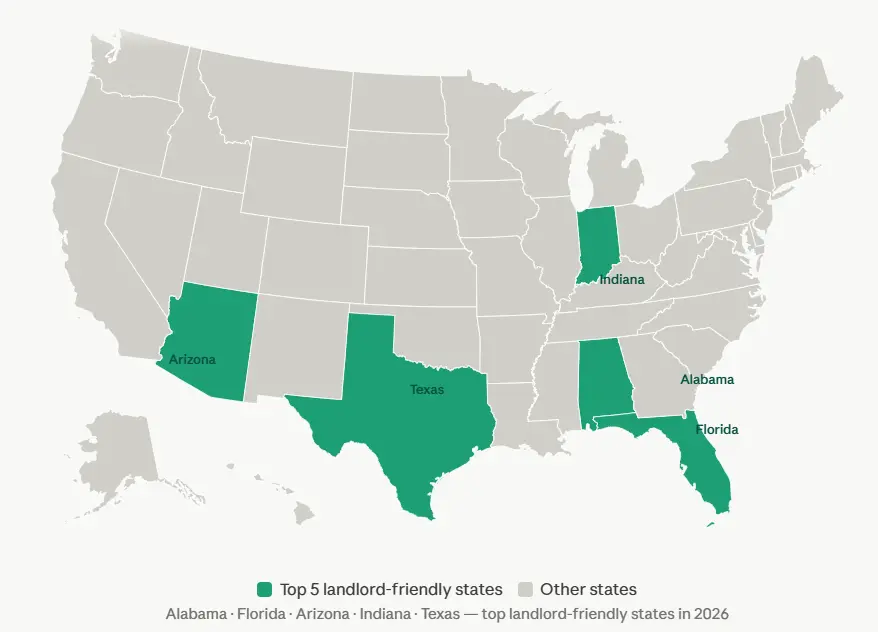
The Top 5 Most Landlord-Friendly States in 2026
Based on the confluence of these favorable attributes, several states consistently emerge as leading destinations for real estate investors prioritizing a landlord-centric environment. While the specific ranking can fluctuate based on evolving legislation and market dynamics, the following states frequently appear at the top of such analyses for 2026:
Alabama
Alabama stands out as a state with remarkably few regulations specifically targeting individual landlords. This translates to a more permissive environment for property owners.
- Low Property Taxes: Alabama generally boasts low property tax rates, contributing positively to investor cash flow.
- No Rent Control: The state does not have statewide rent control measures, allowing landlords to adjust rents based on market conditions.
- Limited Licensing Requirements: The process for obtaining necessary permits and licenses is typically straightforward.
- Flexible Security Deposit Rules: While landlords must act reasonably, there are generally no strict statutory caps on security deposit amounts.
- Streamlined Eviction Process: Alabama’s legal framework facilitates a relatively quick and efficient eviction process for landlords.
- Tenant Rights Protections: Despite its landlord-friendly nature, Alabama does have established tenant rights regarding habitable living conditions and fair treatment.
Top Landlord-Friendly City with High Average Cap Rate: Birmingham, known for its growing economy and affordable housing market, often presents attractive cap rates for rental properties.
Florida
Florida’s robust tourism and growing population contribute to a strong rental market, and its legal framework generally favors property owners.
- No Rent Control: Florida is one of many states that prohibit rent control ordinances, offering landlords significant flexibility in rent adjustments.
- Low Property Taxes: While property taxes vary by county, Florida’s rates are often considered moderate compared to national averages, especially when considering the benefits of homestead exemptions for owner-occupied properties, which indirectly influence the broader market.
- Limited Landlord Licensing: Specific landlord licensing is not universally mandated, simplifying market entry.
- No Cap on Security Deposits: Landlords have considerable latitude in setting security deposit amounts to mitigate risks.
- Efficient Eviction Process: Florida’s legal system is designed to handle evictions relatively swiftly, typically within a few weeks to a couple of months.
- State Preemption: Florida has enacted laws that preempt local governments from enacting stricter rent control or landlord regulations, ensuring a consistent statewide policy.
Top Landlord-Friendly City with High Average Cap Rate: Jacksonville, with its diverse economy and substantial population, frequently offers competitive rental yields and investor opportunities.
Arizona
Arizona presents a compelling case for investors seeking a balanced regulatory environment that supports property ownership.
- No Rent Control: Similar to Florida and Alabama, Arizona has no statewide rent control laws.
- Moderate Property Taxes: Property taxes in Arizona are generally within a reasonable range, though they can vary by county and municipality.
- Straightforward Licensing: The requirements for becoming a landlord are typically manageable.
- No Security Deposit Cap: Landlords can set security deposits without strict statutory limitations, allowing for adequate financial protection.
- Expedited Eviction Procedures: Arizona law provides landlords with a clear and relatively swift process for evicting non-compliant tenants.
- Tenant Protections: Arizona law does outline specific tenant rights, including the right to a habitable dwelling and protection against discrimination.
Top Landlord-Friendly City with High Average Cap Rate: Phoenix, a rapidly expanding metropolitan area, consistently attracts investors due to its strong rental demand and potential for capital appreciation.
Indiana
Indiana offers a stable real estate market with a legal framework that tends to be favorable to landlords.
- No Rent Control: Indiana does not have rent control laws, providing landlords with the freedom to set and adjust rents according to market dynamics.
- Low Property Taxes: The state is known for its relatively low property tax rates, which significantly benefits investor cash flow.
- Minimal Licensing Hurdles: The process for obtaining necessary permits and licenses is generally uncomplicated.
- No Cap on Security Deposits: Landlords in Indiana are not subject to strict limits on security deposit amounts.
- Efficient Eviction Process: Indiana law supports a streamlined eviction process, enabling landlords to resolve tenant issues more quickly.
- Landlord Rights: The state provides landlords with specific rights, including the ability to charge late fees and handle abandoned property.
Top Landlord-Friendly City with High Average Cap Rate: Indianapolis, as the state capital and largest city, offers a diverse rental market and consistent demand, often yielding favorable cap rates.
Texas
Texas has long been a popular destination for real estate investors, and its regulatory environment contributes significantly to its appeal.
- No Rent Control: Texas law explicitly prohibits local governments from enacting rent control, ensuring consistent landlord flexibility across the state.
- No Cap on Security Deposits: Landlords are permitted to set security deposit amounts without statutory limits.
- Relatively Straightforward Eviction Process: Texas offers a relatively efficient legal framework for evictions.
- Landlord Rights: Texas law provides landlords with additional rights, such as the ability to charge late fees and dispose of abandoned property.
- State Preemption: The state’s preemptive laws prevent local municipalities from imposing more restrictive landlord regulations.
- Consideration for Property Taxes: While other aspects are landlord-friendly, Texas does have higher property taxes compared to some other states on this list. Investors must weigh this against the other benefits.
Top Landlord-Friendly City with High Average Cap Rate: Houston, a major economic hub with a large population and diverse housing market, frequently presents opportunities for strong rental yields and attractive cap rates.
The Nuance: Why Investors Might Consider Tenant-Friendly Markets
While the advantages of landlord-friendly states are clear, it is crucial to acknowledge that real estate investors also find compelling reasons to invest in markets with stronger tenant protections. The decision is not always straightforward, and market fundamentals often outweigh regulatory labels.
A notable trend observed in Q4 2025, for instance, indicated a 24% increase in investor purchases in the Milwaukee housing market. Despite Milwaukee’s location within a generally landlord-friendly state (Wisconsin), the city itself has recently enacted renter-centric regulations. These include measures that extend the eviction process through multiple hearings and impose stricter requirements for security deposits and inspections.
Daryl Fairweather, Chief Economist at Redfin, provides critical insight into this phenomenon: "Landlord-friendly and tenant-friendly labels can be helpful, but they can be too broad to guide an investment decision on their own. What matters more is the underlying economics (fundamentals) of a market, like home prices, rent levels, job growth, and long-term demand. A landlord-friendly market with weak fundamentals can underperform a tenant-friendly market with strong population growth and tight supply, for example. I would suggest that investors should treat the regulatory environment as just one of many factors."
This perspective highlights that a landlord-friendly market with deteriorating economic conditions or low appreciation rates might ultimately yield poorer returns than a tenant-friendly market experiencing robust population growth and high rental demand. Fairweather further cautions that "Landlord-friendly doesn’t always mean low risk. Typically in some of these markets, rapid investor activity has already driven up prices, which can compress yields. There’s also the risk of overbuilding or economic volatility. Just because regulations are favorable doesn’t mean the investment will perform well. Always start by paying close attention to fundamentals like affordability, migration trends, and local employment."
Expert Strategies for Navigating Tenant-Friendly Markets
For investors who identify promising opportunities in tenant-friendly markets, strategic approaches can mitigate potential challenges:
Optimizing Cash Flow in Rent-Controlled Markets: Fairweather advises that in markets with rent control, cash flow begins with the acquisition price. "You need to buy at a basis that makes sense given future rent constraints. After that, focus on minimizing turnover and vacancy, since you might not be able to raise rents between tenants. Keeping units well-maintained and building good tenant relationships can reduce churn. I’ve seen some investors also look for properties where allowable increases like inflation-based adjustments or capital improvement passthroughs can help offset costs over time."
Underwriting and Operational Professionalism: In tenant-friendly states, a conservative underwriting approach and highly professional operations are paramount. This includes:
- Rigorous Tenant Screening: Implementing thorough background and credit checks to select reliable tenants.
- Appropriate Rent Setting: Establishing rents at a competitive yet sustainable level from the outset.
- Budgeting for Timelines: Factoring in potentially longer timelines for resolving issues.
- Detailed Regulatory Understanding: Thoroughly familiarizing oneself with local laws concerning notice periods, eviction timelines, and rent increase rules to avoid unexpected complications.
- Professional Guidance: Engaging with local property managers or legal experts, particularly for first-time investors in such markets.
Conclusion: Beyond the Label
In today’s dynamic real estate environment, the simplistic labels of "landlord-friendly" or "tenant-friendly" should not be the sole determinants of investment decisions. As Redfin’s Chief Economist Daryl Fairweather reiterates, "That’s increasingly true. What we’re seeing now is that investors are prioritizing fundamentals over labels. A market like Milwaukee, for example, may be considered tenant-friendly, but if it offers relatively affordable entry points and stable rental demand, it can still be attractive. Meanwhile, some traditionally landlord-friendly markets—like parts of Florida—have cooled due to rising prices and insurance costs. So today, the more important question is: ‘Does the deal make sense given the local market conditions?’ Regulation matters, but it’s not the whole story."
Ultimately, successful real estate investment hinges on a data-driven approach. A comprehensive analysis of deal economics, market fundamentals such as affordability, migration trends, local employment, and rental demand, coupled with a nuanced understanding of the regulatory environment, is the cornerstone of profitability in any market. By leveraging robust data and analytical tools, investors can identify lucrative opportunities and navigate the complexities of diverse housing markets to achieve their financial goals.

