
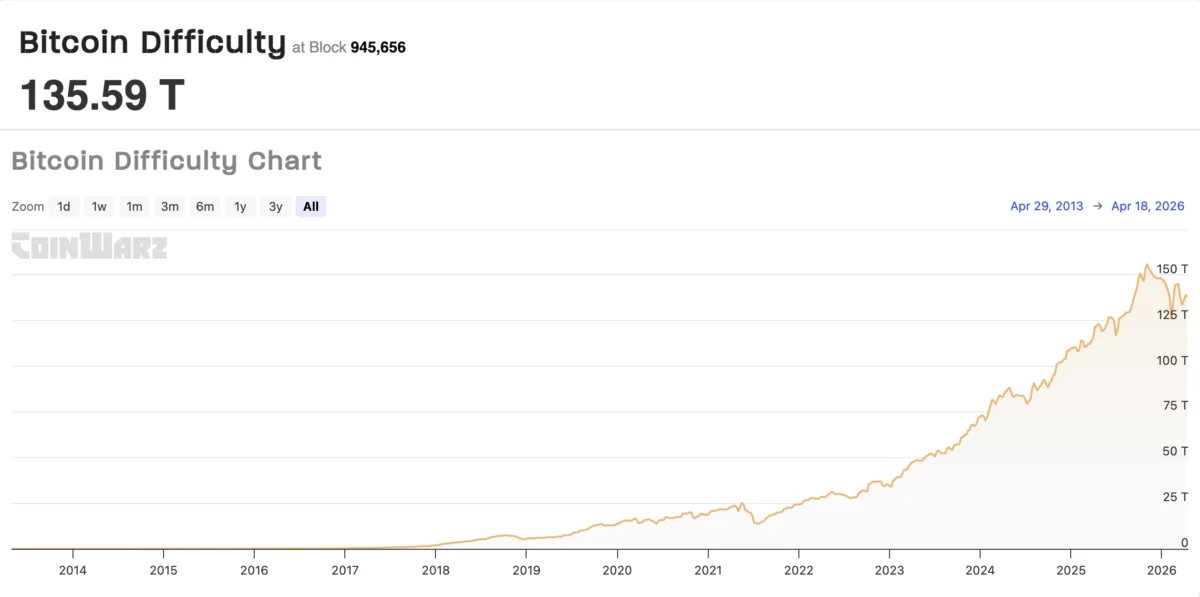
The intricate mechanism governing the creation of new Bitcoin (BTC) has seen a subtle adjustment, with the network’s mining difficulty experiencing a slight decrease on Saturday. This recalibration occurs against a backdrop of unprecedented selling pressure from publicly traded Bitcoin mining companies, which have offloaded record volumes of their mined BTC to shore up finances amidst mounting operational costs and market volatility.
According to data compiled by CoinWarz, a prominent cryptocurrency analytics platform, the Bitcoin mining difficulty has settled at approximately 135.5 T. This represents a modest reduction of about 1.1% over the preceding 24-hour period. Mining difficulty is a crucial metric that reflects the computational effort required to successfully mine a new block on the Bitcoin blockchain. It automatically adjusts roughly every two weeks (or 2,016 blocks) to ensure that blocks are mined at a consistent rate, approximately every ten minutes, regardless of the total hashing power dedicated to the network.
While the current adjustment has brought a marginal reprieve, projections indicate a reversal of this trend in the upcoming difficulty adjustment period. CoinWarz forecasts that the next recalibration, anticipated around May 1, 2026, at 01:24:54 PM UTC, will witness an increase in Bitcoin mining difficulty. The estimated new difficulty level is projected to rise from the current 135.59 T to 137.43 T, an adjustment that will take effect after approximately 1,865 blocks have been processed, a timeframe estimated to be about 12 days, 18 hours, and 41 minutes from the current projection.
A Challenging Environment for Bitcoin Miners
The recent dip in mining difficulty, though slight, underscores the persistent pressures confronting the Bitcoin mining industry over the past year. A confluence of factors has created a challenging economic landscape for miners. These include the halving of block rewards, which reduced the number of new BTC awarded to miners for each block successfully mined; escalating energy prices, a critical component of mining operations; the lingering effects of a broader cryptocurrency bear market; and the overarching impact of geopolitical uncertainties on global markets and supply chains.
The halving events, which occur approximately every four years, are designed to control Bitcoin’s supply and reduce inflation. However, they directly impact miners’ revenue streams by cutting their primary source of income in half. The most recent halving, which occurred in April 2024, reduced the block reward from 6.25 BTC to 3.125 BTC. This reduction, coupled with the increasing computational power and efficiency required to mine Bitcoin, intensifies the financial strain on mining operations, particularly for those with less efficient hardware or higher energy costs.

Public Mining Companies Liquidating Assets at Unprecedented Rates
The financial strain on mining operations is starkly illustrated by the record-breaking sell-offs of Bitcoin by publicly traded mining companies. Data compiled by TheEnergyMag reveals that in the first quarter of 2026, these companies collectively sold more Bitcoin than they did throughout the entirety of 2025. This aggressive liquidation strategy points to a pressing need for capital to cover operational expenditures, which are predominantly denominated in fiat currencies like the U.S. dollar.
Specific mining firms, including Marathon Digital Holdings (MARA), CleanSpark, Riot Platforms, Cango, Core Scientific, and Bitdeer, were identified as major sellers. Cumulatively, these companies divested over 32,000 BTC during Q1 2026. This figure significantly surpasses the approximately 20,000 BTC sold in the second quarter of 2022, a period notably marked by the dramatic collapse of the Terra-Luna ecosystem, an event that plunged the broader cryptocurrency market into a prolonged downturn.
Historically, miners have periodically sold portions of their Bitcoin holdings to manage operational costs, such as electricity, hardware upgrades, and salaries. However, the current market conditions have exacerbated this practice to an extreme degree. As the cost of mining a single Bitcoin has begun to approach or even exceed the prevailing market price, many mining companies are finding themselves in a precarious "treading water" situation, where revenues are barely covering expenses, and they are forced to liquidate assets to remain solvent.
The Squeeze on Profitability
The financial pressure on Bitcoin miners is further corroborated by a recent report from CoinShares, a digital asset investment firm. Their Q1 2026 mining report indicates that as many as 20% of Bitcoin miners are currently operating at a loss under prevailing economic conditions. This statistic highlights a significant segment of the industry struggling with profitability.
The CoinShares report specifically points to the fourth quarter of 2025 as the most arduous period for Bitcoin miners since the April 2024 halving event. The authors attribute this difficulty to a sharp correction in Bitcoin’s price during October 2025, which saw the digital asset plummet from a peak of approximately $125,000 to around $86,000 by December of the same year. This price decline, combined with the persistent increase in the computational difficulty of mining new blocks, created a dual challenge that squeezed profit margins for miners.

The increasing computational difficulty is a direct consequence of the network’s security model. As more hashing power joins the network, the difficulty adjusts upwards to maintain the average block time. This means miners need increasingly powerful and energy-efficient hardware to remain competitive. When coupled with a falling Bitcoin price, this creates a scenario where miners’ revenue decreases while their operational costs, especially for electricity and hardware, remain high or even increase.
Analysis of Implications and Future Outlook
The current trend of increased asset sales by public miners and the subsequent slight decrease in mining difficulty suggests a potential consolidation within the Bitcoin mining industry. Companies that are unable to adapt to the rising costs and reduced revenues may be forced to cease operations or be acquired by more financially robust entities. This could lead to a more concentrated mining landscape, potentially raising concerns about decentralization, although the distributed nature of Bitcoin’s network globally mitigates many such risks.
The decrease in difficulty, while temporary, indicates that some less efficient miners may have indeed powered down their operations, reducing the overall network hash rate and thus lowering the competition for block rewards. This reduction in difficulty can provide a temporary respite for the remaining miners, making it slightly easier to mine blocks.
However, the projected increase in difficulty in the coming weeks signals that the underlying pressures are likely to persist. Miners will need to continue optimizing their operations, securing cheaper energy sources, and potentially upgrading their hardware to remain profitable. The effectiveness of these strategies will be heavily influenced by the future price performance of Bitcoin and the broader macroeconomic environment.
The robust sales figures from public mining companies underscore the critical importance of capital management and operational efficiency in this sector. Their ability to weather the current storm will depend on their strategic decisions regarding asset sales, debt management, and investment in next-generation mining technology. The industry is at a critical juncture, where innovation and adaptability are paramount for survival and future growth.
The narrative of Bitcoin mining is one of constant technological evolution and economic adaptation. The recent difficulty adjustment and the unprecedented sales by public mining firms are not isolated events but rather symptoms of a dynamic industry navigating the inherent cycles of cryptocurrency markets and the unique economic incentives of blockchain technology. As the network continues to mature, the resilience and strategic foresight of its miners will be crucial in maintaining its security and decentralization. The coming months will likely reveal which mining operations are best positioned to thrive in this increasingly competitive and challenging environment.

