
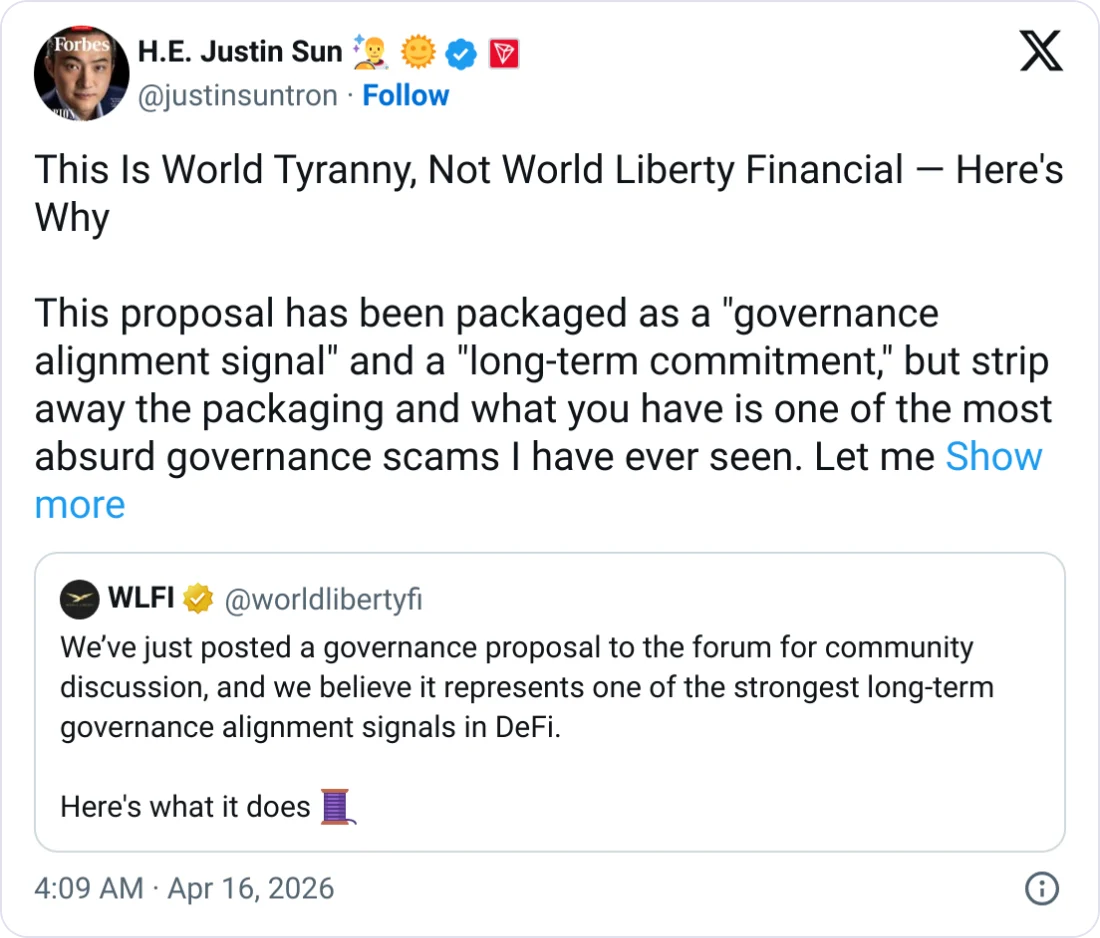
The cryptocurrency platform World Liberty Financial (WLF), associated with the Trump family, is currently embroiled in a significant controversy following the unveiling of a new proposal that seeks to extend the lock-up period for tokens held by early investors. The proposed changes, submitted to the platform’s governance forum on Wednesday, could see these tokens locked for up to an additional four years, and in some extreme cases, indefinitely. This move has triggered a strong negative reaction from prominent figures within the crypto community, including one of the platform’s most significant investors and advisors.
The Core of the Controversy: Extended Token Lock-Up
At the heart of the dispute is a proposal that fundamentally alters the terms for early investors in World Liberty Financial. According to the details published on the platform’s governance forum, the proposal mandates that early investors would face an additional two-year lock-up period on their World Liberty Financial (WLFI) tokens. Following this extended lock-up, the tokens would then be released in phased installments over the subsequent two years. This effectively extends the total vesting period for many early investors beyond their initial expectations.
However, the proposal introduces a particularly contentious clause: token holders who do not consent to this new unlock schedule will "continue to have their tokens locked indefinitely." This provision has been widely interpreted as a coercive measure, designed to pressure investors into accepting the extended vesting terms. The specter of perpetual lock-up for dissenters has ignited widespread criticism, with many viewing it as a significant departure from established practices in the decentralized finance (DeFi) space, where transparency and investor rights are typically paramount.
Key Figures Speak Out: Accusations of "Governance Scams" and "Rug Pulls"
The backlash against World Liberty Financial’s proposal has been swift and severe, with several influential figures in the cryptocurrency world publicly denouncing the plan. Perhaps the most vocal critic is Justin Sun, the founder of Tron and a prominent figure in the crypto industry. Sun is not only an advisor to World Liberty Financial but also its largest investor, reportedly holding a substantial stake that is currently frozen due to the ongoing disputes.
Sun took to the social media platform X (formerly Twitter) on Wednesday to express his outrage, labeling the proposal as "one of the most absurd governance scams I have ever seen." He further elaborated on his concerns, highlighting the indefinite lock-up clause as a form of "coercion." Sun also revealed that he is being "forced out of this voting process" due to World Liberty Financial’s freezing of his tokens, a situation he claims is shared by "a large number of holders with significant voting rights." This alleged disenfranchisement of major stakeholders raises serious questions about the legitimacy and fairness of the governance process itself.
Adding to the chorus of disapproval is Simon Dedic, the founder of the venture capital firm Moonrock Capital. Dedic also used X to voice his criticism, stating that early WLFI investors "who thought they were sitting on solid profits just got rugged." He drew a stark parallel between the current situation and past instances of project exploitation, suggesting that the platform is attempting to "squeeze the same lemon they’ve been inflating with hot air for the past two years." Dedic’s pointed remark about the timing aligning "perfectly with the remainder of [Donald Trump’s] term" suggests a perception of political motivation or timing influencing the financial strategy.
Background Context: A Troubled History and Previous Criticisms
This latest controversy is not an isolated incident for World Liberty Financial. The platform has faced scrutiny and criticism in the past, particularly regarding its operational transparency and tokenomics. Justin Sun himself has been a vocal critic of the platform on multiple occasions, raising concerns about separate proposals and accusing World Liberty Financial of possessing the ability to "blacklist wallets." The platform, however, has consistently denied these accusations.
The WLFI token itself has experienced a significant downturn in value. Having launched with considerable fanfare, its price has plummeted by over 40% year-to-date. This decline is mirrored by a broader contraction in the cryptocurrency and equity markets, but the specific performance of WLFI suggests underlying issues within the project itself. The token is down more than 75% from its all-time high of 33 cents, recorded on September 1st, which was notably its first day of public trading after a shareholder vote authorized its tradability. This early price surge followed by a dramatic decline has fueled skepticism among investors.
World Liberty Financial’s Response: Alignment for the "Long Run"
In response to the mounting backlash, World Liberty Financial has offered a limited statement. A spokesperson for the platform, David Wachsman, told Cointelegraph that the proposal "was designed to further align all the participants in the WLFI ecosystem for the long run." This statement, provided in an emailed response, offers a rationale for the extended lock-up but does little to assuage the concerns of critics who view the proposal as detrimental to investor interests.

Wachsman also confirmed that the voting process for the proposal is scheduled to commence soon and will span a period of one week. This timeline suggests that the decision on the fate of early investors’ tokens is imminent, intensifying the pressure on token holders to make a choice.
Implications and Broader Market Concerns
The implications of this controversy extend beyond World Liberty Financial and its token holders. Such proposals, especially those involving indefinite lock-ups or what are perceived as coercive tactics, can significantly damage investor confidence in the broader cryptocurrency market. When established investors and advisors like Justin Sun publicly denounce a project, it sends a strong signal to the wider community about potential risks and questionable governance practices.
The accusation of a "governance scam" is particularly damaging, as it strikes at the core principles of decentralization and community-driven decision-making that are central to the blockchain ethos. If token holders feel that their rights are being undermined or that their investments are being held hostage, it can lead to a ripple effect, discouraging new investment and potentially leading to a sell-off of assets associated with projects perceived as less trustworthy.
Furthermore, the reference to "LUNA 2.0" allegations, as mentioned in a related Cointelegraph article, evokes memories of catastrophic market collapses, such as the Terra/Luna ecosystem’s dramatic implosion. While the specifics of the WLFI situation may differ, the association with such events amplifies concerns about the stability and integrity of the platform.
Analysis of the Proposal’s Mechanics
The proposal’s structure, particularly the indefinite lock-up for non-compliant token holders, appears designed to create a strong incentive for acceptance. By presenting a stark choice between a structured, albeit extended, release schedule and perpetual inaccessibility, World Liberty Financial aims to consolidate support for its revised tokenomics.
The rationale of "aligning participants for the long run" could be interpreted in several ways. From the platform’s perspective, it might aim to reduce immediate selling pressure on the WLFI token, thereby stabilizing its price and allowing for controlled development and growth. Extended vesting periods are a common tool in traditional finance to ensure that early investors remain committed to a project’s long-term success. However, the method of implementation, particularly the indefinite lock-up for dissenters, deviates significantly from best practices and opens the door to accusations of manipulation.
The freezing of Justin Sun’s tokens and the alleged disenfranchisement of other significant holders raises critical questions about the fairness and transparency of the voting process. If a substantial portion of the voting power is effectively neutralized, the legitimacy of any outcome is called into question. This tactic, if true, could be seen as a way to ensure the proposal passes, even if it lacks broad organic support.
The Financial Landscape for WLFI
The current financial performance of the WLFI token paints a concerning picture. Trading flat at $0.08 over the past 24 hours, it has seen a significant decline of over 40% year-to-date. This performance occurs against a backdrop of broader market downturns in both crypto and traditional markets, but the specific struggles of WLFI suggest project-specific challenges. The token has lost over 75% of its value since its peak of $0.33 on September 1st, the day it became publicly tradable. This sharp decline from its all-time high, coupled with the current governance dispute, creates a challenging environment for the platform and its investors.
Looking Ahead: A Crucial Vote
The upcoming vote on the World Liberty Financial governance forum will be a pivotal moment for the platform and its community. The outcome will not only determine the fate of early investors’ tokens but also significantly impact the platform’s reputation and its ability to attract future investment and participation. The strong opposition from influential figures like Justin Sun and Simon Dedic suggests that the proposal faces an uphill battle, and the platform’s response to these criticisms will be closely watched. The crypto community will be observing whether World Liberty Financial can navigate this crisis transparently and fairly, or if it will be seen as another cautionary tale of questionable governance in the burgeoning world of digital assets. The controversy highlights the ongoing need for robust regulatory frameworks and transparent operational practices within the decentralized finance space to protect investors and foster sustainable growth.

