
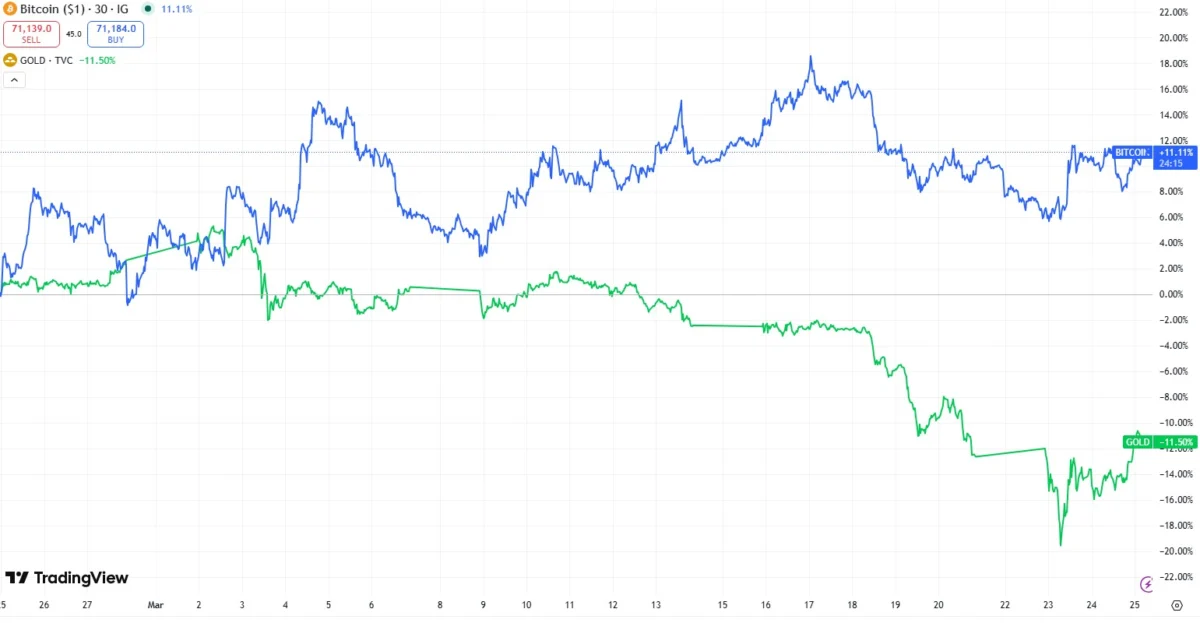
The escalating geopolitical tensions surrounding the conflict with Iran have ignited a vigorous debate about Bitcoin’s role as a digital safe haven, a narrative that has been significantly challenged in recent months. While traditionally gold has been the undisputed sanctuary for investors during times of uncertainty, Bitcoin’s performance in the wake of the conflict has presented a more complex picture, highlighting its intricate relationship with global liquidity and macroeconomic factors rather than a direct correlation with geopolitical shockwaves.
Before the recent escalation in the Middle East, Bitcoin languished in a period of sideways trading for months. This prolonged consolidation occurred even as gold prices soared to record highs, bolstered by persistent inflation concerns and a palpable build-up of geopolitical anxieties. During this phase, Bitcoin conspicuously failed to live up to its proclaimed status as a digital alternative to traditional safe havens like gold. However, the landscape began to shift following the initial strikes by the United States and Israel on Iran on February 28th. In the immediate aftermath of these actions, Bitcoin experienced a sharp decline, dipping to $63,176. Yet, in a notable turn of events, the cryptocurrency has since staged a recovery, appreciating by approximately 12% to reach $71,012 as of Wednesday. This rebound stands in stark contrast to gold’s recent performance.
Simultaneously, the conflict has triggered a surge in oil prices and reignited inflation fears, exerting downward pressure on gold. In the past week alone, gold has seen a significant decline of 11%, marking its largest weekly loss since 1983. This dramatic reversal in fortune for gold, coupled with Bitcoin’s resilience, has led some to re-evaluate the established safe-haven paradigm.
Bitcoin’s Volatility Amidst Geopolitical Shocks
Despite Bitcoin’s recent upward movement, seasoned market analysts caution against prematurely labeling it a safe haven. Jonatan Randin, a senior market analyst at PrimeXBT, posits that Bitcoin continues to exhibit characteristics of a risk asset, often selling off in tandem with traditional equity markets during periods of geopolitical upheaval. "It’s range-bound and showing weakness within a broader downtrend. That’s not safe haven behavior," Randin stated, underscoring the digital asset’s tendency to mirror the volatility of riskier investments rather than providing a stable refuge.
The historical behavior of Bitcoin reveals a pattern of reacting to global news events, including geopolitical shocks and even influential social media pronouncements, such as those from former US President Donald Trump. However, these reactions have typically been short-lived, failing to establish a consistent safe-haven trajectory.
Liquidity: The Dominant Driver of Bitcoin’s Price
The prevailing view among market participants is that global liquidity remains the primary determinant of Bitcoin’s price, with macroeconomic conditions ultimately outweighing the immediate impact of headline-driven volatility. Matthew Pinnock, co-founder of the decentralized finance project Altura, explained that Bitcoin functions as a "high-beta liquidity asset." This means that tighter financial conditions, characterized by higher real yields, a strong U.S. dollar, and reduced inflows into exchange-traded funds (ETFs), tend to diminish marginal capital and exert downward pressure on Bitcoin’s price.
A comprehensive analysis conducted in September 2024 by Sam Callahan of the treasury company OranjeBTC further buttressed this assertion. Callahan’s research revealed a remarkable 0.94 correlation between Bitcoin’s price and global liquidity between May 2013 and July 2024. This strong correlation suggests that Bitcoin’s price movements are deeply intertwined with the ebb and flow of global financial conditions.
Furthermore, Callahan’s study indicated that Bitcoin moved in the same direction as global M2 money supply in 83% of 12-month periods. This directional alignment surpassed that of gold, which registered 68.1%. The S&P 500 index, a benchmark for U.S. large-cap equities and a widely recognized indicator of risk assets, showed the next closest directional alignment after Bitcoin.
This correlation with risk assets and global liquidity is not a new phenomenon. Randin pointed to more recent data reflecting a similar pattern, noting that global liquidity experienced an upswing in the third quarter of 2025, coinciding with a period when Bitcoin reached a new all-time high. This observation reinforces the argument that Bitcoin’s price surges are often fueled by abundant liquidity rather than inherent safe-haven demand.
The divergence between Bitcoin’s performance during geopolitical events and its sensitivity to liquidity conditions complicates the "digital gold" narrative. In an environment where inflation and interest rates move in tandem, Bitcoin’s reaction to monetary policy tightening, rather than to geopolitical stress itself, makes its role as a stable store of value less predictable.
The Oil Shock’s Complication of Bitcoin’s Inflation Narrative
The immediate aftermath of the conflict has been marked by rising oil prices and supply chain disruptions, particularly following the closure of the Strait of Hormuz, a critical global shipping artery. These factors have intensified near-term inflation concerns, shaping market expectations and influencing central bank policies.

Randin elaborated on how rising inflation, exacerbated by geopolitical shocks, can negatively impact Bitcoin in the short term. Elevated oil prices contribute to inflation expectations, which in turn reduce the likelihood of interest rate cuts and sustain high real yields. This cycle leads to tighter financial conditions and dampens risk appetite, thereby limiting demand for assets like Bitcoin. In essence, Bitcoin is not reacting directly to inflation but to the subsequent policy responses.
The Iran conflict propelled oil prices above the $110 mark, prompting the Federal Reserve to revise its 2026 personal consumption expenditures inflation forecast upwards to 2.7%. The central bank also signaled a more cautious approach to monetary easing. This hawkish stance by the Fed, driven by inflationary pressures, further tightens liquidity and reinforces Bitcoin’s behavior as a risk asset.
Randin offered a crucial distinction: "Bitcoin could be better understood as a long-term monetary debasement hedge rather than a short-term inflation hedge, and that’s a critical distinction." He explained that Bitcoin responds to the expansion of money supply over multi-year cycles, not to immediate Consumer Price Index (CPI) prints. Therefore, within the timeframe of a war-driven oil shock, Bitcoin continues to behave as the risk asset it is.
Bitcoin’s Rebound Amidst Conflict, But Risk Profile Persists
The behavior of Bitcoin during the Iran conflict, despite its recent price appreciation, aligns with its established risk asset profile. Each escalation in tensions has historically triggered selloffs and liquidation cascades, reinforcing its correlation with equities. While Bitcoin has shown greater resilience than some traditional assets over certain periods, its fundamental risk-on nature remains evident.
Randin provided context to Bitcoin’s recent performance: "Bitcoin entered this conflict already in a technical bear market, down over 40% from its October highs and well ahead of equities in pricing in deteriorating conditions." He added, "So while it has held up relatively well since the strikes began, outperforming the S&P 500, gold and silver over certain windows, it hasn’t given us any meaningful directional move." This suggests that the current price action, while positive, might be a technical rebound rather than a fundamental shift towards safe-haven status.
A true structural shift would necessitate a clear break from this pattern of reacting to macroeconomic tightening and geopolitical shocks as a risk asset. Such signals have yet to materialize.

On-Chain Data and Macroeconomic Constraints
Despite the price action, on-chain data offers a different perspective. Persistent accumulation, declining exchange reserves, and growing holdings among large wallet investors ("whales") suggest that underlying positioning in Bitcoin is building. This accumulation indicates a long-term conviction among some investors, even if the immediate price action hasn’t fully reflected it.
However, this positioning remains significantly constrained by prevailing macroeconomic conditions. Pinnock highlighted this interplay: "Right now, inflation driven by a hike in oil prices due to geopolitical factors is pushing yields higher and keeping central banks hawkish, which tightens liquidity. That creates a ‘bad inflation’ regime where BTC falls alongside other risk assets."
He further elaborated on the breakdown of the inflation hedge thesis: "The inflation hedge thesis breaks because Bitcoin responds more to monetary expansion than to inflation itself, and currently, conditions are restrictive, not stimulative." This underscores the critical dependency of Bitcoin’s performance on accommodative monetary policies and ample liquidity.
Until liquidity conditions ease and Bitcoin demonstrates a consistent decoupling from equities during periods of market stress, its claim as a reliable safe haven will remain unproven. The current geopolitical climate, while presenting potential catalysts for safe-haven demand, has instead illuminated Bitcoin’s deeper entanglement with global financial liquidity and its inherent risk-asset characteristics. The digital asset’s ability to truly function as "digital gold" hinges on its capacity to provide stability and capital preservation not just during times of monetary expansion, but also amidst the complex interplay of geopolitical tensions and tightening financial conditions.

