

As the global financial services landscape faces an unprecedented convergence of regulatory pressure, heightened consumer expectations, and intensified competition from non-bank entities, the role of technological innovation has transitioned from a competitive advantage to an operational necessity. The upcoming FinovateSpring 2026 conference, scheduled to take place in San Diego from May 5 through May 7, serves as a critical forum for addressing these challenges. This year’s event highlights a specific cohort of five fintech organizations—Bloomfire, ContexQ, Finalytics.ai, Socratix.ai, and Whatfix—each offering specialized artificial intelligence (AI) and data-centric solutions designed to help banks, credit unions, and other financial institutions navigate an increasingly complex digital economy.
The central theme of the 2026 showcase revolves around the transformation of massive, often siloed, data volumes into actionable intelligence. Financial institutions currently process billions of data points daily, ranging from transactional records to customer behavioral patterns. However, the ability to synthesize this information to drive decision-making, identify operational inefficiencies, and deepen customer engagement remains a significant hurdle. The featured innovators at FinovateSpring 2026 propose that the integration of AI-native platforms is the primary solution to these systemic bottlenecks.

The Evolution of the Finovate Showcase and the 2026 Chronology
The Finovate conference series has long been recognized as a barometer for the health and direction of the fintech sector. Since its inception, the event has evolved from a platform for early-stage startups to a sophisticated marketplace where established financial giants seek partnerships with agile technology providers. The 2026 spring iteration arrives at a pivotal moment. Following several years of rapid AI experimentation, the industry is now moving toward a phase of "Applied Intelligence," where the focus shifts from general-purpose models to domain-specific applications that prioritize security, compliance, and measurable return on investment (ROI).
The timeline for the 2026 event began in late 2025 with a rigorous selection process, during which hundreds of applicants were vetted for technical viability and market relevance. The five companies selected for this preview represent the vanguard of this selection. The event in San Diego will feature live, seven-minute demonstrations—a hallmark of the Finovate format—where these companies must prove their value propositions without the aid of slides or promotional videos, focusing entirely on the functionality of their software.
Profiles in Innovation: Five Key Fintech Players
Each of the five companies identified for the 2026 showcase targets a specific pain point within the financial services ecosystem, ranging from internal knowledge management to external fraud prevention.

Bloomfire: Centralizing Institutional Intelligence
Founded in 2011 and headquartered in Austin, Texas, Bloomfire addresses the "knowledge silo" problem that plagues large-scale financial organizations. In an era where regulatory requirements change weekly and internal policies are updated across multiple departments, the ability for employees to access accurate, up-to-date information is paramount. Bloomfire’s platform uses AI to centralize disparate data sources, allowing for accelerated decision-making and reduced operational costs. By improving internal productivity, the company aims to help banks ensure that compliance standards are met consistently across all branches and digital channels.
ContexQ: Forensic Graph AI for Advanced Risk Management
Representing the newest wave of innovation, the Singapore-based ContexQ was founded in 2024 to tackle the sophisticated world of financial crime. Traditional fraud detection systems often fail because they analyze transactions in isolation. ContexQ utilizes "Graph AI" and "Graph Transformers" to map the relationships between more than one billion entities across 12 different languages. This approach allows the platform to detect hidden beneficial ownership and complex money laundering schemes that standard AI models might overlook. By unifying risk and revenue intelligence into a single graph, ContexQ provides a forensic level of oversight that is essential for institutions operating in high-risk or international markets.
Finalytics.ai: The "Segment-of-One" Customer Experience
Based in San Francisco and founded in 2021, Finalytics.ai focuses on the "experience gap" between traditional banks and modern fintech challengers. The company’s platform enables financial institutions to deliver hyper-personalized digital experiences. By analyzing behavioral, transactional, and third-party data in real-time, Finalytics.ai allows a bank’s website or mobile app to adapt instantly to an individual visitor’s needs. This "segment-of-one" strategy aims to replicate the intuitive nature of big-tech platforms like Netflix or Amazon, ensuring that banking customers receive relevant offers and support at the precise moment of need.

Socratix.ai: Scaling Operations Without Incremental Headcount
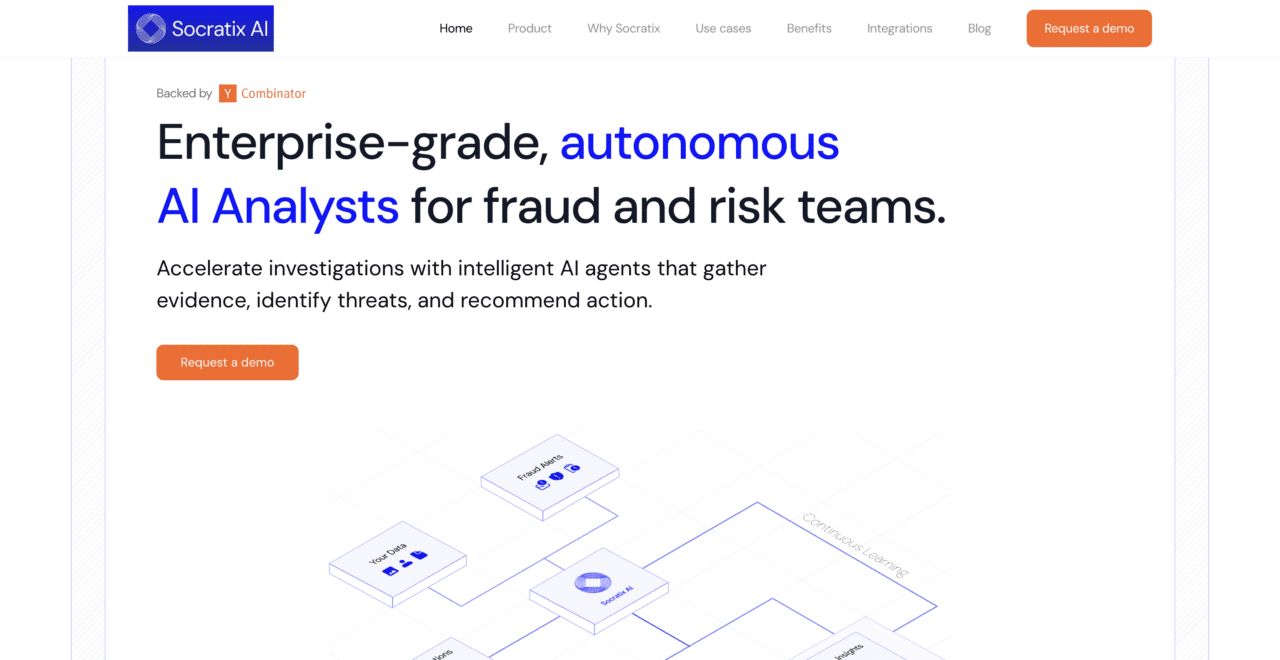
Also operating out of San Francisco, Socratix.ai was founded in 2025 with a mission to drive operational efficiency. One of the primary challenges for mid-tier banks and credit unions is the inability to scale operations without a linear increase in staff costs. Socratix.ai uses AI to automate complex workflows, specifically targeting the reduction of fraud losses and the minimization of false positives. By refining the accuracy of automated systems, the company allows institutions to handle higher transaction volumes and more complex customer queries without significantly expanding their workforce, thereby improving the institution’s efficiency ratio.
Whatfix: Accelerating Digital Adoption and Compliance
Founded in 2013 and headquartered in San Jose, Whatfix provides an AI-native digital adoption platform (DAP). The effectiveness of any financial software is limited by the proficiency of the people using it. Whatfix’s technology, featuring its proprietary ScreenSense AI, provides real-time, contextual guidance to employees and customers as they navigate complex banking systems. This is particularly vital for enforcing compliance during mission-critical workflows. Furthermore, the platform offers "mirror + AI roleplay," a risk-free simulation environment that allows bank staff to practice behavioral training and risk management scenarios before engaging in live environments.
Supporting Data: The Economic Imperative for AI Adoption
The drive toward the technologies showcased at FinovateSpring 2026 is supported by compelling industry data. According to recent market analysis, financial institutions that successfully implement AI-driven personalization see a 10% to 15% increase in revenue from new product sales. Conversely, the cost of financial crime remains a staggering burden; global money laundering is estimated to account for 2% to 5% of global GDP annually. Technologies like ContexQ’s Graph AI are positioned to reclaim a portion of these losses, which for a mid-sized bank can amount to tens of millions of dollars in avoided fines and lost capital.

Furthermore, internal efficiency remains a top priority for Chief Financial Officers (CFOs) in the banking sector. Research indicates that bank employees spend an average of 1.8 hours every day—nearly 9 hours per week—searching for and gathering information. Platforms like Bloomfire aim to reduce this time by up to 30%, representing a significant recovery of human capital. As the labor market for specialized financial roles remains tight, the ability for companies like Socratix.ai and Whatfix to optimize existing staff becomes a vital survival strategy.
Strategic Implications and Industry Reactions
Industry analysts suggest that the focus on AI at FinovateSpring 2026 reflects a broader shift in how banks perceive risk and opportunity. Analysts from major consulting firms have noted that the "wait and see" approach to AI has largely ended. The current consensus among C-suite executives is that the integration of AI is no longer about experimental "chatbots" but about core infrastructure.
"The 2026 cohort demonstrates a move toward deep-tech integration," notes one industry observer. "We are seeing a transition where AI is being baked into the forensic and structural layers of the bank. It is about seeing the invisible—whether that is an invisible fraud network or an invisible customer need."
Reactions from the banking community indicate a particular interest in the compliance and regulatory aspects of these new tools. With regulatory bodies worldwide increasing their scrutiny of AI algorithms, the emphasis placed by companies like Whatfix and Bloomfire on "enforceable compliance" and "knowledge centralization" is highly relevant. Financial institutions are seeking "explainable AI" that can provide an audit trail, ensuring that as they automate, they do not inadvertently create new regulatory vulnerabilities.
Broader Impact and Future Outlook
The innovations presented at FinovateSpring 2026 are likely to have a lasting impact on the competitive dynamics of the financial sector. For community banks and credit unions, these technologies represent a "great equalizer," providing them with the sophisticated tools necessary to compete with the massive R&D budgets of "Tier 1" global banks. By adopting third-party AI solutions that are ready for immediate deployment, smaller institutions can maintain their traditional advantage of local trust while offering modern, high-tech capabilities.
As the industry moves toward May 2026, the focus will remain on the execution of these digital strategies. The success of the demoing companies will be measured not just by the novelty of their code, but by their ability to integrate seamlessly into the legacy architectures that still define much of the global banking system. The San Diego event will ultimately serve as a testing ground for whether these five innovators can deliver on the promise of a more efficient, secure, and customer-centric financial future.

