
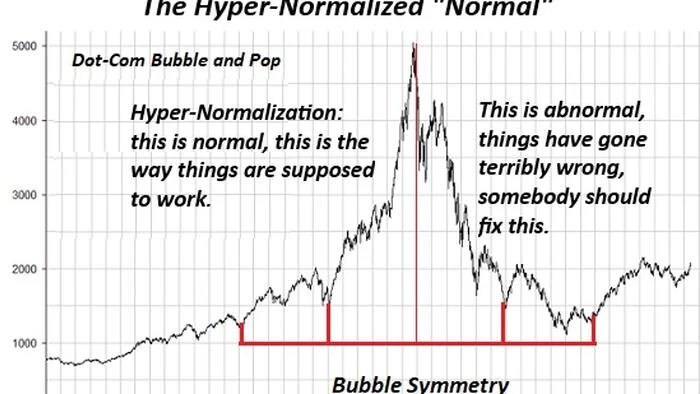
The global economy is grappling with a phenomenon described by financial commentators as the "Everything Bubble," a pervasive overvaluation across various asset classes from equities and real estate to commodities and bonds. This expansive bubble, as articulated by Charles Hugh Smith of the OfTwoMinds blog, is fundamentally unsustainable when viewed through the lens of historical economic waves and cycles. The prevailing challenge in forecasting future economic trajectories lies in the inherent subjectivity of historical analogies; interpretations often bend past and present crises to fit pre-conceived notions, potentially leading to flawed predictions.
The Peril of Selective Historical Analogies
A core argument posits that past eras rarely serve as perfect analogies due to the continuous evolution of societal and economic structures. This necessitates an open-minded approach, acknowledging the possibility that the current crisis may lack any direct historical counterpart capable of offering reliable predictive value. This perspective is critical, especially when considering the remarkable confluence of various long-term cycles and economic waves converging in the present historical moment.
Smith, in collaboration with Richard Bonugli, explored this confluence in their podcast, "Current Waves and Cycles: Energy, Commodities, Inflation." They highlight how such a convergence gives rise to a "polycrisis"—a complex web of overlapping, interconnected, and mutually reinforcing crises that defy simplistic, isolated solutions. Even for those skeptical of the rigid predictability of cycles, the sheer number of major cycles reaching critical junctures simultaneously warrants serious consideration.
Key Cycles Converging on a Critical Juncture
Several significant long-term cycles appear to be culminating in the early to mid-2020s, indicating a period of unavoidable and transformative crisis, resolution, or dissolution:
-
The Fourth Turning Cycle: This roughly 80-year, four-generational cycle, popularized by William Strauss and Neil Howe, describes a recurring generational dynamic in Anglo-American history. It posits that societies move through four distinct phases: High, Awakening, Unraveling, and Crisis. The current period, dating from approximately 2021 (following previous crises around 1781, 1861, and 1941), aligns with the "Crisis" phase. This phase is characterized by a breakdown of existing institutions, heightened social and political tension, and a fundamental restructuring of societal norms and power dynamics. Historical "Fourth Turnings" have typically involved major wars, economic depressions, or profound societal upheavals, suggesting the potential for significant, systemic change in the coming years.
-
The 18-Year Stock Market Cycle: This cycle, observed in historical market data, suggests periods of significant market peaks and troughs roughly every 18 years. Notable instances include market peaks or significant shifts around 1973, 1991, and the global financial crisis of 2008-09. If this pattern holds, the period of 2026-27 could mark another critical inflection point for global equity markets, potentially signaling a peak or the onset of a substantial correction following the extended bull run of the 2010s and early 2020s.
-
Peter Turchin’s 50-Year Cycle (and longer-wave cycles): Sociologist Peter Turchin’s cliodynamics research identifies long-term cycles, often around 50 years, characterized by phases of increasing social instability, elite overproduction, declining real wages, and rising state indebtedness. These factors contribute to a breakdown of social cohesion and political order, often culminating in periods of internal conflict or revolution. Turchin’s work suggests that when multiple such cycles align, the potential for systemic crisis is amplified. His analysis points to the early 21st century as a period ripe for such instability, driven by factors like stagnant or declining living standards for the general populace, increasing competition among elites for scarce positions, and the erosion of governmental legitimacy.
While other cycles, such as sunspot activity, might also play a role, these three represent a compelling, though not exhaustive, indication that the present moment is one of profound, systemic transformation. The confluence of these cycles strongly suggests that relying on simplistic historical parallels from less complex periods could be profoundly misleading.
Cycles vs. Waves: A Deeper Understanding of Economic Dynamics
To refine our understanding of these dynamics, it’s crucial to differentiate between "cycles" and "waves." Historian David Hackett Fischer, in his seminal work The Great Wave: Price Revolutions and the Rhythm of History, meticulously outlined this distinction. He described cyclical rhythms as "fixed and regular, with highly predictable periods." In contrast, great waves are "more variable and less predictable," differing significantly in duration, magnitude, velocity, and momentum. While one price wave might last less than ninety years, another could extend over 180 years. This irregularity makes individual price movements within a wave as unpredictable as individual ocean waves.
Despite their variability, Fischer noted that all great waves share common structural characteristics: a consistent sequence of development, similar patterns of price relatives, comparable movements in wages, rent, and interest rates, and a dangerous volatility that intensifies in their later stages. Crucially, all major price revolutions in modern history have begun in periods of prosperity, ultimately ending in shattering global crises, followed by periods of recovery and relative equilibrium.
Examples of such waves are evident in various economic phenomena. While the "business cycle" or "Kondratieff credit cycle" are often discussed, their durations vary too significantly to be strictly defined by a fixed calendar. Instead, they operate more like waves, driven by internal dynamics such as the build-up of credit and debt, speculative excess, and subsequent crashes. The long-term trend in bond yields and interest rates provides a compelling modern example. After a sustained decline for approximately 40 years, dating back to the early 1980s, these yields have recently shown a decisive upward turn, signaling a potential long-term shift in global financial conditions—a "wave" changing direction. This reversal carries significant implications for government borrowing costs, corporate profitability, and consumer debt.
Both cycles and waves often follow the dynamics of S-curves, which describe the typical life cycle of a trend or innovation. A trend begins with a slow "boost phase," then experiences rapid growth, matures into a "peak," and finally decays or reverses. This S-curve dynamic can be applied to technological adoption, market bubbles, and even societal trends, highlighting the inherent limits to growth and the inevitability of eventual decline or transformation for any given system.
The Shadow of the 1970s: A Partial Analogy
While cautioning against perfect historical analogies, many analysts draw comparisons between the current economic climate and the 1970s, often considered the closest analogous period. The 1970s were characterized by external energy shocks—primarily the OPEC oil embargoes of 1973 and the Iranian Revolution in 1979—which dramatically raised energy costs, triggering widespread inflationary pressures across economies globally. This was compounded by stagnant productivity growth, leading to the debilitating phenomenon of "stagflation" (high inflation coupled with high unemployment and low economic growth).
The institutional tendency at the time to "run the economy hot" through expansionary monetary and fiscal policies further embedded self-reinforcing inflationary expectations. This forced businesses and households into a defensive "risk-off" posture, emphasizing frugality or facing insolvency. The ultimate consequence was a massive erosion of the purchasing power of wages and currency.
Consider the performance of the Dow Jones Industrial Average (DJIA) during this era. From its initial break above 1,000 in 1966, it struggled to maintain this level for over a decade, finally surging decisively past it in 1982. While nominal values might have suggested a recovery, adjusting for inflation reveals a stark reality: an investor who held a stock portfolio from 1966 to 1982 would have seen their real wealth shrink by two-thirds. A dollar invested in 1966 was worth only about 34 cents in real terms by 1982. This protracted period of real wealth destruction served as a painful lesson in the dangers of entrenched inflation and economic stagnation.
However, the current situation presents unique complexities that differentiate it from the 1970s. Today’s global economy is far more interconnected, debt levels (both public and private) are significantly higher, and technological disruption is occurring at an unprecedented pace. Geopolitical tensions are multi-polar, and climate change introduces an entirely new layer of systemic risk. These factors suggest that while lessons from the the 70s are valuable, they might only illuminate a fraction of the challenges ahead.
The Current "Everything Bubble" and its Inevitable Climax
The current "Everything Bubble," encompassing overvalued assets across the board, is widely seen as unsustainable. Its eventual deflation or collapse is framed not merely as a possibility but as an inevitability, functioning as a gigantic wave that is cresting and poised to crash. The intricate interplay of energy markets, commodity prices, currency valuations, persistent inflation, escalating credit and debt levels, rising interest rates, heightened risk perceptions, and the diminishing returns of traditional "growth" models all contribute to a volatile and dynamic socio-economic system.
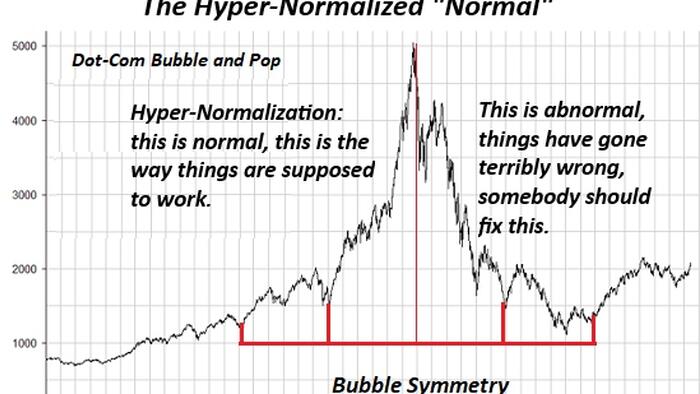
This "hyper-normalized" bubble—a term that suggests a collective acceptance of abnormal, unsustainable conditions as the new normal—represents a peak of speculative excess fueled by decades of loose monetary policy and suppressed interest rates. The long-term trend of declining bond yields, which facilitated cheap borrowing and asset inflation, appears to have definitively reversed, signaling a structural shift in global finance.
The implications of such a crash are profound and far-reaching:
- Financial Market Contagion: A significant downturn in one asset class could trigger cascading failures across others, leading to widespread asset depreciation, margin calls, and potential systemic instability.
- Economic Recession: The deleveraging process would likely lead to a sharp contraction in economic activity, job losses, and business failures, as companies struggle with higher borrowing costs and reduced demand.
- Wealth Redistribution and Inequality: While some "fortunate surfers" (those positioned to benefit from market downturns or possessing significant liquidity) might navigate the chaos, the vast majority of households and investors could experience significant wealth erosion, exacerbating existing inequalities.
- Policy Dilemmas: Central banks and governments would face immense pressure to stabilize markets and economies, but their traditional tools might be less effective or even counterproductive in a polycrisis environment. The risk of policy errors is high, given the unprecedented nature of the challenges.
- Geopolitical Instability: Economic turmoil often fuels social unrest and international tensions, potentially leading to increased protectionism, trade wars, or even regional conflicts as nations compete for diminishing resources or scapegoat external actors.
Preparing for Unpredictable Transformation
The confluence of these long-term cycles, economic waves, and prevailing conditions renders the current era potentially unique. While historical analogies from the decline of the Western Roman Empire, the 17th-century general crisis, the 1970s stagflation, or even the 2008-09 Global Financial Crisis can offer insights into human psychology and the mechanisms of crisis, their predictive value for the decade ahead may be limited.
As this unprecedented wave breaks, the primary focus shifts from prediction to preparation and response. The only element within an individual’s control is their reaction to events they cannot command. This emphasizes the need for resilience, adaptability, and a clear understanding of the systemic forces at play, rather than a reliance on outdated models or simplistic projections. The coming period is poised to be one of significant transformation, demanding new approaches to economic management, personal finance, and societal organization.

