
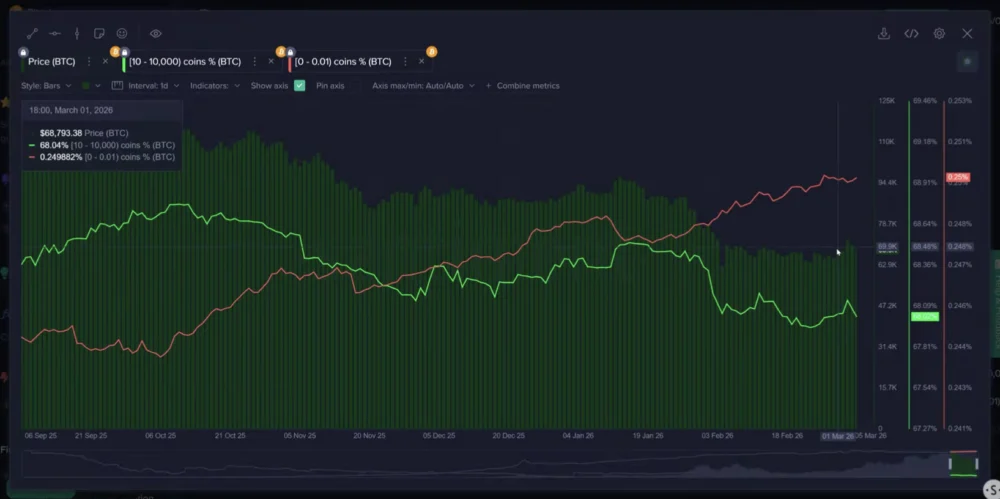
The cryptocurrency market is exhibiting a classic divergence in investor behavior, with seasoned "whales" offloading Bitcoin while retail investors continue to accumulate, a pattern that could signal further price depreciation, according to insights from crypto analytics firm Santiment. This dynamic, coupled with significant outflows from U.S. spot Bitcoin Exchange-Traded Funds (ETFs), paints a cautious picture for the digital asset, which has recently dipped below the psychologically important $70,000 mark.
Whale Distribution Shifts as Retail Investors Step In
Santiment’s analysis, published on Friday, highlights a notable shift in Bitcoin holdings among different investor classes. The report indicates that significant Bitcoin stakeholders, often referred to as "whales" – entities holding between 10 and 10,000 BTC – began to reduce their positions shortly after Bitcoin reached its recent peak of $74,000. This profit-taking activity by large holders contrasts sharply with the behavior of smaller retail investors, who hold less than 0.01 BTC, and who have been actively increasing their stakes.
The data suggests a strategic move by whales. Between February 23rd and March 3rd, a period when Bitcoin was trading within the range of $62,900 to $69,600, these large entities were observed to be accumulating significant amounts of the cryptocurrency. This accumulation phase preceded a price surge that saw Bitcoin breach the $70,000 threshold and briefly touch $74,000. However, since Wednesday, when Bitcoin experienced this upward momentum, the whale cohort has reportedly sold approximately 66% of the Bitcoin they acquired during the accumulation period.
"When retail buys while whales sell, it typically signals that the correction is not yet over," Santiment stated in its report, underscoring the historical significance of this inverse relationship in predicting market downturns. This observation aligns with established market principles where a divergence in sentiment between large, informed investors and smaller, less experienced ones can foreshadow future price action.
Market Sentiment Turns Cautious Amidst Price Decline
The current price of Bitcoin, trading at approximately $67,984 at the time of publication according to CoinMarketCap, reflects the bearish sentiment that has begun to permeate the market. This downward pressure has had a tangible impact on investor psychology, as evidenced by the Crypto Fear & Greed Index. The index, a widely watched barometer of market sentiment, has fallen six points, pushing it further into the "Extreme Fear" territory with a score of 12 on Saturday. Historically, periods of extreme fear have often preceded market bottoms, but they also reflect heightened investor anxiety and potential for further capitulation.
Further compounding the bearish outlook, Michael van de Poppe, founder of MN Trading Capital, echoed Santiment’s concerns. In a post on the social media platform X (formerly Twitter) on Friday, van de Poppe suggested that a continued price decline is a distinct possibility. He articulated a key support level, stating, "If Bitcoin doesn’t find support in this $67-68K region, then we’re likely going to retest the lows for liquidity before bouncing back upwards." This sentiment indicates that if the current price levels fail to hold, Bitcoin could see further downside to test previous lows, a common market mechanism to clear out weaker positions and establish a more robust foundation for a subsequent rally.
Spot Bitcoin ETFs Experience Significant Outflows

Adding another layer to the current market narrative, U.S.-based spot Bitcoin ETFs have recorded their largest daily outflow in three weeks. Data from Farside revealed that on a recent trading day, these eleven ETF products collectively experienced net outflows totaling $348.9 million. This substantial outflow suggests that institutional investors, who have been significant buyers through these ETFs since their approval in January, are now reducing their exposure.
The timing of these outflows, coinciding with the price pullback and whale distribution, is particularly noteworthy. It indicates a potential shift in institutional sentiment or a strategic rebalancing of portfolios in response to market conditions. The approval of spot Bitcoin ETFs marked a significant milestone for the cryptocurrency industry, opening the door for greater institutional participation. Therefore, substantial outflows from these products can exert considerable downward pressure on Bitcoin’s price, as ETF providers may need to sell underlying Bitcoin to meet redemption requests.
Historical Support Levels and Future Projections
While current indicators point towards potential further declines, some analysts are looking to historical data for potential support levels. Economist Timothy Peterson, referencing the Bitcoin Price to Metcalfe Value chart, expressed a strong conviction in a particular price floor. He stated on X that the $60,000 level has historically served as a bottom for Bitcoin and suggested a high probability that the price will remain above this threshold. "This valuation level has always marked a bottom for Bitcoin. About 99.5% chance it stays above $60k," Peterson remarked, implying that while current conditions are bearish, a more severe drop below $60,000 is unlikely based on historical patterns.
This perspective offers a counterpoint to the immediate bearish sentiment, suggesting that even with potential further declines, a significant recovery could be anticipated once Bitcoin tests these historical support zones. The reference to Metcalfe’s Law, which relates the value of a network to the number of its users squared, suggests that Bitcoin’s fundamental value, based on its network effect, might still be strong enough to prevent a catastrophic collapse.
Broader Market Context and Potential Implications
The current price action of Bitcoin is occurring within a broader context of evolving regulatory landscapes and technological advancements in the crypto space. Recent news regarding former President Donald Trump’s National Cyber Strategy, which pledges support for cryptocurrencies and blockchain technology, indicates a growing recognition of the digital asset sector by mainstream political entities. Such developments, while positive in the long term, can create short-term market volatility as investors digest new information and anticipate future policy implications.
Furthermore, ongoing debates about Bitcoin’s cyclical nature, as discussed by figures like Benjamin Cowen, continue to shape investor expectations. The concept of Bitcoin’s four-year cycle, historically tied to its halving events, is a subject of intense scrutiny. While some argue that past patterns may no longer hold true due to increased institutional adoption and market maturity, others maintain that these cycles still exert a significant influence on price movements.
The recent price action, characterized by a sharp decline from recent highs, underscores the inherent volatility of the cryptocurrency market. The interplay between whale distribution, retail accumulation, ETF flows, and broader market sentiment creates a complex environment for investors. The coming days and weeks will be crucial in determining whether Bitcoin can find a stable support level or if the current bearish trend will extend further. The performance of the $67,000-$68,000 region, as highlighted by van de Poppe, will be a key indicator of near-term price direction, while historical support at $60,000, as noted by Peterson, offers a longer-term perspective on potential price floors. Investors are closely monitoring these dynamics to navigate the evolving cryptocurrency landscape.

