
In a significant administrative shake-up marking the first personnel change of President Donald Trump’s second term, Department of Homeland Security (DHS) Secretary Kristi Noem was abruptly fired on Thursday. Senator Markwayne Mullin of Oklahoma has been tapped as her replacement, pending Senate confirmation. This high-profile dismissal comes amidst a deepening impasse over DHS funding, now stretching into its third week, with Democrats making it unequivocally clear that Noem’s ouster does nothing to alleviate their demands for fundamental policy changes regarding immigration enforcement. The ongoing partial shutdown, primarily affecting non-border security components of DHS, continues to exert pressure on critical federal agencies and casts a long shadow over legislative cooperation in Washington.
The Political Quagmire Deepens: Noem’s Ouster and Mullin’s Nomination
President Trump’s decision to remove Secretary Noem, a move long advocated by Democratic lawmakers, was announced amidst a heated standoff over the Department of Homeland Security’s appropriations. Noem, who had served since the beginning of the administration’s second term, had become a lightning rod for criticism from the opposition, particularly concerning the administration’s aggressive immigration enforcement policies. While Democrats had consistently called for her removal, their immediate reaction to the news indicated a firm stance: a change in leadership alone would not be sufficient to resolve the budgetary stalemate.
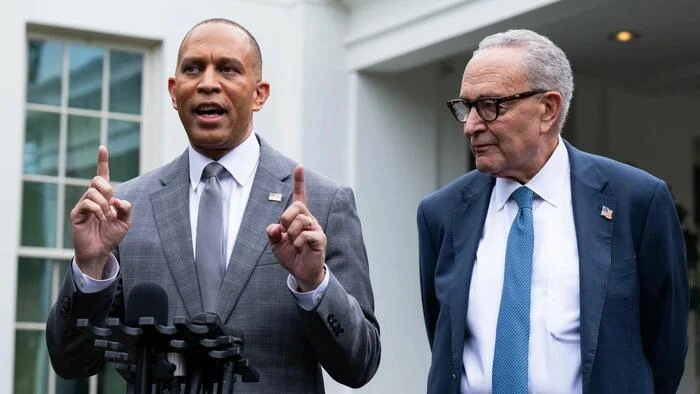
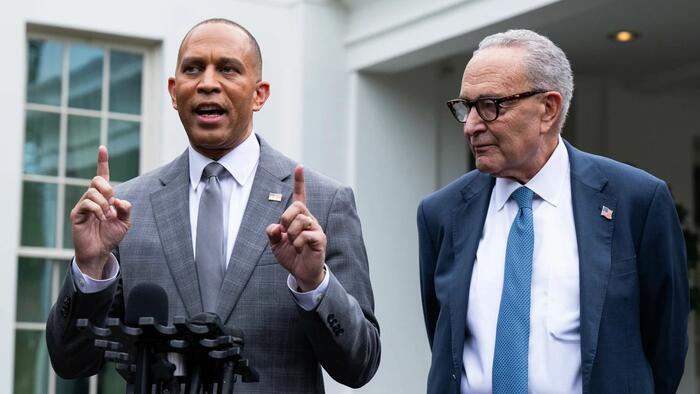
House Minority Leader Hakeem Jeffries articulated this position unequivocally, stating to reporters, "A change in personnel is not sufficient. We need a change in policy." Jeffries further dismissed Noem’s role in the ongoing negotiations, characterizing her as a "corrupt lackey" and asserting that the Democrats’ engagement had always been, and would continue to be, directly with the White House. This perspective underscores the core belief among Democrats that the issues at hand are systemic and deeply embedded in the administration’s approach to immigration, rather than merely a function of individual leadership.
Senate Minority Leader Charles E. Schumer echoed Jeffries’ sentiments, making it clear that the Democratic caucus was uninterested in "administrative adjustments or good-faith assurances." Schumer insisted on legislative action to fundamentally alter how immigration law is enforced. "We have to change them by legislation because I don’t trust any one person being in charge of this agency as long as Trump is president, given the policies he’s espoused, given how ICE has been structured," Schumer asserted, adding with a stark rhetorical flourish, "The rot is deep." This pointed remark highlights the profound distrust Democrats harbor towards the administration’s immigration agenda and its operational arms, particularly Immigration and Customs Enforcement (ICE).
Senator Christopher S. Murphy of Connecticut, the ranking Democrat on the Senate Homeland Security Appropriations Subcommittee, further solidified the party’s united front. He contended that merely "changing the name plate on the door doesn’t change the fact that they are committed to using DHS to terrorize communities and migrants in this country." Such strong language from key Democratic figures signals the formidable challenge facing Senator Markwayne Mullin, who is slated to take over as Secretary on March 31, pending Senate confirmation. Mullin, a Republican from Oklahoma, faces the immediate task of navigating a highly polarized political landscape and a deeply entrenched legislative battle over the very mission and operational parameters of his prospective department.
Chronology of a Crisis: From Tragic Incidents to Legislative Gridlock
The current DHS partial shutdown, now entering its third week, did not emerge in a vacuum. Its roots can be traced back to a series of tragic and contentious incidents in January that inflamed the already volatile debate surrounding immigration enforcement and border security.
The initial catalyst for the legislative demands came in January, following two separate but equally disturbing incidents involving federal agents. The first occurred in Minnesota, where anti-ICE protestors clashed with federal agents. Renee Good reportedly attempted to run over an ICE agent with her vehicle, leading the agent to fatally shoot her in self-defense. Weeks later, in a separate event, Alex Pretti assaulted Border Patrol agents while armed with a loaded gun and was subsequently shot during the confrontation. These events, while tragic, became immediate flashpoints, with both sides interpreting them through their own political lenses.
Democrats swiftly leveraged these incidents to push for a comprehensive legislative package designed to impose significant restrictions on ICE and Customs and Border Protection (CBP). They argued that the incidents underscored a need for greater accountability and revised operational protocols within these agencies. The proposed package, however, was immediately characterized by Republicans as "ridiculous restrictions" that would "put agents at risk and severely hampered their ability to enforce the law."
The legislative stalemate intensified as Democrats introduced a series of specific demands for inclusion in any DHS funding bill. These included:
- Banning agents from wearing masks: A provision intended to increase transparency but criticized by Republicans for exposing agents to doxing and harassment.
- Requiring judicial warrants for entry onto private property: A measure aimed at protecting civil liberties but which Republicans argued would "drown the courts," effectively neutering immigration enforcement capabilities.
- Mandating identification and body cameras: While body cameras initially appeared to be an area of potential bipartisan agreement, Democrats later surprisingly backtracked on this specific demand.
- Prohibiting enforcement near "sensitive locations": This included schools, churches, hospitals, and polling places, designed to protect vulnerable populations but seen by Republicans as creating "safe havens" for undocumented immigrants.
Republicans countered that these demands were not only impractical but dangerous, fundamentally undermining the agencies’ ability to perform their duties effectively. They argued that unmasking agents would compromise their safety and that a blanket warrant requirement would create an insurmountable bureaucratic burden, thereby crippling the administration’s broader immigration agenda. The failure to find common ground on these critical operational details transformed the appropriations process into a battleground for the future of immigration enforcement itself.
Stakes and Standoff: Official Responses and Blame Games
As the shutdown persisted, the rhetoric from both sides escalated, with each party attempting to pin the blame for the ongoing impasse squarely on the other.
Senate Majority Leader John Thune adamantly disputed Schumer’s characterization of Republicans as "stonewalling." Thune countered, "Senate Democrats are not engaging. And furthermore, I would say, beyond not engaging, they are just flat rejecting any chance to sit down and actually talk about it. And that seems to be coming from the top." This statement highlights the profound breakdown in communication and negotiation that has paralyzed legislative progress. Thune’s frustration was evident in his subsequent actions; he made his second attempt in as many months to bring a House-passed DHS funding bill to the Senate floor. As anticipated, Democrats successfully blocked it once again, with the procedural vote failing 51-45, nine votes short of the 60 needed to advance. This repeated legislative maneuver underscores the deep partisan chasm that has formed, where neither side appears willing to cede ground.
The White House, while not explicitly quoted on the day of Noem’s firing, has consistently maintained a hardline stance on border security and immigration enforcement. President Trump’s previous rhetoric has often framed such legislative demands as attempts to weaken national security and undermine the rule of law. The administration’s unwavering commitment to its enforcement policies suggests that Mullin, if confirmed, will be expected to uphold and implement these directives, placing him directly in the crosshairs of the ongoing political battle.
Immigration advocacy groups and civil liberties organizations, on the other hand, have largely sided with the Democrats’ demands. They argue that the proposed restrictions are necessary to protect the rights and safety of immigrant communities and to ensure greater accountability for federal agents. These groups have often cited concerns about alleged abuses of power, lack of transparency, and the humanitarian impact of current enforcement practices. Their vocal support provides additional political leverage for Democrats in their negotiations, framing the legislative fight as a moral imperative rather than merely a budgetary dispute.
Collateral Damage: Agencies on the Brink
While the political debate rages, the practical consequences of the partial DHS shutdown are becoming increasingly dire and difficult to ignore. The Department of Homeland Security is a vast and complex entity, comprising 22 different agencies and employing approximately 240,000 personnel. While ICE and CBP have largely managed to keep their operations running, insulated by a substantial $75 billion Congress funneled to immigration enforcement through last summer’s budget reconciliation law, other critical components of DHS lack such a financial backstop.
Agencies such as the Transportation Security Administration (TSA), the Federal Emergency Management Agency (FEMA), the United States Coast Guard, and the Secret Service are beginning to feel the severe financial squeeze.
- Transportation Security Administration (TSA): Tens of thousands of TSA officers, deemed essential, are working without pay, leading to reports of increased sick calls, reduced morale, and potential security vulnerabilities at airports nationwide. While security lines have not yet collapsed, a prolonged shutdown could severely compromise the efficiency and safety of air travel.
- Federal Emergency Management Agency (FEMA): FEMA’s ability to respond to natural disasters and provide critical aid is significantly hampered. With disaster relief funds potentially frozen or limited, communities recovering from recent events or facing new threats could be left vulnerable. The agency’s long-term planning and readiness exercises also face disruption.
- United States Coast Guard: The Coast Guard, responsible for maritime security, search and rescue operations, environmental protection, and drug interdiction, is operating with thousands of active-duty personnel working without pay. This affects not only their personal finances but also the operational readiness of a vital branch of the military that performs critical national security functions.
- Secret Service: The Secret Service, tasked with protecting the President, Vice President, and other dignitaries, as well as investigating financial crimes, is also operating under immense strain. Agents and support staff are working without compensation, raising concerns about morale, retention, and the potential impact on the agency’s demanding mission.
Beyond these high-profile agencies, numerous other DHS components are affected, including components dealing with cybersecurity, research and development, and infrastructure protection. The cumulative effect is a significant erosion of national security, public safety, and governmental effectiveness, creating a ripple effect across the nation.
Historical Precedent and Future Uncertainties
Government shutdowns are not unprecedented in U.S. history. The longest government shutdown on record occurred in 2018-2019, lasting 35 days, also largely over border security funding. These previous shutdowns have consistently demonstrated significant economic costs, impacts on federal workers, and disruptions to essential government services. Economists have estimated that even short shutdowns can cost billions of dollars in lost economic activity and productivity. Furthermore, they often inflict lasting damage on public trust in government and exacerbate partisan divisions.
The current standoff, fueled by deep ideological differences over immigration, highlights a growing trend of legislative gridlock where appropriations bills become battlegrounds for broader policy debates. This approach to governance risks turning routine legislative processes into existential crises, making it increasingly difficult for the government to function effectively.
The Road Ahead: Mullin’s Challenge and the Unresolved Funding Battle
As Senator Markwayne Mullin prepares to assume the mantle of DHS Secretary, the path ahead appears fraught with challenges. His confirmation process itself will likely become another forum for the intense debate surrounding immigration policy. Should he be confirmed by March 31, he will inherit an agency in the midst of a budgetary crisis and a department whose very mission and methods are under fierce political scrutiny.
The question of whether Mullin can "unlock a deal" to end the standoff remains entirely unclear. Given the entrenched positions of both parties, the likelihood of a swift resolution appears slim. Democrats have made it clear that their demands are not negotiable through administrative adjustments but require fundamental legislative changes. Republicans, backed by the White House, remain steadfast in their commitment to current immigration enforcement strategies.
Mullin’s success will depend on his ability to bridge this seemingly intractable divide, a task that has eluded his predecessor and the highest echelons of congressional leadership. His role will be to manage a critical department operating under severe strain while simultaneously attempting to broker a political compromise that satisfies deeply entrenched ideological opponents. Without a fundamental shift in approach from either the White House or congressional Democrats, the DHS funding impasse and its attendant collateral damage appear set to continue, further testing the resilience of American governance and the patience of its citizens.

