
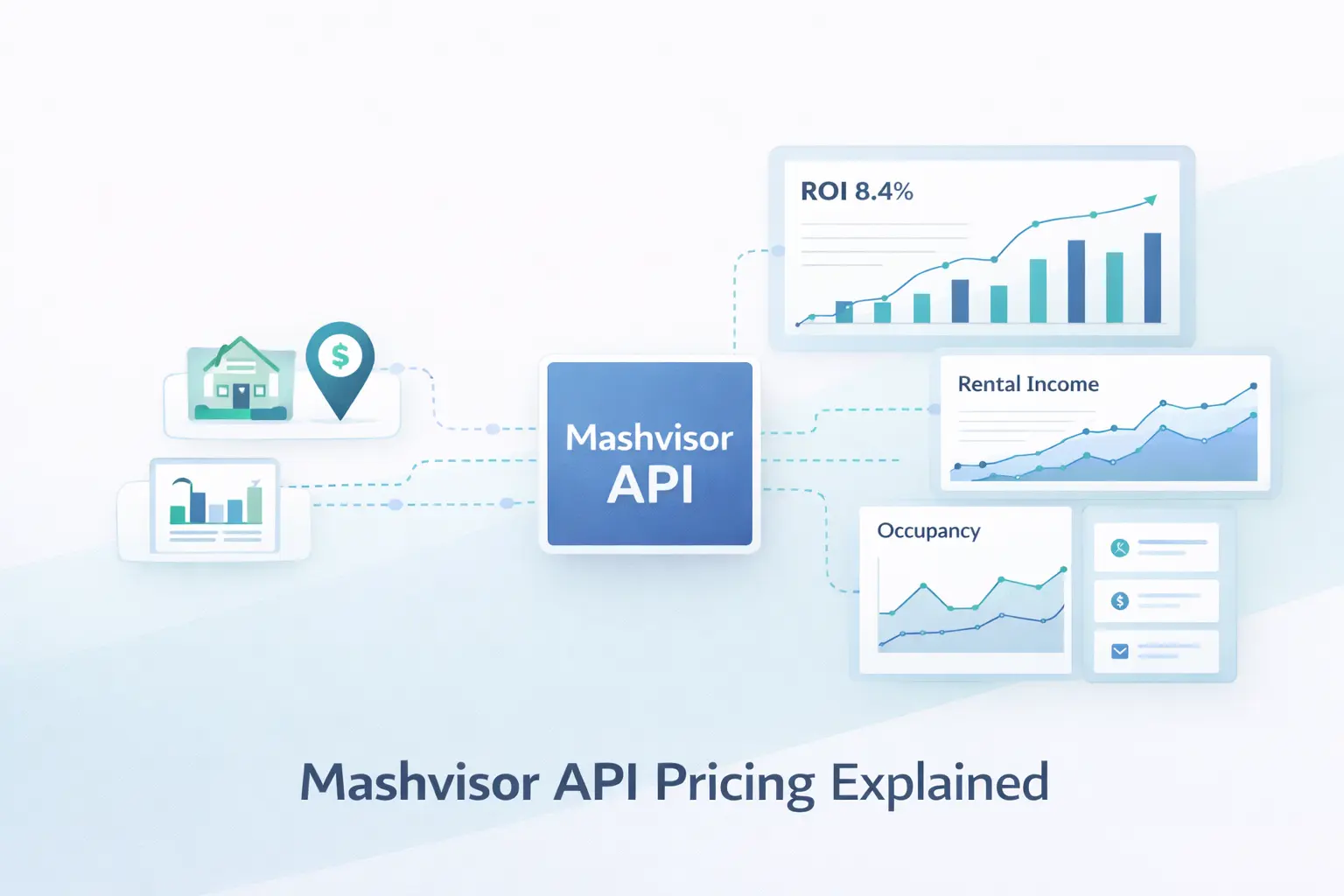
For real estate professionals navigating the complex landscape of data solutions, the decision-making process often hinges on a critical factor: pricing. While features and the breadth of available datasets are paramount, understanding the expected costs before integrating an Application Programming Interface (API) into existing workflows is essential, particularly for investors, PropTech companies, and analytics teams planning for scalability and long-term operational needs. Recognizing this imperative, Mashvisor has structured its API pricing model to offer unparalleled clarity and flexibility through a usage-based system, eschewing traditional fixed monthly licensing fees. This innovative approach aligns costs directly with data extraction, catering to a diverse spectrum of applications—from in-depth investment property analysis and real estate underwriting to sophisticated short-term rental revenue modeling and Debt Service Coverage Ratio (DSCR) checks. Ultimately, Mashvisor’s model empowers professionals and businesses to scale their data access efficiently and cost-effectively as their requirements evolve.
The Evolution of Real Estate Data Accessibility
The real estate industry has undergone a significant digital transformation in recent years. The advent of PropTech has democratized access to data, moving it from the exclusive domain of large institutions to readily available tools for individual investors and small businesses. However, a persistent challenge has been the cost and complexity associated with accessing high-quality, comprehensive real estate data. Historically, obtaining such data often involved expensive licensing agreements, rigid package structures, and a lack of transparency, forcing users to either overpay for unused data or struggle to scale their operations. Mashvisor’s introduction of a usage-based API pricing model represents a strategic response to these industry-wide pain points.
Mashvisor API Pricing: A Transparent and Adaptable Framework
Mashvisor’s API pricing strategy is fundamentally designed to foster transparency and adaptability. By opting for a usage-based structure over rigid, pre-defined data packages, the company ensures that businesses only pay for the data they actively extract. This model is particularly advantageous as it caters to a wide array of users, from nascent startups requiring initial data validation to established real estate analytics platforms managing intricate, high-volume workflows.
The company offers both monthly and annual subscription options, with annual plans providing an added benefit of several months of free access per year. Entry-level API access begins at approximately $129 per month for users with smaller-scale data requirements. The precise cost is determined by specific usage needs, with finalization occurring during a personalized demo consultation. This consultative approach ensures that prospective clients fully understand the API’s capabilities and that the selected plan precisely matches their business objectives.
Decoding the Credit-Based Pricing Model
At its core, the Mashvisor API operates on a credit-based pricing system. Usage is meticulously tracked through API calls, aggregated on a monthly basis. Each interaction with an API endpoint consumes a portion of the allocated credits within the user’s monthly plan. This contrasts sharply with conventional real estate data licensing, which often necessitates substantial upfront investments. Mashvisor’s model facilitates a gradual scaling of data consumption, allowing businesses to commence with modest workloads and expand incrementally as their needs grow.
Crucially, all subscription tiers grant unrestricted access to the comprehensive Mashvisor API documentation and all available endpoints. This ensures that the API’s functionality remains consistent across all pricing levels, with the primary differentiator being the volume of monthly API calls permitted. This structure empowers professionals and enterprises to acquire the precise data required for market research, investment property analysis, rental comparable intelligence, and short-term rental performance modeling, thereby eliminating the financial burden of paying for underutilized data access.
Factors Influencing API Pricing
Several key variables influence the final cost of the Mashvisor API. Understanding these factors is vital for businesses to accurately estimate their total expenditure. The primary drivers of Mashvisor’s real estate data API pricing include:
- Volume of API Calls: The most significant factor. Higher request volumes necessitate higher credit allocations.
- Type of Data Requested: Certain endpoints might consume more credits due to the complexity or volume of data they return.
- Frequency of Access: Regular, high-frequency data retrieval will naturally increase overall usage.
- Integration Scope: The breadth of data points and features integrated into a client’s application.
Mashvisor recognizes that pricing needs to be dynamic. The company offers flexible packages and custom options to accommodate the diverse requirements of both small startups and large enterprises. This ensures that the cost is directly aligned with the measurable business outcomes derived from the data.
For a precise cost estimation, Mashvisor strongly advises engaging with their Data Experts. Scheduling a free demo is the most effective way to understand how the API works and to select a plan that aligns perfectly with a company’s specific business needs.
Mashvisor API Pricing Tiers: A Scalable Solution
Mashvisor has developed four distinct API plans, each calibrated to different monthly request volumes. The fundamental difference between these tiers lies in the number of API calls allocated, enabling businesses to select the plan that best matches their operational scale. Importantly, all plans provide access to every endpoint and the complete documentation.
The following table offers a concise overview of the Mashvisor API pricing tiers:
| Plan | Best For | Monthly API Calls | Typical Users | Common Use Cases |
|---|---|---|---|---|
| Starter | Testing & validation | 500 | Investors & developers | Testing & prototypes |
| Professional | Growing analytics tools | 1,000 | Small startups | Analytics dashboards |
| Growth | Scalable platforms | 3,000 | SaaS products | Production analytics |
| Enterprise | Large-scale apps | 10,000 | Large platforms | Marketplaces & underwriting |
Navigating the Tiers: Choosing the Right Plan
The selection of the most suitable Mashvisor API plan should primarily be guided by the frequency with which an application accesses data and the depth of analytics integration within operational workflows. The following guidelines can assist in estimating the most appropriate starting tier:
- Starter Plan: Ideal for individuals or small teams validating hypotheses, building initial prototypes, or conducting small-scale market research. If your data needs are limited to initial exploration or occasional analysis, this tier offers a cost-effective entry point.
- Professional Plan: Suited for startups and smaller businesses developing analytical tools or dashboards that require more consistent data access. This plan provides a balanced allocation for ongoing analysis and reporting.
- Growth Plan: Designed for SaaS products and platforms experiencing increasing user adoption and data demands. This tier supports more robust production analytics and scalable applications.
- Enterprise Plan: Tailored for large platforms, marketplaces, and businesses with extensive underwriting operations. This plan offers substantial API call volume to support high-demand, mission-critical applications.
Mashvisor emphasizes maximum flexibility. Users can begin with one tier and seamlessly transition to a higher tier as their needs evolve. This adaptability ensures that the pricing structure remains aligned with the dynamic nature of business growth.
Real-World Applications of Mashvisor API Pricing
The true value of Mashvisor’s API pricing model becomes evident when examining how various organizations leverage this data in production environments. The pricing tiers are structured to reflect actual business usage patterns, allowing companies to scale access in alignment with their operational workflows, whether they are analyzing individual rental properties or powering complex analytics platforms.
Investment Property Analysis Applications
PropTech platforms and investor tools frequently utilize the Mashvisor API to automate rental property analysis, calculate projected returns (such as cash-on-cash return or cap rate), and compare investment opportunities across diverse markets. By programmatically retrieving rental estimates, property metrics, and market insights, these applications bypass the time-consuming process of manual data collection and organization. This workflow often involves recurring queries as users explore markets or evaluate listings, making the usage-based pricing model particularly effective for investment property analytics.
Sample Property Data API Request:
GET /property?address=Miami&state=FL
Authorization: Bearer API_KEY
Short-Term Rental Revenue Modeling
Short-term rental (STR) platforms and analytics teams leverage the Mashvisor Airbnb data API to model STR performance, forecast revenue potential, and analyze market demand and supply trends. Access to historical performance data enables these applications to estimate Airbnb occupancy rates and average daily rates (ADR) across various locations. As this type of analysis often runs automatically across numerous properties, the API usage naturally scales with business growth, and Mashvisor’s pricing model directly supports this scalability.
Sample Airbnb Historical Performance Data API Request:
GET /airbnb/historical-performance?city=AustinLearn more about the Mashvisor Airbnb occupancy rate API, as one of the main metrics determining STR revenue.
DSCR and Lending Underwriting Automation
Lenders and FinTech platforms integrate real estate data APIs to streamline underwriting processes and automate DSCR calculations. By programmatically obtaining rental income estimates and comparable property data, teams can significantly reduce manual analysis while standardizing investment evaluations and real estate underwriting processes. For investment property lenders, API usage directly correlates with loan volume, making scalable property data API pricing models highly beneficial for underwriting automation.
Sample API Request to Fetch Rental Estimates for Underwriting:
GET /rental-estimates?property_id=12345&strategy=traditional
Authorization: Bearer YOUR_API_KEY
Accept: application/json
Use the returned rent estimate to compute NOI and run a DSCR check inside your underwriting model.
Rental Comps Analysis and Market Benchmarking
Real estate investors and analytical PropTech platforms rely on comparable real estate and rental data to assess pricing strategies and validate investment assumptions. The Mashvisor API enables these applications to retrieve comparable property performance and neighborhood-level benchmarks programmatically, helping users determine if projected returns align with local market conditions. Since real estate and rental comps analysis is performed repeatedly across multiple properties and markets, usage-based API pricing allows businesses to scale their workflows efficiently without committing to fixed data packages.
Sample API Request Retrieving Rental Comps Data:
GET /rental-comps?property_id=12345Real Estate Marketplaces and Data Platforms
Property marketplaces and analytics platforms utilize the Mashvisor API to enrich listings with investment insights, neighborhood analytics, and rent projections. These integrations necessitate continuous background queries that dynamically update data as users browse properties. For such businesses, API usage grows in tandem with platform adoption, supporting long-term expansion without requiring major pricing restructures.
Sample API Request Enriching a Property Listing With Investment Metrics:
GET /property/analysis?address=Miami&state=FL&strategy=airbnb
Authorization: Bearer YOUR_API_KEY
Accept: application/json
This request retrieves investment analytics for a specific property, allowing platforms to enrich listings with metrics such as estimated rental income, occupancy rate, and projected ROI.
Beyond these examples, the Mashvisor API supports a wide array of applications, including market research tools, automated investment screening systems, portfolio monitoring dashboards, and custom real estate analytics solutions, enabling teams to tailor data access to their unique operational and product needs.
Comparative Analysis: Mashvisor API Pricing vs. Competitors
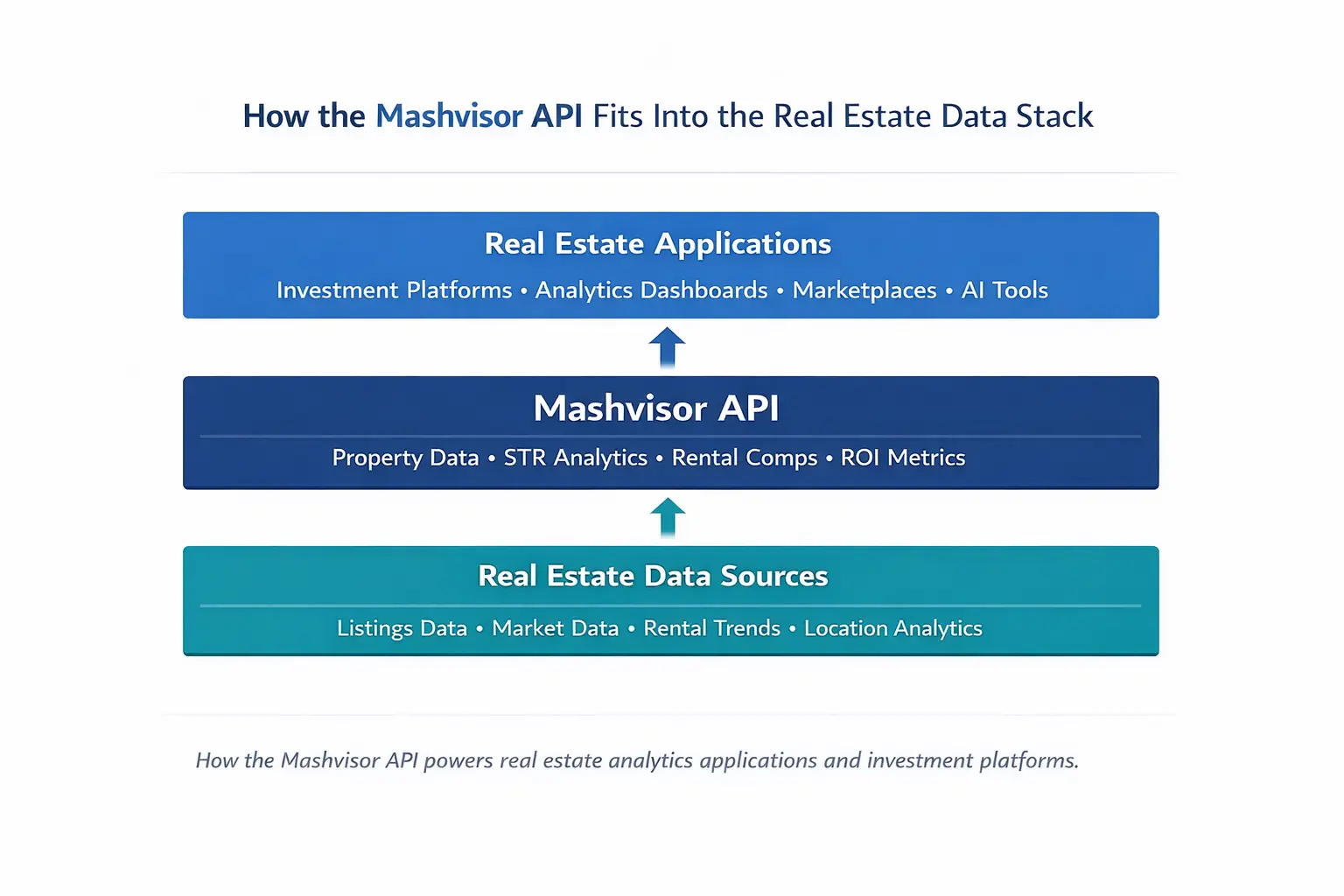
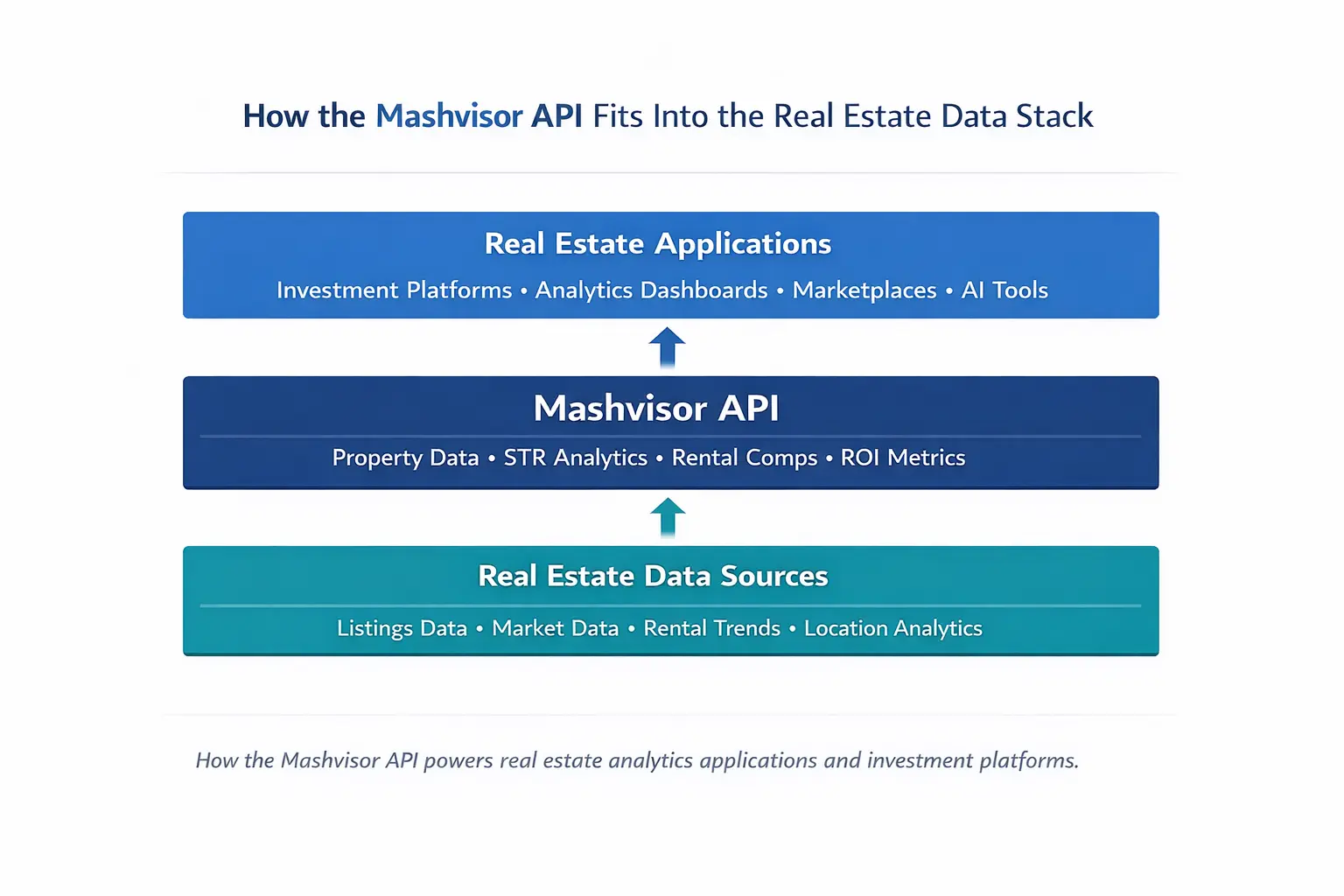
To fully appreciate Mashvisor’s pricing strategy, it is beneficial to compare it with other prominent real estate data API providers. Platforms like Zillow and AirDNA offer valuable datasets, but their pricing and access models are often tailored to different primary functions. Zillow primarily focuses on property lookup and listing data, while AirDNA specializes in short-term rental analytics. Mashvisor, conversely, integrates property records, rental analytics, comps, and performance trends into a single, unified API, offering a more comprehensive solution for investment-focused users.
| Feature | Mashvisor | Zillow | AirDNA |
|---|---|---|---|
| Best For | Investment platforms, Property search, analytics tools & listing apps | Property search & listing apps | STR operators & market research |
| Primary Focus | Property listings, home values, STR & LTR analytics, comps, investment metrics | Property listings & home values | Short-term rental analytics |
| Pricing Model | Credit-based usage model | Access-restricted or partnership-based | Subscription-based market access |
| Scalability | High – scales with usage | Limited for analytics workflows | Moderate – tied to market scope |
Mashvisor’s API is utilized by PropTech startups, STR operators, and real estate analytics platforms in production environments. Unlike the Zillow and AirDNA APIs, the Mashvisor API consolidates property- and market-level data and analytics for both short-term and long-term rentals, facilitating efficient rental analysis for investors employing diverse strategies. Furthermore, Mashvisor provides a flexible, transparent cost structure directly tied to usage.
Estimating Your Mashvisor API Costs
Given Mashvisor’s usage-based pricing model, estimating the total API cost begins with a thorough understanding of how the data will be utilized within your workflow or application. All four plans provide access to all endpoints and documentation, simplifying the selection process to focus on usage volume.
Step 1: Define Your Data Use Case
Identify precisely how the API will support your business operations. Internal research tools, investment analysis workflows, and customer-facing analytics platforms all generate distinct levels of API activity. Clearly defining the use case establishes a realistic baseline for expected usage and, consequently, cost.
Step 2: Estimate Monthly API Requests
Approximate the frequency with which your application will call the API. Each request—whether for property analytics, rental comps, or historical performance data—contributes to your monthly allocation. A simple estimation formula can be employed:
Estimated Monthly API Calls = Number of Users or Automated Jobs x Average Requests per Session x Sessions per Month
Even rough projections can help determine whether a Starter, Professional, Growth, or Enterprise plan is most appropriate.
Step 3: Match Data Needs to a Pricing Tier
Once usage is estimated, align the expected request volume with the available Mashvisor API pricing tiers. Since all plans offer full endpoint access, the decision primarily revolves around scale rather than functionality. Businesses often start with a tier that supports current workloads while allowing room for future growth as adoption increases or automation expands.
Step 4: Request a Custom Pricing Recommendation
The final step involves requesting a pricing consultation. Mashvisor offers customized recommendations based on a user’s integration goals, expected data volume, and long-term scaling plans. Exact pricing details are provided during a demo to ensure businesses select a plan that aligns with their real operational needs, moving beyond generic assumptions.
For those unsure about the best tier for their specific use case, Mashvisor offers a 15-minute consultation with an expert to map workflows to the most suitable plan, with no pressure or upsell.
Conclusion: A Strategic Investment in Data
Understanding API costs is fundamental for businesses developing data-driven real estate products or scaling investment analysis workflows. Mashvisor’s API pricing model, built on flexibility rather than rigid licensing structures, empowers companies to align data access with actual usage and operational growth. With tiered plans based on monthly API calls, comprehensive endpoint access across all plans, and customizable packages for higher-volume needs, the Mashvisor API supports a broad spectrum of applications—from investor tools and underwriting systems to analytics platforms and marketplace integrations. For organizations seeking a scalable real estate data infrastructure, this usage-based approach offers both predictability and ample room for growth as data requirements evolve.
For businesses looking to test the Mashvisor API’s capabilities in practice before committing to a paid plan, a 1-week free trial with 30 credits is available.
Frequently Asked Questions
How Much Does Mashvisor API Cost?
Mashvisor API plans start at approximately $129 per month, with pricing solely based on monthly API usage. The exact cost varies according to request volume and integration requirements. Businesses receive tailored pricing recommendations during a demo to ensure the selected plan aligns with their specific workflow and data needs.
Is Mashvisor API Pricing Pay-per-Request?
Mashvisor employs a credit-based pricing model rather than strict pay-per-request billing. Each plan includes a monthly allocation of API calls, enabling teams to scale usage predictably and avoid the unpredictable per-call costs associated with some real estate data API pricing models.
Does Mashvisor Offer Enterprise API Pricing?
Yes, in addition to standard tiers, Mashvisor offers Enterprise plans designed for high-volume platforms and advanced analytics applications. Custom packages can also be developed for organizations with specialized use cases, larger datasets, or higher request volumes exceeding standard monthly allocations.
What Is Included in the Mashvisor API Access?
All Mashvisor API plans include access to the full documentation and all available endpoints. This encompasses property analytics, rental comps, investment metrics, and historical performance data crucial for underwriting, DSCR analysis, and short-term rental revenue modeling workflows.
Is the Mashvisor API Worth the Cost?
For businesses relying on automated investment analysis or scalable real estate analytics, the Mashvisor API can deliver substantial efficiency gains compared to manual data collection or aggregating data from multiple providers. Its usage-based structure allows companies to start small and expand access as their products or analytics needs grow.

