
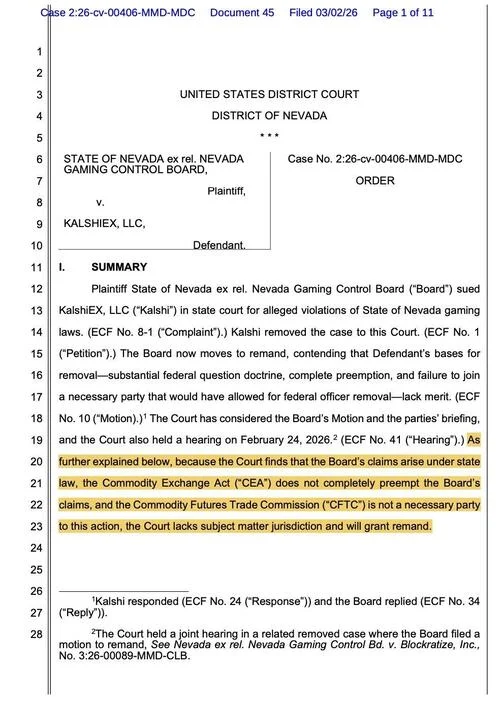
Two recent federal court rulings have significantly increased the regulatory risk for prediction market platforms operating in the United States, particularly within Nevada. These decisions, which saw a federal judge remand disputes involving Polymarket’s parent company Blockratize and the CFTC-regulated platform Kalshi back to state court, empower Nevada regulators to potentially halt prediction-market trading statewide. The implications extend far beyond the Silver State, signaling a potential shift in how these innovative, yet controversial, platforms are viewed and regulated across the nation.
The core of the legal challenge revolves around the question of federal preemption. Both Polymarket, through its parent company Blockratize, and Kalshi had argued that their operations, specifically their event contracts, fall under the exclusive jurisdiction of federal law, namely the Commodity Exchange Act (CEA) and oversight by the Commodity Futures Trading Commission (CFTC). They contended that this federal framework should preempt, or supersede, state gaming laws. However, a federal judge emphatically rejected these arguments in separate rulings issued earlier this week. In a Monday order concerning Blockratize, the judge found that the CEA’s "savings clause" does not completely displace state authority and that the companies had not presented a sufficient basis to block Nevada’s enforcement action at this stage. This pivotal decision means that the Nevada Gaming Control Board (NGCB) can now continue pursuing its civil enforcement cases in state court, where it could seek injunctions restricting Nevada residents from accessing event contracts offered by Polymarket or Kalshi.
Understanding Prediction Markets and Their Regulatory Quagmire
Prediction markets are platforms where users can trade contracts whose value is tied to the outcome of future events. These events can range from political elections and economic indicators to scientific breakthroughs or even entertainment results. Proponents argue that these markets serve as valuable tools for aggregating information and forecasting future events, often with greater accuracy than traditional polls or expert opinions. They are also viewed by some as an alternative form of financial instrument, allowing individuals to hedge risks or speculate on future outcomes.

However, the nature of "betting" on outcomes has consistently placed prediction markets in a contentious legal and regulatory gray area. Regulators, particularly those overseeing traditional gambling, often view these event contracts as a form of illegal wagering, blurring the lines between legitimate financial derivatives and speculative games of chance. This dichotomy is central to the ongoing legal battles. Kalshi, for instance, has actively sought to distinguish itself by operating under CFTC regulation, positioning its event contracts as legitimate financial products. Polymarket, while operating with a more decentralized, crypto-native approach, also facilitates trading on a wide array of event outcomes. The current rulings in Nevada underscore the deep-seated tension between these two interpretations and the jurisdictional complexities that arise.
A Detailed Timeline of Nevada’s Aggressive Stance
Nevada’s proactive and aggressive stance against prediction markets did not emerge overnight. It has been a developing regulatory saga, reflecting the state’s historical commitment to controlling and regulating all forms of gambling within its borders.
- Early 2025 (Initial Scrutiny): The Nevada Gaming Control Board reportedly began its investigations and challenges against platforms like Kalshi, expressing concerns that their event contracts constituted unlicensed gambling operations within the state. This early engagement set the stage for a protracted legal battle.
- March 2025 (Kalshi’s Proactive Legal Action): Following a cease-and-desist order from Nevada regulators, specifically targeting "sports-related betting markets" offered by Kalshi, the company took the unusual step of suing the state. Kalshi’s lawsuit aimed to affirm its status as a federally regulated entity under the CFTC, arguing that its operations were not subject to state gaming laws. This marked a direct confrontation between a federally regulated financial platform and a powerful state gaming authority.
- February [Current Year, Implied] (Ninth Circuit Rebuffs Kalshi): The US Court of Appeals for the Ninth Circuit denied Kalshi’s initial bid to halt Nevada’s gaming regulator from taking action on its sports event contracts. This ruling was a significant setback for Kalshi, signaling that its federal preemption argument would face an uphill battle. It demonstrated that federal courts were, at least at that stage, unwilling to broadly block state regulatory efforts.
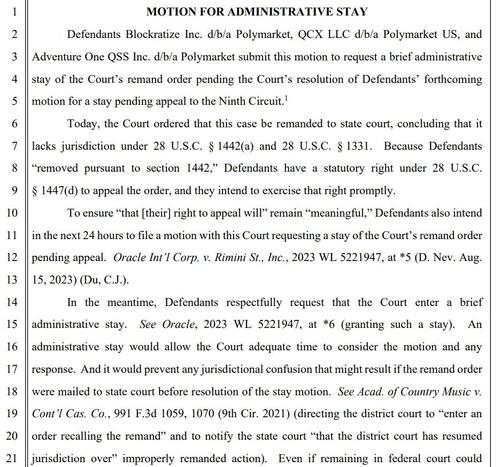
- Monday [Recent] (Blockratize/Polymarket Remand): A federal judge ruled against Blockratize, Polymarket’s parent company, denying its motion to prevent Nevada’s civil enforcement case from proceeding in state court. The judge’s order clarified that the Commodity Exchange Act’s "savings clause" does not completely displace state authority, thereby allowing Nevada to continue its legal pursuit. Blockratize promptly responded by submitting a motion for a brief administrative stay of the remand order, indicating their intent to continue fighting the decision.
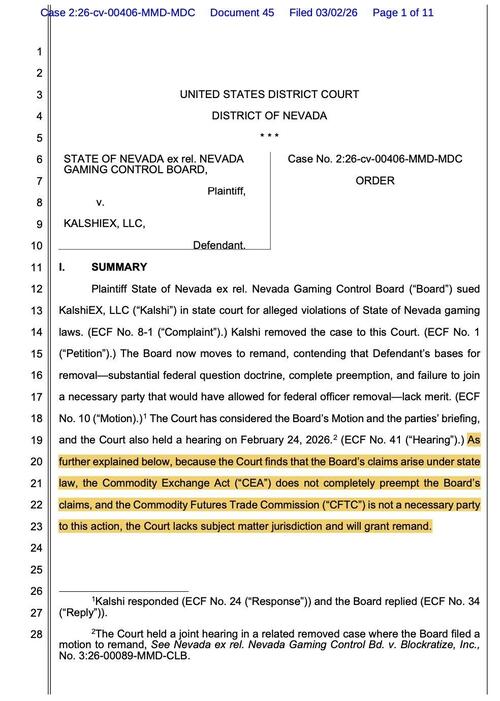
- Tuesday [Recent] (Kalshi Remand and "Imminent" Threat): In a separate, but parallel, ruling, a federal judge also remanded Nevada’s civil enforcement action against Kalshi back to state court. This decision exposed Kalshi to what legal experts, including sports betting and gaming-focused lawyer Daniel Wallach, described as an "imminent temporary restraining order" barring it from offering event contracts in the state. This dual blow to both major prediction market players underscores the current legal peril they face in Nevada.
Expert Reactions and Broader Implications
The recent rulings have sent ripples through the prediction market industry and the broader legal community. Daniel Wallach, a prominent legal expert in gaming and sports betting, took to X (formerly Twitter) to highlight the gravity of the situation. "The ruling could embolden other states to sue Kalshi in state court and seek injunctions to block event contracts, a strategy that has so far succeeded in every case brought," Wallach posted. His analysis points to a significant precedent: if Nevada, a state synonymous with sophisticated gaming regulation, successfully asserts its jurisdiction, other states grappling with similar questions of online betting and financial innovation may follow suit.

From the perspective of the Nevada Gaming Control Board, these rulings are a validation of their mandate. While no official statement from the NGCB has been released post-ruling, their consistent actions indicate a firm belief in their authority to regulate any activity resembling gambling within state lines, regardless of how platforms classify themselves. Their implicit stance is likely centered on consumer protection, preventing unlicensed operations, and ensuring the integrity of the state’s highly regulated gaming ecosystem. They would argue that event contracts, particularly those with speculative outcomes, carry inherent risks of manipulation and are susceptible to insider information, necessitating stringent oversight that only state gaming authorities can provide effectively.
For Polymarket and Kalshi, the rulings represent a significant setback. While they have not issued immediate public statements regarding the specific remand orders (beyond Blockratize’s request for a stay), their ongoing legal efforts suggest a continued belief in the legitimacy and legality of their offerings as financial instruments rather than gambling products. They would likely emphasize the innovative nature of prediction markets, their utility in information aggregation, and their commitment to operating within a regulated framework (in Kalshi’s case, under CFTC oversight). The immediate concern for both companies is the potential for injunctions that would block Nevada residents from accessing their platforms, directly impacting their user base and operational freedom within a key US market.
The Shadow of Insider Trading Concerns
The regulatory and legal scrutiny on prediction markets is further intensified by a series of high-profile incidents involving alleged insider trading and information advantage. These events provide powerful ammunition for regulators who argue that these platforms are ripe for manipulation and pose significant risks to market integrity and fairness.
- The ZachXBT/Axiom Investigation (Recent): Just last week, Cointelegraph reported on suspected insider wallets netting a staggering $1.2 million by betting on the outcome of blockchain sleuth ZachXBT’s highly anticipated investigation into Axiom. ZachXBT released his findings, alleging that Axiom employee Broox Bauer and others had been involved in insider trading activity since early 2025. The precise timing and significant profits generated from these bets on Polymarket immediately raised red flags, fueling concerns about information asymmetry and the potential for illicit gains based on privileged knowledge. The ability to profit from such sensitive, non-public information directly undermines the premise of fair and open markets.
- The Venezuelan President Maduro Bet (January): Earlier this year, a Polymarket account reportedly profited $400,000 after placing a bet on a contract predicting the capture of Venezuelan President Nicholas Maduro. Crucially, this significant wager was made just hours before US forces captured him during a military operation. The timing of the bet strongly suggested access to highly confidential, pre-release information, leading to widespread accusations of insider trading. The user account subsequently "disappeared," further obscuring the origins of the information and the nature of the trade.
- Israeli Military Strikes Arrests (February): In a even more alarming development, Israeli authorities arrested and indicted two individuals suspected of using secret information related to Israel striking Iran for insider trading on Polymarket. This incident highlighted the potential for prediction markets to be exploited in matters of national security and geopolitics, moving beyond financial or political outcomes into areas with grave real-world consequences.
These incidents, particularly the recent Axiom case, reinforce the arguments of regulators like the NGCB. They contend that without robust oversight and stringent regulatory frameworks, prediction markets can become conduits for illicit activities, undermining public trust and potentially facilitating market manipulation. While platforms like Kalshi strive for compliance and transparency, and decentralized platforms like Polymarket inherently present unique challenges for oversight, the perception of susceptibility to insider trading significantly complicates their efforts to be recognized as legitimate financial instruments.
The Distinction Between Kalshi and Polymarket in Nevada’s Crosshairs
It is important to differentiate between Kalshi and Polymarket, even as both face similar regulatory pressure in Nevada. Kalshi has actively pursued a path of legitimacy within the existing US financial regulatory framework. It has secured approval from the CFTC to offer certain event contracts, positioning itself as a regulated exchange. Its arguments for federal preemption stem directly from this regulatory compliance.
Polymarket, conversely, operates with a more decentralized, crypto-based infrastructure. While its parent company, Blockratize, is the entity directly engaged in the Nevada legal dispute, Polymarket’s decentralized nature presents different challenges for traditional regulators. It often operates with pseudonymous users and leverages blockchain technology, which, while offering transparency in transaction data, complicates the identification and enforcement actions against individual actors. Despite these structural differences, Nevada’s courts are treating both platforms similarly in terms of the state’s power to regulate their offerings as potential gambling activities. The underlying issue for Nevada remains consistent: is the activity taking place on these platforms, regardless of their technological or regulatory architecture, considered gambling under state law? The federal judge’s ruling that the CEA’s "savings clause" does not completely displace state authority effectively means that a platform’s federal classification or decentralized nature may not automatically exempt it from state gaming laws.
Nevada’s Economic and Social Context
Nevada’s unyielding stance against unregulated prediction markets is deeply rooted in its economic and social fabric. As the epicenter of legal gambling in the United States, the state has a vested interest in maintaining strict control over all forms of wagering. The gaming industry is a cornerstone of Nevada’s economy, generating billions in revenue and supporting countless jobs. The Nevada Gaming Control Board and the Nevada Gaming Commission are powerful, well-established regulatory bodies with a long history of meticulously overseeing casinos, sportsbooks, and other licensed gaming operations.
From Nevada’s perspective, allowing unregulated prediction markets to operate freely within its borders would not only undermine its existing, highly regulated industry but also pose significant risks to consumer protection. The state has stringent licensing requirements, responsible gaming protocols, and robust enforcement mechanisms designed to ensure fairness, prevent fraud, and protect vulnerable individuals. The argument is that prediction markets, particularly those not fully integrated into Nevada’s regulatory framework, circumvent these protections, creating a shadow market that could lead to consumer harm, illicit financial flows, and a general erosion of regulatory control over a sector vital to the state. The state’s actions are a clear signal that it intends to protect its turf and its residents from what it perceives as unlicensed and potentially harmful forms of wagering.
Conclusion: A Looming Regulatory Showdown
The recent federal court rulings in Nevada mark a critical juncture for prediction markets in the United States. By remanding the cases of Blockratize (Polymarket) and Kalshi back to state court, the federal judiciary has signaled that federal commodities regulation may not automatically preempt state gaming laws, particularly when a state’s "savings clause" preserves its regulatory authority. This empowers the Nevada Gaming Control Board to pursue injunctions that could effectively ban these platforms from operating within the state.
The implications are profound and extend nationally. As Daniel Wallach suggested, Nevada’s success could embolden other states to adopt similar restrictive measures, leading to a fragmented and complex regulatory landscape for prediction markets across the US. This regulatory uncertainty, coupled with persistent concerns over insider trading and market manipulation, places significant pressure on these platforms to either conform to state-level gambling regulations, advocate for a clearer and more unified federal framework, or face a patchwork of prohibitions. The ongoing legal battles in Nevada are not merely local disputes; they are a bellwether for the future of prediction markets and the ongoing struggle to define their place within the existing financial and gaming regulatory structures of the United States. The industry now faces a heightened risk of state-level intervention, potentially stifling innovation and access for American users.

