

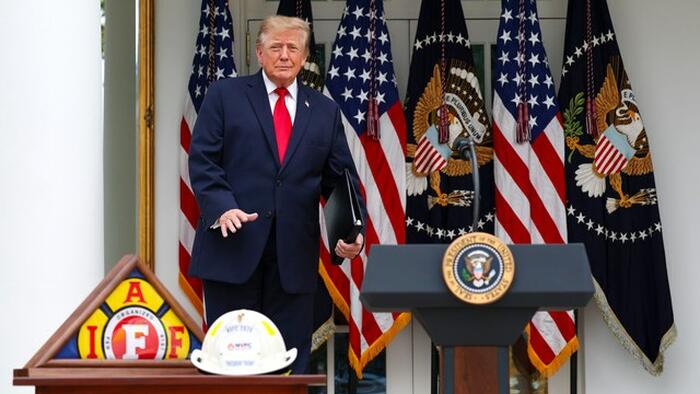
President Donald Trump announced on October 15 that he had directed the Department of Justice (DOJ) to pursue capital punishment for individuals convicted of murdering law enforcement officers and firefighters. The declaration, made during a White House Rose Garden luncheon honoring America’s first responders, signals a significant escalation in the federal government’s stance on crimes against emergency personnel and immediately sparked discussions on legal implications, deterrent effects, and the broader context of capital punishment in the United States.
The White House Announcement and Presidential Directive
Speaking to a gathering of police officers, firefighters, and their families, President Trump emphasized his commitment to protecting those who serve on the front lines. "We’re bringing the death penalty back for anybody that kills a police officer, by the way, or anybody in law enforcement," Trump stated, drawing a direct link between the proposed policy and a perceived reduction in violence. He elaborated that his directive to the DOJ initially focused on police officers but was subsequently expanded to include firefighters, referencing instances where firefighters face life-threatening assaults. "They’re on the ladder and they get shot at and nobody ever talks about that," he noted, expressing confidence that such a measure would lead to a rapid decrease in these types of shootings.
The President underscored the nation’s profound gratitude towards its first responders. "America owes our first responders a debt it can never fully repay," he affirmed. "But as president, I will always stand behind those who stand on the front lines of law enforcement, fighting fires, all of the things that you people do so courageously." This rhetoric aligns with a consistent theme throughout his administration of strong support for law enforcement and emergency services, often encapsulated by "Back the Blue" sentiments.
Support from First Responder Leadership
The luncheon served as a platform for various first responder organizations to voice their appreciation for the President’s policies. Paul Perez, President of the National Border Patrol Council, praised the administration’s perceived unparalleled support. "First responders have never had the support or leadership from any administration that we have from you," Perez stated, crediting President Trump for strengthening national security and border integrity. "And it’s because of you that America is stronger, America is safer, and the border is totally secure because of you and your leadership."
Steve Hirsch, Chairman of the National Volunteer Fire Council, presented President Trump with a fire helmet, a symbolic gesture of protection and solidarity. "While this helmet protects us in a fire or a wreck, we want it to protect you," Hirsch conveyed. He added a spiritual dimension to the gift, expressing a wish for divine protection: "We want God to wrap his protective arm around you and use this helmet – remember that we want you to be protected by our Lord." These statements from key figures in the first responder community highlight the strong alignment between the President’s policy stance and the perceived needs and values of these groups.
The Landscape of Capital Punishment in the United States
The President’s directive reignites a long-standing national debate about capital punishment, its application, and its effectiveness. In the United States, the legal framework for the death penalty is complex, involving both federal and state jurisdictions. Currently, the federal government and the U.S. military maintain the allowance for death penalty sentencing. Additionally, 27 states permit capital punishment, while 23 states and Washington, D.C., have abolished it. Among the states that technically allow capital punishment, four – California, Pennsylvania, Oregon, and Ohio – have placed executive holds on executions, effectively halting their application despite existing statutes.
Many U.S. states already classify the murder of a law enforcement officer as a capital offense, often with aggravating circumstances that elevate it to a death-eligible crime. However, even in these states, the actual application of the death penalty can be hampered by legal challenges, gubernatorial moratoria, or evolving judicial interpretations. The federal death penalty, while rarely used compared to state-level executions, applies to a range of offenses, including certain murders, treason, and large-scale drug trafficking. Federal executions resumed under the Trump administration after a 17-year hiatus, further underscoring the shift in federal policy.
Statistical Context of First Responder Fatalities
Understanding the statistical realities surrounding first responder fatalities provides crucial context for the President’s directive. According to the FBI’s Law Enforcement Officers Killed and Assaulted (LEOKA) program, an average of approximately 50 officers are intentionally killed by firearms or other weapons each year. This figure fluctuates, with some years seeing spikes and others declines. For instance, in 2021, the FBI reported 73 law enforcement officers feloniously killed in the line of duty, marking a significant increase from previous years. These statistics often drive calls for stronger protections and harsher penalties for those who target law enforcement.
For firefighters, intentional killings are significantly rarer but devastating when they occur. The U.S. Fire Administration (USFA) reported that 30 on-duty firefighters were shot and killed by gunfire in the United States since 1990. While the vast majority of firefighter line-of-duty deaths are due to causes such as heart attacks, vehicle accidents, or structural collapses, the instances of targeted violence underscore the inherent dangers of their profession and the unique vulnerabilities they can face, particularly in situations involving civil unrest, domestic disputes, or arson investigations. These figures, though disparate, collectively highlight the severe risks undertaken by both police and firefighters, providing a backdrop for the presidential initiative.
Legal and Jurisdictional Implications
President Trump’s directive to the Department of Justice primarily concerns federal prosecutions. This means the policy would apply to cases where federal jurisdiction is established, such as crimes occurring on federal property, against federal officers, or involving specific federal statutes. However, most murders of police officers and firefighters fall under state jurisdiction. This distinction is critical: a presidential directive to the federal DOJ does not automatically alter state laws or state prosecution practices.
For the directive to have widespread impact, it would require states to either align their capital punishment statutes and prosecution priorities with the federal stance or for federal jurisdiction to be expanded in such cases. The latter would be a complex legal undertaking, potentially involving new legislation or reinterpretations of existing laws, and would undoubtedly face constitutional challenges regarding states’ rights and federal overreach.
Furthermore, the implementation of federal capital punishment itself is fraught with legal challenges. Death penalty cases are among the most litigated, often involving lengthy appeals processes, questions of due process, challenges to execution methods, and debates over cruel and unusual punishment under the Eighth Amendment. Even with a clear directive, securing convictions and carrying out executions under federal law is a protracted and resource-intensive process. The directive serves as a strong policy statement and a signal of intent, but its practical application faces significant legal and logistical hurdles within the existing federal and state judicial systems.

Broader Impact and Reactions
The announcement is likely to elicit varied reactions across the political spectrum and among civil society organizations. Law enforcement advocacy groups, such as the Fraternal Order of Police, the National Sheriff’s Association, and the National Association of Police Organizations, who were represented at the luncheon, are generally expected to welcome the directive as a strong statement of support for their members and a potential deterrent against violence. They often argue that such measures are necessary to ensure the safety of officers and to demonstrate that attacks on them will be met with the severest penalties.
Conversely, civil liberties organizations and death penalty abolitionist groups are expected to voice strong opposition. Organizations like the American Civil Liberties Union (ACLU) and the National Coalition to Abolish the Death Penalty consistently argue against capital punishment on moral, ethical, and legal grounds, citing concerns about wrongful convictions, disproportionate application based on race or socioeconomic status, and its effectiveness as a deterrent. They might argue that the directive is a political gesture rather than a substantive solution to crime and that it risks expanding a system they deem inherently flawed. Legal scholars may also weigh in on the constitutionality of such a directive, particularly concerning its potential scope and any conflicts with established legal precedents.
Politically, the directive serves to reinforce President Trump’s "law and order" platform, appealing to a segment of the electorate that prioritizes tough-on-crime policies and strong support for law enforcement. It can be seen as a strategic move to energize his base and differentiate his approach from those who advocate for criminal justice reform or reduced police funding. However, it may also alienate voters who are skeptical of capital punishment or who believe that the focus should be on addressing the root causes of crime rather than punitive measures alone.
The debate over the death penalty’s deterrent effect is also central to this discussion. Proponents often argue that the threat of capital punishment deters violent crime, particularly against those in authority. Opponents, however, point to numerous studies that have found no conclusive evidence that the death penalty deters crime more effectively than life imprisonment. This ongoing academic and public debate will undoubtedly be re-energized by the President’s directive, with each side marshaling evidence and arguments to support their positions.
Historical Context and Future Outlook
The notion of enhanced penalties for crimes against first responders is not new. Many jurisdictions have long recognized the unique vulnerability and societal importance of police and firefighters, enacting laws that impose harsher sentences for assaults or murders committed against them. What makes President Trump’s directive significant is its explicit focus on the federal death penalty, a tool that has seen fluctuating application and intense scrutiny throughout U.S. history. From the landmark Supreme Court cases of Furman v. Georgia (1972), which temporarily halted executions, to Gregg v. Georgia (1976), which reinstated them under specific guidelines, the death penalty has been a constant subject of legal and societal evolution.
Looking ahead, the practical impact of this directive will depend on several factors: the willingness of federal prosecutors to pursue capital charges in such cases, the outcomes of potential legal challenges, and the broader political climate surrounding criminal justice. While a presidential directive can set a policy tone and prioritize certain types of prosecutions within the executive branch, the ultimate application of the death penalty remains subject to the intricate checks and balances of the American legal system. The announcement serves as a powerful symbol of the administration’s commitment to first responders and a renewed emphasis on punitive measures for those who harm them, yet its real-world implementation will likely unfold over years of legal battles and policy debates.

