
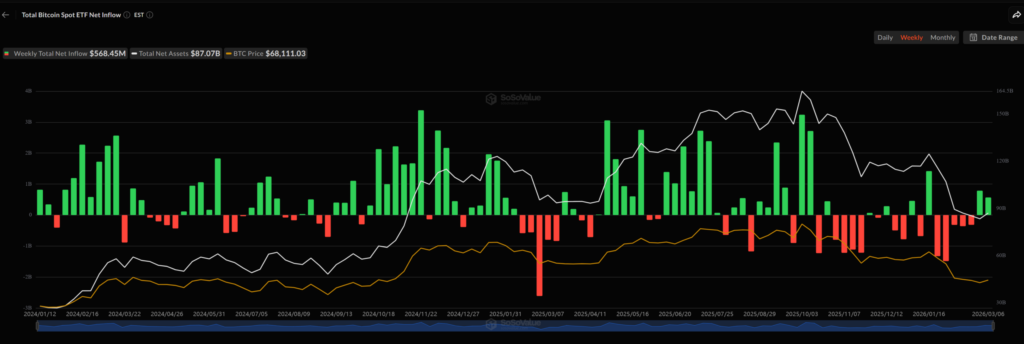

US spot Bitcoin exchange-traded funds (ETFs) have recorded their second consecutive week of net inflows, a significant development marking the first back-to-back weekly gains for these products in five months. This positive trend suggests a potential resurgence of investor appetite for Bitcoin exposure following a period of sustained outflows that saw billions of dollars withdrawn from these investment vehicles.
According to data compiled by SoSoValue, a prominent analytics platform, spot Bitcoin ETFs attracted approximately $568.45 million in net inflows during the most recent reporting week. This follows a robust previous week, which saw inflows of about $787.31 million. The cumulative positive flow over these two weeks indicates a discernible shift in market sentiment, moving away from the cautious stance that characterized the preceding months.
A Period of Correction and Recovery for Bitcoin ETFs
Before this recent turnaround, the landscape for US spot Bitcoin ETFs was marked by significant investor withdrawals. For five consecutive weeks, these funds experienced cumulative outflows totaling roughly $3.8 billion. The most substantial weekly withdrawal during this prolonged downturn occurred in the week ending January 30, when spot Bitcoin ETFs collectively shed approximately $1.49 billion. This period of sustained redemptions had raised questions about the long-term demand for Bitcoin-based investment products.
The recent inflows, however, paint a different picture. The renewed positive momentum is not only a sign of increased investor interest but also a potential indicator of a stabilizing or recovering market for digital assets. The first week of positive inflows, ending March 15, saw $787.31 million pour into these ETFs, a figure that the subsequent week’s $568.45 million continues to build upon. This consistent inflow pattern, even if fluctuating daily, suggests a growing conviction among investors.
Daily Flows Reveal Market Dynamics
Examining the daily flows provides a more granular view of the market’s behavior during the latest reporting week. Monday saw a strong start with inflows amounting to $458.19 million. Tuesday continued this positive trend with an additional $225.15 million. The momentum appeared to strengthen further on Wednesday, with the ETFs attracting a notable $461.77 million.
However, the latter half of the week presented a more mixed picture. Thursday witnessed a reversal, with $227.83 million in outflows, indicating some profit-taking or reallocation by investors. This trend continued into Friday, which saw further redemptions totaling $348.83 million. Despite these outflows towards the end of the week, the overall net inflow for the entire week remained positive, underscoring the strength of the earlier inflows. This daily volatility is not uncommon in the cryptocurrency market and often reflects short-term trading strategies and responses to market news.

Ether ETFs Also Show Signs of Life
The positive trend extends beyond Bitcoin. US spot Ether (ETH) ETFs also experienced their second consecutive week of net inflows, mirroring the performance of their Bitcoin counterparts. These Ether-based funds attracted approximately $23.56 million in net inflows this week, following a prior week’s inflow of $80.46 million. This marks the first instance of back-to-back weekly gains for Ether ETFs since early October of the previous year.
Similar to Bitcoin ETFs, Ether ETFs had also endured a period of significant withdrawals prior to this recent rebound. Across five consecutive weeks, these funds saw cumulative outflows exceeding $1.38 billion. The most substantial weekly outflow for Ether ETFs during that streak occurred in the week ending January 23, when approximately $611 million was redeemed.
The daily flows for Ether ETFs also displayed variability. Monday saw inflows of $38.69 million, followed by a slight dip with $10.75 million in outflows on Tuesday. Wednesday provided a significant boost with $169.41 million in inflows, indicating a strong demand for Ether exposure on that day. However, like Bitcoin ETFs, the positive momentum appeared to wane towards the end of the week, suggesting that while investor interest is returning, it remains subject to market fluctuations.
Bitcoin ETFs Outpacing Gold ETFs in Adoption
A striking comparison has emerged regarding the adoption rate of Bitcoin ETFs relative to traditional gold ETFs. Fernando Nikolić, Blockstream’s director of marketing, highlighted in a recent post on X (formerly Twitter) that spot Bitcoin ETFs have managed to match approximately 15 years of cumulative inflows experienced by gold ETFs, all within less than two years of their own market debut. This is particularly noteworthy given that gold ETFs have had a significant head start of over a decade and a half in the investment landscape.
This remarkable feat occurred even during a period when Bitcoin experienced a substantial drawdown of 46% and several months of negative price performance. Nikolić’s analysis suggests that institutional demand for Bitcoin remained resilient and strong, even in the face of market volatility and price corrections. This resilience challenges traditional notions of asset behavior and highlights Bitcoin’s unique position in the modern financial ecosystem.
Nikolić further elaborated on the narrative comparing Bitcoin to gold, stating, "Anyone still arguing about whether bitcoin is ‘digital gold’ is wasting their breath. Bitcoin isn’t trying to be gold. Bitcoin is making gold look slow." This statement emphasizes the disruptive potential of Bitcoin and its ability to carve out its own distinct identity as a store of value and investment asset, potentially eclipsing the performance and adoption trajectory of established commodities.
Broader Implications and Market Analysis

The sustained inflows into both Bitcoin and Ether ETFs, coupled with the impressive comparison to gold ETF adoption, carry significant implications for the broader cryptocurrency market and traditional finance.
-
Institutional Adoption and Maturation: The consistent inflows, especially after a period of outflows, signal a growing comfort level among institutional investors with digital asset exposure through regulated products. This suggests that the market is maturing, and traditional financial institutions are increasingly integrating cryptocurrencies into their investment strategies. The availability of ETFs has lowered the barrier to entry for many investors who may have previously been hesitant due to the technical complexities or regulatory uncertainties associated with direct cryptocurrency ownership.
-
Demand Drivers and Market Sentiment: The renewed investor appetite can be attributed to several factors, including the anticipation of potential interest rate cuts by central banks, a general improvement in macroeconomic sentiment, and the ongoing narrative of Bitcoin as a potential inflation hedge and a scarce digital asset. The price action of Bitcoin itself plays a crucial role; periods of price appreciation often attract more investment, creating a positive feedback loop. Conversely, significant price drops can lead to outflows as investors de-risk. The current inflows suggest that the underlying demand drivers are strong enough to overcome recent price volatility.
-
The "Digital Gold" Narrative Revisited: The comparison to gold ETF inflows is particularly compelling. Gold has historically been considered the ultimate safe-haven asset and a hedge against inflation. For Bitcoin ETFs to achieve such rapid adoption in a fraction of the time highlights the increasing acceptance of Bitcoin as a comparable, and in some aspects, superior, store of value. This doesn’t necessarily mean Bitcoin will replace gold, but it strongly suggests that it is carving out a significant and growing niche in the alternative asset class. The argument that "Bitcoin is making gold look slow" points to its digital nature, accessibility, and potential for faster value appreciation in certain market conditions.
-
Regulatory Landscape and Future Outlook: The success of these spot ETFs is also a testament to the evolving regulatory landscape. The approval of spot Bitcoin ETFs in the US was a watershed moment, legitimizing the asset class for a wider range of investors. As more institutional capital flows into these products, it can lead to increased price discovery, liquidity, and further integration of cryptocurrencies into the global financial system. The positive performance of Ether ETFs also suggests a growing interest in other major cryptocurrencies beyond Bitcoin, potentially paving the way for further ETF approvals for other digital assets.
-
Investor Behavior and Market Cycles: The cyclical nature of inflows and outflows in crypto ETFs is a key observation. The recent period of outflows demonstrated investor caution, possibly triggered by market corrections or shifts in risk appetite. The subsequent inflows indicate a rebound in confidence. This pattern is typical of many asset classes, but the speed and magnitude of these shifts in the crypto space can be more pronounced. Understanding these cycles is crucial for investors seeking to navigate the volatile cryptocurrency market.
The sustained positive flows into US spot Bitcoin ETFs, for the second consecutive week, represent a significant milestone. This trend, coupled with the similar positive performance of Ether ETFs and the striking comparison to gold ETF adoption rates, points towards a maturing market and a growing acceptance of digital assets among institutional and retail investors alike. While daily flows may fluctuate, the overall trajectory suggests a renewed conviction in Bitcoin and cryptocurrencies as viable investment vehicles, potentially reshaping the future of asset allocation and investment strategies. The ongoing performance of these ETFs will be closely watched as indicators of broader market sentiment and the continued integration of digital assets into the mainstream financial world.