


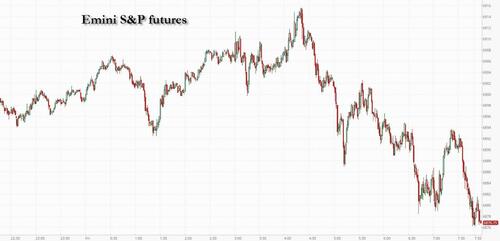
US equity futures are once again trading in negative territory, hovering near session lows and poised to extend Thursday’s significant losses, as the market grapples with a deepening sense of uncertainty surrounding the artificial intelligence (AI) trade. The spectacular plunge in momentum stocks, triggered by Nvidia’s post-earnings/guidance dip, has sent ripples through investor confidence, raising questions about the sustainability and future trajectory of the AI revolution. As of 8:00 AM ET, S&P futures were down 0.6%, setting the stage for a monthly loss following a tumultuous February. Nasdaq futures, heavily weighted by technology, saw a sharper decline of 0.7%, reflecting intensified pressure on growth stocks. The month has been defined by a dual apprehension: the specter of an AI bubble and the profound disruptive potential of the technology itself.
The narrative surrounding AI continues to present a series of contradictions. In one striking example, data center operator CoreWeave saw its shares plummet 12% after reporting a larger-than-expected loss and projecting higher capital expenditure, fueling concerns about potential overspending on the crucial infrastructure required for AI. Conversely, Dell Technologies surged an impressive 12% after its sales outlook for AI servers comfortably surpassed analyst estimates, indicating robust demand for the specialized machines essential to the burgeoning AI data center build-out. This divergence underscores the market’s ongoing struggle to differentiate between genuine growth and speculative excess within the AI ecosystem.
Beyond equities, the broader financial landscape reflected a cautious mood. The benchmark 10-year Treasury yields slid below the psychologically significant 4% mark, indicating a flight to safety, while the US Dollar remained largely flat against a basket of major currencies. Commodities presented a mixed picture, with energy prices ticking higher, while metals saw varied performance; silver outperformed, even as gold traded flat. Today’s macroeconomic calendar features key data releases, including the Producer Price Index (PPI) and Construction Spending, which investors will scrutinize for further clues on inflation and economic activity.
The AI Paradox: Nvidia’s Setback and Sectoral Divergence
The catalyst for the recent market jitters can largely be traced back to Nvidia, a titan in the AI sector. Despite delivering what many considered to be record-breaking earnings and robust guidance, the chipmaker suffered its worst single-day decline since April on Thursday. This unexpected reaction suggested a critical shift in investor sentiment: even spectacular results from the world’s most valuable company were no longer sufficient to justify its premium valuation. The previous day’s significant sell-off in Nvidia, a bellwether for AI innovation and market enthusiasm, cast a long shadow over Friday’s trading, signaling that the "AI scare trade" — a period where the disruptive potential of AI and concerns over its valuation rattled markets — was far from over.
The "Magnificent Seven" cohort of mega-cap technology stocks, which have largely powered the S&P 500’s gains for years, exhibited a mixed performance in premarket trading. While Nvidia managed a modest rebound of 0.4% after its substantial Thursday slide, other giants mostly trended lower: Alphabet was little changed, Tesla dipped 0.2%, Amazon and Apple both fell 0.5%, Meta Platforms also saw a 0.5% decrease, and Microsoft registered the largest decline at 0.8%. This fragmented performance suggests investors are becoming more selective, moving away from a broad-brush approach to tech investing and scrutinizing individual company fundamentals and AI exposure more closely.
The contrasting fortunes of CoreWeave and Dell highlight the complex dynamics at play within the AI infrastructure segment. CoreWeave’s troubles, stemming from higher-than-anticipated losses and capital expenditures, point to the immense costs associated with building and operating the specialized data centers needed for AI workloads. Investors are clearly questioning the profitability and return on investment for these massive infrastructure projects. In stark contrast, Dell’s optimistic outlook for AI server sales underscores the voracious demand from enterprises and cloud providers for the hardware that fuels AI. This duality suggests that while the demand for AI capabilities remains robust, the supply-side economics of delivering that infrastructure are under increasing scrutiny, with potential winners and losers emerging.
Broader Market Undercurrents and Monthly Performance Review
The current market volatility comes at the close of a February that has seen US equities grapple with persistent fears of an AI bubble and the technology’s far-reaching disruptive power. The S&P 500, despite its resilience earlier in the year, is now set for a monthly loss, reflecting the erosion of gains driven by a few dominant tech names. This sentiment aligns with observations from analysts who have noted a lingering overvaluation in certain US asset classes.
Guillermo Hernandez Sampere, head of trading at asset manager MPPM, articulated this concern, stating, "The outperformance highlights the possibility of a lingering overvaluation in some asset classes in the US, as well as doubts about the independence of the Federal Reserve’s future monetary policy." This perspective suggests that investors are not only wary of inflated tech valuations but also keeping a close eye on the Fed’s stance amidst evolving economic data. Such doubts often prompt a rotation into markets abroad and companies tied to broader, more traditional economic growth, a trend that has become increasingly visible. Sampere added, "Barring an economic downturn in Europe, the outperformance should continue," hinting at a potential shift in global investment flows.
The broader earnings season, which is set to conclude next week, has added another layer of complexity. So far, the results have been somewhat underwhelming, with the fewest S&P 500 companies beating estimates since 2022. Of the 481 companies that have reported to date, 73.4% have surpassed forecasts, while nearly 22% have fallen short. This suggests that while a majority are still clearing the bar, the breadth of outperformance is narrowing, potentially indicating a more challenging environment for corporate profitability.

Macroeconomic Data and Federal Reserve Outlook
Today’s economic data slate is crucial for market participants attempting to gauge the trajectory of inflation and the Federal Reserve’s monetary policy path. The January Producer Price Index (PPI), scheduled for release at 8:30 AM ET, will provide insights into price trends before they reach consumers. PPI data feeds directly into the Fed’s preferred inflation gauge, the Personal Consumption Expenditures (PCE) index. Bloomberg Economics forecasts that producer price inflation likely slowed to 0.2% in January, down from 0.5%. A softer PPI reading could bolster the case for further interest rate cuts by the Federal Reserve later in the year.
Following PPI, the February MNI Chicago PMI (9:45 AM ET) will offer a snapshot of manufacturing activity in the Midwest, while December Construction Spending (10:00 AM ET) will provide details on investment in new structures. Finally, the February Kansas City Fed services activity index (11:00 AM ET) will round out the day’s economic releases. No Federal Reserve speakers are scheduled, meaning market reactions will be purely data-driven. The recent slide in 10-year Treasury yields, which tumbled 26 basis points in February to 3.98%, marks its best monthly performance in a year. This decline in yields reflects increased investor confidence in upcoming rate cuts, with swap traders adding to bets on a July move being almost fully priced after a brief scaling back earlier this week.
Beyond AI: Corporate Maneuvers and Strategic Shifts
While AI dominated headlines, other significant corporate news also moved markets. Netflix, the streaming giant, saw its shares rise more than 7% after it reportedly withdrew from the bidding war for Warner Bros., a strategic move that could be interpreted as a focus on organic growth and content creation rather than costly acquisitions.
In a move that sparked considerable debate, Jack Dorsey’s financial technology firm, Block, announced plans to cut 4,000 employees, nearly half its workforce. The company attributed these layoffs, in part, to a bet on AI changing the future of labor productivity. However, this explanation has been met with skepticism by some, who point to previous instances of corporate bloat and management issues. Critics highlighted that Block had reportedly spent $68 million on a party just months before the mass layoffs, drawing parallels to Elon Musk’s drastic workforce reductions at Twitter (Dorsey’s previous company) which thrived despite the cuts. This narrative suggests that while AI may indeed reshape labor markets, the immediate cause of some layoffs might be more rooted in operational inefficiencies and management decisions rather than solely technological disruption.
Looking ahead, the investment community eagerly awaits Berkshire Hathaway’s annual report, due on Saturday. This year’s report holds particular significance as it will include Greg Abel’s first annual letter to shareholders detailing performance since he assumed the CEO role from the legendary Warren Buffett. This will offer an initial glimpse into the strategic direction under Abel’s leadership.
Mounting Concerns in Private Credit Markets
Beneath the surface of public equity markets, unease surrounding the private credit sector continues to intensify. Following the widely publicized collapse of First Brands, another "spectacular new private credit blowup" in London has reportedly sent Wall Street chasing billions, indicating a potential contagion risk. Further compounding these concerns, a private credit fund overseen by Apollo Global Management recently cut its dividend and marked down the value of its assets, citing signs of strain in parts of its loan book.
These incidents underscore growing worries about the opacity and potential vulnerabilities within the rapidly expanding private credit market. As traditional banks have pulled back from certain lending areas, private credit funds have stepped in, offering financing to companies that might not qualify for conventional loans. While this has provided crucial capital, it also raises questions about the underwriting standards, leverage levels, and liquidity risks embedded within these less regulated corners of the financial system. The persistence of these blowups suggests that the market’s initial unease about private credit is well-founded and warrants close monitoring.
Global Market Landscape: Resilience and Rotation
While US markets faced headwinds, European and Asian markets presented a more nuanced picture, with some regions demonstrating notable resilience and even outperformance. Europe’s Stoxx 600 index was on track for its eighth consecutive monthly advance, marking its longest such streak in over a decade. Telecommunications and mining stocks led the gains, while travel and consumer products shares edged lower. Major movers included Swiss Re, which rose 3.6% after reporting a 47% year-over-year rise in 2025 net profit and announcing a $500 million share buyback. Spain’s Cellnex saw its 2025 operating profit more than double annually, while Telefonica reportedly negotiated the purchase of 1&1 in Germany in a €5 billion deal, sending its shares up 3.7%. Even British Airways parent IAG, despite a dip, beat FY profit expectations and announced a €1.5 billion share buyback.
Andrea Tueni, head of sales trading at Saxo Banque France, highlighted Europe’s advantageous position: "Europe is currently better positioned than the US and outperforming as its tech sector is much smaller and there is much less uncertainty on monetary policy." This perspective suggests that Europe’s relative insulation from the highly concentrated US tech sector and a clearer monetary policy outlook are contributing to its appeal.
Asian stocks traded mixed but demonstrated overall strength, with a key regional benchmark poised to close its best February on record. The MSCI Asia Pacific Index gained as much as 0.6% on Friday, benefiting from investor appetite for the region’s AI infrastructure companies. The index is up 6.7% this month, on track for its best February since its inception in 1998. This performance underscores the region’s role as a significant beneficiary of the global AI buildout, particularly its hardware firms, despite growing concerns over spending levels and business disruption.
However, not all Asian markets shared equally in the gains. South Korea’s Kospi fell 1%, with major chipmakers Samsung and SK Hynix experiencing declines. Chinese technology stocks in Hong Kong capped their worst month in two years, weighed down by weak earnings and a lack of buying from mainland investors. Sentiment toward China’s internet giants has cooled amidst concerns over valuations and rising competition eroding corporate bottom lines. In a notable development, global investors offloaded nearly $5 billion of South Korean equities on Friday, signaling profit-taking after the equity benchmark rallied nearly 50% this year, pushing past the 6,000 threshold.
Commodities and Currencies: A Patchwork of Performance
In currency markets, the US dollar was set for its fourth consecutive monthly loss, indicating a broader weakening trend against other major currencies. The Norwegian Krone led the G10 currencies with a 0.54% rise. The British pound, however, edged slightly lower against the dollar following a special election in the UK that reportedly laid bare the unpopularity of Prime Minister Keir Starmer’s government.
Commodities presented a mixed but generally stable picture. Oil prices rose again on Friday, recovering some ground after sliding on Thursday, reflecting ongoing supply-demand dynamics and geopolitical considerations. Gold traded flat, but prices remained on track for an impressive seventh consecutive monthly advance, underscoring its role as a safe-haven asset amidst global uncertainties. Silver outperformed gold, indicating specific industrial demand or short-term speculative interest.
The cross-asset movements reflect a sustained demand for havens, influenced by a confluence of factors including policy uncertainty emanating from the Trump administration, ongoing tensions in the Middle East, and lingering questions about the underlying strength of US economic growth.
Expert Perspectives and Future Outlook
The current market environment is characterized by a complex interplay of enthusiasm for transformative technology and apprehension about its immediate economic implications and valuation. Strategists led by Michael Hartnett at BofA foresee international stocks outperforming US equities for the remainder of this decade, a sentiment echoed by others who point to potential overvaluation in US markets.
The ongoing "AI scare trade" underscores the market’s attempt to reconcile the immense potential of AI with its disruptive power, particularly concerning job displacement. While some, like Jack Dorsey’s Block, cite AI as a reason for workforce reductions, the broader debate about the technology’s true impact on labor productivity versus other factors like corporate bloat remains open.
The market’s unease is palpable, yet not indicative of an imminent collapse for all. Andrea Tueni of Saxo Banque France noted, "I don’t see any major correction coming, but any hint of a recession linked to AI in the US would certainly trigger some unpleasant trading." This cautious optimism suggests that while volatility is expected, a full-blown downturn would likely require a more definitive economic catalyst, potentially one tied to the AI narrative itself.
As February draws to a close, investors are left navigating a volatile landscape where the promise of AI is tempered by questions of valuation, the sustainability of infrastructure spending, and its broader economic ramifications. The divergence in corporate performance, the shifting sands of global market leadership, and persistent concerns in niche financial sectors like private credit all contribute to an environment demanding careful analysis and strategic positioning for the months ahead. The market’s rollercoaster ride continues, reflecting a deep recalibration as the world adjusts to the accelerating pace of technological change and its economic consequences.