

For real estate professionals navigating the complex landscape of data-driven decision-making, the cost of accessing crucial information often becomes a pivotal factor, following the evaluation of features and dataset comprehensiveness. Investors, burgeoning PropTech companies, and established analytics teams require transparent and predictable cost structures before integrating Application Programming Interfaces (APIs) into their core workflows. This is particularly critical when anticipating scalability and planning for long-term, evolving data demands. Recognizing this industry-wide challenge, Mashvisor has introduced a revamped API pricing model designed to offer unparalleled clarity and flexibility through a usage-based structure, moving away from the often restrictive and opaque fixed monthly licensing fees common in the market. This strategic shift directly addresses the need for predictable expenditure, aligning costs with the actual volume of data extracted and supporting a diverse spectrum of applications, from granular investment property analysis and rigorous real estate underwriting to sophisticated short-term rental revenue modeling and crucial Debt Service Coverage Ratio (DSCR) checks.
The impetus for this pricing evolution stems from observed industry trends. Traditional data licensing models often necessitate significant upfront investment and can lead to substantial overspending if actual data utilization falls short of contracted volumes. This rigidity can stifle innovation, particularly for startups and smaller firms with limited capital, and create budgetary uncertainties for larger enterprises undergoing expansion. By adopting a usage-based approach, Mashvisor aims to empower its clients, allowing them to scale their data access efficiently and economically as their business needs grow over time, ensuring they only pay for what they use and derive tangible value from their data investments.
The Mechanics of Mashvisor API Pricing: A Paradigm Shift
Mashvisor’s API pricing model is meticulously engineered to deliver both transparency and adaptability, granting businesses the precise control they need over their real estate data consumption without the burden of fixed, often inflexible, monthly expenditures. In stark contrast to conventional data packages that frequently lead to overpayment for unused capacity, Mashvisor champions a usage-based framework. This innovative approach renders the API’s cost structure accessible and advantageous for a broad array of users, ranging from nascent startups meticulously testing market viability to seasoned real estate analytics platforms managing intricate and high-volume workflows.
The company offers both monthly and annual subscription options, with the latter providing a distinct financial advantage by including several months of access free of charge each year, thereby enhancing overall value. API access is designed to be accessible, with entry-level plans starting at approximately $129 per month for users with modest data requirements. The precise cost determination is contingent upon individual usage metrics and is finalized through a personalized demo consultation. This consultative approach ensures that prospective clients gain a comprehensive understanding of the Mashvisor API’s functionalities and that their selected plan precisely aligns with their organization’s specific operational and strategic objectives.
Decoding the Credit-Based Pricing Model
At its core, the Mashvisor API’s cost model operates on a credit-based system, where usage is meticulously tracked through API calls aggregated on a monthly basis. Each distinct request made to an API endpoint consumes a portion of the allocated credits within the monthly subscription plan. This methodology starkly contrasts with traditional real estate data licensing agreements, which typically demand substantial upfront financial commitments. The credit-based structure, conversely, facilitates a gradual ramp-up, allowing users to commence with smaller workloads and progressively expand their data utilization as their analytical needs and operational scale increase.
Crucially, all subscription plans afford unrestricted access to the comprehensive Mashvisor API documentation and every available endpoint. This ensures a consistent level of functionality across all pricing tiers, with the primary differentiator being the scaling capacity of monthly call limits. Consequently, professionals and enterprises can acquire the precise data required for vital functions such as in-depth market research, detailed investment property analysis, competitive rental comparable (comps) intelligence, and sophisticated short-term rental revenue modeling. This model effectively eliminates the financial penalty of paying for data access that remains unutilized, fostering a more cost-efficient and results-oriented approach to data acquisition.
Determinants of API Pricing
Several key factors directly influence the final cost of utilizing the Mashvisor API. It is imperative for businesses to thoroughly understand the impact of these variables to accurately forecast their total expenditure before initiating integration. The primary indicators that shape the Mashvisor real estate data API pricing include:
- Volume of API Calls: The sheer number of requests made to the API per month is the most significant driver of cost. Higher request volumes translate to higher credit consumption.
- Type of Data Requested: While most endpoints consume a standard credit, certain highly data-intensive or specialized queries might have a slightly different credit allocation, though this is consistently communicated within the documentation.
- Subscription Term (Monthly vs. Annual): Opting for an annual subscription typically provides a cost savings compared to month-to-month billing, reflecting a commitment to longer-term partnership.
- Customization and Support Needs: While standard plans cover most use cases, enterprise-level clients with unique integration requirements or exceptionally high data demands may engage in custom package negotiations that could include dedicated support.
Given the wide variability in pricing based on specific data point utilization, Mashvisor provides a spectrum of flexible packages and custom options tailored to meet the diverse needs of both agile startups and large-scale enterprises. This ensures that the financial investment is directly aligned with the measurable business outcomes derived from the API.
For the most accurate estimation of expected costs and to leverage the full benefits of the Mashvisor API, consulting directly with their Data Experts is recommended. Scheduling a complimentary demo is the most effective way to ascertain the optimal plan for a company’s unique business requirements.
Navigating Mashvisor API Pricing Tiers: A Practical Guide
Following a theoretical understanding of the Mashvisor API’s pricing mechanics, it’s essential to examine how this structure translates into tangible subscription tiers designed to accommodate varying levels of data usage. Mashvisor has strategically developed four distinct API plans, each calibrated around specific monthly request volumes. The fundamental difference among these subscription tiers lies in the number of API calls allocated, empowering businesses to select the tier that most closely aligns with their operational scale and analytical demands. Importantly, regardless of the chosen tier, all plans grant comprehensive access to all available endpoints and complete documentation, ensuring consistent functionality and depth of data.
The following table provides a clear visualization of the four Mashvisor API pricing tiers:
| Plan | Best For | Monthly API Calls | Typical Users | Common Use Cases |
|---|---|---|---|---|
| Starter | Testing & validation | 500 | Investors & developers | Testing & prototypes |
| Professional | Growing analytics tools | 1,000 | Small startups | Analytics dashboards |
| Growth | Scalable platforms | 3,000 | SaaS products | Production analytics |
| Enterprise | Large-scale apps | 10,000+ | Large platforms | Marketplaces & underwriting |
This tiered structure is designed to scale seamlessly with a business’s evolving needs, ensuring that as data requirements increase, so too can API access without disruptive pricing shifts.
Selecting the Optimal Tier for Your Requirements
Choosing the most appropriate Mashvisor API plan hinges primarily on the frequency with which your application will access data and the depth of analytical integration within your operational workflows. The following guidelines can assist in estimating which tier might serve as the most suitable starting point:
- Starter Tier: Ideal for individual investors, small development teams, or businesses in the early stages of exploring API integration. It’s perfect for initial testing, building proof-of-concept applications, and validating data feasibility with a limited scope. With 500 monthly calls, it provides enough capacity to explore core functionalities without significant financial commitment.
- Professional Tier: Suited for small startups or businesses that have moved beyond initial testing and are developing functional analytics dashboards or client-facing tools that require more regular data access. The 1,000 monthly calls offer a balance for growing operational needs, supporting more robust reporting and analysis.
- Growth Tier: Designed for SaaS products and established analytics platforms that require scalable data feeds for their production environments. With 3,000 monthly calls, this tier accommodates businesses with a consistent and substantial demand for real estate data, supporting multiple users or automated processes without performance bottlenecks.
- Enterprise Tier: Tailored for large-scale applications, expansive marketplaces, and intensive underwriting operations that necessitate significant data throughput. The 10,000+ monthly calls provide ample capacity for high-volume data retrieval, complex analytical models, and enterprise-wide data integration, ensuring that even the most demanding workflows are adequately supported.
Crucially, Mashvisor emphasizes maximum flexibility. Users can initiate their journey with one tier and seamlessly transition to a higher tier as their needs evolve, ensuring continuous alignment between data consumption and business objectives. The true value of the Mashvisor API becomes profoundly apparent when examining its practical application in real-world business scenarios.
Real-World Applications of Mashvisor API Pricing
The pricing tiers of the Mashvisor real estate API are fundamentally structured around how businesses actively utilize market and property data within production environments. This approach allows companies to scale their data access in direct correlation with their operational workflows, whether they are analyzing individual rental properties or powering complex, large-scale analytics platforms. The following examples illustrate how diverse organizations effectively match their API access needs with specific business goals:
Investment Property Analysis Applications
PropTech platforms and specialized investor tools leverage the Mashvisor API to automate the intricate process of rental property analysis. This includes calculating expected returns, such as cash-on-cash return and cap rate, and facilitating the comparison of investment opportunities across diverse markets. Instead of engaging in laborious manual data collection and organization, these applications can programmatically retrieve rental estimates, critical property metrics, and valuable market insights through what is recognized as a leading real estate data API. This workflow typically involves recurring queries as users explore markets or evaluate specific listings, making the usage-based pricing model exceptionally effective for investment property analytics.
A sample API request for property data might look like this:
GET /property?address=Miami&state=FL
Authorization: Bearer API_KEY
Short-Term Rental Revenue Modeling
Short-term rental (STR) platforms and dedicated analytics teams utilize the Mashvisor Airbnb data API to meticulously model STR performance, forecast revenue potential, and analyze market demand and supply dynamics. Access to historical performance data is paramount for applications aiming to accurately estimate Airbnb occupancy rates and average daily rates (ADR) across various geographic locations. Given that this type of analysis often operates automatically across a multitude of properties, the usage of the Airbnb API naturally scales in tandem with business expansion. The Mashvisor Airbnb data API pricing is specifically designed to accommodate this reality, ensuring cost-effectiveness as operations grow.
A sample API request for historical Airbnb performance data:
GET /airbnb/historical-performance?city=Austin
Further exploration into the Mashvisor Airbnb occupancy rate API is highly recommended, as this metric is a primary determinant of STR revenue.
DSCR and Lending Underwriting Automation
Lenders and FinTech platforms integrate real estate data APIs to streamline their underwriting processes and facilitate accurate DSCR calculations. By programmatically accessing rental income estimates and comparable property data, teams can significantly reduce manual analysis efforts while simultaneously standardizing investment evaluations and underwriting real estate processes. For investment property lenders, API usage directly correlates with loan volume, making scalable property data API pricing models particularly advantageous for underwriting automation.
A sample API request to fetch rental estimates for underwriting purposes:
GET /rental-estimates?property_id=12345&strategy=traditional
Authorization: Bearer YOUR_API_KEY
Accept: application/json
The rent estimate returned by this request can be used to compute Net Operating Income (NOI) and subsequently perform a DSCR check within an underwriting model.
Rental Comps Analysis and Market Benchmarking
Real estate investors and analytical PropTech platforms rely heavily on comparable real estate and rental data to accurately assess pricing strategies and validate investment assumptions. The Mashvisor API empowers these applications to programmatically retrieve comparable property performance data and neighborhood-level benchmarks, enabling users to determine whether projected returns align with prevailing local market conditions. The process of real estate and rental comps analysis is inherently iterative, often involving repeated queries across numerous properties and markets. Usage-based API pricing allows businesses to efficiently scale these workflows without being locked into rigid, fixed data packages.
A sample API request to retrieve rental comps data:
GET /rental-comps?property_id=12345
Real Estate Marketplaces and Data Platforms
Property marketplaces and comprehensive analytics platforms integrate the Mashvisor API to enrich their listings with critical investment insights, detailed neighborhood analytics, and precise rent projections. These integrations necessitate continuous background queries that dynamically update data as users browse properties. For such businesses, API usage naturally expands with platform adoption, providing a foundation for long-term growth without requiring significant pricing restructures.
A sample API request to enrich a property listing with investment metrics:
GET /property/analysis?address=Miami&state=FL&strategy=airbnb
Authorization: Bearer YOUR_API_KEY
Accept: application/json
This request retrieves detailed investment analytics for a specific property, enabling platforms to enhance their listings with vital metrics such as estimated rental income, occupancy rates, and projected Return on Investment (ROI).
While these examples highlight some of the most prevalent applications of the Mashvisor API, its utility extends far beyond these specific use cases. Teams frequently integrate the API into market research tools, automated investment screening systems, comprehensive portfolio monitoring dashboards, and bespoke real estate analytics solutions, thereby adapting data access to their unique operational and product development needs.
Comparative Analysis: Mashvisor API Pricing vs. Competitors
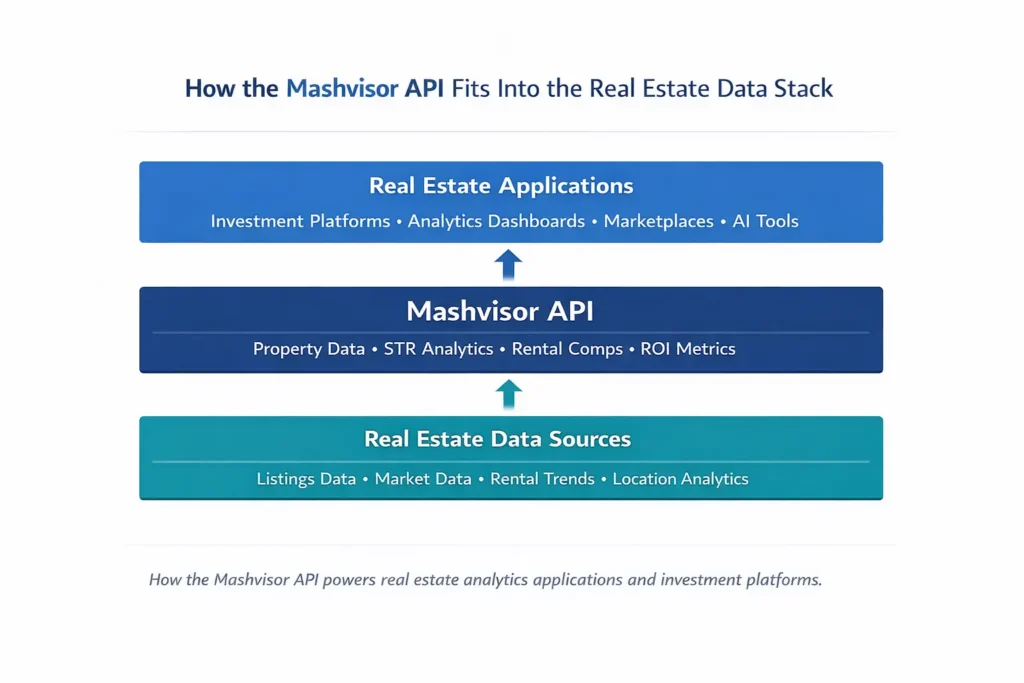
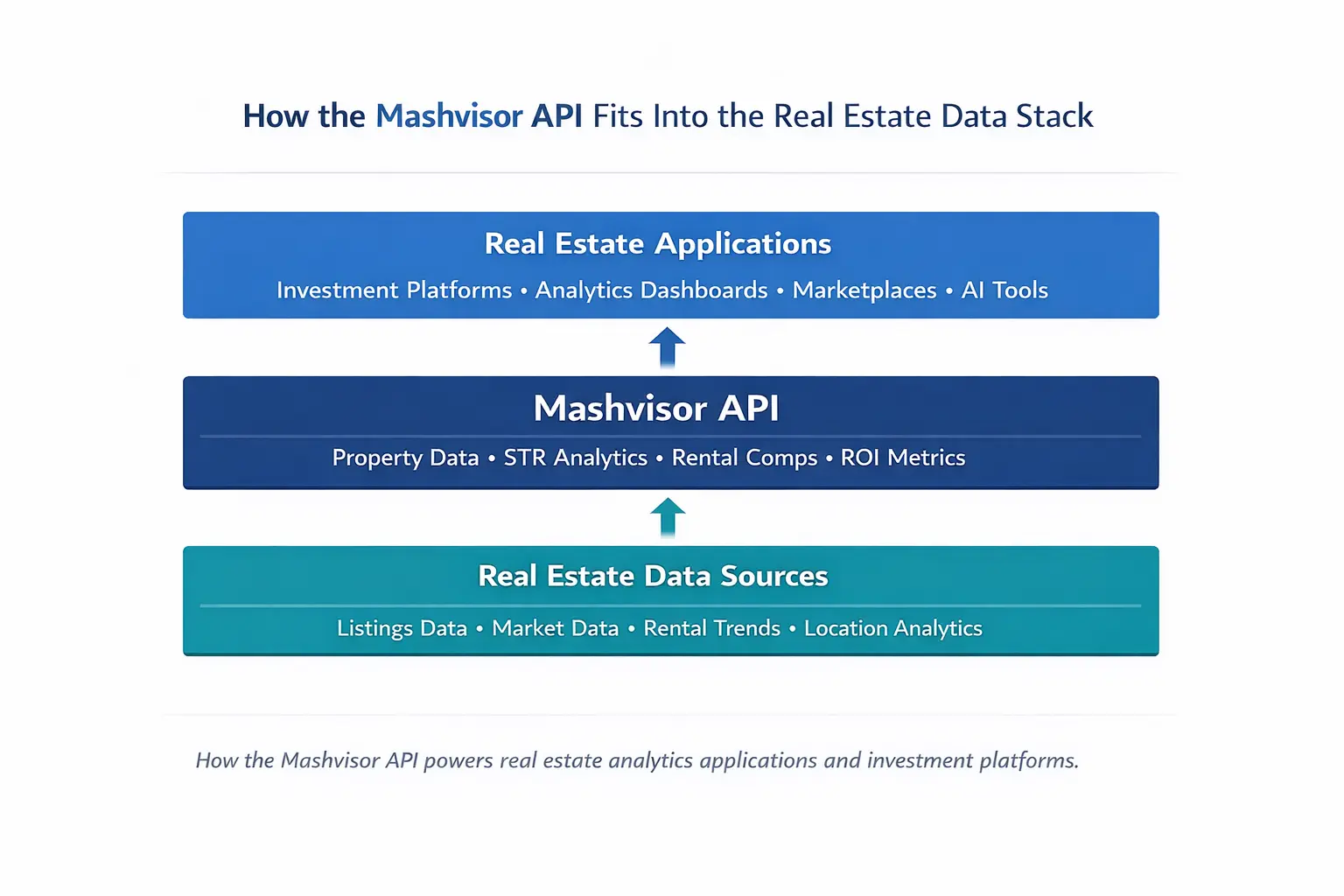
A thorough evaluation of real estate data API pricing necessitates a comparative understanding of how Mashvisor’s model stacks up against other prominent providers in the market. Platforms like Zillow and AirDNA, while offering valuable datasets, are often designed with different primary objectives, influencing their cost structures and access models. Zillow primarily focuses on property lookup and listing data, whereas AirDNA specializes in short-term rental analytics. Mashvisor, in contrast, offers a unified API that integrates property records, rental analytics, comps, and performance trends into a single, cohesive offering.
This holistic approach not only impacts the breadth of available datasets but also fundamentally influences how businesses scale their data usage and manage costs over time. The following table presents a comparative overview of the investment property API pricing offerings from these three key providers:
| Feature | Mashvisor | Zillow | AirDNA |
|---|---|---|---|
| Best For | Investment platforms, Property search, analytics tools & listing apps | Property search & listing apps | STR operators & market research |
| Primary Focus | Property listings, home values, STR & LTR analytics, comps, investment metrics | Property listings & home values | Short-term rental analytics |
| Pricing Model | Credit-based usage model | Access-restricted or partnership-based | Subscription-based market access |
| Scalability | High – scales with usage | Limited for analytics workflows | Moderate – tied to market scope |
Mashvisor’s API is actively utilized by PropTech startups, STR operators, and real estate analytics platforms in production environments. A key differentiator from the Zillow API and the AirDNA API is Mashvisor’s comprehensive integration of both property- and market-level data and analytics for both short-term and long-term rentals. This dual focus enables efficient rental analysis for investors employing diverse strategies. Furthermore, Mashvisor distinguishes itself with a flexible, transparent cost structure that is exclusively dependent on usage.
Estimating Your Mashvisor API Costs: A Step-by-Step Approach
Given Mashvisor’s usage-based pricing model for API access, accurately estimating the total API cost begins with a clear understanding of how the data will be integrated and utilized within your workflow or application. A significant advantage is that all four standard plans provide access to all endpoints and documentation, eliminating the need to select a plan based on feature sets alone.
The following steps provide a straightforward framework for estimating your likely Mashvisor API costs before formally requesting access:
Step 1: Define Your Data Use Case
The initial step involves clearly identifying how the API will serve your business operations. Internal research tools, investment analysis workflows, and customer-facing analytics platforms all generate distinct levels of API activity. Specifically:
- Internal Research: Analyzing market trends or evaluating potential acquisitions for internal decision-making.
- Automated Workflows: Powering algorithms that continuously screen properties, perform underwriting, or generate reports.
- Client-Facing Applications: Providing data-driven insights and tools directly to end-users, such as investors or property managers.
A precise definition of the use case is essential for establishing a realistic baseline for expected usage and, consequently, the associated costs.
Step 2: Estimate Monthly API Requests
The subsequent step involves approximating the frequency with which your application will interact with the API. Each request—whether it’s for retrieving property analytics, rental comps, or historical performance data—contributes to your monthly allocation. A simple estimation formula can be applied:
Estimated Monthly API Calls = (Number of Users or Automated Jobs) x (Average Requests per Session) x (Sessions per Month)
Even preliminary projections can effectively indicate whether a Starter, Professional, Growth, or Enterprise plan is most appropriate for your specific situation.
Step 3: Match Data Needs to a Pricing Tier
Once you have estimated your anticipated usage, you can align your projected request volume with the available Mashvisor API pricing tiers. As all plans offer comprehensive endpoint access, the decision primarily revolves around scale rather than functionality. Businesses often opt for a tier that supports their current workloads while incorporating a buffer for anticipated growth as adoption increases or automation expands.
Step 4: Request a Custom Pricing Recommendation
After estimating your usage, the final and most crucial step is to request a personalized pricing consultation. Mashvisor provides tailored recommendations based on each user’s integration objectives, expected data volume, and long-term scaling strategies. Precise pricing details are typically shared during a demo session to ensure that businesses select a plan that is perfectly aligned with their real operational needs, rather than relying on generalized assumptions.
To receive personalized assistance and a custom quote, booking a free demo is highly recommended.
Who Mashvisor API is Best For (and Who It’s Not)
- Best For: PropTech startups, independent investors, real estate syndicators, mortgage lenders, institutional investors, property management firms, and real estate analytics platforms seeking scalable, transparent data solutions.
- Not Ideal For: Businesses with extremely low data needs that might be adequately met by manual research, or organizations requiring highly niche, specialized datasets not covered by Mashvisor’s comprehensive offering.
If you are uncertain about which tier best fits your specific use case, booking a brief 15-minute call with a Mashvisor expert can provide invaluable guidance. They can meticulously map your workflow to the most suitable plan, offering a no-pressure, no-upsell experience.
The Bottom Line: Scalability and Predictability in Real Estate Data
Understanding API costs is paramount for businesses that are developing data-driven real estate products or scaling their investment analysis workflows. Rather than adhering to rigid licensing structures, Mashvisor’s API pricing is intentionally designed around flexibility, enabling companies to precisely match their data access with actual usage patterns and operational growth trajectories.
Featuring tiered plans based on monthly API calls, universal access to all endpoints across every plan, and customizable packages for high-volume requirements, the Mashvisor API effectively supports a wide array of applications. These range from essential investor tools and sophisticated underwriting systems to advanced analytics platforms and seamless marketplace integrations. For organizations in pursuit of a scalable and robust real estate data infrastructure, this usage-based approach offers both predictable cost management and ample room for expansion as data requirements evolve.
For those eager to experience the practical application of the Mashvisor API before committing to a paid plan, a complimentary 1-week free trial, complete with 30 credits, is available.
Frequently Asked Questions About Mashvisor API Pricing
How Much Does the Mashvisor API Cost?
The cost of Mashvisor API plans begins at approximately $129 per month, with pricing determined exclusively by monthly API usage. The exact cost fluctuates based on the volume of requests and specific integration needs. Businesses receive personalized pricing recommendations during a demo to ensure the selected plan aligns precisely with their unique workflow and data requirements.
Is Mashvisor API Pricing Pay-per-Request?
Mashvisor employs a credit-based pricing model rather than a strict pay-per-request billing system. Each plan includes a defined monthly allocation of API calls, which enables teams to scale their usage predictably and avoid the unpredictable per-call costs sometimes associated with other real estate data API pricing models.
Does Mashvisor Offer Enterprise API Pricing?
Yes, in addition to standard tiered plans, Mashvisor provides Enterprise plans specifically designed for high-volume platforms and advanced analytics applications. Custom packages can also be developed for organizations with specialized use cases, exceptionally large datasets, or request volumes that exceed standard monthly allocations.
What Is Included in Mashvisor API Access?
All Mashvisor API plans grant comprehensive access to the full documentation and all available endpoints. This includes access to property analytics, rental comps, investment metrics, and historical performance data crucial for underwriting, DSCR analysis, and short-term rental revenue modeling workflows.
Is the Mashvisor API Worth the Cost?
For businesses that depend on automated investment analysis or require scalable real estate analytics capabilities, the Mashvisor API can deliver significant efficiency gains compared to manual data collection or the integration of multiple disparate data providers. Its usage-based structure empowers companies to start small and progressively expand their data access as their products or analytical needs mature.