
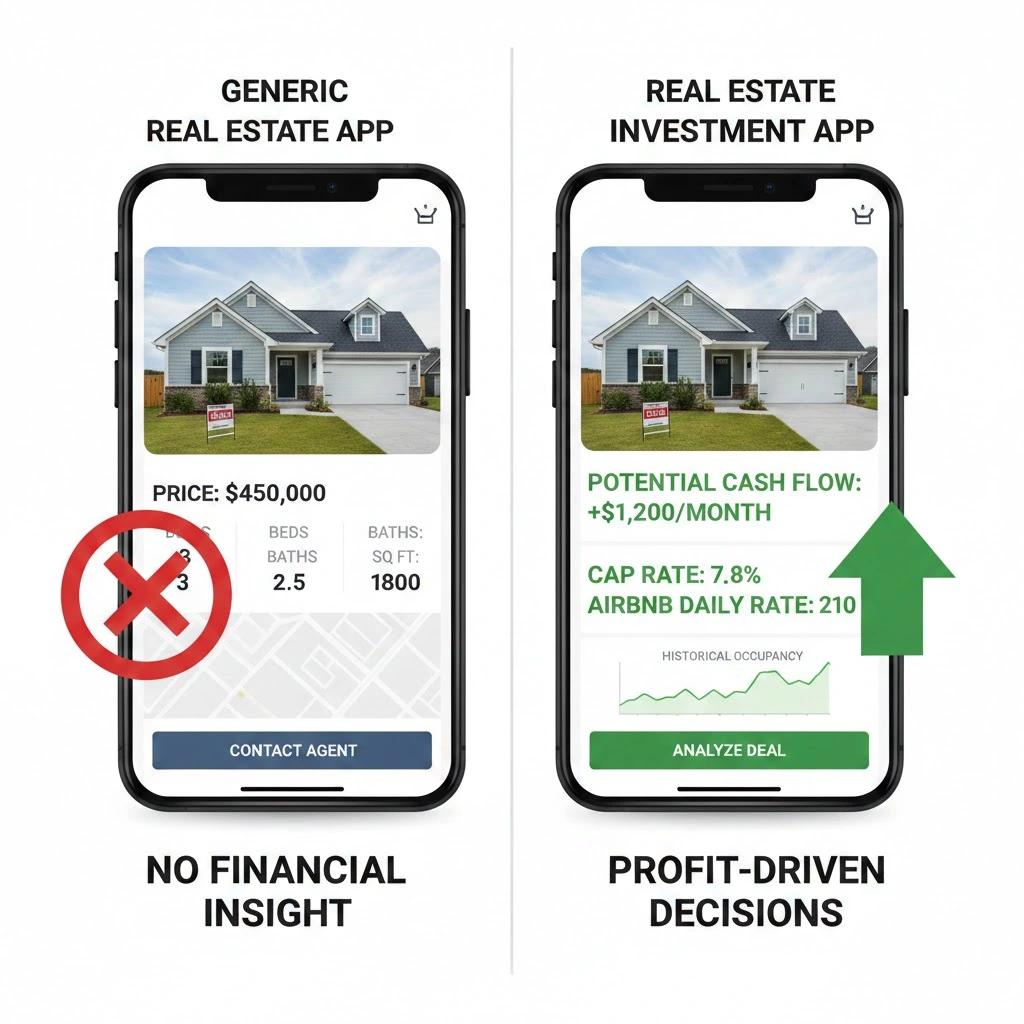

The landscape of real estate technology is undergoing a profound transformation, marking the definitive end of the era dominated by generic home search applications. For the past decade, the industry’s digital forefront was characterized by platforms primarily focused on showcasing property listings with photographs and pricing information. However, the market dynamics have dramatically shifted. Today, the real estate sector is increasingly driven by sophisticated investors rather than solely by prospective homebuyers. These discerning users no longer seek mere property aggregators; they demand powerful decision-making tools. This fundamental pivot from simple search functionalities to in-depth analytical capabilities presents a substantial opportunity for entrepreneurs and technology innovators. By developing specialized, niche investment platforms, founders can capture a high-value audience willing to invest in actionable data rather than browsing free, superficial content. This guide serves as a comprehensive blueprint for constructing a scalable and data-intensive real estate investment application, delving into product strategy, technical architecture, and proven monetization models.
The Strategic Pivot: Why Investment Grade Wins in a Crowded Market
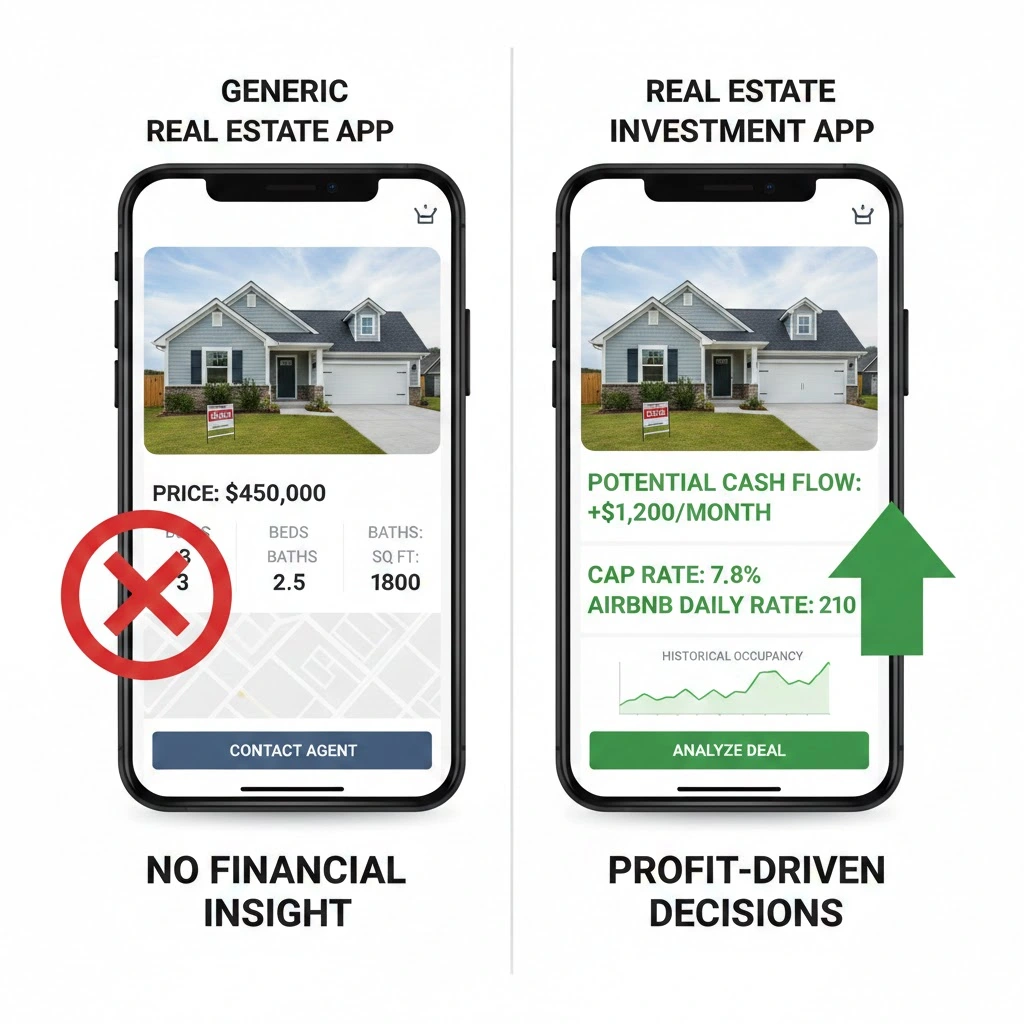
The vast majority of nascent real estate technology startups falter due to a misguided attempt to compete directly with established giants like Zillow on the sheer volume of property listings. This is an unwinnable strategy, given that Zillow commands extensive Multiple Listing Service (MLS) contracts and possesses billions of dollars in funding. Instead, successful PropTech ventures are carving out significant market share by prioritizing financial intelligence. While a generic application might present a three-bedroom house at a price point of $450,000, an investment-focused platform goes further, detailing the property’s 7.8% Cap Rate and its potential for $3,200 in monthly Airbnb revenue. The overarching objective shifts from merely assisting individuals in locating a residence to empowering them to underwrite a profitable asset. This strategic reorientation transforms the application’s backend from a passive repository of information into an active, dynamic tool for financial analysis and investment decision-making.
Core Features: Building an App Investors Will Rely On
To cultivate an application that resonates with real estate investors, developers must transcend basic search filters such as the number of bedrooms and bathrooms. The feature set must directly address the paramount question: "Will this property generate a return on investment?"
ROI-Driven Search Capabilities
Investors typically do not initiate their property search based on school districts or proximity to amenities. Their primary consideration is yield. Consequently, an effective investment application must incorporate filters that allow users to identify properties based on their financial performance metrics. This necessitates the ability to sort properties by key indicators such as Capitalization Rate (Cap Rate), Cash-on-Cash Return, and projected Occupancy Rates. This approach inverts the traditional search paradigm. Instead of starting with a desired location and hoping to discover a suitable deal, users can begin with a specific profit objective and then identify the geographical areas that align with their financial goals.
Interactive Heatmaps for Visualizing Investment Corridors
The sheer density of real estate data can be overwhelming, rendering a list of hundreds of properties difficult for human cognition to process effectively. The solution lies in visual intelligence. Implementing interactive heatmaps is crucial for visualizing "Investable Corridors." By overlaying profitability metrics and financial performance layers onto a geographical map, users can instantaneously identify neighborhoods exhibiting the highest potential Airbnb revenue or the most favorable price-to-rent ratios. This visual discovery layer often serves as the initial point of engagement for new users, guiding them towards promising opportunities.
The Deal Analyzer: A Retention Powerhouse
The Deal Analyzer represents a critical feature for user retention. Once an investor identifies a potential property, the ability to conduct a thorough financial evaluation is paramount. A dynamic calculator that allows users to toggle between traditional rental income strategies and short-term rental (e.g., Airbnb) scenarios is essential for determining which approach yields a superior return. The key to a truly effective analyzer lies in its customization. Moving beyond static default values, users should be empowered to input their specific financial parameters, such as mortgage rates, property management fees, and down payment percentages, to observe how these variables influence the projected Cash-on-Cash return. This level of personalized analysis fosters a deeper engagement and builds user confidence.
The Data Ecosystem: Deconstructing the Technology Stack
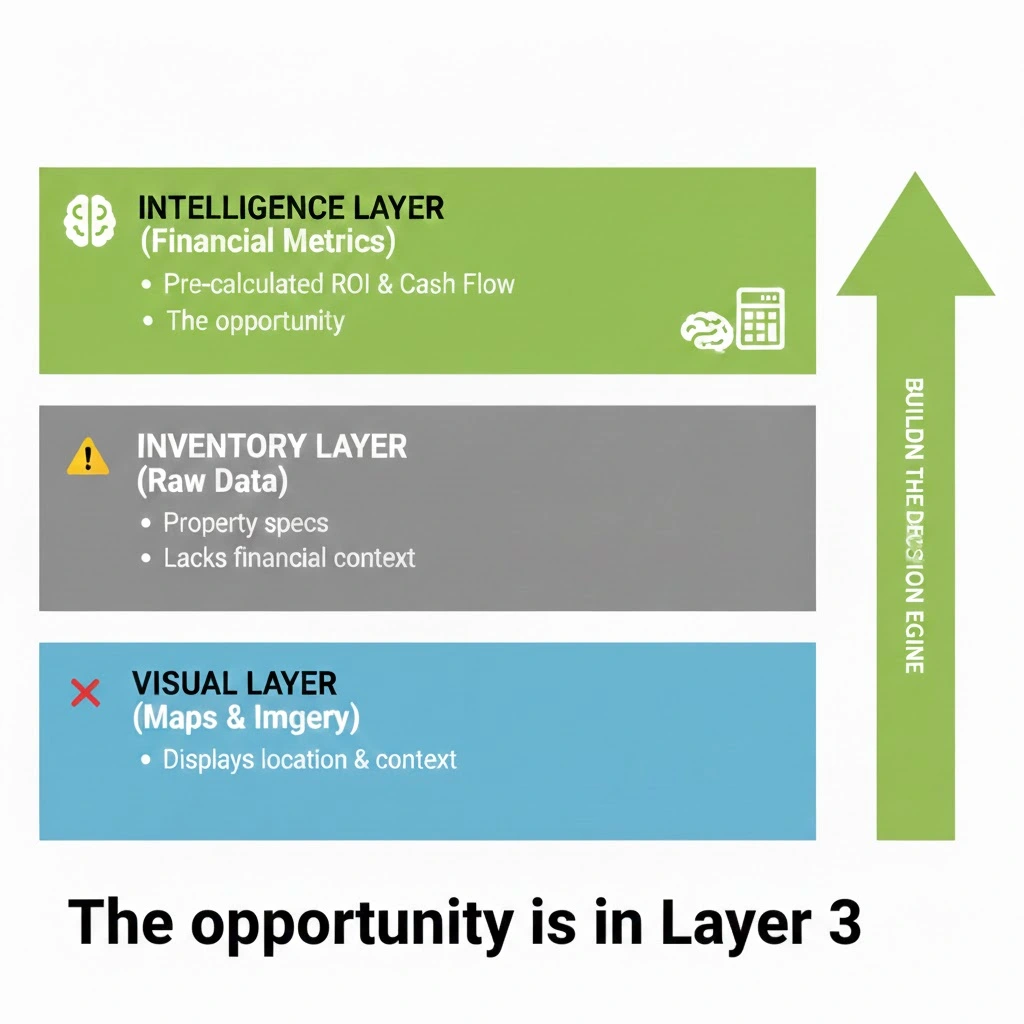
Before embarking on the coding process, a thorough understanding of the real estate data landscape is imperative. Many founders mistakenly assume that all real estate data is uniform. This assumption is a critical error. A modern real estate application is, in fact, a sophisticated stack comprising three distinct types of Application Programming Interfaces (APIs).
Type A: The Visual Layer APIs
These are foundational, commodity APIs, such as those provided by Google Maps or Mapbox. They are indispensable for accurately pinpointing property locations and offering street-level views. However, their utility diminishes significantly when it comes to assessing property value. While they can indicate a property’s proximity to a park, they cannot quantify how that proximity might enhance rental yield or overall profitability.
Type B: The Inventory Layer APIs
This layer provides access to raw listing data, including essential details like property address, square footage, and list price. While vital, this data is inherently incomplete for investment purposes. It confirms the existence of a property but offers no insight into its financial viability. Relying exclusively on this layer necessitates the establishment of extensive internal teams dedicated to data cleaning, normalization, and enrichment, a resource-intensive undertaking.
Type C: The Intelligence Layer APIs
This represents the crucial missing link that leads to the failure of approximately 90% of real estate applications. To construct a functional investment platform, access to pre-calculated financial metrics is indispensable. This includes detailed information on rental comparables, expense ratios, and historical occupancy rates for individual properties. The development of such a comprehensive dataset from scratch can consume years of dedicated engineering effort. Most founders encounter a roadblock at this stage, possessing mapping and listing data but lacking the essential investment logic and analytical frameworks.
The Master Architecture: A Top-to-Bottom Overview
To engineer a high-performance real estate investment engine, a departure from a rudimentary client-server model is required. A production-ready architecture necessitates a three-tiered approach that meticulously separates raw data ingestion from proprietary investment logic. This structured framework ensures that the application functions not merely as a data viewer but as a sophisticated financial analysis tool.

Tier 1: The Ingestion Tier (Data Sourcing)
This forms the foundational layer of the technology stack. Rather than relying on the development and maintenance of fragile web scraping mechanisms, the ingestion tier should leverage pre-normalized data through robust APIs. This approach ensures data accuracy, reliability, and efficiency.
Tier 2: The Logic Engine Tier (The Secret Sauce)
This intermediary service layer is where proprietary value is injected. It acts as a crucial bridge between the raw data provided by APIs and the end-user interface. This tier is responsible for the "user-context overlay," taking baseline API data and recalculating it dynamically based on user-specific inputs and preferences.
Tier 3: The Presentation Tier (The User Interface)
The apex of the architectural hierarchy is where the product vision is brought to life. This layer encompasses the user interface (UI) and user experience (UX) design, translating complex financial data into intuitive and actionable visualizations for the end-user.
The Request Lifecycle: From User Click to Financial Insight
To comprehend the intricate interplay between these architectural tiers within a live operational environment, examining the procedural execution flow of a single user session is illuminating. This sequence, akin to a "ladder" of events, effectively transforms raw data into actionable financial insights.
The Architecture Solution: Leveraging Infrastructure-Grade APIs
Historically, the primary barrier to entry for developing sophisticated investment applications was the intricate data pipeline. This often required a dedicated team of data engineers to scrape websites, meticulously clean addresses, and resolve duplicate records. Today, this entire obstacle can be circumvented by leveraging infrastructure-grade APIs that manage the critical "Intelligence Layer" on behalf of the developer.
To illustrate the construction of such a streamlined architecture, the Mashvisor API serves as a practical reference implementation. This API was selected due to its unique capability to integrate both the "Inventory Layer" and the "Intelligence Layer" seamlessly. It delivers pre-calculated investment metrics, such as Cap Rate and Cash-on-Cash Return, which are fundamental to the architectural design being presented.
Accelerating Development with Data APIs: A Three-Tiered Backend
A robust backend architecture should be segmented into three distinct tiers for data ingestion, ensuring the application is fast, accurate, and scalable.
Tier 1: The Market Benchmark Layer
Before a user delves into the specifics of a particular property, they typically assess the broader market conditions. Constructing a backend that aggregates thousands of listings to derive median values is computationally intensive and can be exceptionally slow. The architectural solution involves targeting summary endpoints. Instead of performing local aggregations, the ingestion layer should query endpoints designed to return normalized benchmarks, such as average Airbnb Cap Rates, traditional rental income figures, and occupancy rates. This allows the frontend to render market health dashboards instantaneously, alleviating the burden on the application’s database.
This layer is particularly critical for enabling the "Heatmap" feature. By retrieving city-level averages, neighborhoods can be color-coded based on their performance, effectively guiding users toward the most profitable areas before they even examine individual listings.
Tier 2: The Property Object and Financial Core
This tier represents the operational heart of the application. While a standard MLS feed provides physical property characteristics, an investment-grade API delivers crucial financial performance data. The system should utilize a universal entry point API endpoint, allowing users to query property data by street address, Mashvisor ID, or MLS ID. This flexibility accommodates various discovery methods. By submitting query parameters such as address, city, state, and zip code, a request is triggered that returns far more than just a property’s price.
This endpoint delivers a comprehensive breakdown object containing calculated cash flow, Cap Rate, and projected rental income for both Airbnb and traditional rental strategies, presented side-by-side. By ingesting this object, the investment logic engine begins with a completed underwriting model, eliminating the need to start from a blank slate. This empowers developers to concentrate on building proprietary features, such as custom expense modeling, rather than expending resources on fundamental financial calculations.
The distinction between "raw data" and "investment intelligence" becomes evident in the JSON response. Instead of mere physical specifications, developers receive pre-underwritten financial insights.
  "mls_id": "937135",
  "ROI":
    "traditional_rental": 1835,
    "airbnb_rental": 397,
    "traditional_cap_rate": 1.81,
    "airbnb_cap_rate": -2.69,
    "roi_updated_at": "2026-01-25T08:09:11.000Z"
  ,
  "neighborhood":
    "name": "Little Bit of Country",
    "mashMeter": 29
By integrating this data, the risk of miscalculating critical metrics and eroding user trust is significantly mitigated. A standard MLS feed provides physical attributes; an intelligence-grade API furnishes the essential underwriting data.
Tier 3: The Validation Layer
Trust is fundamentally built on verification. Users will be reluctant to accept ROI projections unless they can examine the comparable properties and aggregated data that underpin these figures. To construct a robust "Validation Layer," the architecture should integrate two synchronized endpoints:
-
Macro: Aggregated Analysis: The
GET /v1.1/client/rento-calculator/lookupendpoint is utilized to establish the market baseline. This serves as the engine for high-level projections. Because it operates dynamically across multiple geographical levels (city, neighborhood, zip code, or a specific street address), it enables the application to return pre-modeled financial metrics, such as median rental income, occupancy rates, and Cap Rates, in a single API call. -
Micro: Dynamic Evidence: To ground these projections in tangible reality, the
GET/v1.1/client/rento-calculator/list-compsendpoint is layered in. This retrieves the actual Airbnb or Long-Term Rental (LTR) properties that were used in the preceding analysis.
The "Macro-to-Micro" advantage creates a seamless feedback loop of trust by pairing high-level projections with granular, verifiable evidence. By employing these synchronized rento-calculator endpoints, developers can deliver dynamic, street-level validation through a unified data structure, thereby enhancing both investor confidence and engineering efficiency.
The Logic Engine: Elevating Beyond Basic API Integration
While APIs provide the raw fuel for the application, the "engine" is what truly drives its performance. The most critical component of a custom architecture is the investment logic engine. This is the proprietary code that differentiates a platform from a mere data viewer. A common pitfall for many founders is tightly coupling their frontend directly to the API response, displaying raw fields like airbnb_cash_flow without further processing. This represents a significant missed opportunity. A production-grade architecture treats the API response as a baseline scenario, a starting point for more sophisticated analysis.
Implementing the User Context Overlay
The investment logic engine should ingest these baseline values and then apply a "user context overlay." This overlay encompasses user-specific financing terms, their applicable tax bracket, and their preferred management strategies. For instance, an API might return a Cap Rate calculated based on an all-cash purchase. The engine should then dynamically recalculate a Leveraged Internal Rate of Return (IRR) based on current mortgage rates and the user’s specific financing terms. This requires a stateless calculation service positioned between the normalized data and the frontend.
The transformative power of this logic engine becomes evident when considering a property in Florida with a baseline IRR of 11% based on an all-cash purchase. If a user activates a financing toggle, applying a 25% down payment with a 6.8% mortgage rate, the engine should instantaneously recalculate the IRR to 17.4%, factoring in the new debt service. This immediate transition from raw data to actionable insight is precisely why users are willing to pay for professional subscriptions.
This transformation constitutes the core intellectual property of the software asset. The logic engine ingests the baseline "all-cash" data and outputs the "leveraged" financial reality:
  "baseline_irr": 0.11,
  "personalized_irr": 0.174,
  "user_context":  "down_payment": 0.25, "interest_rate": 0.068 ,
  "monthly_debt_service": 2150
By developing this distinct logic layer, the application becomes insulated from potential disruptions caused by changes in API sources. The proprietary algorithms for calculating IRR remain the company’s intellectual property, crucial for long-term scalability and the valuation of the software asset itself.
Solving Seasonality with Historical Data Analysis
One of the most complex challenges in real estate technology development is accurately accounting for seasonality. A superficial assessment of rental income based on a single point in time can be dangerously misleading. A property in a popular beach town might show minimal revenue in November but generate $15,000 in July. If an application only ingests current month performance data, it will provide a wildly inaccurate underwriting model.
To address this, the architecture must incorporate a "Time Series Analysis Layer." This layer interacts with historical performance endpoints to retrieve trend data over the preceding 12 to 36 months. Upon querying these historical performance endpoints, a dataset containing monthly occupancy rates, average daily rates, and revenue figures is obtained. The application’s architecture should not merely display this data as a chart; it must ingest this time-series information to compute a "Seasonality Index" for the property. By analyzing the variance in occupancy month-over-month, the system can assign a Risk Score to the asset. A property with consistent revenue exhibits low risk, whereas a property with significant monthly fluctuations presents a higher risk profile. Presenting this calculated risk score to users adds substantial value and credibility.
By analyzing the variance in occupancy month-over-month, the system can assign a risk score based on the historical time-series array:
  "property_id": "12345",
  "monthly_historical": [
    "month": "July", "rev": 8200, "occ": 0.94,
    "month": "Nov", "rev": 1200, "occ": 0.18
  ],
  "calculated_risk_index": "High (Seasonal)"
The Build vs. Buy Financial Argument: A Strategic Imperative
The decision to architect an application around an integrated API solution like Mashvisor is fundamentally a financial one. The alternative involves establishing an internal Data Engineering division, an undertaking that can easily exceed $150,000 annually in engineering salaries and infrastructure costs alone.
To effectively illustrate the trade-off between engineering overhead and speed-to-market, consider the following comparative analysis:
| Feature | Build Internal | Integrate API |
|---|---|---|
| Time to Market | 6-12 months | 2-4 weeks |
| Engineering | Dedicated Data Team required | Existing Backend team |
| Maintenance | Constant Scraper Updates | Managed Endpoints |
| Legal/Risk | High Legal Risk (Scraping) | Fully Licensed Data |
| Pricing | High/Unpredictable Capex | Fixed/Scalable Opex |
By adopting a "Buy" mindset rather than a "Build" mentality for data infrastructure, real estate data can be treated as a utility. This strategic shift liberates the development team to concentrate on core competencies, including:
- Building Proprietary Algorithms: Focusing on unique investment logic and analytical models.
- Enhancing User Experience: Creating intuitive interfaces and engaging user journeys.
- Developing Differentiated Features: Innovating beyond standard offerings to provide unique value.
- Scaling the Business: Concentrating on growth strategies and market penetration.
Monetizing the Intelligence Layer: Selling Financial Certainty Over Information
Generic real estate applications often struggle with monetization because property search has become a commoditized service. In contrast, investment-focused platforms possess powerful revenue levers due to their ability to sell "financial certainty." The monetization strategy should directly mirror the application’s data architecture.
The Pro Subscription: Gating the Intelligence Layer
The most effective monetization model is a value-based paywall. The "visual layer" (maps) and the "inventory layer" (listing specifications) can be utilized to drive top-of-funnel engagement and encourage user sign-ups. However, once a user attempts to access the "intelligence layer"—comprising pre-calculated Cap Rates, Cash-on-Cash Returns, and logic-engine-driven calculators—they are prompted to upgrade to a Pro Tier. By gating access to these high-value, Mashvisor-powered financial objects, revenue generation becomes directly tied to the most critical data points within the application’s stack.
The Enterprise Tier: The Validation and Risk Premium
For institutional investors or high-volume buyers, trust is paramount and requires demonstrable evidence. The "validation layer" can be monetized separately through an Enterprise Tier. This tier provides access to:
- Detailed Property-Level Underwriting Reports: Comprehensive financial analyses for individual assets.
- Market Trend Analysis Tools: Advanced insights into broader market dynamics and potential risks.
- Customizable Data Feeds: Tailored data streams for integration into institutional workflows.
- Direct API Access for Bulk Analysis: Enabling large-scale portfolio analysis and due diligence.
The High-Intent Lead Generation Model
Instead of selling generic leads to any real estate agent, a more sophisticated approach involves routing "Investment-Ready" leads. A user who has dedicated significant time—perhaps 20 minutes—to adjusting mortgage rate sliders within the logic engine demonstrates a high level of intent. By tagging users based on the specific ROI thresholds they are targeting, they can be connected with investment-savvy realtors or lenders who are willing to pay a premium for qualified, data-driven prospects. This model ensures that leads are highly relevant and possess a greater propensity for conversion.
Conclusion: The Future of Real Estate Technology is Specialized and Data-Driven
The current opportunity within the PropTech sector lies not in sheer volume but in tangible value. By strategically pivoting from a generic search portal to a specialized investment platform, entrepreneurs can address a more complex problem for a more affluent audience. With the right architectural foundation, anchored by robust data APIs such as Mashvisor, it is possible to develop a product that transcends simply displaying properties. Such a platform can illuminate users’ financial futures. Technology is no longer the primary impediment; the tools now exist to construct these sophisticated applications within months rather than years. The singular remaining barrier is effective execution.
Ready to Build the Next Generation of PropTech?
Don’t allow data fragmentation to impede your launch timeline. Join the ranks of forward-thinking founders and developers leveraging Mashvisor’s infrastructure-grade API to power their investment engines. Book a concise introductory call to map out your optimal architecture and data stack.