

Bitcoin (BTC) investors who demonstrate patience, holding their digital assets for a minimum of three years, are rewarded with an exceptionally high probability of positive returns, according to comprehensive data analysis. André Dragosch, Head of Research at Bitwise Europe, shared insights derived from an extensive review of Bitcoin’s price history, highlighting a stark contrast between short-term speculation and long-term conviction. The findings suggest that while short-term trading carries significant risk, strategic long-term holding positions investors for near-guaranteed gains.
The Unwavering Track Record of Long-Term Bitcoin Holdings
A deep dive into Bitcoin’s price trajectory from July 17, 2010, to February 11, 2026, reveals a compelling narrative for patient investors. The Bitwise analysis, encompassing over a decade of market fluctuations, concludes that the likelihood of experiencing a loss on Bitcoin investments plummets to a mere 0.70% when holdings are maintained for at least three years. This statistic is particularly striking, indicating that nearly every three-year period, regardless of its entry point in Bitcoin’s history, has ultimately resulted in profitability for the holder.
The data further reinforces the benefits of extended holding periods. Beyond the three-year mark, the risk of loss diminishes even more dramatically. For investors holding Bitcoin for five years, the probability of being in the red drops to a negligible 0.2%. When this holding period extends to a full decade, the risk of loss approaches zero, effectively becoming statistically insignificant. This consistent pattern underscores a fundamental principle in Bitcoin investing: time in the market significantly mitigates risk.

Conversely, the analysis starkly illustrates the perils of short-term trading. Traders who engage in intraday buying and selling face a considerably higher probability of financial loss. The data indicates that intraday buyers encountered a 47.1% chance of being "underwater," meaning their investment’s current value was less than their purchase price. This elevated risk persisted even with slightly longer, albeit still short, holding periods. A one-week holding period presented a 44.7% chance of loss, while a one-month duration saw this figure at 43.2%. Even holding Bitcoin for a full year still carried a substantial 24.3% probability of experiencing a drawdown. These figures paint a clear picture: the volatile nature of Bitcoin’s price in the short term makes it a high-stakes game for those seeking quick gains.
"Stronger Hands" Showcase Remarkable Resilience and Profitability
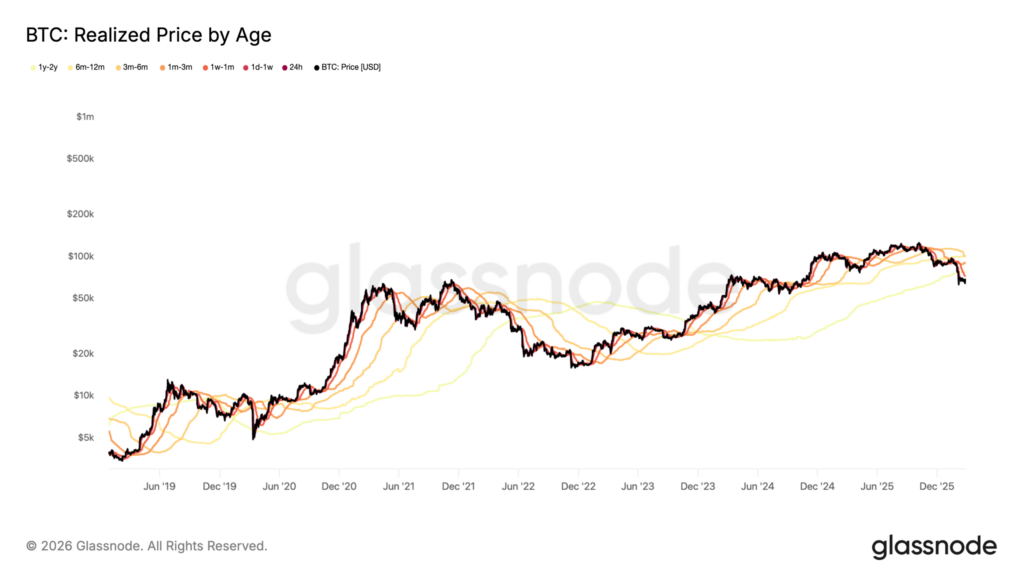
The concept of "stronger hands," referring to investors with conviction and a long-term perspective, is strongly supported by the realized price metric. This metric, which tracks the average price at which an asset was last moved on the blockchain, offers a valuable insight into the profitability of different investor cohorts. The analysis shows a significant decline in holder losses across multi-year holding windows.
As of recent market data, Bitcoin experienced a notable price correction, trading approximately 50% below its peak reached in October 2025, with prices hovering around $65,000. Despite this significant pullback, investors who had held Bitcoin for three to five years remained comfortably in profit. Their realized price for this cohort stood at approximately $34,780. This means that even with the recent market downturn, these long-term holders were still sitting on an impressive profit margin of around 90%. This resilience highlights the compounding effect of Bitcoin’s long-term growth trajectory, which has historically weathered significant short-term volatility.
The current market environment has fueled discussions among traders and analysts regarding the potential for further price declines. Some market participants have suggested that the ongoing Bitcoin price correction could extend towards the $30,000 mark. Such a significant drop would undoubtedly erode the profit cushions of many investors. For the three-to-five-year holding cohort, a move to $30,000 would bring their investments perilously close to the breakeven point, intensifying the psychological pressure and testing their resolve. This scenario raises critical questions about whether these long-term holders would succumb to sell pressure during such a drawdown or maintain their conviction and continue to hold.

In stark contrast, the majority of traders who acquired Bitcoin within the past two years found themselves "underwater" amidst the recent price correction. The cohort that has held BTC for six to twelve months (6m-12m) had an average cost basis of approximately $101,250. This position left them with an unrealized loss of roughly 35% as of Saturday. For the cohort that has held Bitcoin for one to two years (1y-2y), their cost basis was lower, around $78,150. This positioned them with a more manageable unrealized loss of approximately 15%. This divergence in realized losses between the more recent buyers and the longer-term holders further reinforces the pattern observed in the holding-period data: the longer an investor’s time horizon with Bitcoin, the more insulated they tend to be from significant drawdowns during market corrections.
Charting the Future: Bitcoin Price Projections and Market Sentiment
Looking ahead, the cryptocurrency market continues to be a subject of intense analysis and diverse price predictions. Several prominent financial institutions and analysts have put forth forward-looking targets for Bitcoin’s price, particularly for the years 2026 and 2027.
Global brokerage firm Bernstein, a consistent proponent of Bitcoin’s long-term potential, has maintained its bullish price target of $150,000 for Bitcoin in 2026. This conviction is partly based on the observation of relatively modest net outflows from spot Bitcoin Exchange-Traded Funds (ETFs), which the firm views as a sign of underlying strength. Bernstein analysts, led by Gautam Chhugani, characterized the current Bitcoin price action as a "mere crisis of confidence," suggesting that the market’s reaction to price drops may be disproportionate to fundamental shifts.
In a more cautious outlook, Standard Chartered has issued a warning regarding a potential "final capitulation" phase for Bitcoin. The bank’s analysts suggested that this phase could drive BTC prices down to $50,000, citing weak ETF inflows and a challenging macroeconomic environment as contributing factors. However, Standard Chartered also projects a recovery towards $100,000 by the end of 2026, indicating a belief in the asset’s long-term rebound capabilities despite short-term headwinds.

Extending the temporal horizon, Timothy Peterson, an analyst known for his data-driven approach, has utilized historical "average return" frameworks to project future price movements. His analysis points towards a potential Bitcoin price of $122,000 by early 2027, with a high probability that BTC will trade above this figure. Peterson’s methodology often incorporates the study of trailing positive price months and put option payoff data, aiming to identify statistically significant trends in Bitcoin’s historical performance.
These varied projections underscore the dynamic and often unpredictable nature of the cryptocurrency market. While some analysts focus on the resilience of long-term holders and the potential for institutional adoption to drive prices higher, others caution about the impact of macroeconomic factors and potential for further downside. The interplay of these forces will undoubtedly shape Bitcoin’s trajectory in the coming years.
Broader Implications and Market Dynamics
The insights drawn from Bitwise’s analysis carry significant implications for both retail and institutional investors navigating the cryptocurrency landscape. The overwhelming evidence that long-term holding of Bitcoin significantly de-risks an investment is a crucial piece of information for those considering entering or expanding their positions. It suggests that a strategic approach focused on accumulating and holding rather than frequent trading is a more sustainable path to wealth creation within the Bitcoin ecosystem.
The current market correction, while concerning for short-term traders, also presents an opportunity for long-term investors to accumulate Bitcoin at potentially lower prices. The data indicates that dips have historically been buying opportunities for those with a multi-year horizon, as the asset has consistently recovered and reached new highs.

Furthermore, the contrasting performance of different holding cohorts highlights the importance of psychological fortitude in investing. The ability to withstand short-term volatility without succumbing to panic selling is a defining characteristic of successful long-term investors. As Bitcoin matures as an asset class, understanding these behavioral economics alongside technical analysis will become increasingly vital.
The ongoing developments in the Bitcoin ETF market also play a crucial role in shaping investor sentiment and accessibility. While net outflows can create short-term selling pressure, the sustained interest from institutional investors, as evidenced by Bernstein’s analysis, suggests a growing acceptance of Bitcoin as a legitimate asset class. This institutional adoption can provide a foundational layer of demand, potentially smoothing out some of Bitcoin’s historical price volatility over the long term.
As the market continues to evolve, with new technologies, regulatory frameworks, and macroeconomic conditions constantly influencing price action, the fundamental principle highlighted by Dragosch and Bitwise remains a potent guide: patience and a long-term perspective are paramount for those seeking to harness the full potential of Bitcoin as an investment. The data unequivocally suggests that for Bitcoin, time is indeed money, and the longer one waits, the more certain that money becomes.
Disclaimer: This article does not constitute investment advice or recommendations. All investments and trading activities involve risk, and readers are encouraged to conduct their own thorough research before making any financial decisions. Cointelegraph strives to provide accurate and up-to-date information but does not guarantee its completeness or reliability. Forward-looking statements within this article are subject to risks and uncertainties, and Cointelegraph shall not be liable for any loss or damage arising from reliance on this information.