
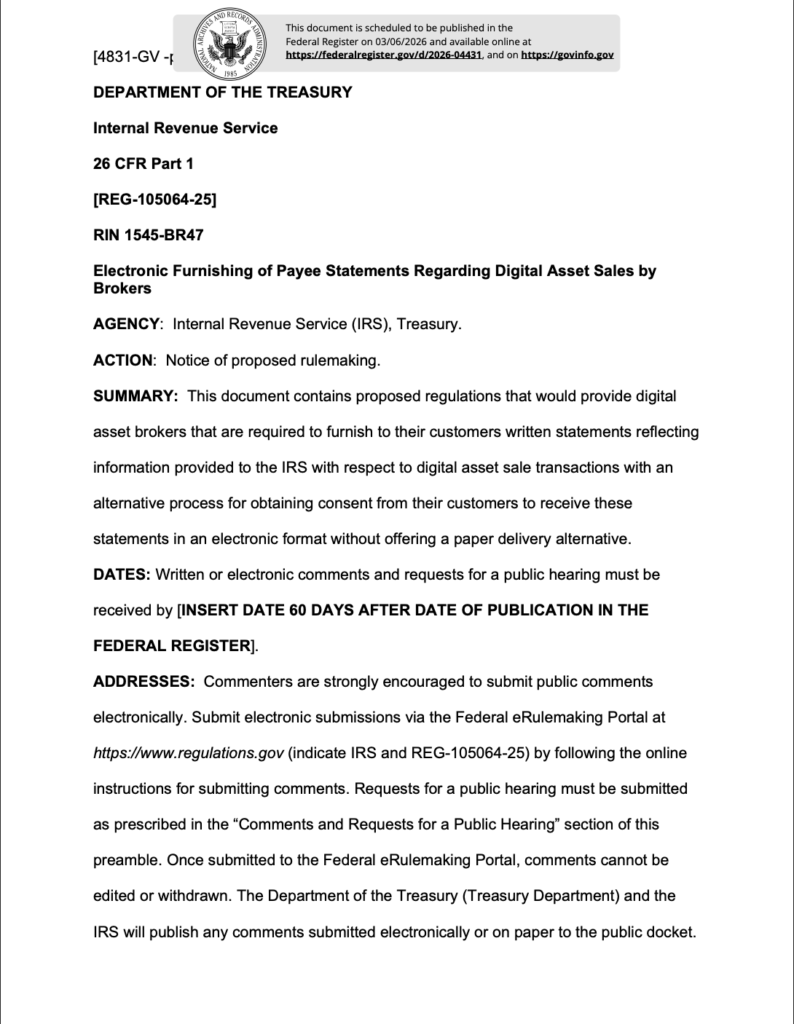

The U.S. Internal Revenue Service (IRS) is advancing a significant shift in how cryptocurrency transaction data is delivered to taxpayers, proposing new rules that would mandate electronic delivery of tax forms to users of centralized crypto exchanges. This move, detailed in a proposal slated for publication on Friday, aims to streamline reporting processes and potentially increase tax compliance within the rapidly growing digital asset sector.
Under the current regulatory framework, cryptocurrency exchanges, acting as brokers, are obligated to provide users with paper copies of Form 1099-DA – the crucial document detailing cryptocurrency transactions from centralized platforms – if a user specifically requests it. This existing provision acknowledges a need for paper-based documentation for some individuals. However, the IRS’s proposed regulations seek to fundamentally alter this requirement, moving towards a default electronic system.
The core of the proposed change lies in removing the obligation for exchanges to furnish paper forms unless explicitly mandated by the IRS for specific circumstances not covered by this proposal. More notably, the new rules would empower brokers to “terminate” their relationships with clients who refuse to consent to electronic delivery of these tax forms. This provision signals the IRS’s strong intent to drive adoption of digital documentation for tax purposes. Furthermore, the proposal explicitly aims to prohibit users from retroactively revoking their consent for electronic forms, effectively locking in electronic delivery once agreed upon.
This regulatory push by the IRS comes at a time when digital asset ownership in the United States is substantial and continues to grow. According to the National Cryptocurrency Association (NCA), a prominent crypto advocacy group, approximately one in five Americans, translating to roughly 55 million individuals, currently hold digital assets. This widespread adoption underscores the increasing importance of clear and efficient tax reporting mechanisms for this asset class.
Evolution of Crypto Tax Reporting: A Chronological Overview
The IRS’s engagement with cryptocurrency taxation has been an evolving process, marked by increasing scrutiny and the development of specific reporting requirements. The introduction of Form 1099-DA was a significant step in this evolution.

Early Stages and Initial Guidance: In the nascent years of cryptocurrency, the IRS primarily relied on existing guidance for property transactions to treat digital assets as property for tax purposes. This meant that capital gains and losses applied to crypto transactions. However, the lack of specific reporting forms created ambiguity for both taxpayers and exchanges.
The Infrastructure Investment and Jobs Act (2021): A pivotal moment arrived with the passage of the Infrastructure Investment and Jobs Act, which included provisions mandating broader reporting for digital asset transactions. This legislation laid the groundwork for the IRS to develop more comprehensive rules.
Proposed Broker Reporting Requirements (2023): The Treasury Department and the IRS released proposed regulations in August 2023 detailing how brokers would be required to report digital asset transactions. This included the requirement to report gross proceeds from sales and other dispositions of digital assets.
Introduction of Form 1099-DA: Following the proposed regulations, Form 1099-DA was developed. This form is designed to report the gross proceeds from the sale or exchange of digital assets that are treated as securities, as well as other relevant information. Centralized exchanges and other crypto brokers are the entities responsible for issuing this form to their users.
Current Rules and the Proposed Shift: Under the rules that have been in place, exchanges must provide Form 1099-DA to users upon request, with the option of paper delivery. The current proposal, however, signifies a move away from this user-driven request model towards a system where electronic delivery is the default and refusal can lead to account termination.
Key Components of the IRS Proposal
The IRS’s proposal addresses several critical aspects of tax reporting for digital assets:

- Mandated Electronic Delivery: The most significant change is the proposed shift to mandatory electronic delivery of tax forms, including Form 1099-DA. This aims to reduce administrative costs for exchanges and potentially speed up the delivery of tax information to users.
- Client Termination for Non-Compliance: The provision allowing brokers to terminate relationships with clients who refuse electronic delivery is a strong enforcement mechanism. It suggests that the IRS views electronic consent as a fundamental requirement for engagement with regulated crypto platforms.
- Irrevocable Consent: The prohibition against retroactively revoking consent for electronic forms ensures that once a user agrees to receive documents electronically, this agreement remains in effect. This prevents users from switching back to paper forms at a later date to avoid compliance.
- Reporting Requirements for Brokers: The IRS reiterates that all broker-dealers, which include platforms providing crypto services, are required to report user proceeds from each transaction. Form 1099-DA serves as the primary vehicle for this reporting. The form details the customer’s identifying information, such as name and Taxpayer Identification Number (TIN), and the gross proceeds from transactions.
It is important to note that for the 2025 tax year, exchanges are not required to track the cost basis of digital assets. The responsibility for tracking cost basis – the original price paid for an investment – remains with the individual investor. This aspect of tax reporting is often complex and has been a point of discussion within the crypto community.
Addressing Tax Compliance Challenges in the Digital Asset Space
The IRS’s focus on electronic delivery and stricter reporting requirements stems from broader challenges in ensuring tax compliance within the cryptocurrency ecosystem. The NCA report highlights several key issues:
- Tax Compliance as an Adoption Barrier: The NCA survey of 54,000 respondents revealed that tax compliance is a significant impediment to cryptocurrency adoption. Approximately 10% of respondents cited digital asset taxes as a concern. This suggests that the complexity and perceived burden of crypto taxation deter potential investors.
- Demand for Education: A substantial portion of crypto holders expressed a desire for more clarity on tax implications. More than one-third of respondents indicated they wanted greater education on the tax implications of digital assets. This points to a need for improved communication and accessible resources from both the IRS and the industry.
- Complexity of Transactions: The inherent nature of cryptocurrency transactions, which can be numerous, global, and sometimes involve multiple platforms and protocols, contributes to the complexity of tax reporting. The lack of standardized cost basis tracking by exchanges further compounds this challenge for investors.
The proposed shift to electronic delivery can be seen as an attempt to simplify the administrative side of tax reporting, making it easier for exchanges to comply and for users to receive their necessary tax documentation promptly.
Background: The DeFi Broker Rule Controversy
The current IRS proposal arrives in the wake of significant regulatory debate surrounding decentralized finance (DeFi). In December 2024, the IRS issued a rule that controversially classified various front-end services, including those provided by decentralized exchanges (DEXs) and DeFi platforms, as broker-dealers. This classification would have subjected these platforms to stringent tax reporting requirements, including the collection of know-your-customer (KYC) information and reporting of user proceeds to the IRS.
This proposed rule faced strong opposition from the crypto industry, which argued that it would be technically infeasible for many DeFi protocols and could stifle innovation in the nascent sector. The decentralized nature of DeFi, often characterized by pseudonymity and automated protocols, presents unique challenges for implementing traditional broker-dealer regulations.
A significant development occurred in April 2025 when U.S. President Donald Trump signed a resolution that effectively killed the DeFi broker rule. This move was widely welcomed by the cryptocurrency industry, which viewed it as a reprieve from potentially burdensome regulations.

However, concerns persist within the industry regarding the potential for future regulations to impose similar reporting requirements. Ambiguous language in other legislative proposals, such as the stalled CLARITY market structure bill, has led some crypto industry executives to sound alarms about potential mandates for KYC reporting on DeFi platforms. These ongoing discussions underscore the dynamic and often contentious relationship between regulatory bodies and the evolving digital asset landscape.
Potential Implications of the Proposed Rules
The IRS’s proposed shift to mandated electronic delivery of tax forms carries several potential implications for cryptocurrency users and exchanges:
- Increased Efficiency for Exchanges: For centralized exchanges, this change could significantly reduce the operational costs associated with printing and mailing paper tax forms. This efficiency gain might be passed on to users in various forms, although direct benefits are not guaranteed.
- Faster Access to Tax Information for Users: Electronic delivery generally means that users will receive their tax forms much faster than traditional mail, allowing them more time to prepare and file their tax returns.
- Potential for Exclusion of Certain Users: The provision allowing for client termination for refusal of electronic delivery raises concerns about the potential exclusion of users who may have legitimate reasons for preferring paper documentation or who lack consistent internet access. This could disproportionately affect certain demographics or individuals in areas with limited digital infrastructure.
- Enhanced IRS Oversight: By standardizing electronic delivery, the IRS aims to create a more unified and accessible dataset for tax reporting. This could facilitate more effective oversight and potentially lead to increased identification of unreported cryptocurrency income.
- Catalyst for Digital Transformation: This proposal further solidifies the trend towards digital-first interactions in financial services. It encourages users to embrace digital methods for managing their financial information, aligning with broader digital transformation initiatives.
- Further Clarity on User Responsibilities: While the IRS is simplifying the delivery mechanism, the responsibility for accurately tracking cost basis and reporting all taxable events remains with the investor. This proposal does not alter those fundamental tax obligations.
The proposed rules are open for public comment, a standard part of the regulatory process. This allows stakeholders, including cryptocurrency exchanges, advocacy groups, and individual users, to voice their opinions and concerns. The final regulations will be issued after careful consideration of these public comments. The IRS’s move signals a continued commitment to integrating digital assets into the established tax framework, with a clear emphasis on modernization and efficiency.