
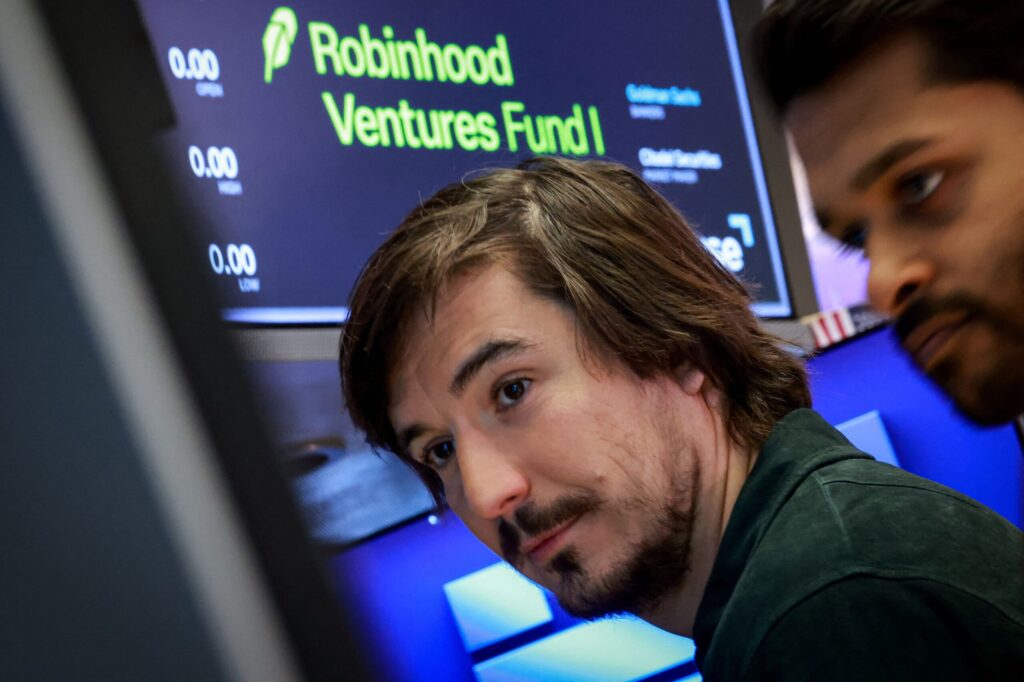

New York, NY – Robinhood Markets’ much-anticipated foray into democratizing private market investments faced an immediate setback on Friday, March 7, 2026, as its inaugural Venture Fund I (RVI) plunged 11% in its public market debut on the New York Stock Exchange. The fund, which aims to provide retail investors unprecedented access to a curated portfolio of high-growth private companies, opened at $22 per share after pricing its initial public offering (IPO) at $25. It subsequently touched an intraday low of $21 before closing the trading day precisely at $21 per share, casting a shadow of uncertainty over investor appetite for riskier assets amidst escalating geopolitical tensions.
The launch of RVI represents a significant strategic move for Robinhood, the commission-free trading platform that rose to prominence by disrupting traditional brokerage models. The fund, structured as a closed-end investment vehicle, offers exposure to prominent private entities such as the financial technology giant Revolut and the data analytics powerhouse Databricks. For years, these kinds of investment opportunities have largely been the exclusive domain of institutional investors, venture capital firms, and high-net-worth individuals. Robinhood CEO Vlad Tenev, who rang the Opening Bell with the Robinhood Ventures Fund I team at the NYSE on March 6, 2026, articulated the company’s ambitious vision earlier on Friday during an interview with CNBC’s "Squawk on the Street."
A Bold Vision for Democratized Investing
"You have companies that are out there at valuations in the hundreds of billions, even getting into the trillions in private markets before retail investors get a chance to come in at all, and this is happening more and more," Tenev stated emphatically. "We’re trying to solve this by not just opening the door to private markets but completely blowing them off the hinges so that they can never be closed." This statement encapsulates Robinhood’s long-standing mission to break down barriers in financial markets, a philosophy that previously revolutionized stock trading by eliminating commissions and simplifying investment processes for millions of everyday investors. The RVI fund sought to extend this ethos to the opaque and often exclusive realm of private equity and venture capital.
Historically, private markets have offered the potential for outsized returns, particularly during the early growth phases of disruptive companies. However, they are also characterized by illiquidity, lengthy investment horizons, and a lack of transparency, making them unsuitable for many retail investors. The closed-end fund structure chosen for RVI aims to mitigate some of these challenges by allowing shares to be bought and sold on a public exchange, theoretically providing a degree of liquidity that direct private investments lack. Yet, the initial market reception suggests that even with this innovative structure, the inherent risks and the prevailing macroeconomic climate are significant factors influencing investor sentiment.
Context of a Volatile Market Debut
The challenging debut of Robinhood’s Venture Fund I occurred against a backdrop of heightened market volatility. Major U.S. stock averages were on pace for weekly declines, with the S&P 500, Dow Jones Industrial Average, and Nasdaq Composite all registering losses as traders offloaded equities. The primary catalyst for this risk-off sentiment was the intensifying geopolitical conflict between the United States and Iran, which had escalated beyond initial expectations. Fears of prolonged instability in the Middle East, potential disruptions to global oil supplies, and broader economic repercussions gripped investors, leading to a flight to safety.
Crude oil prices, a bellwether for geopolitical tensions, had surged over 7% for the week, pushing Brent crude futures above $90 per barrel by mid-week, a level not consistently seen since late 2025. This surge in energy costs fueled concerns about inflationary pressures and the potential for central banks to maintain higher interest rates for longer, thereby dampening economic growth prospects. The CBOE Volatility Index (VIX), often referred to as the market’s "fear gauge," had spiked significantly, signaling increased investor anxiety and a preference for defensive assets over growth-oriented or novel investment vehicles like RVI.
A Deeper Look at the Private Markets and Robinhood’s Strategy
The phenomenon of companies remaining private for longer periods, often achieving multi-billion dollar valuations before considering a public listing, has been a defining characteristic of the capital markets over the past decade. This trend is driven by several factors, including the availability of substantial private capital, the desire to avoid the intense scrutiny and regulatory burdens associated with public markets, and the flexibility to pursue long-term strategies away from quarterly earnings pressures. Companies like Stripe, SpaceX, and indeed, Revolut and Databricks, have exemplified this trend, accumulating immense value in private hands.
Robinhood’s RVI fund was designed to bridge this gap, offering a professionally managed portfolio of such private entities. The fund’s ability to hold stakes in a diverse array of private companies, including those that might otherwise be inaccessible to individual investors, was touted as its key advantage. The investment strategy focused on identifying late-stage private companies with proven business models and significant growth potential, aiming to capture the value appreciation typically reserved for institutional players. However, the illiquid nature of the underlying assets means that the fund’s public market valuation can diverge significantly from the net asset value (NAV) of its holdings, especially in periods of market stress.
Analyst and Investor Reactions
Market analysts offered mixed reactions to RVI’s debut. Many lauded Robinhood’s innovative approach and its continued commitment to financial inclusion. "Robinhood’s venture fund is a bold step that challenges the traditional gatekeepers of wealth," commented Sarah Jenkins, a senior fintech analyst at Equitas Research. "It’s a clear signal of their intent to move beyond just stock trading and tap into new growth areas, aligning with their mission to democratize finance." She also noted, however, that the timing of the launch, amid heightened geopolitical and economic uncertainty, presented a formidable headwind.
Conversely, some market observers expressed caution, particularly regarding the suitability of private market exposure for the average retail investor. "While the concept of opening up private markets is appealing, the risks are substantial," stated Michael Chen, a portfolio manager at Global Asset Partners. "Private company valuations are inherently more subjective and less transparent than public ones. Furthermore, the fund’s performance will be subject to both the liquidity dynamics of a closed-end fund on the public market and the underlying performance of illiquid private assets, creating a complex risk profile that many retail investors may not fully grasp." Chen emphasized the importance of investor education regarding the unique risks associated with such funds, especially the potential for discounts to NAV during periods of market stress.
The Broader Implications
The lukewarm reception of Robinhood’s Venture Fund I could have several broader implications. For Robinhood itself, it might necessitate a re-evaluation of its messaging and investor education efforts for future alternative investment products. While the company has successfully cultivated a large base of retail investors, translating that engagement into complex, higher-risk investment vehicles requires careful navigation, especially when initial performance is disappointing. The success or failure of RVI could influence Robinhood’s long-term strategy for diversification beyond its core trading platform and into wealth management and alternative assets.
For the retail investment community, RVI’s debut serves as a stark reminder that "democratization" does not equate to "de-risking." While it opens doors to previously inaccessible asset classes, it also introduces retail investors to new forms of market risk, including liquidity risk, valuation risk, and manager-specific risk inherent in private market investing. The performance of RVI will undoubtedly be closely watched as a bellwether for retail investor appetite for such sophisticated products. A sustained discount to NAV or further price declines could temper enthusiasm, while a rebound could pave the way for similar offerings from other platforms.
Furthermore, the launch and subsequent performance of RVI could subtly influence the broader venture capital and private equity landscape. Should Robinhood successfully demonstrate a viable model for public market access to private assets, it could pressure traditional private equity firms to consider more accessible structures. Conversely, a challenging trajectory for RVI might reinforce the perception that private markets are best left to institutional players with specialized expertise and longer time horizons.
As the trading week concluded, RVI’s closing price of $21 per share represented a significant deviation from its IPO price, highlighting the immediate challenges facing this ambitious undertaking. While Robinhood remains committed to its vision of tearing down financial barriers, the market’s initial verdict underscores the complex interplay of innovation, market sentiment, and macroeconomic realities in shaping the future of investment access. The journey for Robinhood’s Venture Fund I, and for the broader movement to democratize private markets, has only just begun, and its trajectory will be a crucial case study in the evolving landscape of global finance.