
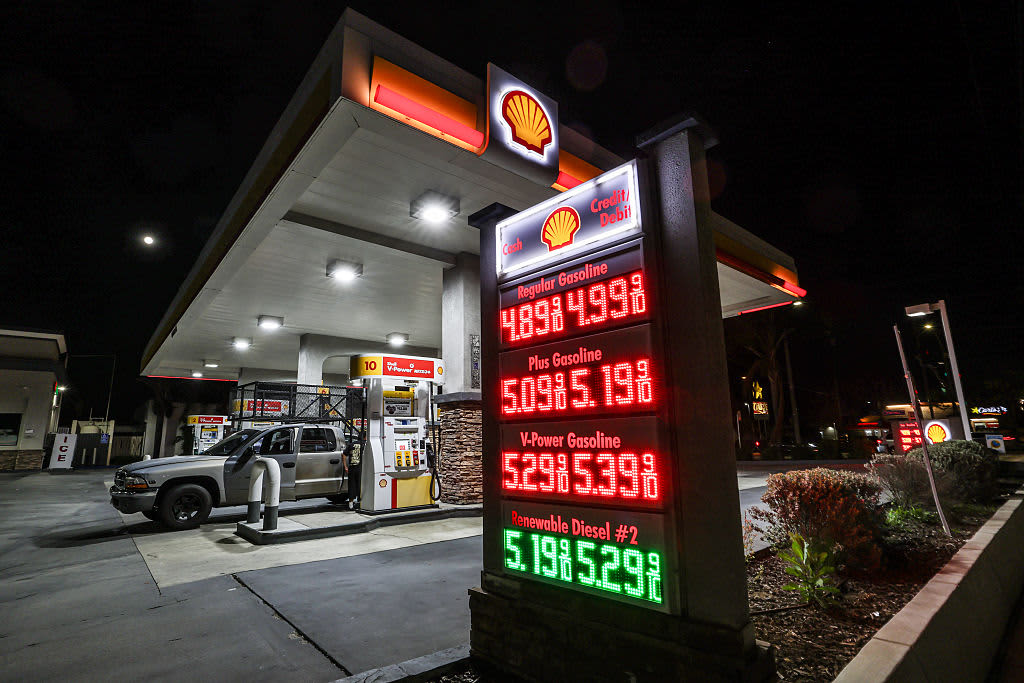

The recent surge in global oil prices, exacerbated by the U.S.-Iran conflict, poses a significant threat to President Donald Trump’s economic agenda, potentially negating the stimulative effects of his signature legislative achievement, the "One Big Beautiful Bill Act." Economists and market strategists are warning that the substantial increase in energy costs could effectively cancel out the financial benefits intended for American consumers through individual tax cuts and boosted refunds, redirecting billions of dollars from household budgets directly to the gas pump. This development not only complicates the administration’s ongoing battle against inflation but also casts a shadow over projections for accelerated U.S. economic growth in 2026.
The Economic Erosion of Tax Benefits
At the heart of the concern is the direct financial impact on consumers. Raymond James strategists estimate that if oil prices remain elevated by more than $20 per barrel compared to pre-U.S.-Iran war levels, nearly all the economic benefit derived from the individual tax cuts could be wiped out. This includes both the impact of reduced payroll withholdings and the more substantial effect of sweetened tax refunds. Tavis McCourt, a strategist at Raymond James, articulated this stark reality, stating, "With the $25 move last week, if the oil price stays here, it essentially offsets the fiscal benefit from the [One Big Beautiful Bill Act]."
McCourt’s analysis is grounded in consumer spending patterns. He calculates that Americans collectively spent over $420 billion on gasoline in the fourth quarter of 2025. Applying any sustained increase in oil market prices to this expenditure, even accounting for potential reduced demand and companies’ need to maintain profit margins, leads to a significant conclusion: a $20 surge in oil prices could translate to consumers spending an additional $150 billion at the pump annually. This figure is critical when juxtaposed against the Tax Foundation’s estimate that the individual tax cuts from the "One Big Beautiful Bill Act" are projected to total $129 billion for 2025, with the vast majority of this amount anticipated to materialize as tax refunds during the current filing season. The arithmetic is unambiguous: the increased cost of fuel could surpass the entirety of the tax relief.
Chronology of Rising Tensions and Prices
The current economic predicament has roots in a rapidly unfolding geopolitical situation. Before the U.S.-Iran conflict escalated, specifically on February 27, U.S. crude oil prices closed at a relatively stable $67.02 per barrel. The outbreak and progression of the war quickly disrupted global supply chains and sparked fears of broader instability in the energy-rich Middle East, sending crude prices soaring. By Tuesday morning, despite a period of significant price volatility and a "whiplash" effect on Monday, oil was still trading robustly at $88.20 per barrel—a jump of more than $20 per barrel from its pre-war benchmark. This rapid appreciation underscored the market’s immediate and acute reaction to geopolitical risk.
President Trump stated in an interview with a CBS News reporter on Monday that the war was "very complete," suggesting an imminent resolution. However, he refrained from providing a specific timeline for its conclusion during a subsequent press conference. Even with a cessation of hostilities, the historical precedent suggests that a return to pre-conflict oil price levels is not instantaneous. McCourt referenced past events like the 1990 Gulf War and the 2022 Russian invasion of Ukraine, noting that it took approximately six months for oil prices to normalize following those significant geopolitical disruptions. This historical pattern suggests that even if the U.S.-Iran conflict is indeed over, consumers could face elevated gasoline prices for an extended period, prolonging the erosion of their tax benefits.
Expert Reactions and Divergent Outlooks
The potential for oil price hikes to neutralize tax cuts has drawn a range of reactions from leading economists and financial strategists. Stephanie Roth, chief economist at Wolfe Research, echoed similar concerns, indicating that her own estimations for the consumer impact of elevated oil prices mirrored the projected spending boost from the tax law. However, Roth added a crucial caveat in a Tuesday note from Wolfe: oil prices would likely need to remain above $100 per barrel for a sustained period for the full offsetting effect to materialize. "In all these scenarios, it has to last longer than it is now," Roth commented, acknowledging that the immediate impact on gas prices, while significant, might still be considered "short-lived and modest compared to how it may ultimately play out." This suggests a watchful waiting approach, where the duration of high prices is as critical as their magnitude.

The timing of this oil price shock is particularly disadvantageous, coinciding precisely with the period when consumers are expected to receive their tax refunds. Citadel Securities estimated last week that by March 1, only 30% of these refunds had been distributed, with that figure projected to rise to around 75% by May 1. This means a substantial portion of the anticipated cash injection is arriving just as energy costs are escalating. Gabriel Shahin, CEO of Falcon Wealth Planning, succinctly captured the dilemma in an email to CNBC: "The bottom line is that if we were expecting those tax refunds to lift consumer spending, these higher oil prices are just redirecting all that cash toward energy costs. It’s essentially voiding out the economic boost we were set to see."
However, not all experts share this dire outlook. Dan Niles, portfolio manager at Niles Investment Management, offered a more optimistic perspective, framing the tax refunds as a crucial buffer that could help the economy weather higher oil prices rather than being completely nullified by them. Niles recalled similar price spikes in 2022 and 2023, periods when Wall Street widely predicted a recession due to surging interest rates. He pointed out that despite those stresses, and coming off the heels of surging inflation in 2021, a recession did not materialize. "You already had that stress tested a bit," Niles argued. "So if that’s the case back then, and coming off of inflation surging in 2021, and you still didn’t get a recession, why would you think inflation down at 3% and oil at $100 would cause a recession now?" His view suggests that the economy may have developed a greater resilience to energy price shocks than previously assumed.
Distinguishing Current Dynamics from Past Shocks
Many analysts are naturally drawing parallels between the current surge in oil prices and the shock experienced four years prior, when Russia’s invasion of Ukraine sent energy markets into disarray. While the immediate cause—geopolitical conflict—is similar, Stephanie Roth of Wolfe Research cautioned against over-reliance on such comparisons, emphasizing that the underlying economic conditions are fundamentally different. "The economic backdrop is not a mirror image of where we are today," Roth stated. She highlighted key disparities: four years ago, core inflation was running at a significantly higher 5.5% compared to the current 3%, and job growth was robust at around 500,000 new positions monthly, whereas it has recently slowed to 37,000 over the past couple of months. These distinctions suggest that the economy’s capacity to absorb an oil price shock today might be different, potentially more vulnerable given the slower job market and already moderate inflation levels.
Broader Economic Implications and Policy Challenges
The weakening of fiscal stimulus from the "One Big Beautiful Bill Act" could have profound implications for the U.S. economy in 2026. The tax law was initially heralded as a catalyst for economic expansion, with many economists predicting a reacceleration of U.S. growth, partially attributed to its provisions. If the expected boost to consumer spending is diverted to energy costs, these growth forecasts may need to be revised downward.
The administration’s broader fight against inflation, a key policy objective, also faces new headwinds. Higher gasoline prices directly contribute to the Consumer Price Index and can lead to increased costs across various sectors, from transportation to manufacturing, potentially reigniting inflationary pressures just as they appeared to be moderating. This scenario presents a complex policy challenge, requiring a delicate balance between managing energy markets, supporting consumer purchasing power, and maintaining overall economic stability.
For the stock market, McCourt believes that while the economy could weather weaker-than-expected stimulus, provided the labor market remains robust, the impact on stock outlooks for the year might be limited. He noted that the market, particularly consumer discretionary stocks, had not fully priced in a significant surge in consumer spending from the tax cuts, with these stocks underperforming the S&P 500 in 2026. This suggests that the market may already be somewhat insulated from the potential disappointment of the tax cuts’ full impact.
Ultimately, the resilience of the labor market remains a critical determinant. "We just have never had a sustained pullback in consumer spending without substantial job losses," McCourt explained. While there might be "some shifts in spending" as consumers prioritize energy costs, he believes it is "probably not going to impact the overall consumer spending levels" unless widespread job losses occur. This highlights the foundational role of employment stability in buffering the economy against external shocks like soaring oil prices. The coming months will be crucial in observing whether the American consumer, armed with tax refunds but facing higher fuel bills, can sustain the economic momentum initially envisioned by the "One Big Beautiful Bill Act."