

The cryptocurrency and artificial intelligence sectors are experiencing a period of significant upheaval and strategic realignment, marked by pivotal decisions from both governmental bodies and financial institutions. In a move that has sent ripples through the technology and defense communities, OpenAI has been awarded a contract to deploy its advanced AI models on classified United States Department of Defense networks. This development occurs mere hours after the White House, under President Donald Trump’s directive, mandated a halt to the use of technology from Anthropic, a key AI partner, across all federal agencies. Anthropic’s CEO, Dario Amodei, has publicly decried the Pentagon’s decision to label his company a "supply chain risk" as "unprecedented," emphasizing his company’s commitment to ethical AI development and its refusal to engage in applications involving fully autonomous weapons or mass domestic surveillance. Concurrently, Wall Street titan Morgan Stanley is making a significant foray into the digital asset space, having applied for a national bank charter to facilitate the custody, trading, and staking of cryptocurrencies on behalf of its extensive client base.
Pentagon’s Strategic Pivot: OpenAI Gains Foothold as Anthropic Faces Scrutiny
The U.S. Department of Defense’s decision to integrate OpenAI’s AI capabilities into its classified networks represents a significant strategic shift, especially in light of the simultaneous prohibition on Anthropic’s technology. The announcement, made via a late Friday post on X by OpenAI CEO Sam Altman, detailed the company’s agreement to provide its models within the Pentagon’s "classified network." Altman highlighted the department’s apparent "deep respect for safety" and its willingness to operate within OpenAI’s established ethical parameters. This contract award, coming so swiftly after the directive against Anthropic, suggests a rapid recalibration of the DoD’s AI partnerships and priorities.
The backdrop to this development is a turbulent week for the artificial intelligence industry. On Friday, Defense Secretary Pete Hegseth publicly designated Anthropic as a "Supply-Chain Risk to National Security." This classification, typically reserved for foreign adversaries, carries substantial implications, mandating that defense contractors must certify they are not utilizing Anthropic’s AI models. This move was further solidified by President Trump, who issued a directive to all U.S. federal agencies to immediately cease their use of Anthropic technology. Agencies currently reliant on Anthropic’s systems have been granted a six-month transition period to find alternatives.

Anthropic CEO’s Strong Condemnation of Pentagon’s "Unprecedented" Decision
Dario Amodei, the chief executive of Anthropic, has voiced strong opposition to the Pentagon’s recent actions, characterizing the decision to label his company a security risk as "unprecedented." Anthropic has been a significant collaborator with the U.S. Department of Defense, aligning with the vast majority of AI use cases proposed by defense officials. However, the company has maintained a firm stance against developing fully autonomous weapons platforms and engaging in mass domestic surveillance.
In an interview with CBS News, Amodei articulated his concerns, stating, "These are things that are fundamental to Americans: the right, not to be spied on by the government, the right for our military officers to make decisions about war, themselves, and not turn it over completely to a machine." His remarks underscore a broader ethical debate surrounding the deployment of advanced AI in sensitive government and military applications, particularly concerning accountability, human oversight, and civil liberties. The swiftness with which the Pentagon moved from partnering with Anthropic to deeming it a risk, while simultaneously engaging with OpenAI, has drawn considerable criticism and raised questions about the consistency and transparency of the decision-making process.
Timeline of Events: A Week of Rapid AI Policy Shifts
The past week has witnessed a rapid succession of policy decisions and contract awards that have significantly altered the landscape of AI integration within the U.S. government:
- Early Week: Reports indicate ongoing discussions and collaborations between Anthropic and the Department of Defense regarding various AI applications.
- Friday Morning: Defense Secretary Pete Hegseth issues a public statement labeling Anthropic a "Supply-Chain Risk to National Security." This designation triggers immediate implications for defense contractors.
- Friday Afternoon: President Donald Trump issues a directive to all federal agencies mandating the immediate halt of Anthropic technology usage, with a six-month grace period for existing implementations.
- Friday Evening: OpenAI CEO Sam Altman announces on X that his company has secured a contract to deploy its AI models on classified U.S. Department of Defense networks.
- Concurrent Developments: News emerges of Morgan Stanley’s application for a national bank charter to expand its cryptocurrency services.
This compressed timeline highlights an accelerated pace of policy change and strategic maneuvering within the defense and financial sectors concerning advanced technologies.

Morgan Stanley’s Strategic Embrace of Digital Assets: A New Era for Crypto Banking
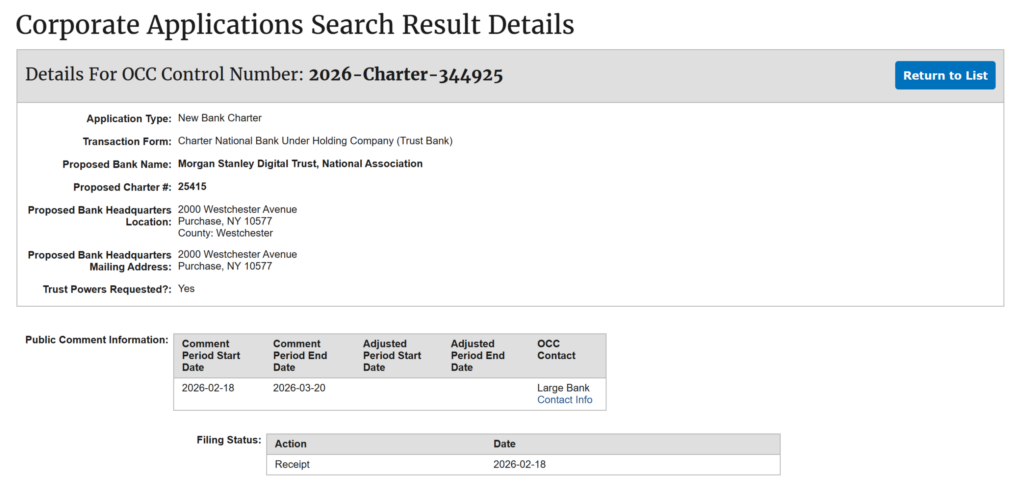
In a move that signals a significant endorsement of the cryptocurrency market by traditional finance, Wall Street behemoth Morgan Stanley has formally applied for a de novo national trust bank charter. This application, filed with the Office of the Comptroller of the Currency (OCC), paves the way for the financial institution to offer a comprehensive suite of digital asset services to its clients, including custody, trading, and staking.
The public filing, submitted under the name "Morgan Stanley Digital Trust, National Association," was received by the OCC on February 18th. Further details, revealed on Friday through reports from Bloomberg and Forbes, elaborate on the subsidiary’s business plan. Morgan Stanley Digital Trust is slated to provide custody for specific digital assets, execute purchases, sales, swaps, and transfers to support client investment activities, and offer crypto staking services. This initiative aligns with Morgan Stanley’s ongoing expansion into the cryptocurrency space, which has included offering Bitcoin futures to its wealth management clients and investing in crypto-related companies.
The application for a bank charter represents a more profound commitment, allowing Morgan Stanley to operate as a regulated financial institution specializing in digital assets. This move is indicative of a growing trend among major financial players to integrate digital assets into their core offerings, driven by increasing client demand and the evolving regulatory landscape. The ability to custody and trade cryptocurrencies under a banking charter provides a layer of security and regulatory compliance that is crucial for institutional adoption.
Broader Implications and Analysis
The confluence of these events carries significant implications for both the future of artificial intelligence in national security and the integration of cryptocurrencies into mainstream finance.

For AI and National Security: The Pentagon’s abrupt shift away from Anthropic and towards OpenAI raises critical questions about the criteria for evaluating AI safety and security within government operations. The designation of Anthropic as a "supply chain risk" without extensive public explanation could set a precedent for how AI vendors are vetted and approved. The rapid embrace of OpenAI, despite its own ongoing ethical considerations and development trajectory, suggests a prioritization of immediate operational capabilities. This decision could influence future government contracts and the broader AI industry’s approach to national security applications. Amodei’s concerns about autonomous weapons and surveillance highlight the persistent ethical dilemmas that accompany the rapid advancement of AI, particularly in contexts with high stakes. The differing approaches of the U.S. government and leading AI companies in defining and implementing AI safety protocols will be a crucial area to monitor.
For Cryptocurrency and Traditional Finance: Morgan Stanley’s application for a national trust bank charter signifies a maturation of the cryptocurrency market. The willingness of a global financial institution to invest in regulated infrastructure for digital assets underscores the increasing legitimacy and potential of this asset class. This move is likely to encourage other traditional financial institutions to accelerate their exploration and adoption of crypto services, potentially leading to greater liquidity, enhanced security, and more robust investment products for a wider range of investors. The ability to custody and trade cryptocurrencies under a federal charter also suggests a more structured and compliant pathway for institutional participation, which could further bridge the gap between traditional finance and the burgeoning digital asset ecosystem. The long-term impact of such institutional adoption on market stability, regulatory frameworks, and the overall perception of cryptocurrencies is expected to be substantial.
In conclusion, this period marks a pivotal moment, demonstrating the dynamic interplay between technological innovation, national security imperatives, and the evolving financial landscape. The decisions made today will undoubtedly shape the trajectory of artificial intelligence and cryptocurrency adoption for years to come.