

In a significant move to bolster user protection against increasingly sophisticated cryptocurrency scams, leading digital asset exchange OKX has announced the integration of Alterya, a cutting-edge fraud-detection platform developed by blockchain analytics firm Chainalysis. This strategic partnership marks a pivotal shift in the industry, moving beyond reactive post-transaction monitoring to proactive intervention, aiming to intercept fraudulent payments before they are irrevocably sent to scam-controlled accounts.
The integration signifies a crucial evolution in how cryptocurrency exchanges approach security and user safety. Historically, many exchanges primarily focused on Know Your Customer (KYC) procedures and transaction monitoring after funds had moved. However, the persistent rise in crypto-related fraud, particularly through social engineering tactics that persuade users to transfer assets to malicious actors, has necessitated a more robust, preventative approach. OKX’s adoption of Alterya underscores a commitment to safeguarding its user base by identifying and flagging suspicious payment destinations at the point of transaction.
Alterya’s innovative technology operates by analyzing a wide spectrum of scam infrastructure. This includes meticulously scanning websites, social media platforms, and messaging channels for indicators of fraudulent activity. By correlating these online signals with financial identifiers such as cryptocurrency wallet addresses and bank account numbers, Alterya creates a comprehensive risk profile. When integrated into an exchange’s withdrawal process, the platform empowers OKX to identify and, where necessary, block transfers destined for addresses demonstrably linked to ongoing scams. This proactive blocking mechanism is designed to prevent users from inadvertently funding criminal enterprises.
Traditional Anti-Money Laundering (AML) frameworks have often centered on the sender of funds, employing stringent KYC checks and monitoring transaction patterns. Alterya, conversely, adopts a recipient-centric strategy. It focuses on identifying wallets and accounts that are part of known scam networks or are utilized in money mule operations, where individuals unknowingly facilitate illicit fund transfers. This targeted approach allows for a more precise and effective disruption of scam operations.
The acquisition of Alterya by Chainalysis in early last year for a reported $150 million was a landmark event, signaling Chainalysis’ strategic expansion beyond its core expertise in blockchain tracing and compliance into the realm of real-time fraud prevention for payment systems. Prior to this acquisition, Alterya had already established a strong reputation, collaborating with prominent exchanges such as Coinbase and Binance. The company claims its systems are currently monitoring over $23 billion in monthly transaction volume and have successfully prevented approximately $300 million in losses over the past twelve months, underscoring the tangible impact of its preventative capabilities.
The Escalating Threat of Crypto Scams and the Industry’s Response
The cryptocurrency industry has witnessed a significant surge in scam-related losses in recent years, prompting a broader and more urgent focus on robust risk monitoring and fraud intelligence platforms. Exchanges, payment providers, and other blockchain-based services are increasingly investing in advanced tools to mitigate these escalating threats. This trend is driven by the sheer volume of financial losses and the damaging impact on user trust and market stability.

Companies specializing in blockchain analytics, such as TRM Labs and Elliptic, have long been recognized for their capabilities in transaction tracing and sanctions screening. However, in response to the evolving threat landscape, these firms have expanded their offerings to include sophisticated wallet risk scoring and real-time transaction monitoring. These advanced features are now being integrated directly into withdrawal and payment flows, enabling platforms to detect and alert on suspicious activities as they occur.
For instance, as reported by Cointelegraph previously, TRM Labs recently partnered with banking infrastructure provider Finray Technologies. This collaboration aims to deliver real-time risk alerts for suspicious activities across multiple blockchains. This development exemplifies the growing convergence between cryptocurrency compliance needs and traditional financial control mechanisms, highlighting a maturing approach to digital asset security.
Data Underscores the Scale of the Problem
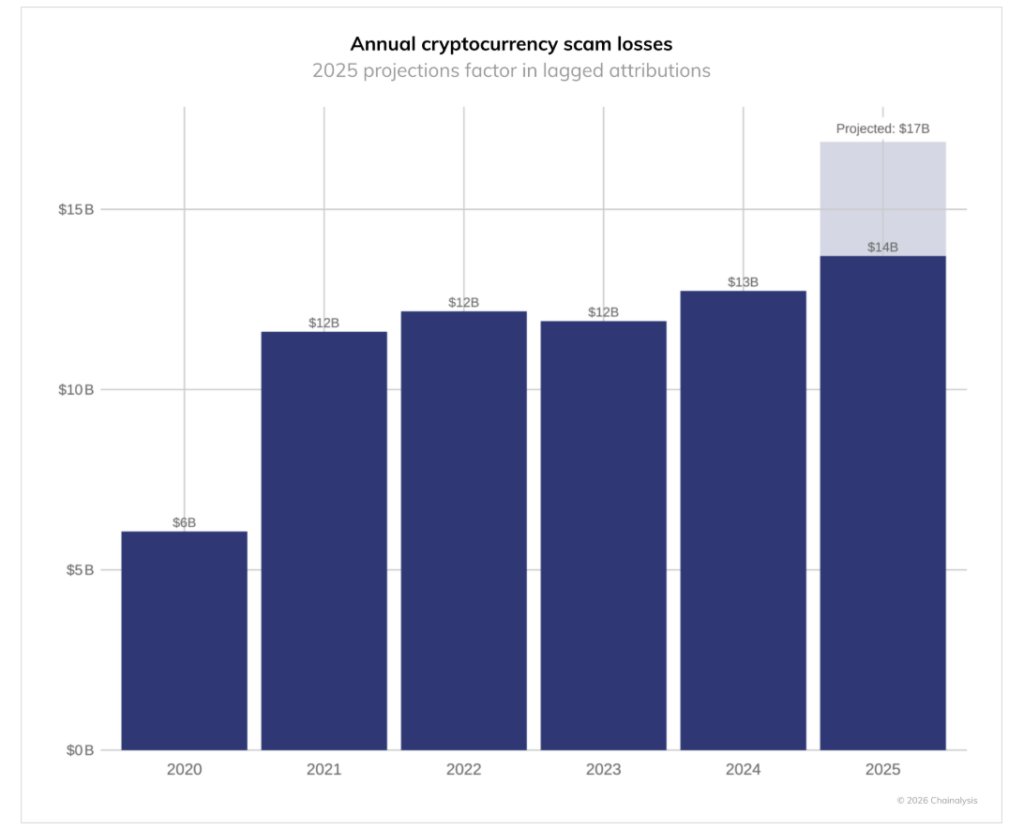
The persistent threat of crypto scams is starkly illustrated by recent data. Research conducted by Chainalysis estimates that approximately $17 billion was lost to crypto-related scams in the year 2025 alone. This figure represents a substantial increase and underscores the urgent need for enhanced security measures.
Among the various types of scams, impersonation scams have seen the most dramatic year-on-year increase. These often involve fraudulent investment platforms or individuals posing as trusted entities or celebrities to deceive victims. According to Chainalysis data, impersonation scams experienced a staggering rise of about 1,400% in 2025, indicating a highly effective and rapidly growing tactic employed by malicious actors.
The effectiveness of these scams often stems from the persuasive tactics used to lure victims into believing they are making legitimate investments or engaging in secure transactions. Social engineering, phishing, and sophisticated online personas are frequently employed to build trust before the scam is executed.
A Shift Towards Proactive Defense Mechanisms
The integration of Alterya by OKX is not an isolated event but rather part of a broader industry trend. As scam techniques become more sophisticated, the reliance on traditional security measures alone has proven insufficient. The focus is shifting from detecting fraud after it has occurred to preventing it from happening in the first place.
Chainalysis’ acquisition of Alterya, for example, was a clear signal of its strategic intent to provide more comprehensive fraud prevention solutions. The platform’s ability to analyze scam infrastructure across various digital channels and link it to financial identifiers offers a powerful new layer of defense. By integrating this capability into the withdrawal process, exchanges like OKX can intercept fraudulent transactions before user funds are compromised.

The implications of this shift are far-reaching. For users, it means a potentially safer trading environment, with reduced risk of falling victim to scams that can lead to significant financial losses. For exchanges, it represents an enhanced ability to protect their customer base, thereby fostering greater trust and loyalty. Furthermore, by disrupting the flow of funds to scam operations, these preventative measures contribute to the overall integrity and stability of the cryptocurrency ecosystem.
The Timeline of Evolving Security Measures
The journey towards more proactive scam prevention in the crypto space can be traced through several key developments:
- Early Years: Focus on basic security measures, wallet encryption, and early KYC implementations. Transaction monitoring was primarily for AML compliance.
- Mid-2010s: Rise of more sophisticated phishing and Ponzi schemes. Exchanges began implementing basic fraud detection algorithms, but these were largely reactive.
- Late 2010s: Increased regulatory scrutiny and the growth of blockchain analytics firms like Chainalysis, Elliptic, and TRM Labs, primarily for compliance and investigative purposes.
- Early 2020s: The proliferation of decentralized finance (DeFi) and non-fungible tokens (NFTs) created new avenues for scams, including rug pulls and fake projects. This period saw a significant increase in reported scam losses.
- 2023-2024: Emergence of advanced fraud prevention platforms like Alterya, focusing on pre-transaction analysis and infrastructure mapping. Chainalysis’ acquisition of Alterya in early 2023 highlighted the growing demand for these proactive solutions. Exchanges like Coinbase and Binance were early adopters of Alterya’s technology.
- Present: OKX’s integration of Alterya signifies a mainstream adoption of these proactive defense mechanisms by major exchanges, reflecting a mature industry response to persistent threats. The continued development of AI-powered tools and cross-industry collaborations are expected to further enhance scam prevention capabilities.
Broader Industry Impact and Future Outlook
The proactive stance taken by OKX, empowered by Chainalysis’ Alterya platform, is likely to set a precedent for other major cryptocurrency exchanges. As scam tactics continue to evolve, the industry will need to remain agile and innovative in its defense strategies. The focus on identifying and blocking fraudulent destinations before funds are sent represents a significant advancement in user protection.
The success of such integrations will depend on the continuous refinement of Alterya’s algorithms and the ongoing collaboration between exchanges and analytics firms. The ability to analyze vast amounts of data from diverse sources – from dark web forums to social media trends – will be crucial in staying ahead of malicious actors.
Moreover, this trend highlights a broader convergence of traditional financial security principles with the unique challenges of the blockchain landscape. The integration of robust fraud detection systems into the core operational flows of cryptocurrency exchanges is a necessary step towards building a more secure and trustworthy digital asset market. As losses from crypto scams continue to represent a significant concern, proactive prevention tools like Alterya are becoming indispensable components of a secure exchange infrastructure, offering a vital shield for users navigating the complexities of the digital economy. The commitment to investing in such advanced technologies underscores a maturing industry that prioritizes user safety and long-term sustainability.