
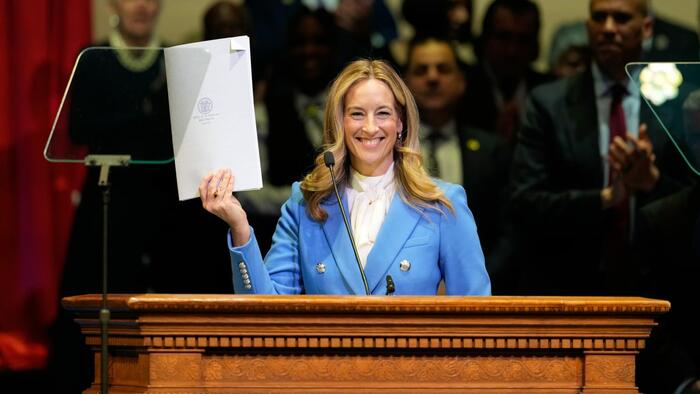

New Jersey Governor Mikie Sherrill, who assumed office earlier this year, has issued a stark warning regarding the state’s financial health, revealing an impending structural deficit estimated at $3 billion. This significant shortfall, where annual spending consistently outpaces revenues, casts a shadow over the state’s fiscal outlook, even as a projected surplus of $7.2 billion is anticipated by the end of 2026. The announcement comes just weeks before Governor Sherrill is set to unveil her inaugural state budget on March 10th, placing immediate pressure on her nascent administration to navigate complex financial waters. The declaration has swiftly ignited a political debate, with Governor Sherrill attributing a portion of the state’s fiscal challenges to federal policies from the previous presidential administration, specifically citing "federal cuts" under former President Donald Trump.
Understanding the Structural Deficit: A Deeper Dive
A structural deficit represents a fundamental imbalance in a government’s finances, where recurring expenditures exceed recurring revenues. Unlike a cyclical deficit, which might fluctuate with economic cycles, a structural deficit persists even when the economy is performing well, indicating deeper, systemic issues. In New Jersey’s case, the $3 billion figure signifies that, without significant policy changes, the state is projected to spend $3 billion more than it collects in taxes and other revenues each year. This persistent gap can be driven by a variety of factors, including unsustainable growth in entitlement programs, rising public employee pension and healthcare costs, stagnant tax bases, or long-term economic shifts. For New Jersey, a state known for its high cost of living and property taxes, the implications of such a deficit are particularly profound, potentially impacting everything from school funding to infrastructure projects and credit ratings.
The Role of Federal Stimulus and its Exhaustion
A critical component of Governor Sherrill’s assessment revolves around the role of federal COVID-19 relief funds. She explicitly acknowledged that these stimulus funds are "drying up" and that their temporary infusion had effectively "papered over" many pre-existing budgetary problems within New Jersey. This observation aligns with analyses from various economists and financial watchdogs who have consistently cautioned that the unprecedented federal aid distributed during the pandemic—through measures like the CARES Act, the American Rescue Plan, and various other programs—while crucial for immediate economic stability, also created a temporary fiscal illusion for many states.
During the height of the pandemic and its immediate aftermath, states like New Jersey received billions in federal assistance designed to mitigate economic fallout, support healthcare systems, and maintain public services. This influx allowed states to increase spending, avoid difficult budget cuts, and in some cases, even build up reserves. However, the temporary nature of these funds meant that once they were exhausted, states would be confronted with their underlying fiscal realities. Many "alternative economists" had indeed been asserting for years that without fundamental reforms, the expiration of these federal lifelines would expose chronic structural imbalances. New Jersey, having utilized these funds to manage its budget, is now facing this inevitable fiscal reckoning.
A Look Back: New Jersey’s Recent Fiscal History
The current fiscal predicament did not materialize overnight but is rather the culmination of years of budgetary decisions and economic trends. Governor Sherrill’s administration is the inheritor of a complex financial landscape, much of which developed under previous leadership.
The Murphy Administration (2018-2024): Former Governor Phil Murphy, a Democrat, presided over New Jersey during a period marked by significant spending increases and the advent of federal COVID-19 relief. While his administration often touted increases in state aid to education and investments in infrastructure, critics frequently raised concerns about the long-term sustainability of the state’s fiscal trajectory. Spending growth during his tenure outpaced revenue growth in several key areas, exacerbating the state’s structural issues, which were temporarily masked by federal infusions.
Warnings from the NJ Policy Perspective (2023): As early as August 2023, the New Jersey Policy Perspective (NJPP), a respected non-partisan think tank, issued a detailed analysis highlighting "red flags" in the Fiscal Year 2024 budget. Their report estimated a structural deficit of $1.5 billion for that year, a precursor to the larger figure now cited by Governor Sherrill. The NJPP specifically warned of a looming crisis, projecting that revenues could fall short by $3-4 billion annually in coming years if prevailing trends continued. They pointed to declining year-over-year revenues in many states, including New Jersey, coupled with unsustainable spending growth as primary drivers of this impending crisis. This analysis provided an early, independent validation of the deep-seated fiscal challenges the state was facing, predating the current administration’s official acknowledgment.
Allegations of Misleading Financial Disclosures (2025): Further complicating the narrative is the political fallout from the previous administration’s handling of state finances. In 2025, Republican legislators openly accused former Governor Murphy’s administration of attempting to conceal the burgeoning budget crisis. Senator Declan O’Scanlon (R-Monmouth) became a prominent voice in this criticism, reviewing financial disclosures from the New Jersey Department of the Treasury. What he uncovered, according to O’Scanlon, was "a series of grossly misleading data" shared with both Wall Street credit rating agencies and the general public. These accusations, which included threats to report the previous administration to the Securities and Exchange Commission (SEC), suggested a deliberate effort to present a more favorable financial picture than reality warranted. Such actions, if proven, could have severe consequences for the state’s credibility, potentially leading to higher borrowing costs and a loss of investor confidence. The timing of these allegations, well before the current governor took office, suggests that the fiscal shortfall was an escalating concern known to policymakers, relying on temporary federal funds and potentially manipulated data to defer the problem.
Governor Sherrill’s Budget Approach and Political Stance

In her public remarks, Governor Sherrill has adopted a firm stance, acknowledging the gravity of the situation while also engaging in a political strategy. While admitting the temporary nature of COVID relief funds, she immediately pivoted to criticizing the Trump Administration, asserting that "federal cuts" were contributing to the state’s incoming fiscal crisis. This claim aligns with a broader Democratic narrative that has, in various contexts, attributed state-level financial pressures to federal policy shifts, such as changes to the State and Local Tax (SALT) deduction cap implemented under the Trump tax reforms, or reductions in specific federal grant programs. The SALT cap, which limited deductions for state and local taxes to $10,000, disproportionately affected high-tax states like New Jersey, potentially impacting their ability to raise revenues without further burdening residents.
Despite the challenging fiscal outlook, Governor Sherrill has pledged not to raise taxes. Instead, she has directed state departments to identify significant savings. Her administration faces the delicate task of balancing the need for fiscal austerity with the demands for maintaining public services and avoiding policies that could harm the state’s economic competitiveness. She explicitly warned that a failure to act decisively could trigger adverse consequences, including credit downgrades, cuts to school funding, and other painful ramifications under New Jersey’s balanced budget requirement. New Jersey, like many states, is constitutionally or statutorily mandated to pass a balanced budget, meaning that any deficit must be addressed either through spending cuts or revenue increases.
Her statement, "Washington isn’t coming to save us. Trump is only making things worse," underscores her administration’s perspective that federal intervention is unlikely, and that the state must take responsibility for its own financial future. She added, "We have to stand up on our own two feet and make some tough choices. But that’s fine. I’ve been doing hard things for most of my life – and that’s what I was elected to do." This rhetoric aims to convey a sense of resolve and leadership in the face of adversity, preparing the public for potentially unpopular decisions.
New Jersey’s Debt Burden in a National Context
New Jersey’s fiscal challenges extend beyond its annual structural deficit to its substantial overall debt burden. As of late 2025, New Jersey’s total state government debt was roughly $213 billion. This staggering figure ranks among the highest in the nation, making New Jersey one of the most indebted states per capita. High levels of state debt translate into significant annual debt service payments, which consume a substantial portion of the state’s budget, diverting funds that could otherwise be allocated to essential public services, infrastructure improvements, or tax relief. The burden of this debt, combined with unfunded pension liabilities, creates a formidable obstacle to achieving long-term fiscal stability and economic growth. Servicing this debt often requires continuous borrowing, creating a cycle that can be difficult to break, especially in an environment of rising interest rates.
The "Blue State" Fiscal Pattern: A Broader Look
The original analysis pointed to a "discernible pattern" observed in states grappling with significant deficits, noting that many of them are governed by Democrats. New Jersey’s extreme deficit, exceeding $3 billion, indeed places it in an exclusive club that includes other large, predominantly Democratic-led states such as California, New York, Illinois, Pennsylvania, and Maryland. California and New York, in particular, are facing even more severe shortfalls, with deficits reportedly exceeding $30 billion.
While the original content suggests this pattern "has nothing to do with Trump," a more nuanced journalistic analysis acknowledges that the fiscal challenges in these states are multifaceted and cannot be attributed to a single factor or administration. However, it is a point of frequent political debate. Critics often argue that Democratic-led states tend to have higher spending on social programs, more generous public employee benefits, and a greater reliance on progressive taxation, which can be more volatile with economic cycles. These states often have higher fixed costs related to legacy pension obligations, robust public sector unions, and comprehensive social safety nets.
Conversely, proponents of the policies in these states argue that the higher spending reflects a commitment to robust public services, social equity, and environmental protection. They might also point to demographic shifts, aging infrastructure, and unique economic pressures in these populous, urbanized states as contributing factors. The higher cost of living and business operations in these states can also contribute to fiscal pressures. Regardless of the underlying causes, the observation of a clustering of significant deficits in these states highlights a complex interplay of political philosophy, historical fiscal decisions, and unique economic conditions that differentiate them from states with more conservative fiscal policies.
Potential Implications for Residents and Businesses
The looming $3 billion structural deficit in New Jersey carries significant implications for both its residents and businesses.
- Credit Downgrades: A persistent structural deficit signals fiscal instability to credit rating agencies. A downgrade in New state’s bond rating would increase the cost of borrowing for essential capital projects, such as roads, bridges, and public buildings, thereby diverting more taxpayer dollars to debt service.
- Cuts to Public Services: If Governor Sherrill holds firm on her pledge not to raise taxes, the only viable path to balancing the budget will be through spending cuts. This could lead to reductions in critical public services, including education funding, healthcare programs, public safety initiatives, and infrastructure maintenance. Schools, in particular, often bear the brunt of state budget cuts, potentially impacting class sizes, programs, and teacher salaries.
- Economic Competitiveness: Fiscal instability and the threat of future tax hikes can deter businesses from investing in the state or encourage existing businesses to relocate. This could lead to job losses and a reduction in the state’s overall economic vitality. New Jersey already faces challenges in retaining businesses and residents due to its high cost of living and tax burden.
- Future Taxation: While Governor Sherrill has pledged no new taxes, the history of states facing similar predicaments suggests that this stance may be difficult to maintain in the long run. The original article posits that "blue states inevitably revert to higher taxes on the middle class… because Democrats rely on government handouts and subsidized programs as a way to buy votes." While this is a politically charged assertion, the reality is that states grappling with structural deficits often consider various revenue-enhancing measures, which can include increases in income tax, sales tax, property tax, or new fees. For New Jersey residents and businesses, the possibility of being "slapped with high taxes within the next year" remains a tangible concern, regardless of current pledges, given the scale of the deficit and the pressure to balance the budget.
Navigating the Path Forward
Governor Sherrill’s administration faces a monumental task. Her first budget address on March 10th will be closely scrutinized for how she plans to address the $3 billion structural deficit without resorting to tax increases. The political challenge lies in making "tough choices"—identifying substantial savings across state departments—while minimizing the impact on essential services and avoiding a backlash from public sector unions and advocacy groups. The broader context of New Jersey’s high debt and the observed fiscal patterns in other Democratic-led states adds layers of complexity to her administration’s efforts. The outcome of these budgetary decisions will not only shape New Jersey’s financial landscape for years to come but also serve as a significant test of Governor Sherrill’s leadership and fiscal acumen in an era of constrained resources and heightened political polarization. The debate over who is truly to blame for the state’s fiscal woes—be it federal policies, past state administrations, or fundamental spending priorities—will undoubtedly continue to animate political discourse in the Garden State.