
The already volatile conflict gripping the Middle East entered a dangerous new phase this week, with Iran and Israel engaging in direct, tit-for-tat strikes on critical energy infrastructure. What began as a week-long series of intense aerial bombardments and missile exchanges has now broadened into an "oil depot war," threatening to further destabilize global energy markets and pull regional actors deeper into the conflagration. As of Friday, March 7, 2026, at 14:25 ET, the Islamic Revolutionary Guard Corps (IRGC) declared it had successfully struck Israel’s Haifa refinery, framing the assault as direct retaliation for a renewed wave of Israeli attacks on Iranian energy facilities, including a major refinery in Tehran. This development underscores a rapid and concerning escalation that could have far-reaching economic and geopolitical consequences.
Deepening Conflict: Strikes on Energy Infrastructure
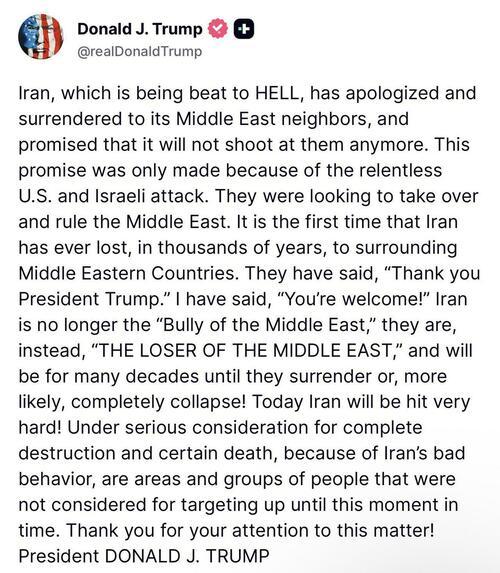
The targeting of strategic oil facilities represents a significant qualitative shift in the ongoing hostilities. Iranian state media, including the semi-official Fars News Agency, alleged that the latest cycle of escalation was initiated by US and Israeli warplanes. These forces reportedly struck an oil depot in southern Tehran, an incident they claimed was part of a broader and intensified bombing campaign across Iran. Visual evidence emerging from Tehran on Friday depicted "massive fireballs" and mushroom clouds rising above the capital, strongly suggesting a direct hit on a major refinery or oil storage facility, corroborating earlier reports from outlets like RT.
In immediate response, the IRGC announced its strike on the Haifa refinery. Located on Israel’s Mediterranean coast, the Haifa refinery is one of the country’s largest and a vital component of its energy security, processing a significant portion of its crude oil imports. Such an attack, if confirmed by independent sources and demonstrably effective, carries not only immediate operational consequences for Israel’s fuel supply and industrial output but also profound psychological and economic implications. It signals Iran’s willingness to target core economic assets, mirroring the perceived attacks on its own. This dangerous mirroring of tactics has prompted observers like financial journalist Javier Blas to note on social media that the "regional energy infrastructure is getting pulled deeper and deeper into the conflict in a rapid escalation," a sentiment echoed by many concerned about the conflict’s trajectory. The targeting of these facilities raises alarms about the potential for environmental catastrophe, supply chain disruptions, and soaring global oil prices, adding a new layer of complexity to an already intractable crisis.
Regional Repercussions and Expanding Fronts
The conflict’s geographical scope has expanded dramatically beyond the immediate borders of Iran and Israel. Saturday morning saw a direct drone hit on Dubai International Airport, a major global aviation hub. While Emirates reportedly resumed limited flights after a brief suspension, the attack on such a prominent civilian target in a neutral country marks a severe escalation, highlighting the willingness of Iranian-backed forces to target critical infrastructure across the Gulf. This incident followed earlier drone and missile attacks on other Gulf countries throughout Saturday.
Further evidence of the widening conflict emerged from Saudi Arabia, which reported intercepting two ballistic missiles aimed at Prince Sultan Air Base and drones targeting the Shaybah oilfield. Prince Sultan Air Base is a significant facility hosting US military personnel and assets, while Shaybah is one of the world’s largest oilfields, critical to global crude supplies. These attacks underscore the vulnerability of US assets and vital energy infrastructure in the region, directly implicating Gulf nations in the conflict despite their efforts to remain neutral.
Concurrently, a "second front" has intensified in Lebanon. Israeli air and ground raids on the Lebanese town of Nabi Chit, located in the eastern Bekaa Valley, reportedly resulted in at least 41 fatalities. This operation signifies a significant escalation in fighting with Hezbollah, Iran’s powerful proxy in Lebanon, and suggests a deepening Israeli campaign to neutralize threats emanating from its northern border. Beirut, the Lebanese capital, has also reportedly come under aerial bombardment, with entire buildings leveled, indicating a broader and more destructive phase of the conflict in the Levant. These simultaneous developments paint a grim picture of a rapidly expanding regional war, with civilian populations bearing the brunt of the violence.
Diplomatic Flurry Amidst Escalation and Internal Power Struggles
Amidst the escalating violence, a complex and contradictory diplomatic landscape has emerged, revealing deep internal divisions within Iran’s leadership. On Saturday afternoon, Iran’s Foreign Ministry, speaking on behalf of President Masoud Pezeshkian, expressed an "openness to de-escalation within our region," with the critical proviso that "our neighbors’ airspace, territory, and waters are not used to attack the Iranian People." This statement, perceived by some as an "olive branch" to Gulf countries, was quickly followed by an apology from Pezeshkian to neighboring states for coming under attack.
However, the sincerity and efficacy of this diplomatic gesture were immediately questioned, not least because of the ongoing Iranian drone and missile launches targeting Israel and Gulf nations. Critics suggest that Pezeshkian’s authority might be severely curtailed, with the IRGC effectively "running the show" and potentially operating with a degree of "autonomy/division of action among the various military command chains." This observation highlights the long-standing power struggle between Iran’s civilian government and its hardline military establishment, particularly the IRGC, which often dictates foreign and security policy.
Adding to the internal flux, reports from Iranian state media indicate that a new Supreme Leader could be chosen within the next 24 hours. This development, occurring amidst a major conflict, suggests intense jostling between various reformist and hardline factions, with analysts widely anticipating that more conservative candidates are likely to prevail, potentially solidifying the IRGC’s influence.
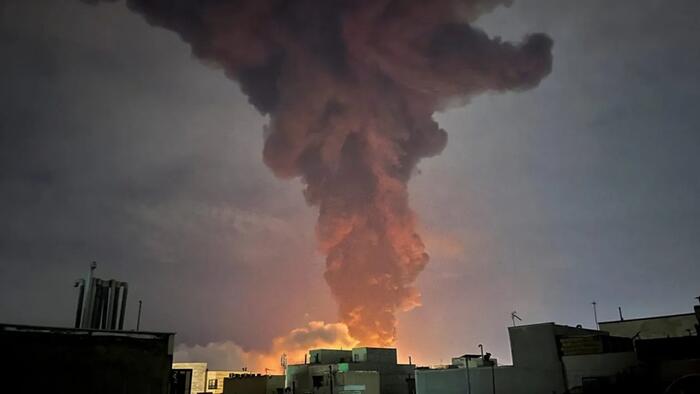
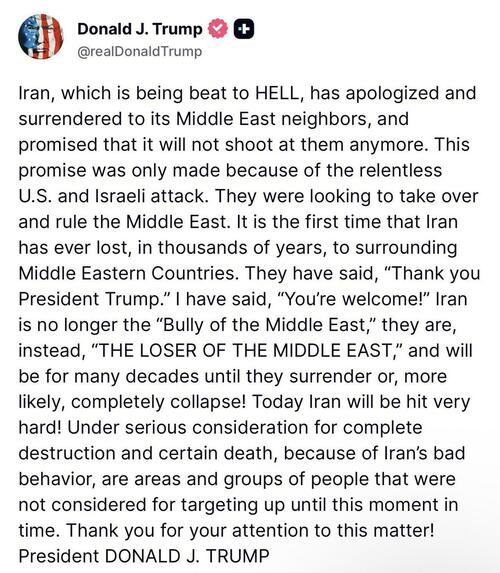
The prospect of de-escalation was further diminished by a swift and unequivocal rejection from the United States. President Donald Trump, posting on Truth Social, declared Pezeshkian’s gesture "almost immediately killed," reiterating his demand for Iran’s "unconditional surrender." Trump went further, proclaiming "victory" and warning that "today Iran will be hit very hard," promising even more escalation. He controversially stated that "under serious consideration for complete destruction and certain death, because of Iran’s bad behavior, are areas and groups of people that were not considered for targeting up until this moment in time." This aggressive rhetoric from Washington effectively extinguished any immediate hopes for a diplomatic off-ramp, underscoring the deep chasm between the belligerents’ positions.
US Military Posture and Strategic Reinforcements
In a significant show of force, the United States Navy is reportedly preparing to deploy a third carrier strike group to the Middle East, a move that would mark the first time since the 2003 Iraq War that three US supercarriers have been simultaneously present in the Mideast theatre. According to reports from Fox News and open-source intelligence, the USS George H. W. Bush (CVN-77) and her Carrier Strike Group have completed their Composite Training Unit Exercise (COMPTUEX) and are expected to depart Naval Station Norfolk, Virginia, before the end of March for a regularly scheduled deployment to the U.S. 5th Fleet Area-of-Responsibility.
The precise mission of the USS George H. W. Bush remains unclear: whether she will relieve the long-deployed USS Gerald R. Ford (CVN-78), which entered the Red Sea on Thursday after nearly 11 months in the region, or if she will arrive to further reinforce the already substantial US naval presence. Regardless, the deployment of a third carrier strike group signals a serious commitment to projecting power and potentially expanding military options in the face of escalating regional hostilities. Each carrier strike group typically comprises a nuclear-powered aircraft carrier, at least one cruiser, several destroyers, and a carrier air wing of 60-70 aircraft, representing immense firepower and strategic flexibility. This build-up is intended to deter further Iranian aggression, protect US interests and allies, and potentially provide additional strike capabilities should the conflict intensify further.
Information Warfare and Censorship
As the conflict rages, both sides are actively engaged in information warfare and implementing stringent censorship measures. In Iran, the Ministry of Intelligence issued stern warnings against any anti-government protests, firmly stating that such actions would not be tolerated while the country is under attack. The ministry accused "American-Zionist mercenaries" of photographing missile impact sites and transmitting footage to "terrorist satellite networks" abroad, cautioning citizens that assisting foreign media or intelligence operations would be treated as a national security offense. This indicates a concerted effort by the Iranian regime to control the narrative, suppress dissent, and prevent independent reporting on the war’s impact within its borders.
Similarly, Israel has reportedly implemented a heavy military censorship campaign, with Israeli media on Saturday morning reporting the interception of the eighth missile launch since midnight, often without detailing the full extent of damage or the locations of impacts. This suggests an apparent attempt to conceal the true extent of damage inflicted by Iranian ballistic missiles and drones after a week of intense attacks. Footage from Tel Aviv, showing the Iron Dome missile defense system "struggling and failing" in certain instances, suggests that Iran’s barrages may be overwhelming Israeli defenses in ways not fully acknowledged by official reports. Both governments appear to be managing public perception, underscoring the strategic importance of information control during wartime.
Economic Fallout and Maritime Threats
The economic dimensions of this conflict are rapidly expanding, particularly concerning global energy supplies and maritime trade. The IRGC claimed responsibility for striking another oil tanker on Saturday, identifying it as the "Louise P," flagged under the Marshall Islands and described as "one of the assets of the terrorist America," hit by a drone in the Persian Gulf. This incident highlights Iran’s intent to disrupt international shipping and target vessels perceived as linked to its adversaries.
Shortly after, Bloomberg reported that a second bulk carrier, the Liberia-flagged Sino Ocean, broadcast its destination signal as "CHINA OWNER_ALL CREW" while transiting the Strait of Hormuz. This highly unusual declaration suggests an attempt by vessels to signal neutrality or avoid being targeted by Iranian forces amidst the heightened tensions. The Strait of Hormuz, a narrow waterway at the mouth of the Persian Gulf, is a critical chokepoint through which approximately 20% of the world’s petroleum passes. Its effective closure for a week due to multiple attacks has already caused significant disruptions to global shipping and has likely contributed to volatility in oil prices. The targeting of tankers and the militarization of this vital shipping lane have profound implications for global trade, energy security, and insurance markets.
Assessing Iran’s Capabilities and Resilience
The true depth of Iran’s ballistic missile capabilities remains a subject of intense speculation and debate among military analysts. Some suggest that Iran might be "running low" on its arsenal after a week of sustained attacks, while others, like Habibullah Khan, argue that Iran is "playing chess," deliberately exhausting interceptors before deploying "newer missiles" like the Khorramshahr 4, Kheibar, and Fattah, which he claims "not a single country could stop." The operational effectiveness and resilience of Iran’s missile forces are crucial unknowns that will influence the trajectory of the conflict.
Adding to the strategic analysis, a classified US National Intelligence Council assessment, reportedly completed a week before the war began, concluded that "even a large-scale assault on Iran would be unlikely to topple the Islamic Republic." The report, according to The Washington Post, outlined succession scenarios should Supreme Leader Ali Khamenei be killed, but ultimately concluded that institutional mechanisms would likely keep the system intact and that opposition groups were "unlikely" to seize power. This assessment suggests that the US intelligence community harbors a realistic view of the Iranian regime’s resilience, potentially contrasting with some of the more optimistic or aggressive rhetoric from the White House regarding regime change. This analysis implies that military action, however intense, may not achieve the desired political outcome of dismantling the Islamic Republic.
Humanitarian Cost and The Road Ahead
The human cost of this escalating conflict is tragically mounting. In the United States, a somber moment is anticipated as the bodies of six American service members killed in the conflict are scheduled to arrive at Dover Air Force Base for a dignified transfer ceremony, with both President Trump and Vice President JD Vance confirmed to be attending. These casualties underscore the direct involvement and sacrifices being made by US personnel in the region. Beyond military losses, the widespread targeting of civilian infrastructure and the expansion of hostilities into populated areas in Lebanon and potentially other Gulf states suggest a growing humanitarian crisis with potential for mass displacement and loss of life.
As the conflict grinds into its second week, with no real efforts at de-escalation gaining traction and rhetoric on all sides intensifying, the prospect of a swift resolution appears increasingly dim. The direct targeting of energy infrastructure, the expansion of battlefronts across the Gulf and Levant, the internal political struggles within Iran, and the significant US military build-up collectively point towards a protracted and highly dangerous regional war. The implications for global stability, energy markets, and the lives of millions in the Middle East remain profoundly uncertain.