
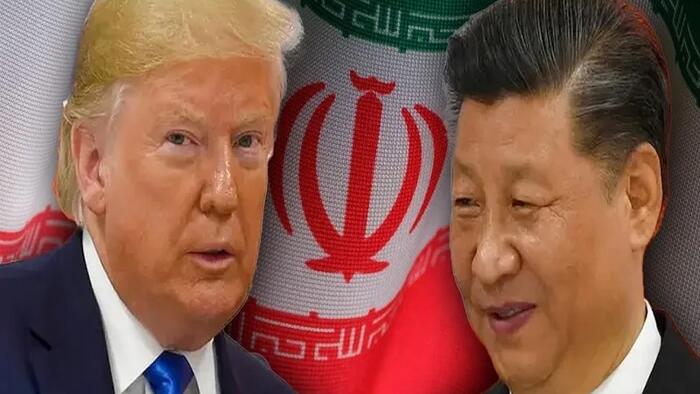

This provocative geopolitical theory, articulated by analyst Andrew Korybko, posits that the underlying motivation for any potential future US military campaign against Iran extends far beyond stated objectives of defending American interests or even regional stability. Instead, Korybko argues that such actions, particularly within the framework of a hypothetical "Trump 2.0" administration, would be meticulously designed to strategically undermine China’s economic ascent and re-establish a unipolar global order dominated by the United States. This perspective challenges conventional narratives, suggesting a grand strategy centered on energy resource control as a primary tool for geopolitical coercion.
The Core Thesis: Geopolitical Energy Control
Korybko’s analysis fundamentally diverges from public explanations for military engagements. While former President Trump, for instance, has previously asserted that US military actions are intended to "defend the American people," and some critics have playfully or seriously linked such moves to domestic political distractions, Korybko contends these are secondary or diversionary. The true strategic prize, he argues, is Iran’s vast hydrocarbon wealth. Iran possesses an estimated 208.6 billion barrels of proven crude oil reserves, ranking fourth globally, and holds the world’s second-largest proven natural gas reserves, totaling approximately 33.5 trillion cubic meters. These immense resources are crucial for global energy markets, and critically, for China’s burgeoning economy.
The theory suggests that securing "proxy control" over these reserves would grant the United States unprecedented leverage. This control could manifest through a compliant Iranian government, installed or heavily influenced by US actions, which would then align its energy export policies with US strategic interests. The ultimate aim is not merely to disrupt Iran’s economy but to weaponize its energy output against China. By controlling or influencing a significant portion of global energy supply, the US could potentially dictate terms for China’s access to vital resources, thereby slowing its industrial growth and diminishing its economic power.
Unpacking the "Strategy of Denial"
Central to Korybko’s argument is the concept of a "Strategy of Denial," attributed to former Under Secretary of Defense for Policy Elbridge Colby. Colby’s strategic framework, particularly outlined in his work on competition with peer adversaries, emphasizes preventing a rival from achieving its objectives rather than solely focusing on one’s own capabilities. In the context of China, this strategy would involve systematically denying Beijing access to the markets and resources essential for its continued economic expansion and military modernization.
Korybko extrapolates this strategy to suggest a multi-pronged approach under a potential "Trump 2.0" administration. This would involve a series of trade deals designed to reorient global supply chains and market access away from China. For instance, proposed trade agreements with the European Union and India could include provisions that subtly or overtly incentivize these economic blocs to curtail China’s access to their markets, possibly through punitive tariffs on Chinese goods if cooperation is withheld. This economic pressure would be mirrored by efforts to disrupt China’s energy security.
The resource dimension, particularly relevant to Iran, would involve active measures to control or influence major energy producers. Korybko highlights Venezuela, Nigeria, and other leading energy exporters as potential targets for US influence or "special operations." The objective is to curtail China’s access to the energy resources — oil and gas — that fuel its industrial base and support its ambitious Belt and Road Initiative. By orchestrating a reduction or redirection of energy supplies, the US could inflict significant economic pain on China, forcing it to reconsider its geopolitical trajectory.
A crucial component of this "Strategy of Denial" involves US influence over energy exports from key nations like Venezuela, and potentially Iran and Nigeria. This influence, once established, could be "weaponized" through threats of curtailment or outright cut-offs of energy supplies to China. Concurrently, pressure could be exerted on Gulf allies, such as Saudi Arabia and the UAE, to align their energy export policies with this US strategic objective. The overarching goal is to compel China into an "indefinite junior partnership status" relative to the United States, effectively through a "lopsided trade deal" that would fundamentally alter the global economic power balance.
China’s Energy Lifeline and Vulnerabilities
China’s economic engine is heavily reliant on imported energy. As the world’s largest crude oil importer and a significant natural gas consumer, its energy security is a paramount concern for Beijing. In 2023, China imported over 70% of its crude oil needs, making it highly vulnerable to disruptions in global supply chains or targeted energy curtailment. While China has diversified its energy sources over the years, including major suppliers like Saudi Arabia, Russia, and Angola, Iran has historically been a notable, albeit fluctuating, contributor to its energy mix, especially during periods when Iranian oil was offered at discounted prices due to international sanctions.
Kpler data cited by Korybko indicates that Iran represented approximately 13.4% of China’s total 10.27 million barrels per day (MMbpd) of seaborne oil imports in the preceding year. While this figure can fluctuate based on sanctions enforcement and global market dynamics, it underscores Iran’s potential as a significant, though not exclusive, energy provider for China. The US strategic objective, as theorized, would be to control, curtail, or completely cut off this flow. Such a move would force China to seek more expensive or less reliable alternative sources, thereby increasing its energy costs, impacting its manufacturing competitiveness, and straining its foreign exchange reserves.
The "Venezuelan Model": A Blueprint for Proxy Control?
The analysis posits that the US initially pursued diplomatic avenues to achieve its strategic objectives in Iran, aiming to "replicate the Venezuelan model." The "Venezuelan model" typically refers to a strategy of intense economic pressure, sanctions, diplomatic isolation, and support for opposition figures, often coupled with overtures to security forces, designed to effect a change in government or significant policy shifts. In Venezuela’s case, this involved US recognition of an interim president, Juan Guaidó, and sustained pressure on the Maduro government, including severe sanctions on its oil industry.
Korybko suggests that Iran initially "flirted" with such diplomatic overtures, perhaps enticed by potential economic incentives to ease sanctions. However, Tehran ultimately did not commit to such an arrangement, viewing it as a "strategic surrender" that would compromise its national sovereignty and regional influence. This perceived refusal, according to the theory, then prompted a shift towards authorizing military action as a means to achieve the same end: establishing proxy control.
A key element of this "Venezuelan model" replication, as inferred from Trump’s hypothetical statements regarding the Islamic Revolutionary Guard Corps (IRGC), would be an offer of immunity to IRGC members if they were to lay down their arms during a US military campaign. This proposition is interpreted as a strategic maneuver to co-opt elements of Iran’s powerful security apparatus. By offering immunity, the US could aim to cultivate a "newly US-aligned IRGC" that would govern Iran during a political interim, preceding new elections. This scenario mirrors the US strategy in Venezuela, where the hope was that segments of the Venezuelan security forces would defect and support a US-backed transitional government.
Such a strategy would seek to avoid the "Balkanization" of Iran, a scenario where the country fragments along ethnic or sectarian lines, which would destabilize the region and potentially create a power vacuum too complex to manage. Instead, preserving the Iranian state, albeit under proxy control, would allow it to resume a role as a US regional ally. This repositioned Iran could then potentially support Western influence projection, particularly through alliances like the Azeri-Turkish Axis, along Russia’s southern periphery. This would serve the dual purpose of tightening US encirclement of Russia while simultaneously gaining unparalleled resource leverage over China.
Potential Economic and Geopolitical Repercussions
Should Korybko’s hypothesized "Strategy of Denial" come to fruition, the economic and geopolitical repercussions would be profound and far-reaching:
For China:
- Energy Insecurity: Drastically increased energy costs, potential rationing, and disruption to manufacturing and supply chains.
- Economic Deceleration: A significant slowdown in economic growth, potentially derailing its "superpower rise" and ambition to overtake the US as the world’s largest economy.
- Trade Imbalance: Being coerced into a "lopsided trade deal" would mean accepting unfavorable terms, impacting its export-driven economy and hindering technological advancement.
- Strategic Vulnerability: Highlighting its dependence on external energy sources and maritime trade routes, potentially prompting greater domestic resource development or a more aggressive stance in securing alternative routes.
For Iran:
- Loss of Sovereignty: A change in government leading to proxy control would mean a significant loss of national sovereignty and control over its strategic resources.
- Political Instability: The process of regime change or significant political transition, even with an offer of immunity to security forces, would likely be fraught with internal conflict and dissent.
- Economic Reorientation: Its economy would be re-engineered to align with US strategic interests, potentially altering its trading partners and development trajectory.
For the United States:
- Restored Unipolarity: Achieving its stated goal of restoring US-led unipolarity, reasserting its dominance in the global order.
- Enhanced Leverage: Gaining significant economic and geopolitical leverage over China and other rivals.
- Regional Influence: Solidifying its influence in the Middle East and potentially extending it along Russia’s southern flank.
- Increased Tensions: Potentially escalating global tensions with China and Russia, leading to a more confrontational international environment.
For Global Energy Markets:
- Price Volatility: Significant disruptions to Iranian oil and gas exports would inevitably lead to extreme price volatility in global energy markets.
- Supply Shocks: Depending on the scale of disruption, the world could face severe energy supply shocks, impacting consumers and industries globally.
- Redrawing Energy Maps: The strategic reorientation of a major producer like Iran would fundamentally redraw global energy trade routes and alliances.
Broader Implications for Global Order
The "new National Security Strategy" mentioned in the original analysis, specifically its call to "rebalance China’s economy toward household consumption," is presented as a euphemism for this radical re-engineering of the global economy. This shift would entail deliberately curtailing China’s access to both markets and resources, thereby undermining its status as "the world’s factory" and its role as the US’s only systemic rival. The ultimate objective is to dismantle the foundations of China’s economic power, thereby restoring an era of US-led unipolarity as articulated by figures like Marco Rubio in his Munich speech, which detailed a strategy for competing with China.
Furthermore, Korybko emphasizes that such a strategy in Iran would not only target China but also serve to "tighten its encirclement of Russia." By fostering a US-aligned Iran and potentially leveraging the Azeri-Turkish Axis to project Western influence along Russia’s southern periphery, the US would deal a powerful blow to the emerging concept of multipolarity. Multipolarity, characterized by several centers of global power (e.g., US, China, Russia, EU, India), is seen by its proponents as a more balanced and stable international system than unipolarity. The proposed strategy, therefore, represents a decisive move to counter and reverse this trend, ensuring continued US primacy.
The theoretical implications extend to international institutions and the norms of international law. Unilateral military actions aimed at regime change or proxy control, particularly in a sovereign state with significant global energy resources, would undoubtedly trigger widespread condemnation from various international bodies and non-aligned nations. Such actions could further erode trust in the rules-based international order, potentially leading to a more fractured and confrontational global landscape.
In summary, Korybko’s analysis presents a complex and deeply strategic rationale for any future US military engagement in Iran. It moves beyond immediate tactical objectives or domestic political considerations, instead framing such actions as integral components of a grand strategy aimed at reshaping the global economic and geopolitical order in favor of continued US dominance, primarily by strategically weakening China and containing Russia. While highly speculative and presented as an analytical forecast of future policy, it offers a stark alternative perspective on the motivations driving superpower competition in the 21st century.