

The international arena is currently characterized by a complex interplay of geopolitical realignments, economic pressures, and simmering conflicts, leading to widespread concerns about the stability of the global order. At the forefront of these tensions are the persistent standoffs with Iran, the ongoing conflict in Ukraine, and the escalating strategic competition between the United States and China, each contributing to a dynamic and unpredictable global landscape.
Mounting Pressure and Iran’s Resilience
Recent observations suggest that the extensive pressure campaigns levied against Iran have not yielded the desired capitulation from Tehran. This resistance is rooted in a deep historical and cultural context, particularly the tenets of Shi’ism, which emphasize steadfastness in the face of adversity. The United States, often perceived as the primary architect of these pressures, has employed a strategy centered on economic sanctions and diplomatic isolation, aiming to compel Iran to alter its nuclear program, regional policies, and human rights record.
The history of U.S.-Iran relations has been fraught with tension, particularly since the 1979 Iranian Revolution. A pivotal moment in recent history was the 2015 Joint Comprehensive Plan of Action (JCPOA), an international agreement that saw Iran limit its nuclear activities in exchange for sanctions relief. However, the U.S. withdrawal from the JCPOA in 2018 under the Trump administration, followed by the re-imposition and escalation of sanctions, significantly intensified the economic strain on Iran. These "maximum pressure" tactics, while severely impacting Iran’s economy, have not led to a change in the regime’s fundamental posture. Iranian leaders have consistently maintained that they will not negotiate under duress and have often leveraged regional proxy forces to project influence and respond to perceived threats.
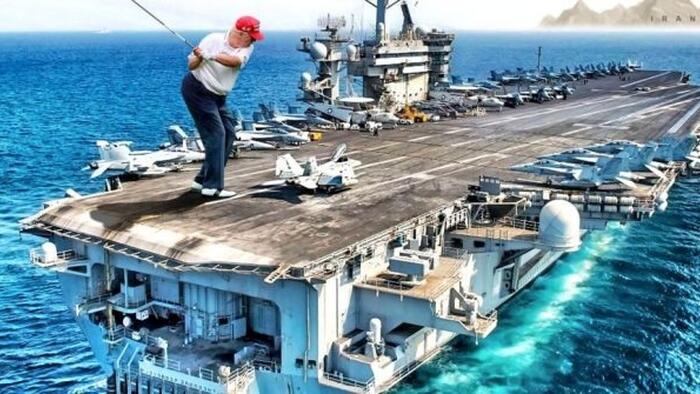
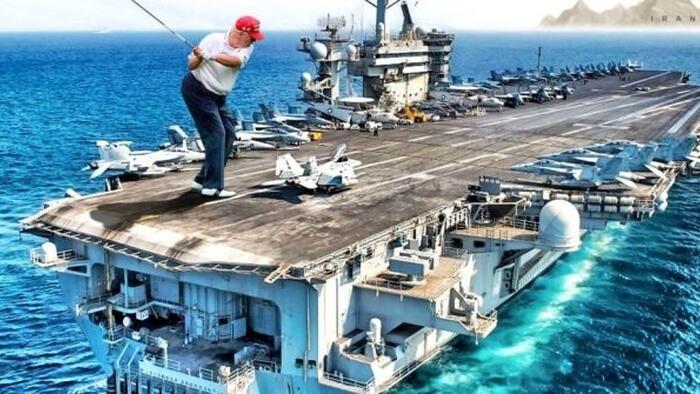
Concurrently, military deployments in strategic waterways, such as the Persian Gulf, frequently draw attention. The presence of significant naval assets, including U.S. aircraft carrier strike groups, is often interpreted by regional observers as a demonstration of force and a potential precursor to military action. Such deployments invariably raise the specter of direct confrontation, particularly given the heightened rhetoric from both sides and the historical flashpoints in the region. Despite ongoing diplomatic efforts, including potential "last chance saloon" negotiations, the prospect of an Iranian capitulation appears remote, leading some analysts to consider scenarios ranging from continued stalemate to more direct military engagement. The implications of such an escalation for regional and global stability would be profound, potentially disrupting vital energy supplies, triggering wider conflicts, and drawing in various international actors.
Geopolitical Maneuvering and the Ukraine Conflict
Beyond the immediate concerns surrounding Iran, the global stage is grappling with broader geopolitical shifts, often framed by some observers as a return to "total war" dynamics. This perspective suggests that major conflicts and international crises may serve as political diversions for domestic challenges or as mechanisms to consolidate power and wealth within specific elite factions. The Munich Security Conference, an annual gathering of international security policy leaders, frequently serves as a barometer for such sentiments. In recent iterations, discussions have consistently highlighted a perceived "war on Russia" as a central theme, reflecting deep divisions over the conflict in Ukraine.
The conflict in Ukraine, which intensified significantly with Russia’s full-scale invasion in February 2022, has fundamentally reshaped European security architecture and global alliances. Initially characterized as a "proxy war," the conflict has evolved into a full-scale conventional war, drawing extensive military and financial support from Western nations to Ukraine. This support, coupled with comprehensive sanctions against Russia, underscores a concerted effort by the Anglo-American and Atlanticist powers to counter Russian aggression and uphold international norms. However, the prolonged nature of the conflict and its economic repercussions have also fueled debates about the long-term sustainability of this approach and the potential for unintended escalation.
Defense spending has seen a significant uptick globally in response to these developments. Projections for defense budgets, particularly in the United States, indicate a sustained increase, with some estimates suggesting substantial growth by the middle of the decade. This trend highlights the continued influence of what is often termed the "military-industrial complex," or more broadly, the "MICIMATT" (military-industrial-congressional-intelligence-media-academia-think tank complex). Proponents argue that such investments are necessary for national security and deterrence in an increasingly volatile world, while critics contend that they divert resources from pressing social needs and perpetuate a cycle of conflict. The argument that this complex acts as an "escape valve" for economic pressures or as a driver of Western "turbo-capitalism" underscores a critical perspective on the interplay between economic systems and geopolitical strategies, especially in a context where global economic leadership is being challenged.
Economic Realignment and the European Energy Crisis
The shift in the global energy landscape represents one of the most immediate and impactful consequences of these geopolitical realignments, particularly for Europe. The continent’s historic reliance on cheap Russian natural gas came to an abrupt end following the sanctions imposed after the Ukraine conflict. This rupture has forced European nations, notably Germany, to pivot rapidly towards alternative energy sources, primarily liquefied natural gas (LNG) imports.
The economic implications of this pivot have been severe. Data from organizations like the Institute for Energy Economics and Financial Analysis (IEEFA) has highlighted the dramatic increase in Europe’s dependence on U.S. LNG. Some analyses project that the U.S. could supply up to 80% of the EU’s LNG imports by 2030. This dependence is underscored by significant trade agreements, such as the one announced in July 2022, committing the EU to purchase substantial quantities of U.S. energy products. While these agreements bolster energy security from a geopolitical standpoint, they come at a considerable economic cost. LNG from the U.S. is significantly more expensive than pipeline gas from Russia, leading to skyrocketing energy prices across the EU.
This surge in energy costs has dealt a severe blow to European industrial enterprises. Manufacturers, particularly in energy-intensive sectors, have faced unprecedented operational challenges, leading to widespread shutdowns, production curtailments, and bankruptcies. Germany, historically an industrial powerhouse with a manufacturing sector heavily reliant on affordable energy, has been particularly affected. This phenomenon has been termed by some as the "Triumph of De-Industrialization," reflecting concerns that Europe’s industrial competitiveness is being eroded, potentially leading to long-term economic decline and a weakening of its global standing. The strategic implications extend beyond economics, potentially reshaping political alignments as European nations grapple with balancing energy security, economic viability, and geopolitical allegiances.
The Rise of Multipolarity and Eastern Economic Integration
In contrast to the challenges faced by the West, a coalition of "rational RIC (Russia-India-China) actors" is actively engaged in a complex strategic buildup, aiming to reshape the global economic and security architecture towards a more multipolar order. This involves a coordinated effort across several fronts:
- De-dollarization and Yuan Internationalization: Russia, facing extensive Western sanctions, has strategically reduced its reliance on the U.S. dollar, engaging in bilateral trade in local currencies and exploring alternative financial mechanisms. China, meanwhile, continues its steady expansion of the internationalized yuan, promoting its use in global trade and investment. Initiatives like the Cross-Border Interbank Payment System (CIPS) are being developed as alternatives to the Western-dominated SWIFT system, aiming to facilitate yuan-denominated transactions globally.
- BRICS Expansion and Alternative Payment Systems: The BRICS bloc (Brazil, Russia, India, China, South Africa) has emerged as a significant platform for cooperation among developing economies. Discussions within BRICS have centered on creating a common payment system to reduce reliance on Western financial infrastructure, thereby offering members greater financial autonomy. The group has also seen increasing interest from other nations seeking membership, signaling a growing desire for alternatives to existing global governance structures. India, while maintaining strategic relationships with the U.S. and its allies, is actively leveraging its position to advance its interests within BRICS, including its payment system architecture.
- Interconnected Maritime Security: The increasing frequency of joint naval drills involving Russia, China, and Iran in various strategic waters, including the Gulf of Oman and the Indian Ocean, underscores a growing military and security alignment among these nations. These exercises are interpreted as demonstrations of collective defense capabilities, aimed at countering perceived Western dominance and asserting their presence in critical maritime corridors.
The U.S. National Security Strategy (NSS) has articulated a global design often characterized by five spheres of influence: the U.S. itself, Russia and China designated as primary adversaries, and India and Japan as key partners or "vassals" in the framework. This strategy emphasizes that the "security, freedom and prosperity of the American people is directly linked to our capacity of trading and being implicated in a position of force in the Indo-Pacific." While framed as a geoeconomic opportunity, this assertion is often perceived by other nations, including India, as a thinly veiled threat of force, highlighting a broader imperial imperative to secure natural resources and control strategic territories. The evolving dynamics suggest that the U.S. design for global order is increasingly challenged by the emergence of these alternative power centers.
The Ultimate Showdown: US-China Rivalry
The "New Great Game" in the 21st century is increasingly defined by the strategic competition between the United States and China. This rivalry permeates various domains, from trade and technology to military capabilities and ideological influence. Diplomatic engagements, such as potential high-level visits by U.S. leaders to China, are closely watched for signs of de-escalation or further entrenchment of positions. While the U.S. may seek to secure agreements that uphold the dominance of the U.S. dollar, analysts widely anticipate significant challenges, as China is unlikely to concede ground on its core strategic objectives.
Beijing’s economic strategy is multifaceted and geared towards long-term financial independence and global influence. Key elements include:
- Yuan Internationalization: China is systematically promoting the yuan as a global reserve and trade currency, encouraging its use in bilateral agreements and developing alternative financial infrastructure.
- Gold-Backed Corridors: Efforts to build gold-backed financial corridors and increase gold reserves are seen as a strategic move to buttress the yuan’s stability and offer an alternative to fiat currencies susceptible to Western financial leverage.
- Strategic Resource Control: China exerts significant influence over global supply chains for critical minerals and commodities, giving it leverage in international trade. Reports of restricting exports of materials like silver, or strategically adjusting holdings of U.S. treasuries, are interpreted as deliberate financial maneuvers to influence global markets and assert economic power.
The prevailing view in Beijing is that the stability of American economic bubbles is sustained by a combination of oligarchic control and continuous money printing, a model they believe lacks a sustainable "Plan B." This perception reinforces China’s resolve to pursue its own path, characterized by economic diversification, technological self-sufficiency, and the gradual reordering of global financial systems. The competition is not merely economic; it is a fundamental contest over the future shape of the international order, where China champions a multipolar world against what it perceives as existing hegemonic structures.
Erosion of International Norms and Domestic Undercurrents
The current geopolitical climate is also marked by a perceived erosion of established international norms and a move towards a "no holds barred" approach to statecraft. This is exemplified by actions such as the freezing or seizure of national assets. Following the conflict in Ukraine, Western nations, including the U.S. and European Union members, moved to immobilize a significant portion of Russia’s foreign exchange reserves and other state-owned assets. While justified under the framework of sanctions and international law by the imposing nations, these actions have been described by some as "piracy" or a violation of sovereign immunity, setting a controversial precedent for the use of financial warfare.
Furthermore, domestic political landscapes and internal challenges within major powers can significantly influence foreign policy decisions. In the United States, high-profile scandals, such as the revelations surrounding the Epstein files, can generate intense public scrutiny and calls for accountability. While direct causation is often difficult to prove, the concept that foreign policy initiatives might be strategically timed or amplified to divert attention from pressing domestic issues or to consolidate political narratives remains a recurring theme in political analysis. The interplay between domestic political imperatives, economic pressures, and foreign policy decisions creates a complex web of motivations that shape international relations.
The philosophical underpinnings of this period are also subjects of intense debate. Concepts such as "post-truth," where objective facts are less influential than appeals to emotion and personal belief, are increasingly prevalent. This environment, where truth itself becomes contested, creates challenges for rational discourse and consensus-building in international affairs. The broader historical trajectory, from the philosophical architecture provided by Plato and Aristotle to the post-World War II era of liberal capitalism and American democracy, is seen by some as having culminated in a period where the West is struggling to localize itself historically. The rise of new global powers, particularly China, suggests that the West, which once dictated the terms of global engagement, may increasingly find itself as a spectator in the unfolding chapters of history.
Ultimately, the confluence of these factors – escalating tensions with Iran, the ongoing conflict in Ukraine, the strategic rivalry between the U.S. and China, and the broader economic and ideological realignments – underscores a profound shift in the global order. The omnipresent geopolitical battlefield is indeed becoming more ferocious day after day, demanding nuanced understanding and adaptive strategies from all international actors.