
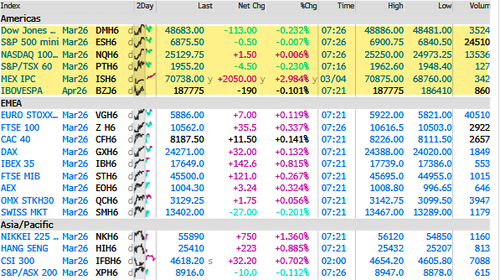

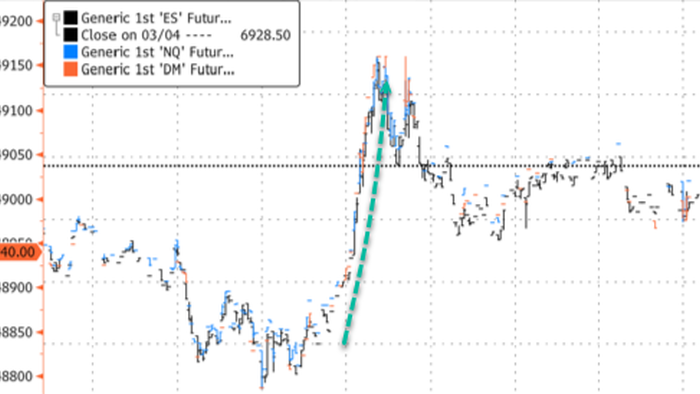
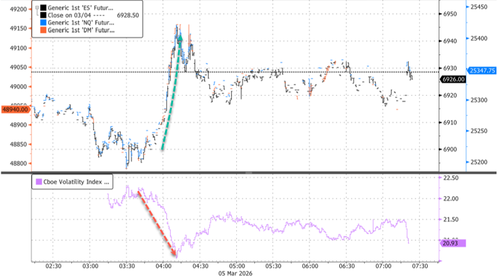
United States equity futures experienced a notable surge in early trading, commencing around 4:00 a.m. ET, following reports from Bloomberg News indicating that Iran had previously signaled a readiness to relinquish its stockpiles of highly enriched uranium during high-stakes negotiations, just prior to the U.S. initiating "Operation Epic Fury." This development, despite relating to events that transpired in the preceding week, proved sufficient to trigger a significant market reaction. S&P 500 E-mini futures, which had been trading lower, swiftly reversed course, erasing earlier losses to trade flat, while Nasdaq futures also showed minimal change, reflecting the profound sensitivity of global financial markets to geopolitical headlines, irrespective of their immediate novelty.
Market Reaction and the Weight of Geopolitical News
The dramatic turnaround in U.S. equity futures underscores the inherent volatility and rapid responsiveness of financial markets to information concerning geopolitical stability, particularly when it involves major global powers and sensitive issues like nuclear proliferation. The initial dip in futures suggested a prevailing sentiment of caution or concern among investors, likely stemming from the broader context of escalating tensions between the United States and Iran, which culminated in the aforementioned "Operation Epic Fury." However, the subsequent rebound, directly attributed to the recirculation of Bloomberg’s report, illustrates how even previously known or "old" news can inject a potent dose of optimism or pessimism into trading floors if its perceived significance shifts or if it is presented anew to a wider audience.
The S&P 500 E-mini futures, a widely watched benchmark for the broader U.S. stock market, saw its value surge, effectively wiping out any pre-market declines. This movement is indicative of a "risk-on" sentiment, where investors become more willing to take on riskier assets like equities in anticipation of reduced geopolitical uncertainty. Similarly, Nasdaq futures, representing the technology-heavy segment of the market, also stabilized, signaling a broader relief across various sectors. This immediate and pronounced reaction highlights the premium investors place on any perceived de-escalation of conflict, particularly in regions critical to global energy supplies and political stability. The fact that the market reacted so strongly to information that was not strictly "new" speaks volumes about the underlying anxiety regarding U.S.-Iran relations and the potential economic ramifications of prolonged conflict or escalation.
The Substance of Iran’s Reported Offer
The core of the news triggering this market movement was a report, initially from Bloomberg, citing the state-run Islamic Republic News Agency (IRNA). According to IRNA, Iran’s Deputy Foreign Minister Majid Takht-Ravanchi stated during recent nuclear negotiations that the country’s highly enriched uranium stockpile was "the result of our practical achievements and that we are ready to get rid of it, provided we get something good in return." This statement, reportedly made in private diplomatic channels, suggests a conditional willingness by Tehran to dismantle a key component of its nuclear program, a significant concession if verified and acted upon.
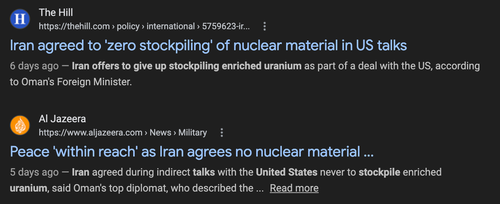
Further corroborating details emerged through CBS News, which reported on Friday of the preceding week that Iran had agreed to surrender its enriched material, aiming for "zero accumulation," and to permit full verification of its nuclear program by the International Atomic Energy Agency (IAEA). This information was conveyed by Oman’s Foreign Minister Badr al Busaidi, who has played a pivotal role as a mediator in several rounds of U.S.-Iran talks over the past month. Albusaidi specifically told CBS News’ "Face the Nation" that "substantial progress" had been made towards a deal to curb Iran’s nuclear program, adding that a "peace deal is within our reach." He further clarified that Iran had agreed to "never, ever have… nuclear material that will create a bomb," and that existing stockpiles would be "blended to the lowest level possible" and "converted into fuel, and that fuel will be irreversible." These details painted a picture of a potentially groundbreaking diplomatic breakthrough, offering a pathway to de-escalation.
Background and Context: A History of Nuclear Diplomacy and Escalation
To fully appreciate the significance of Iran’s reported offer, it is crucial to understand the tumultuous history of nuclear diplomacy between the U.S. and Iran. The Joint Comprehensive Plan of Action (JCPOA), signed in 2015, was a landmark agreement designed to prevent Iran from developing nuclear weapons in exchange for sanctions relief. Under the JCPOA, Iran agreed to significantly reduce its uranium enrichment capacity, limit its stockpile of enriched uranium, and allow extensive international inspections. However, the agreement faced severe challenges, particularly with the U.S. withdrawal in 2018 under the previous administration, which reimposed crippling sanctions.
Following the U.S. withdrawal, Iran gradually began to roll back its commitments under the JCPOA, increasing its uranium enrichment levels and expanding its stockpiles, citing the failure of other parties to uphold their economic commitments. This escalating enrichment activity significantly heightened international concerns about Iran’s nuclear ambitions and its potential to develop nuclear weapons. The "highly enriched uranium stockpiles" mentioned in the Bloomberg report refer to these materials, which, if enriched to higher purities, could be used in nuclear weapons.
The context of "Operation Epic Fury" is equally critical. While specific details of this operation remain limited, its designation implies a significant military posture or action by the United States. Such a named operation suggests a heightened state of alert, possibly involving a substantial deployment of military assets to the region, and a readiness for potential offensive action. The reports of Iran’s willingness to make concessions came "just before" or in the shadow of this operation, strongly suggesting that the imminent threat of military intervention served as a powerful catalyst for Tehran to signal its openness to negotiation and concession. Indeed, CBS reports explicitly mentioned the Iranian side’s willingness to make significant concessions "to stave off a massive US attack, given the immense build-up of Pentagon assets in the region." This background illuminates the high stakes involved in the negotiations and the perceived urgency for a diplomatic resolution.
The Role of Mediators and Diplomatic Channels
Oman has historically served as a crucial intermediary in U.S.-Iran relations, often providing a discreet channel for communication between the two adversaries who lack formal diplomatic ties. Foreign Minister Badr Albusaidi’s active role in mediating "several rounds of U.S.-Iran talks over the last month" underscores the importance of back-channel diplomacy in preventing outright conflict. His public statements to CBS News, confirming "substantial progress" and the proximity of a "peace deal," lent significant credibility to the reports of Iran’s concessions. The Omani mediation highlights the enduring efforts by regional players to foster stability and prevent a wider conflagration, often working quietly behind the scenes to bridge seemingly insurmountable divides.
However, the efficacy of these mediated discussions remains clouded by a lack of public confirmation from U.S. officials. On Wednesday, preceding the market jump, CNN had reported that Iranian intelligence officials had sent messages to Washington regarding potential talks to end the conflict. Yet, notably, no U.S. official has publicly confirmed that any such negotiations are currently underway or that the specific terms reported by Bloomberg and CBS have been officially acknowledged by the American side. This absence of official U.S. corroboration introduces a layer of uncertainty and skepticism, which sophisticated investors and analysts would factor into their assessments.
Discrepancy: Market Optimism Versus Reality on the Ground
Perhaps one of the most intriguing aspects of this situation is the stark contrast between the market’s enthusiastic response and the more cautious outlook reflected in predictive markets. While U.S. stocks jumped on the perceived "hope" of de-escalation, Polymarket odds for a ceasefire by month-end actually slipped to just 1 in 4. Polymarket, a decentralized prediction market, allows participants to bet on the outcome of future events, with the odds reflecting the collective wisdom and sentiment of its users. The divergence between surging stock prices and declining ceasefire odds suggests a disconnect: traditional equity markets might be reacting primarily to the potential for good news, driven by algorithms and quick sentiment shifts, while prediction markets, often populated by individuals with deeper geopolitical insight, may be weighing the complexities, the lack of official U.S. confirmation, and the historical pattern of U.S.-Iran brinkmanship more heavily.
This discrepancy could indicate that while the market is quick to price in optimism based on favorable headlines, a more sober assessment suggests that a definitive resolution to the conflict remains distant and highly uncertain. It highlights the often-irrational exuberance of short-term market movements compared to the more grounded, albeit speculative, assessments of geopolitical experts and informed participants in prediction markets. The "why this old news is being recirculated remains unclear" adds to the analytical challenge, prompting questions about strategic leaks, diplomatic maneuvering, or simply a delayed or renewed emphasis by media outlets.
Implications and Future Outlook
The incident serves as a potent reminder of how geopolitical developments, even those with a delayed impact or ambiguous confirmation, can significantly sway market sentiment. The phrase "Iran potentially surrendering its uranium stockpiles may become the new ‘trade war’ headlines for the stock market casino" aptly captures this phenomenon. Throughout President Trump’s first term and subsequent periods, market participants became accustomed to a volatile dance of headlines related to trade disputes, where every positive or negative comment from officials could send indices swinging. The U.S.-Iran dynamic, with its high stakes, potential for military conflict, and implications for global oil supplies, possesses similar characteristics, making it a recurring source of market sensitivity.
For investors, this scenario underscores the necessity of robust risk management strategies and a nuanced understanding of geopolitical currents. While immediate reactions can be sharp, the long-term trajectory of markets will depend on the actualization of diplomatic breakthroughs and sustained de-escalation. The lack of official U.S. confirmation for the reported concessions means that the path forward is fraught with uncertainty. Until verifiable progress is made and publicly acknowledged by all principal parties, the U.S.-Iran relationship will likely remain a significant source of market volatility.
Beyond market fluctuations, the potential for Iran to surrender its highly enriched uranium stockpiles carries profound implications for international security and nuclear non-proliferation efforts. If such an agreement were indeed reached and implemented, it would significantly reduce the risk of nuclear proliferation in the Middle East, a region already grappling with numerous conflicts. It could also pave the way for broader diplomatic engagement and potentially a recalibration of U.S.-Iran relations, though the deep-seated mistrust and numerous points of contention between the two nations suggest any such thaw would be gradual and challenging.
In conclusion, the surge in U.S. equity futures in response to resurfaced reports of Iran’s willingness to cede enriched uranium highlights the profound impact of geopolitical developments on global financial markets. While the immediate reaction reflects a hopeful shift in sentiment, the absence of official U.S. confirmation and the contrasting signals from prediction markets suggest that the path to a lasting resolution remains complex and uncertain. This episode serves as a powerful illustration of the delicate interplay between diplomacy, military posturing, media reporting, and market psychology in an increasingly interconnected world.