

The landscape of global financial services has undergone a fundamental transformation as the industry enters the second quarter of 2026, moving decisively past the era of generative AI experimentation and into a period of deep operational integration. No longer satisfied with simple chatbots or superficial customer-facing interfaces, Tier 1 banks and regional credit unions alike are prioritizing "operational intelligence"—a move toward AI systems that handle complex back-office logic, legacy data migration, and autonomous workflow execution. As the industry prepares for FinovateSpring 2026, scheduled to take place at the Sheraton San Diego from May 5 through May 7, the focus has shifted toward five specific companies that represent the vanguard of this practical AI revolution: Ventus AI, Zengines, Lyzr AI, Saris AI, and Syntex. These firms are moving to address the most persistent bottlenecks in banking, from the "black box" of legacy COBOL code to the multi-week delays inherent in small-business onboarding.
The Shift from Generative to Agentic AI in 2026
To understand the significance of the upcoming demonstrations at FinovateSpring, one must look at the trajectory of financial technology over the last three years. In 2023 and 2024, the industry was captivated by Large Language Models (LLMs) and their ability to summarize documents or provide basic customer support. However, by 2025, a "productivity plateau" emerged where banks realized that while AI could talk, it could not yet do. This led to the rise of "Agentic AI"—systems capable of planning, using tools, and executing multi-step business processes with minimal human intervention.
Market data from early 2026 suggests that global spending on AI in the banking sector is projected to exceed $100 billion by the end of the year, a 25% increase from 2025. This surge is driven by a desperate need for efficiency as interest rate volatility and regulatory pressures tighten margins. The five companies debuting at FinovateSpring are positioned at the intersection of this spending surge and the technical requirement for "deterministic" AI—systems that provide predictable, auditable results rather than the probabilistic "hallucinations" that plagued earlier iterations of the technology.

Ventus AI: Turning Transaction Data into Semantic Intelligence
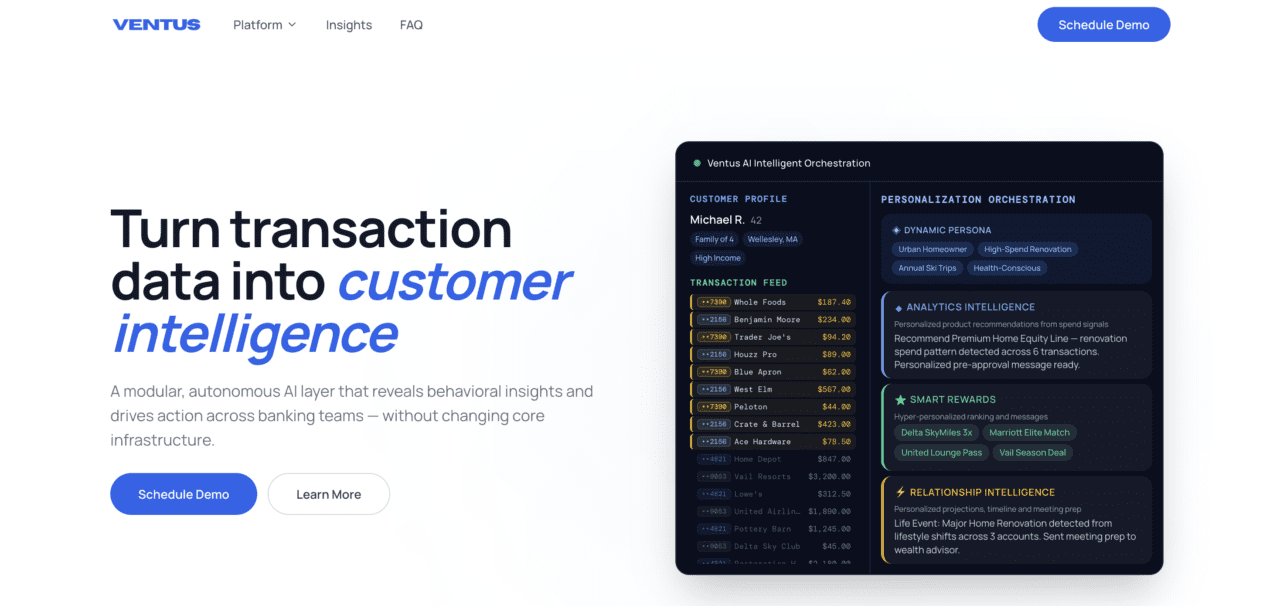
Founded in Delaware in 2025, Ventus AI represents the next evolution in data enrichment. For decades, banking transaction data has been a chaotic mix of cryptic merchant strings and numeric codes. Ventus AI utilizes semantic customer intelligence to bridge the gap between raw data and actionable human insights. By transforming transaction histories into dynamic personas, the platform allows banks to detect life events—such as a customer preparing to buy a home or a small business expanding its fleet—weeks before the customer explicitly informs the bank.
The core value proposition of Ventus AI lies in its "plug-in intelligence" model. Unlike previous generations of data tools that required a complete overhaul of a bank’s core infrastructure, Ventus integrates with existing systems to provide a layer of understanding that facilitates personalized digital banking. This "human-centered" approach is critical in 2026, as banks compete not just on interest rates, but on the relevance of their digital interactions.
Zengines: Solving the Legacy Mainframe Bottleneck
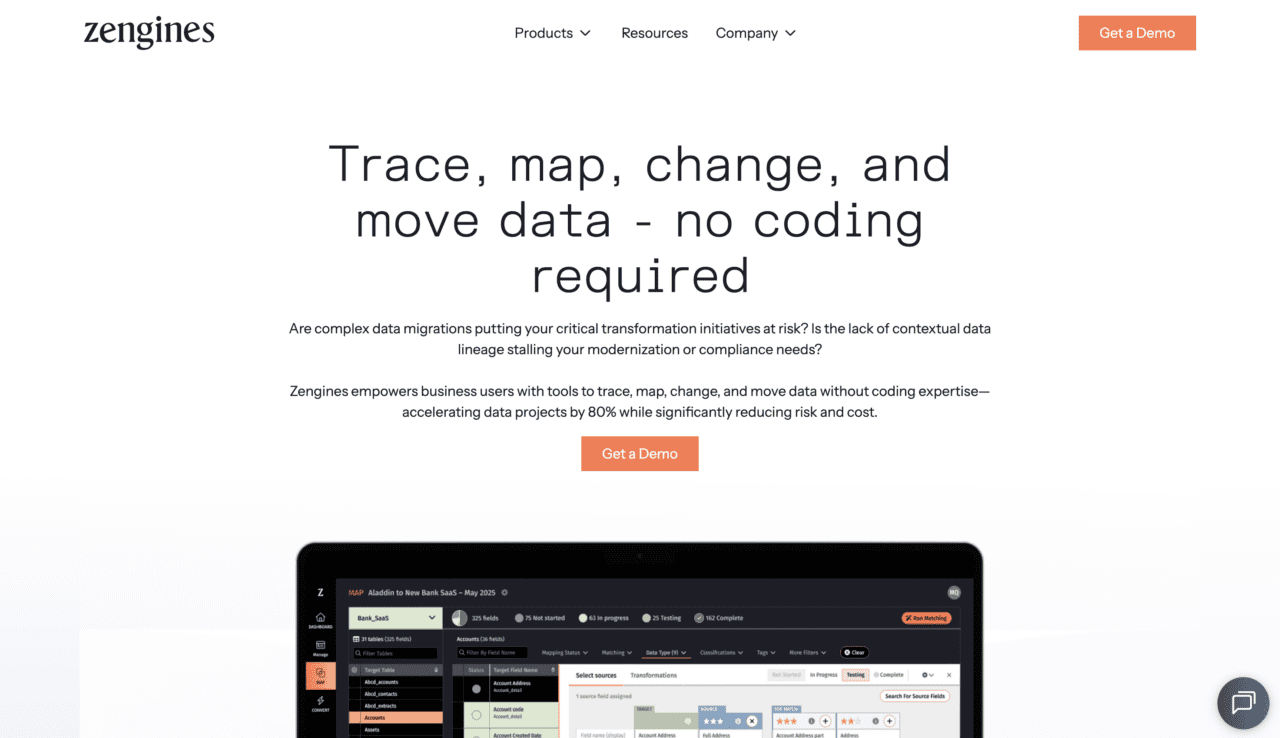
Perhaps no challenge is more daunting for modern CIOs than the persistence of legacy mainframes. It is estimated that nearly 70% of global financial transactions still touch systems running on decades-old code. Zengines, headquartered in Bedford, Massachusetts, has developed a platform specifically designed to modernize these systems without losing the embedded business logic that has been refined over half a century.
Zengines offers a two-pronged solution: Data Lineage and Data Migration. The Data Lineage tool provides a map of how data moves through legacy environments, making these "black boxes" searchable and transparent for auditors. Meanwhile, the Data Migration tool is designed for the business analyst rather than the software engineer, allowing non-coders to drive migration processes. This democratization of data movement is essential for compliance in 2026, as regulators increasingly demand real-time transparency into how financial data is handled and moved.
Lyzr AI: The Rise of Production-Ready Agentic Applications
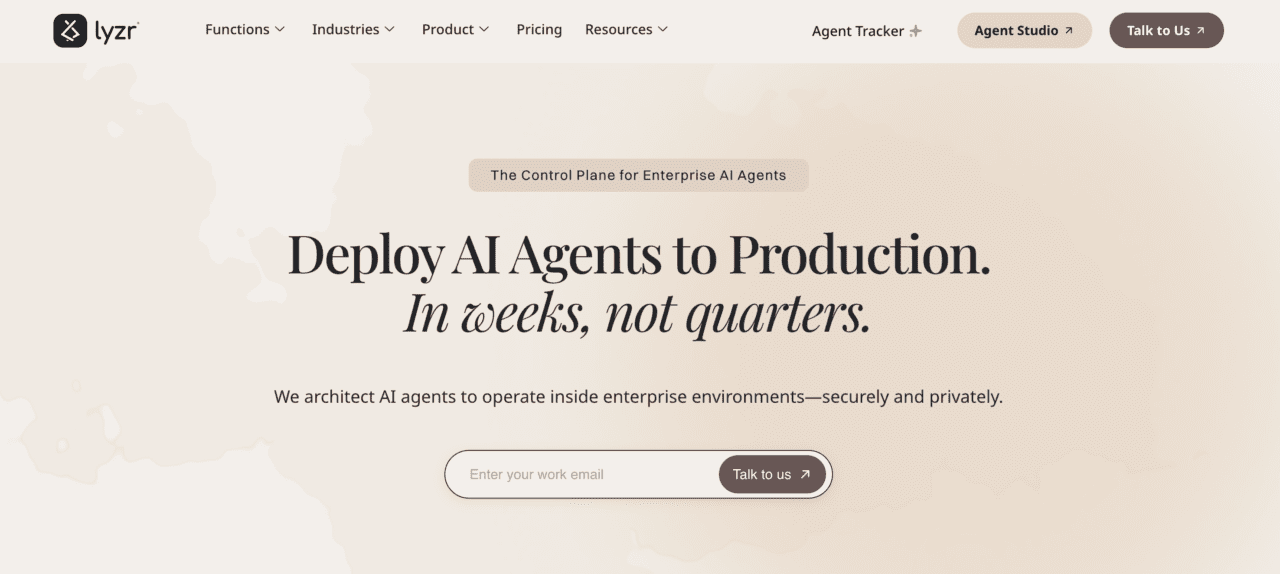
Lyzr AI, founded in 2023 and based in New Jersey, addresses the "governance gap" in enterprise AI. While many firms have experimented with building AI agents, moving those agents into a production environment requires a level of security and deterministic validation that early platforms could not provide. Lyzr Architect serves as a bridge, converting natural language instructions into governed, production-ready agentic applications.
In the context of the 2026 banking environment, Lyzr’s platform is particularly relevant for its "GPU-optimized model execution" and its ability to provide full-stack apps with exportable code. This prevents "vendor lock-in," a major concern for large financial institutions that want to maintain control over their proprietary logic. By providing deterministic validation and comprehensive audit logging, Lyzr ensures that when an AI agent makes a decision—such as approving a credit limit increase—there is a clear, traceable path for compliance officers to follow.
Saris AI: Automating the Back-Office with Zero Change Management
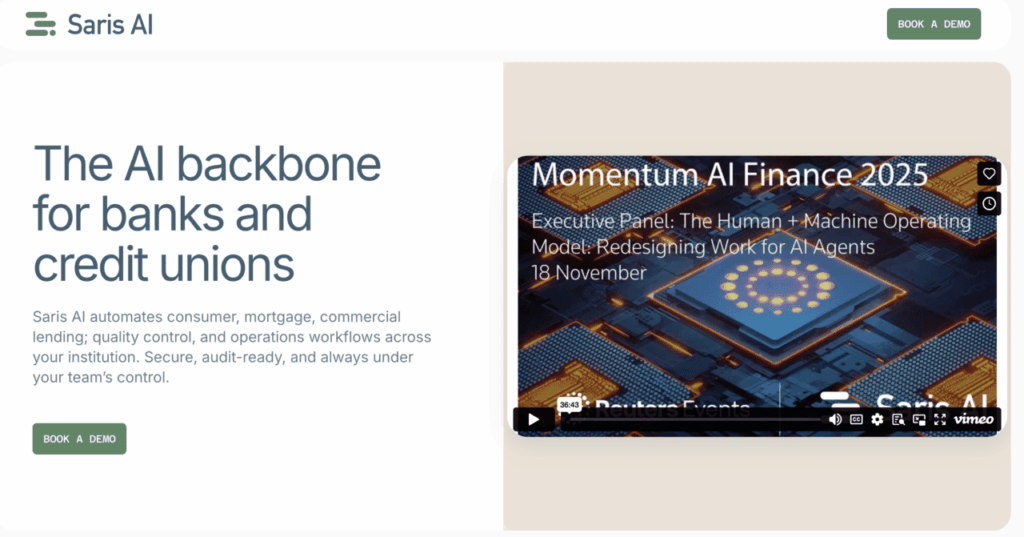
San Francisco-based Saris AI, established in 2024, focuses on the "hidden" costs of banking: the back-office workflows. While front-end apps have become sleek and fast, the manual processing of loan originations, document verification, and internal communications remains a drag on profitability. Saris AI builds autonomous agents that integrate directly with core banking platforms and document repositories.
The company’s most striking claim is the ability to automate up to 90% of back-office tasks with "zero change management." In an industry often resistant to cultural shifts, the ability to deploy AI that works within existing frameworks is a significant competitive advantage. For credit unions and regional banks, which often lack the massive IT budgets of their larger counterparts, Saris AI offers a way to scale operations and handle increased volume without a corresponding increase in headcount.
Syntex: Reimagining Small Business Onboarding
The final piece of the operational AI puzzle is provided by Syntex. Founded in 2025, Syntex targets one of the most persistent pain points in commercial banking: the onboarding of small and medium-sized enterprises (SMEs). Historically, verifying ownership structures and tracking document approvals for a new business account could take weeks. Syntex utilizes AI-driven document verification and real-time tracking to reduce this window to just a few days.
By providing a self-serve client intake portal and a robust Reg B audit trail, Syntex allows banks to offer a "Big Tech" experience to small business owners. In 2026, where speed of capital is a primary differentiator for SMEs, the ability to go from application to active account in 48 to 72 hours is a game-changer for regional banks looking to claw back market share from digital-only neobanks.
Broader Impact and Industry Implications
The emergence of these five companies at FinovateSpring 2026 signals a broader shift in the fintech ecosystem. We are seeing a move away from "disruption" for disruption’s sake and toward "enabling" technologies that help traditional institutions survive and thrive. The common thread among Ventus, Zengines, Lyzr, Saris, and Syntex is their focus on the "unsexy" but vital components of banking: data integrity, legacy migration, governance, back-office efficiency, and onboarding.
Industry analysts suggest that the "efficiency ratio"—a key metric of bank profitability—could improve by as much as 300 to 500 basis points for institutions that successfully implement these agentic and operational AI layers. Furthermore, the regulatory landscape of 2026, characterized by stricter data privacy laws and the need for explainable AI (XAI), makes the governed and deterministic nature of these platforms a necessity rather than a luxury.
Chronology of the Event and Registration Details
FinovateSpring 2026 serves as the premier stage for these technologies. The event’s chronology is designed to maximize interaction between tech founders and banking executives:
- May 5, 2026: Opening keynotes focusing on the state of AI in finance, followed by the first round of live, seven-minute demos (including Ventus AI and Zengines).
- May 6, 2026: Deep-dive sessions into agentic AI and legacy modernization, featuring demos from Lyzr AI and Saris AI.
- May 7, 2026: Focused sessions on customer experience and onboarding, featuring Syntex, followed by the "Best of Show" awards.
The event is expected to attract over 600 bankers, ranging from executives at the "Big Four" US banks to leadership teams from community banks and credit unions. This diverse attendance reflects the universal nature of the challenges being addressed. Registration for the event is currently open, with organizers offering a 20% discount for early registrants using specific promotional codes.
Conclusion: The Era of Practical Intelligence
As the financial world gathers in San Diego this May, the narrative will not be about what AI might do in the distant future, but what it is doing today. The five companies highlighted represent a move toward a more efficient, transparent, and responsive financial system. By solving the "hard problems" of data semantics, legacy code, and back-office friction, these pioneers are helping banks transition from traditional institutions into agile, AI-first organizations. For the banking sector, 2026 is the year the "buzzword" of AI finally became the "bedrock" of operational excellence.