
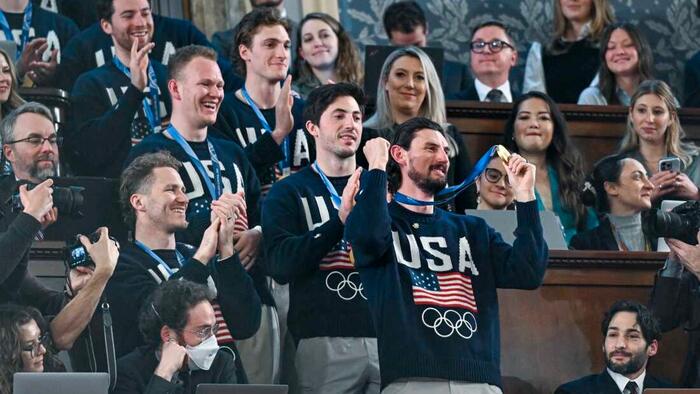

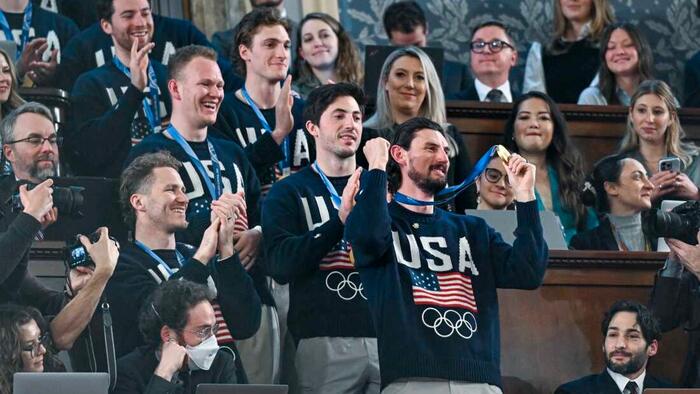
The conclusion of the 2026 Winter Olympics in Milan and Cortina brought with it a familiar wave of national pride for many Americans, particularly following the triumphant performance of U.S. athletes. After an era often characterized by deep political fissures and "rage politics," these global sporting events traditionally offer a rare moment of collective unity, allowing citizens to set aside differences and rally behind a shared national identity. This year, the U.S. men’s hockey team’s gold medal victory became a focal point for such sentiment, eliciting widespread cheers and public displays of patriotism. However, a distinct counter-narrative emerged within certain segments of the media, highlighting a profound discomfort, even aversion, to these expressions of national pride and symbols.
The Unifying Power of Olympic Success
The 2026 Winter Olympics, hosted across the picturesque Italian Alps, served as a global stage where athletic prowess and national spirit converged. For American audiences, the journey of the U.S. Olympic team, culminating in several medal wins, provided moments of collective joy and inspiration. Historically, the Olympics have transcended political divides, offering a temporary truce in partisan battles as citizens unite under the banner of national representation. This was particularly evident in the aftermath of the men’s hockey gold medal game, a contest that captivated millions across the nation. The victory, hard-fought and against a formidable opponent, ignited a surge of patriotic fervor.
Upon returning to the United States, hockey hero Jack Hughes, a standout player in the gold medal game, experienced this outpouring of national pride firsthand. His return to New Jersey was met with an enthusiastic reception, characterized by roaring chants of "USA, USA" and a vibrant sea of American flags. In a gesture that underscored the unifying spirit of the moment, Hughes immediately invited his Olympic teammate, Tage Thompson of the visiting Buffalo Sabres, to join him on the ice. The two skated arm-in-arm, celebrated by a cheering crowd that embraced not only their athletic achievement but also the broader sense of national accomplishment. This scene, replicated in various forms across the country, exemplified the traditional role of sports in fostering a shared sense of identity and pride. The athletes’ spontaneous celebration with the crowd, and later, their acceptance of a congratulatory call from the President of the United States, were widely perceived as natural extensions of representing one’s nation on the global stage.
A Counter-Narrative Emerges: Media Discomfort with Patriotism
Despite the widespread public enthusiasm, a notable segment of the media presented a strikingly different perspective, articulating discomfort and even antagonism towards these displays of patriotism. This aversion to the American flag and overt expressions of national pride was not only voiced but openly explored and analyzed in major liberal publications, leading to a significant divergence in how the Olympic victories were framed.
One of the most prominent examples came from HuffPost, which published an article titled "There’s a Name for the Discomfort You’re Feeling Watching the Olympics Right Now." The article, authored by senior writer Monica Torres, was deemed significant enough to be published a second time shortly before the gold-medal hockey game, a timing that suggested an intent to prepare readers for what the publication anticipated would be a potentially "triggering" display of American triumph. The subheading explicitly stated, "If waving the American flag or chanting ‘USA!’ turns you off right now, you’re not alone," immediately signaling its target audience and thematic focus.
Torres’s article opened with a stark juxtaposition of national celebration against a backdrop of domestic political grievances: "While President Donald Trump’s deportation agenda separates families, and federal agents detain 5-year-olds and kill unarmed civilians, American athletes are winning medals on behalf of the nation at the Olympics right now." This framing immediately positioned national sports victories not as a cause for unqualified celebration, but as a source of "cognitive dissonance" for those critical of the nation’s political actions. To elaborate on this psychological impact, Torres interviewed three licensed therapists. Los Angeles-based clinical social worker Aimee Monterrosa explained that the perceived "atrocities" of the United States could "trigger feelings of guilt, despair, shame, [and] anger" when confronted with national sports celebrations. Similarly, expert Lauren Appio echoed this sentiment, suggesting that "waving the American flag or chanting, ‘USA!’ [can make] us feel grossed out or ashamed." This narrative suggested that for a segment of the population, particularly those on the political left, expressions of national pride were not only unappealing but actively distressing, requiring therapeutic intervention to navigate.
Vox’s Critique and the Glorification of Eileen Gu
Further amplifying this critical perspective, Alex Abad-Santos, a senior correspondent at Vox and former Atlantic writer, published an article analyzing the "winners and losers" of the 2026 Olympics. His assessment diverged sharply from conventional patriotic sentiment. Notably, Abad-Santos declared the U.S. men’s hockey team, despite their gold medal victory, to be among the biggest "losers" of the games. His reasoning centered on the team’s perceived alienation of certain citizens through their patriotic statements and, critically, their acceptance of a congratulatory call from the President of the United States. In Abad-Santos’s view, "The conversation surrounding the win quickly shifted into how the team celebrated and who it celebrated with," implying that their celebratory actions were politically charged and alienating rather than unifying.
In a striking contrast, Abad-Santos named Eileen Gu as a significant "winner" of the Olympics. Gu, an American-born freestyle skier who famously chose to represent China, reportedly received substantial financial incentives from the Chinese government. Throughout the games, Gu garnered attention not only for her athletic prowess but also for her public criticisms of the United States, while notably remaining silent on human rights issues within China. Abad-Santos lauded Gu, stating, "Gu symbolizes the reality that athletes don’t need the US’s backing or support to be commercially successful. That makes some Americans like Vance uneasy. She also embodies the very American idea of relentlessly pursuing success and maximizing it, no matter what it takes. Gu represents the American dream and the startling concept that America isn’t necessary for it." This statement was particularly revealing, celebrating the idea that the "American dream" could be achieved and even defined outside the context, and even in opposition, to America itself.
This lionization of Gu was not isolated. Charlotte Harpur, writing for The New York Times’s sports publication, The Athletic, described Gu in almost superhuman terms, suggesting, "You would be forgiven if you thought Gu was a quasi-human robot expertly created by artificial intelligence, so eloquent are her responses to the media." This effusive praise further underscored a narrative that elevated an athlete who chose to represent a geopolitical rival while simultaneously criticizing American athletes for their expressions of national loyalty.
The New York Times and the "Lost Room" Narrative
The critical commentary extended to The New York Times and The Athletic directly. The day after the U.S. men’s hockey team’s victory, The Athletic published an article by Jerry Brewer titled "The U.S. men’s Olympic hockey team won gold – and then lost the room." Brewer acknowledged that speaking with the U.S. president after such a win is typically "an obligatory celebration." However, he argued that "these are not normal times," elaborating, "This isn’t a neutral climate. This isn’t a neutral president. And in a nation this polarized, the proximity carries weight whether the players are being intentional or merely naive." This perspective implied that in the current political climate, even apolitical gestures of national pride, especially when involving a controversial political figure, become inherently divisive and alienating to a significant portion of the populace. It suggested that athletes, regardless of their intentions, must navigate a complex political landscape where traditional expressions of patriotism are no longer universally accepted or even tolerated.
Broader Implications: Patriotism, Media, and Polarization
The reactions from HuffPost, Vox, and The New York Times, as highlighted by legal scholar Jonathan Turley, represent more than just isolated opinions; they reveal a significant ideological divide within American society and its media landscape. These articles, by explicitly linking national pride to feelings of shame or by critiquing traditional patriotic displays, strip away what Turley describes as the "pretense of past pieces" and lay bare a deep-seated antagonism towards the United States’ symbols and celebrations among certain segments of the left-leaning media.
This phenomenon can be understood within the broader context of increasing political polarization in the United States. Data from organizations like the Pew Research Center consistently show a widening ideological gap between Democrats and Republicans, not just on policy issues but also on fundamental questions of national identity and patriotism. While a majority of Americans across the political spectrum express pride in their country, the nature of that pride and the conditions under which it is expressed have become highly contentious. For some, patriotism is inseparable from a critical self-assessment of the nation’s historical and contemporary failings, making unconditional celebration difficult or even morally reprehensible. For others, national pride in moments of collective achievement, such as the Olympics, is a fundamental expression of unity that should transcend political disagreements.
The media’s role in this dynamic is multifaceted. While some outlets aim to reflect diverse viewpoints, others may actively shape or reinforce particular narratives. The specific framing used by HuffPost, Vox, and The Athletic suggests a conscious effort to challenge traditional notions of patriotism, particularly when associated with figures or policies deemed objectionable by their target audience. This approach can contribute to an "echo chamber" effect, where like-minded individuals consume media that validates their existing viewpoints, further entrenching polarization. Jonathan Turley notes that these writers are "largely writing for each other," suggesting a disconnect between these specific media narratives and the sentiments of a broader American public.
Indeed, while certain media outlets depicted patriotism as "traumatizing," the overwhelming public response to the Olympic victories, particularly the men’s hockey gold, indicated a strong appetite for national unity and celebration. The scenes of fans cheering "USA, USA" and waving flags were not isolated incidents but reflections of a widely felt collective pride. Jack Hughes’s emotional reaction to the crowd’s reception – "struggling not to get emotional at that moment" – underscored the genuine and widespread nature of this sentiment, confirming that for the vast majority of Americans, such displays are "rousing" rather than "repulsive."
In conclusion, the 2026 Winter Olympics offered a poignant illustration of the ongoing cultural and political clashes in the United States. While sporting achievements traditionally foster national unity, the reactions from specific media outlets demonstrated a significant ideological chasm regarding patriotism and national identity. This divergence highlights the challenges of finding common ground in an increasingly polarized society, where even moments of athletic triumph can become battlegrounds for competing narratives about what it means to be an American. The debate over national symbols and celebrations, far from being superficial, touches upon deep questions of collective identity, historical reckoning, and the future direction of the nation.