
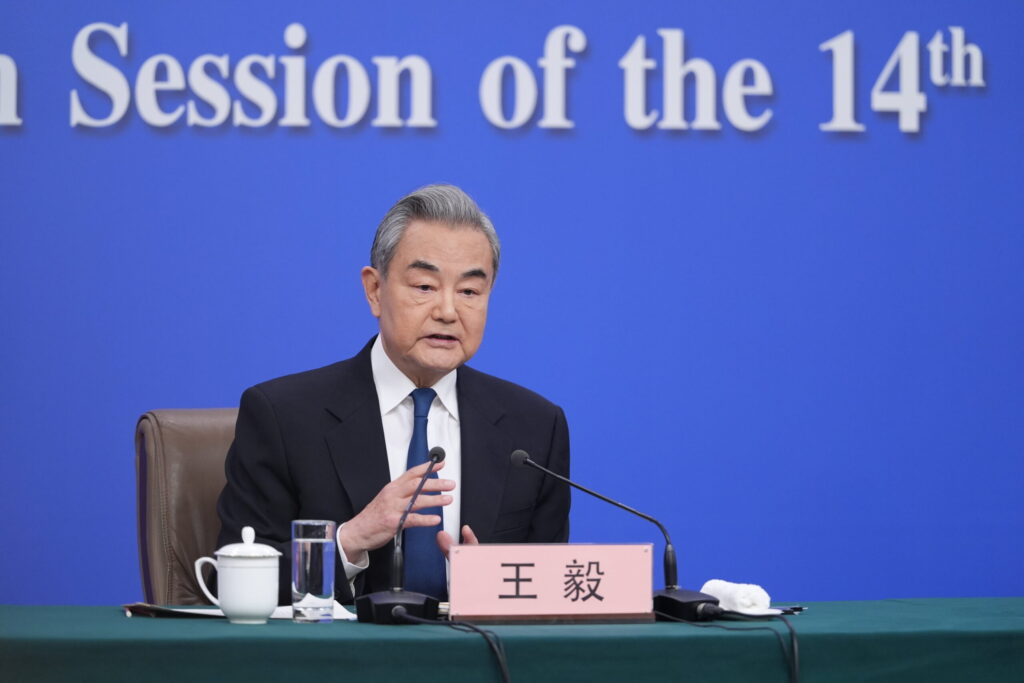

BEIJING – Chinese Foreign Minister Wang Yi on Sunday delivered a comprehensive and assertive address on China’s foreign policy and external relations, emphasizing the indispensable benefits of engagement with the United States even as the two global powers navigate profound differences over the escalating conflict in Iran and persistent trade tariffs. Speaking on the sidelines of the fourth session of the 14th National People’s Congress (NPC), Wang signaled that meticulous preparations are well underway for a highly anticipated meeting between Chinese President Xi Jinping and U.S. President Donald Trump, a summit poised to shape the trajectory of bilateral relations and global stability.
"The agenda of high-level exchanges is already on the table," Wang informed a packed press conference in Mandarin Chinese, his remarks conveyed through an official translation. He underscored the critical need for both nations to engage in "thorough preparations accordingly, create a suitable environment, manage the risks that do exist and remove unnecessary disruptions." His comments reflect Beijing’s strategic imperative to maintain channels of communication with Washington, particularly amidst a volatile international landscape. Wang issued a stark warning against isolationism, stating, "Turning our backs on each other would only lead to mutual misperception and miscalculation. Sliding into conflict or confrontation would only drag the whole world down." This sentiment encapsulates China’s long-held position that cooperation, not confrontation, is the only viable path for the world’s two largest economies.
A Crucial Diplomatic Timeline Emerges
The groundwork for this pivotal presidential engagement was laid in the fall of 2025, following an in-person meeting between President Xi Jinping and President Donald Trump in South Korea. During this encounter, both leaders reportedly indicated plans for reciprocal visits to each other’s countries, signaling a commitment to direct, high-level dialogue despite underlying tensions. The U.S. side has since announced a tentative schedule for President Trump’s visit to China, slated for March 31 to April 2, 2026. This would mark the first trip to China by a sitting U.S. president since 2017, representing a significant return to presidential-level diplomacy after a period characterized by heightened geopolitical competition and infrequent direct contact.
However, Beijing has yet to formally confirm the exact dates for President Trump’s arrival, a detail that has fueled speculation among international observers regarding the certainty of the trip. Wang Yi, while not elaborating on the specific itinerary, reiterated the profound importance of these high-level interactions, describing them as having "provided [an] important strategic safeguard for the China-U.S. relationship to improve and move forward." This emphasis highlights China’s view that direct leader-to-leader communication is essential for managing complex issues and preventing further deterioration of ties. The prospect of such a summit, even with its inherent uncertainties, offers a glimmer of hope for de-escalation and the potential resolution of contentious issues that have plagued the relationship for years.
Geopolitical Quicksands: The Iran Conflict and Global Stability

The backdrop against which this diplomatic overture is unfolding is one of significant global instability, most notably the escalating conflict in Iran. The potential for President Trump’s visit to coincide with the immediate aftermath of joint U.S.-Israeli attacks on Iran has raised considerable doubts among analysts regarding the feasibility of the scheduled trip. These strikes, which commenced on February 28, 2026, have dramatically reshaped the Middle East’s geopolitical landscape, culminating in the death of Iran’s Supreme Leader, Ayatollah Ali Khamenei, and the U.S. capture of Venezuelan leader Nicolas Maduro. These events, occurring in rapid succession, have introduced unforeseen complexities into an already fragile international environment.
Wang Yi, while refraining from directly naming either Khamenei or Maduro in his Sunday remarks, unequivocally reiterated Beijing’s urgent calls for a ceasefire in the Iran conflict. His condemnation of the hostilities was palpable: "This is a war that should not have happened. It is a war that does no one any good." China’s position reflects its consistent advocacy for peaceful resolution and de-escalation in regional conflicts, particularly those with the potential for widespread destabilization. Beijing views such conflicts through the lens of their impact on global trade, energy security, and the broader international order, all of which are central to China’s economic and strategic interests.
In the wake of the U.S.-Israeli strikes, Chinese diplomacy has been intensely active. Official readouts confirm that Foreign Minister Wang has engaged in telephone calls with at least seven foreign ministers, including those of Russia, Iran, and Israel, since February 28. These high-level communications underscore China’s concerted efforts to mediate, or at least to understand and influence, the unfolding crisis. While the specific details of these conversations remain confidential, it is understood that Wang emphasized China’s commitment to international law, the principle of non-interference, and the imperative of protecting civilian lives. China’s engagement in this crisis can be interpreted as an attempt to assert its role as a responsible major power, advocating for stability in a region vital to global energy supplies and trade routes. The capture of Nicolas Maduro, though geographically distant, adds another layer of complexity, intertwining the geopolitical dynamics of the Middle East with broader U.S. foreign policy objectives and potentially signaling a more aggressive U.S. stance on international leadership.
The Economic Battleground: Tariffs, Decoupling, and the "G2" Debate
Beyond the immediate geopolitical flashpoints, the enduring economic tensions between the U.S. and China remain a central concern. The bilateral discussions surrounding the upcoming summit are set against the backdrop of a fragile truce reached in October 2025, which saw both nations agree to lower tariffs on each other’s goods to below 50% for a period of one year. This agreement marked a significant de-escalation from the height of tensions in the spring of 2025, when duties had ratcheted up to well over 100% on a wide array of products, severely impacting global supply chains and inflicting considerable economic costs on businesses and consumers worldwide.
The origins of the trade war trace back several years, rooted in U.S. complaints about China’s trade practices, including intellectual property theft, forced technology transfer, and state subsidies. While the October 2025 truce provided a temporary reprieve, the underlying structural issues and the philosophical divergence on economic policy persist. Data from the preceding years indicated that the peak tariffs had led to a significant contraction in bilateral trade volumes, with some estimates suggesting a reduction of over 25% in certain sectors, costing both economies billions in lost revenue and increased consumer prices. The truce offered a much-needed breathing room, allowing businesses to plan with slightly more certainty, yet the specter of renewed tariff hikes looms large.
In his remarks, Wang Yi directly addressed the concept of a U.S.-China "G2," a term sometimes employed by President Trump to describe a world led by the two dominant powers. Wang firmly pushed back against this notion, instead emphasizing China’s unwavering commitment to multipolarity in global governance. He argued that the world’s complex challenges require collective action from a diverse array of nations, rather than a duopoly. Without explicitly naming the U.S., Wang issued a sharp warning against protectionist measures, cautioning against "erecting tariff barriers and pushing [for] economic and technological decoupling." He employed a vivid metaphor to convey the self-defeating nature of such policies: "This is no different from using kindling to put out a fire. You will only get burned." This statement reflects China’s deep concern over the potential for a fragmentation of the global economy, which it views as detrimental to its own growth model and to global prosperity. The call for multipolarity aligns with China’s broader foreign policy vision of a more equitable and representative international order, where emerging economies and developing nations have a greater voice.

The National People’s Congress: A Platform for Policy and Diplomacy
Foreign Minister Wang Yi’s press conference was a key event during China’s eight-day annual parliamentary meeting, the National People’s Congress, which is scheduled to conclude on Thursday. The NPC is China’s highest organ of state power, though in practice it primarily functions as a rubber stamp for decisions made by the Communist Party of China. Nevertheless, it serves as a crucial platform for announcing key government policies, setting economic targets, and presenting a unified national agenda to both domestic and international audiences.
During this session, China’s top leadership, including President Xi Jinping, Premier Li Qiang, and Vice Premier He Lifeng, convene with thousands of delegates from across the country. The NPC provides an invaluable opportunity for the leadership to convey its strategic priorities, both internally and externally. Wang Yi’s address, delivered in this high-profile setting, was therefore meticulously crafted to project China’s foreign policy stance with clarity and authority. It underscored Beijing’s unwavering commitment to its core interests while signaling a pragmatic willingness to engage with the international community, even amidst significant challenges. The discussions within the NPC typically revolve around economic growth, technological innovation, national security, and social stability, all of which are inextricably linked to China’s external relations and its perception on the global stage.
Broader Implications and the Path Forward
The convergence of these critical issues – the impending U.S.-China summit, the escalating conflict in Iran, and the precarious state of global trade relations – creates a highly complex and consequential moment for international diplomacy. The statements from Foreign Minister Wang Yi underscore China’s recognition of the gravity of the situation and its strategic desire to influence outcomes that align with its national interests. The planned summit between President Xi and President Trump, if it proceeds as scheduled, carries immense weight. Analysts suggest that the primary objective for both sides would be to stabilize the relationship, manage expectations, and prevent further deterioration, rather than achieving grand breakthroughs on contentious issues.
The stakes are exceptionally high. A failure to manage US-China relations effectively could have catastrophic consequences for global peace, economic stability, and the ability to address transnational challenges such as climate change, pandemics, and nuclear proliferation. The implications of the Iran conflict, in particular, extend far beyond the Middle East, threatening to disrupt global energy markets, trigger refugee crises, and exacerbate sectarian tensions. China, as a major energy importer and a significant global trading power, has a vested interest in regional stability.
The path forward, as articulated by Wang Yi, necessitates a delicate balance of engagement and principled assertion. It requires both Washington and Beijing to "manage the risks that do exist and remove unnecessary disruptions." This entails not only high-level diplomatic exchanges but also sustained dialogue at various levels, confidence-building measures, and a commitment to multilateralism. As the world watches Beijing for further confirmations regarding President Trump’s visit, the global community holds its breath, recognizing that the interactions between these two powerful nations will profoundly shape the geopolitical and economic landscape for years to come.