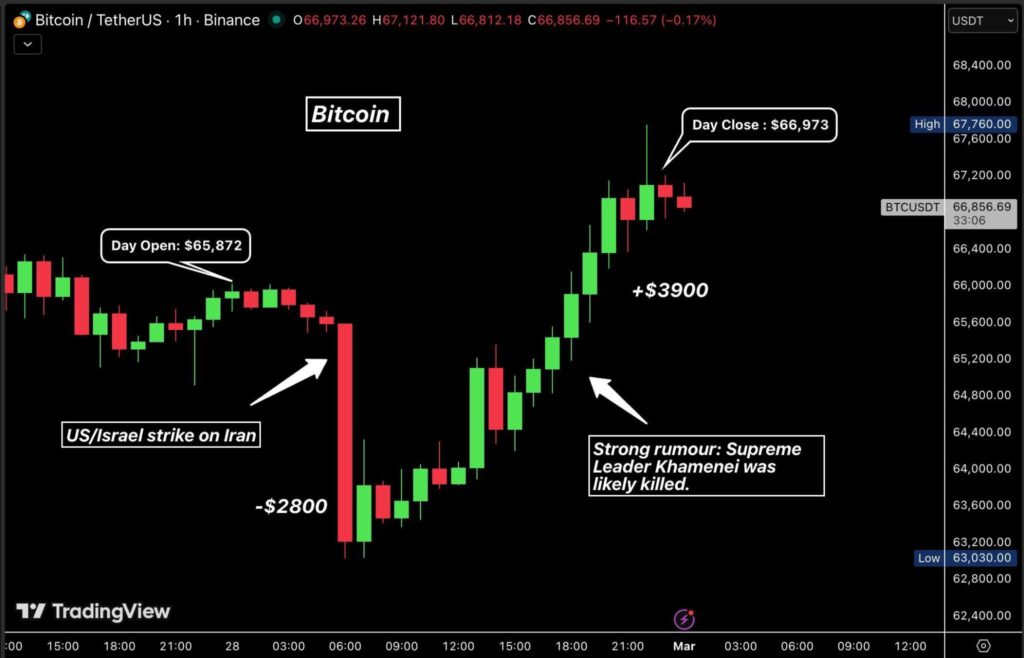

Bitcoin (BTC) has demonstrated a notable recovery, recouping losses sustained during a significant dip triggered by reports of US-Israeli air strikes on Iran and alleged news regarding the death of Iran’s Supreme Leader Ayatollah Khamenei. The cryptocurrency reached $68,200 in early trading on Sunday morning on Coinbase, according to data from TradingView. This rebound signifies a $5,000 increase in less than 24 hours from its Saturday low of $63,000, indicating a swift market reaction to evolving geopolitical developments.
At the time of reporting, BTC was trading around $67,350, effectively returning to Friday’s price levels. However, the asset remains confined within a three-week range-bound channel, suggesting that while short-term volatility has subsided, a decisive upward trend has yet to materialize. The recent price action has also led to substantial liquidations within the cryptocurrency market. Over the past 24 hours, approximately 157,000 traders experienced liquidations totaling $657 million, with leveraged long and short positions being almost equally affected, according to data compiled by CoinGlass.
The catalyst for this market volatility appears to be a confluence of escalating geopolitical tensions and speculative reports. The BBC reported on Saturday that Iran’s Supreme National Security Council stated Ayatollah Khamenei had died at his office. This unsubstantiated claim, if it were to be true, would represent a seismic shift in the geopolitical landscape of the Middle East, with profound implications for regional stability and global affairs. Former US President Donald Trump, on his social media platform Truth Social, described the late Ayatollah as "one of the most evil people in history" and stated that his death would be "justice for the people of Iran, but for all great Americans, and those people from many countries throughout the world, that have been killed or mutilated by Khamenei and his gang of bloodthirsty thugs."
Further exacerbating the situation, reports emerged of US-Israel air strikes targeting Iran. While the specifics and extent of these strikes were not immediately clear, they added another layer of uncertainty to an already volatile situation. The Islamic Revolutionary Guard Corps commander-in-chief, Mohammad Pakpour, and the secretary of Iran’s Defense Council, Ali Shamkhani, were also reportedly killed in these strikes, according to initial reports.
The market’s interpretation of these events has been multifaceted. Analyst Ash Crypto commented on Sunday via X (formerly Twitter), suggesting that "After news of Iran’s Supreme Leader Khamenei’s death, the market pumped because people are taking it as the end of the US-Iran war." This sentiment implies that traders are viewing the potential demise of a key figure and perceived escalation of conflict as a signal for a de-escalation of broader hostilities. Ash Crypto further posited that "If this conflict shows signs of resolution before Monday’s open, I think Bitcoin can hold its gains and move higher." This perspective highlights the market’s sensitivity to perceived diplomatic breakthroughs or the cessation of active conflict, which can often be interpreted as reducing systemic risk and encouraging investment.
Geopolitical Tensions as a Driver of Bitcoin’s Price Movements
The relationship between geopolitical instability and Bitcoin’s price has been a recurring theme in the cryptocurrency market. Often dubbed "digital gold," Bitcoin is perceived by some investors as a hedge against inflation and geopolitical uncertainty, similar to traditional safe-haven assets like gold. When tensions rise in key global regions, particularly those with significant economic or strategic importance, investors may seek to diversify their portfolios by allocating capital to assets perceived as less susceptible to traditional market disruptions.
The recent events in the Middle East, characterized by alleged strikes and high-profile casualties, represent a significant escalation of regional tensions. Historically, periods of heightened geopolitical risk have often coincided with increased interest in Bitcoin, as investors look for alternatives to traditional financial markets that may be more vulnerable to the fallout of such events. This dynamic was observed during previous geopolitical flashpoints, where surges in Bitcoin’s price were often attributed, at least in part, to its role as a potential safe haven.
A Brief Chronology of Events
To understand the market’s reaction, it is crucial to establish a timeline of the reported events:
- Saturday (specific time not provided): Reports emerge of US-Israeli air strikes on Iran.
- Saturday (specific time not provided): BBC reports, citing Iran’s Supreme National Security Council, that Supreme Leader Ayatollah Khamenei has died.
- Saturday (specific time not provided): Former US President Donald Trump makes statements on Truth Social regarding the alleged death of Ayatollah Khamenei.
- Saturday (specific time not provided): Bitcoin price dips to approximately $63,000.
- Sunday Morning: Bitcoin price recovers to $68,200 on Coinbase, indicating a rapid rebound.
- Sunday (at the time of writing): Bitcoin is trading around $67,350.
This rapid sequence of events, from alleged casualties and strikes to market dips and subsequent recoveries, underscores the speculative and often sentiment-driven nature of cryptocurrency markets, especially in response to major global news.
Bitcoin’s Broader Market Context: A Challenging Start to the Year
Despite the recent rebound, it is important to contextualize Bitcoin’s performance within its broader year-to-date trajectory. The cryptocurrency has just concluded what is considered its third-worst February on record, marking only the fourth time since 2013 that the asset has ended the month in negative territory. In February, BTC experienced a decline of just under 15%. For historical perspective, its most significant February loss occurred in 2014, when it plummeted by 31%, followed by a 17.4% drop in February 2025, according to CoinGlass data.
Furthermore, Bitcoin is currently on a trajectory to close its first quarter of the year with its worst performance since 2018. Year-to-date, the asset has already seen a decline of nearly 23%, highlighting a challenging start to the year for investors. This ongoing bearish trend, even with short-term rallies, suggests that underlying market sentiment may still be cautious, with the recent geopolitical events providing a temporary, albeit significant, boost rather than a fundamental shift in market direction.
Analysis of Market Liquidations
The substantial liquidation figures of $657 million over 24 hours, affecting approximately 157,000 traders, are a direct consequence of the sharp price volatility. When prices swing significantly, particularly in a leveraged market, positions that are not sufficiently collateralized can be automatically closed by exchanges to prevent further losses for the broker. The near-even split between long and short liquidations suggests that both bullish and bearish bets were heavily impacted by the abrupt price movements, indicating a chaotic period for traders attempting to navigate the market’s uncertainty. Such high liquidation volumes can sometimes contribute to further price swings as forced selling or buying occurs.
Potential Implications and Expert Commentary
The market’s optimistic interpretation of the geopolitical events as a precursor to de-escalation is a key factor driving the current recovery. If reports of conflict resolution or significant diplomatic progress emerge in the coming days, it could provide further support for Bitcoin’s price. Conversely, any resurgence of hostilities or a lack of clear de-escalation could lead to a renewed downturn.
The narrative of Bitcoin as a safe-haven asset is being tested in real-time. While it has shown resilience in recovering from a sharp dip, its ability to sustain these gains will depend heavily on the actual developments in the Middle East and the broader economic outlook. Investors will be closely watching for official statements from relevant governments and international bodies to gauge the true extent of the geopolitical situation and its potential impact on global markets.
The inclusion of prominent figures like the commander-in-chief of the Islamic Revolutionary Guard Corps and the secretary of Iran’s Defense Council in the reported casualties suggests a high-level engagement, which, if true, would signify a significant escalation. However, the swift market reaction suggests that traders are prioritizing the potential for an end to the conflict, perhaps driven by the perceived weakening of Iran’s leadership.
Broader Economic and Market Considerations
Beyond the immediate geopolitical fallout, Bitcoin’s performance is also influenced by macroeconomic factors, including inflation rates, interest rate policies of central banks, and overall investor risk appetite. The recent data on Bitcoin’s poor performance in February and its projected worst Q1 since 2018 suggests that broader market headwinds, such as tighter monetary policies or a general slowdown in risk assets, may have been weighing on the cryptocurrency even before the Middle East tensions escalated.
The cryptocurrency market, while often volatile, is increasingly intertwined with traditional financial markets. Therefore, significant geopolitical events that impact global stock markets, currency valuations, and commodity prices are likely to have a ripple effect on Bitcoin. The coming days will be critical in determining whether the current recovery is a sustainable trend or a temporary reprieve driven by speculative hope for a swift resolution to the geopolitical crisis.
The commitment to independent, transparent journalism by Cointelegraph, as stated in their editorial policy, is crucial in navigating such complex and rapidly evolving situations. Providing accurate and timely information, while encouraging independent verification, is essential for market participants to make informed decisions. The ongoing analysis of Bitcoin’s performance, especially in the context of significant global events, will continue to be a focal point for investors and analysts alike.