
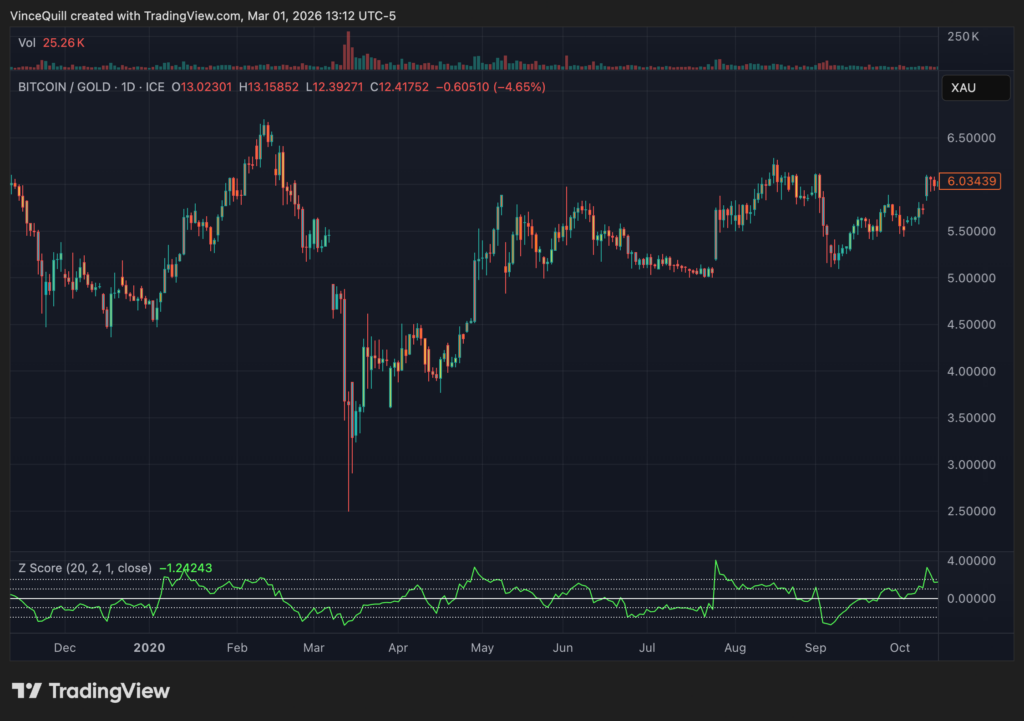

Samson Mow, CEO of Bitcoin technology firm Jan3, has put forth a compelling argument suggesting that Bitcoin (BTC) is currently undervalued when measured against the market capitalization of gold and the global money supply. This perspective, if accurate, could indicate an impending price reversal for the leading cryptocurrency. Mow’s analysis, shared on the social media platform X, highlights a significant discrepancy in valuation, positioning Bitcoin as potentially poised for substantial growth.
Bitcoin’s Valuation Discrepancy: A Deep Dive into the Numbers
According to Mow, Bitcoin’s current valuation places it approximately 24% to 66% below its historical trend relative to gold’s market cap or the global money supply. In stark contrast, gold itself is described as being "overextended," suggesting its price has potentially outpaced its fundamental value. This divergence implies that investors may be overlooking Bitcoin’s intrinsic worth while over-allocating to traditional safe-haven assets like gold.
To contextualize these figures, it’s important to consider the prevailing market prices at the time of Mow’s statement. Gold futures for April delivery had recently closed at $5,247.90. Simultaneously, tokenized gold, such as PAX Gold USD, was trading around $5,404.14. These figures represent the current market perception of gold’s value, against which Mow is benchmarking Bitcoin.
The Z-Score: A Statistical Indicator of Price Deviation
Mow’s analysis leans heavily on the Z-score, a statistical metric widely used to measure how far a data point is from its mean, expressed in terms of standard deviations. In the context of financial markets, the Z-score for Bitcoin’s price relative to gold helps to ascertain whether Bitcoin is trading above or below its historical average price when paired with gold.
A Z-score of 0 signifies that Bitcoin’s price is in line with its historical average relative to gold. A positive Z-score indicates that Bitcoin is trading above this historical average, while a negative Z-score suggests it is trading below it. Mow’s assertion is that a Z-score below a certain threshold, specifically -2, has historically preceded significant price rallies in Bitcoin.
At the time of Mow’s post, the Z-score of the Bitcoin-to-gold ratio was reported to be approximately -1.24. While this figure is below zero, it has not yet reached the critical -2 level that Mow identifies as a precursor to major upward price movements. This suggests that, according to his metric, Bitcoin is currently in a position of relative undervaluation, but the conditions for a "major" rally, as defined by his analysis, may not be fully materialized yet.
Historical Precedents: Z-Score and Bitcoin’s Explosive Rallies

The validity of Mow’s Z-score hypothesis is bolstered by historical data. TradingView data, which Mow referenced, shows that the Bitcoin-to-gold ratio Z-score plummeted below -3 in November 2022. This period coincided with the dramatic collapse of the cryptocurrency exchange FTX, a catastrophic event that sent shockwaves through the digital asset market. Following this nadir, Bitcoin experienced an extraordinary rally, surging by over 150% in the subsequent 12 months. By November 2023, BTC had significantly recovered, demonstrating the potential for substantial price appreciation after periods of extreme undervaluation as indicated by the Z-score.
Further historical evidence supports this pattern. During the COVID-19 pandemic-induced market crash in March 2020, the Z-score metric also fell below -2. At that time, Bitcoin’s price reached a low of approximately $3,717. The ensuing year saw an unprecedented surge, with Bitcoin climbing by over 300%. This remarkable ascent culminated in November 2021, when Bitcoin reached its then-all-time high of around $69,000, underscoring the predictive power of this valuation metric in identifying significant buying opportunities.
A Contrarian View in a Market of Doubts
Mow’s optimistic outlook stands in contrast to a prevailing sentiment among some market analysts. A segment of cryptocurrency experts is forecasting further downside for Bitcoin, predicting a potential drop to $50,000 or even lower. These bearish forecasts are often attributed to persistent investor uncertainty and escalating geopolitical tensions, which tend to drive investors towards perceived safe-haven assets.
Recent price action has reflected some of these concerns. Bitcoin experienced a notable pullback, falling by over 50% from its peak to a low of $60,000. While it has since staged a limited recovery to levels nearing $66,400, the market remains sensitive to global events. The recent developments in the Middle East, for instance, have added another layer of volatility and uncertainty, prompting some traders to re-evaluate their risk exposure.
The debate over Bitcoin’s future price trajectory highlights the inherent complexities and divergences in market analysis. While some focus on macroeconomic headwinds and short-term price action, others, like Mow, adopt a longer-term perspective, emphasizing fundamental valuation metrics and historical patterns.
The Global Money Supply Context: A Broader Perspective
Mow’s comparison of Bitcoin to the global money supply adds another dimension to his undervaluation thesis. The global money supply encompasses all forms of money held by individuals, businesses, and governments. Traditionally, assets like gold have been seen as a hedge against inflation and currency devaluation, serving as a store of value.
Bitcoin, with its fixed supply capped at 21 million coins, is often touted as a digital store of value, analogous to digital gold. The argument is that as the global money supply continues to expand, driven by quantitative easing and fiscal stimulus measures by central banks, the scarcity of Bitcoin becomes increasingly attractive. If Bitcoin were to achieve a market capitalization comparable to that of gold, or even a significant fraction of the global money supply, its price would theoretically need to increase exponentially.
Estimates for the total global money supply vary, but generally range in the hundreds of trillions of dollars. Gold’s market capitalization, while substantial, is significantly smaller. By positioning Bitcoin’s current market cap far below these benchmarks, Mow suggests that there is immense room for growth as the asset matures and gains wider acceptance as a legitimate store of value and a potential medium of exchange.

Implications for Investors and the Crypto Ecosystem
If Mow’s analysis proves correct, the implications for investors could be profound. A sustained price reversal driven by a re-evaluation of Bitcoin’s fundamental value could lead to significant capital inflows into the cryptocurrency market. This, in turn, could benefit not only Bitcoin but also the broader altcoin ecosystem, which often experiences correlation with Bitcoin’s price movements.
However, the path to such a reversal is unlikely to be linear. The cryptocurrency market is known for its volatility, and external factors, including regulatory developments, technological advancements, and macroeconomic shifts, can all influence price action. Investors are therefore advised to conduct their own due diligence and consider their risk tolerance before making any investment decisions.
The ongoing debate between bullish and bearish viewpoints underscores the speculative nature of the cryptocurrency market. While Mow’s data-driven approach offers a compelling argument for undervaluation, the market’s ultimate direction will be determined by a complex interplay of supply and demand, investor sentiment, and broader economic forces. The historical precedents he cites, however, provide a strong foundation for his optimistic outlook, suggesting that periods of significant Bitcoin rallies have often followed instances of extreme price deviation from historical averages.
Broader Economic and Geopolitical Considerations
The current economic climate is characterized by a complex web of factors, including persistent inflation concerns in some economies, rising interest rates, and ongoing geopolitical uncertainties. These elements contribute to a cautious investment environment, where capital often flows towards assets perceived as safe havens. Gold has traditionally fulfilled this role, but Bitcoin has increasingly been viewed by a segment of investors as a modern alternative, particularly for those seeking to hedge against currency debasement and systemic financial risks.
The increasing institutional adoption of Bitcoin, evidenced by the approval of spot Bitcoin ETFs in the United States, further bolsters the argument for its growing legitimacy as an asset class. This institutional interest, coupled with the ongoing development of Bitcoin’s technological infrastructure and its increasing integration into the global financial system, could gradually shift the perception of Bitcoin from a speculative fringe asset to a more established component of diversified investment portfolios.
Mow’s analysis, by focusing on Bitcoin’s relative undervaluation against established stores of value like gold and the vast global money supply, taps into this narrative of Bitcoin’s potential to capture a significant portion of the global wealth. The Z-score metric, in particular, provides a quantitative framework for identifying potential inflection points in Bitcoin’s price cycle, suggesting that current levels may represent a favorable entry point for long-term investors anticipating a re-rating of the asset.
As the cryptocurrency market continues to evolve, insights from prominent figures like Samson Mow provide valuable perspectives for understanding the forces shaping its trajectory. His emphasis on fundamental valuation metrics and historical price patterns offers a counterpoint to more short-term speculative analyses, reminding investors of the underlying potential that may be masked by market noise and temporary price fluctuations. The coming months and years will undoubtedly reveal whether Bitcoin indeed lives up to its potential as a significantly undervalued asset poised for substantial growth.