
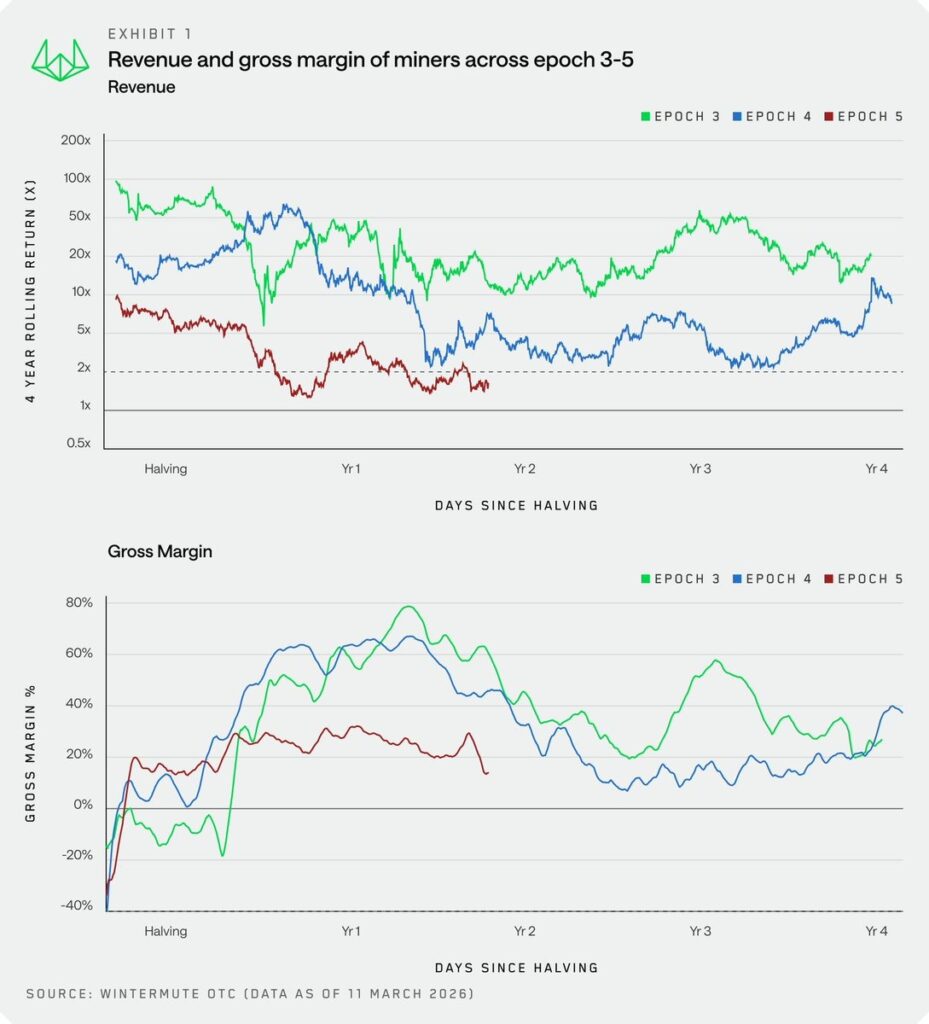

The landscape for Bitcoin miners has become increasingly challenging in the current market cycle, with diminishing returns pushing many to the brink of profitability. Market maker Wintermute has highlighted a critical juncture for the industry, suggesting that miners must pivot towards new revenue streams, such as artificial intelligence (AI) hosting, or strategically leverage their existing Bitcoin holdings to generate yields. This recommendation comes as the foundational economics of Bitcoin mining are being tested by a confluence of factors, prompting a re-evaluation of traditional operational models.
Wintermute’s analysis, detailed in a recent blog post, points to a structural shift in the Bitcoin mining cycle, which they term "Epoch 5." Historically, Bitcoin miners have invested heavily in building substantial power infrastructure in regions with low energy costs, a strategy that has served them well in previous market cycles. However, the current environment reveals that this infrastructure is precisely what the burgeoning artificial intelligence industry urgently requires and cannot easily replicate. AI development and deployment demand immense computational power and access to cost-effective electricity, creating a potential symbiotic relationship between Bitcoin miners and AI companies.
The firm characterizes the Bitcoin mining business model as "structurally rigid." While the prospect of pivoting to AI hosting offers a compelling diversification opportunity, Wintermute acknowledges that it represents a "drastic and capital-intensive step." This implies significant upfront investment in hardware, infrastructure upgrades, and potentially retraining of personnel to accommodate the demands of AI workloads.
This strategic advice from Wintermute coincides with a growing trend of mining giants exploring AI ventures. MARA Holdings, a prominent mining company, recently filed with the U.S. Securities and Exchange Commission (SEC) on March 3, signaling its intention to sell a portion of its Bitcoin holdings to fund a transition into AI technology. This move by MARA Holdings underscores the urgency and seriousness with which major players in the mining sector are approaching this potential paradigm shift.
Further evidence of the financial pressures faced by miners can be seen in the significant sell-offs of Bitcoin. Publicly listed mining companies have collectively sold over 15,000 Bitcoin since October, a trend that CleanSpark, another major miner, exemplified by selling most of its February Bitcoin output to generate $36.6 million in proceeds. These sales indicate a need for immediate capital to cover operational costs and potentially reinvest in new technologies or business strategies.
The Legacy of the HODL Era and Untapped Yield Potential
Wintermute’s report delves into the substantial Bitcoin reserves held by miners, noting that they collectively possess close to 1% of the total Bitcoin supply. The firm attributes this large holding to a "legacy of the HODL era," a period characterized by a strong emphasis on long-term holding of Bitcoin rather than active treasury management. This approach, while historically successful in bull markets, may be proving insufficient in the current climate, leaving a significant portion of their "full toolkit of treasury management" largely untapped.
Traditionally, crypto yield generation has been confined to established methods like staking and decentralized finance (DeFi) protocols. However, Wintermute proposes that Bitcoin miners can unlock substantial returns by actively managing their BTC treasuries. This active management could involve monetizing market risk through sophisticated financial instruments. Examples include the strategic use of derivatives, such as covered calls (selling call options on their Bitcoin holdings to generate premium income) and cash-secured puts (selling put options to potentially acquire more Bitcoin at a lower price while earning a premium).
Beyond active management, passive yield generation strategies are also available. Miners could deploy their Bitcoin holdings into reputable lending protocols, earning interest on their reserves. These protocols, operating within the broader DeFi ecosystem, offer a way to put idle assets to work, generating a steady income stream that can supplement their core mining operations.
Strategic Balance Sheet Management: A Competitive Edge
The firm strongly advocates for a paradigm shift in how miners view their Bitcoin assets. "We believe active balance sheet management is the most underutilized lever available to miners and one that deserves far greater strategic attention," Wintermute stated. They contend that miners who embrace this proactive approach, treating their BTC holdings as a "working asset rather than a passive reserve," will possess a "structural edge into the next halving." This implies that a dynamic and strategic approach to treasury management will be crucial for survival and prosperity in the evolving mining landscape.
The urgency of this strategic reorientation is underscored by the unprecedented market conditions. For the first time in a four-year market cycle, Bitcoin has failed to deliver the anticipated two-times price return needed to compensate for the revenue reductions caused by the Bitcoin halving events. Historically, price appreciation has offset the decrease in block rewards, but this cycle has seen gross margins of miners peak at levels that previously represented bear market floors. This indicates a more fundamental pressure on profitability that cannot be solely remedied by price increases.
Furthermore, the transaction fee market, which has historically provided a partial offset to mining revenue, has not consistently filled the gap. Wintermute describes this revenue stream as "episodic" rather than structural, meaning it is not a reliable or predictable source of income. The unpredictable nature of transaction fees, often driven by network congestion or specific events, makes them an insufficient substitute for the declining block rewards.
Meanwhile, energy costs, a primary operational expense for Bitcoin miners, continue to exert significant pressure on margins. The increasing cost of electricity, coupled with the need for more efficient, and thus often more expensive, mining hardware, creates a double squeeze on profitability.
A "Healthy Shakeup" for the Mining Industry
Wintermute’s analysis suggests that the current squeeze on mining profitability is distinct from previous downturns in 2018 and 2022. They characterize this challenging period not as a crisis, but as a "healthy shakeup" that is inherently aligned with the design principles of Bitcoin. The network is designed to adapt and evolve, and this period of financial pressure may serve to weed out less efficient operations and drive innovation within the industry.
The implication of this "shakeup" is that the Bitcoin mining industry will likely become "more efficient as a result." Companies that can adapt to the new economic realities by diversifying their revenue streams, optimizing their operations, and strategically managing their assets will be better positioned to thrive. This could lead to a more consolidated and technologically advanced mining sector in the long term.
The shift towards AI hosting is particularly noteworthy. The infrastructure built by Bitcoin miners—massive data centers with high-capacity power delivery and cooling systems—is directly transferable to the needs of AI computation. Companies like NVIDIA, a leading provider of AI hardware, have emphasized the immense power requirements of AI models. Bitcoin miners, with their established energy infrastructure and often access to off-peak or renewable energy sources, are uniquely positioned to meet this demand.
The capital-intensive nature of AI hosting is also a key factor. Establishing AI data centers requires significant investment in specialized hardware, networking, and cooling solutions. For Bitcoin miners, who already possess much of the foundational infrastructure, the transition may involve upgrading existing facilities and investing in AI-specific server hardware, which could be a more manageable capital outlay than building entirely new facilities from scratch.
The potential for AI hosting to generate substantial revenue streams is significant. The demand for AI computing power is projected to grow exponentially in the coming years, driven by advancements in machine learning, generative AI, and data analytics across various industries. By offering their computing resources and infrastructure, Bitcoin miners could tap into this rapidly expanding market, creating a vital new revenue stream that is less dependent on Bitcoin’s price volatility and block reward dynamics.
Broader Implications and Future Outlook
The recommendations from Wintermute carry significant implications for the future of Bitcoin mining. They signal a move away from a singular focus on Bitcoin block rewards towards a more diversified and sophisticated business model. This evolution is not merely about survival but about capitalizing on emerging technological trends.
The success of this pivot will depend on several factors. Firstly, the ability of mining companies to secure the necessary capital for AI infrastructure upgrades and hardware acquisitions will be critical. Secondly, establishing partnerships with AI companies and developing robust service offerings will be essential for attracting and retaining clients. Finally, regulatory landscapes surrounding both cryptocurrency and AI will need to be navigated carefully.
The trend of publicly listed miners selling Bitcoin to fund diversification efforts suggests that the market is already recognizing the need for change. As more companies explore AI and other ventures, the Bitcoin mining industry could transform from a niche sector focused solely on digital asset production into a broader technology and infrastructure provider. This would not only enhance the financial stability of individual mining operations but also contribute to the overall maturation and integration of the cryptocurrency ecosystem into the broader digital economy. The coming months and years will likely witness significant strategic realignments within the Bitcoin mining industry as it grapples with these evolving economic and technological forces.