
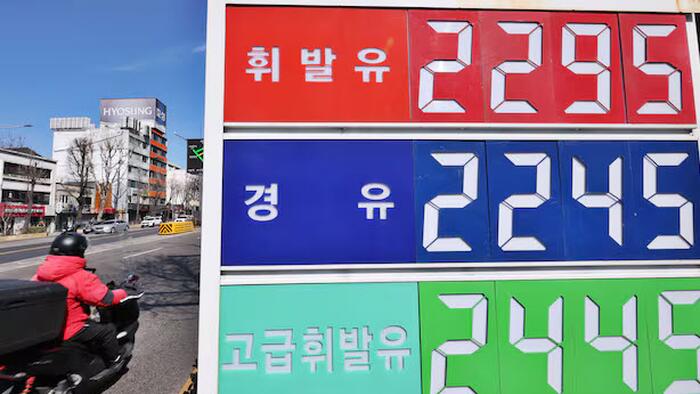

Asian financial markets are experiencing significant turbulence, with a widespread downturn observed this morning, as the region, critically positioned as the world’s largest oil-importing bloc, grapples with a dramatic surge in crude oil prices. This economic shockwave, primarily triggered by escalating geopolitical tensions in the Middle East, has compelled several nations to enact unprecedented measures to shield their economies and citizens from the immediate impact. Among the most drastic responses, South Korea has announced its first domestic fuel price cap in nearly three decades, swiftly followed by Taiwan, which is also moving to limit weekly oil price increases, underscoring the severe economic strain these nations are facing.
Economic Vulnerabilities and Resilience Across Asia
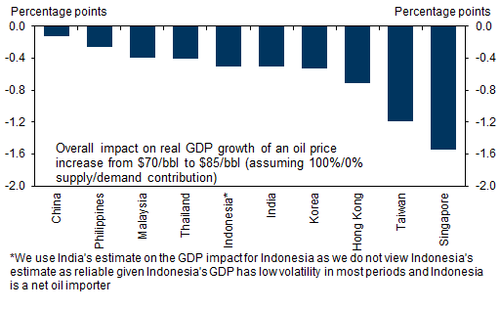
The ripple effects of soaring oil prices are not uniformly distributed across the Asian continent, a fact highlighted by recent analyses. According to a detailed assessment by Goldman Sachs, which examines the correlation between higher oil prices and real GDP growth, China demonstrates a remarkable degree of insulation from supply-driven oil price increases when compared to its emerging Asian counterparts. The analysis suggests that a $15 per barrel increase in crude oil prices would lead to a modest 0-0.1 percentage point reduction in China’s GDP growth and a contained 0.1-0.2 percentage point rise in headline Consumer Price Index (CPI) inflation.
Several factors contribute to China’s comparative resilience. Its diverse economic structure, which includes a significant domestic manufacturing base and a growing service sector, provides a buffer against external energy shocks. Furthermore, the potential for robust government intervention plays a crucial role in dampening the pass-through of global price increases to consumers. The state’s capacity to subsidize energy costs, control strategic reserves, and manage domestic pricing mechanisms offers a powerful tool for economic stabilization. Last year’s substantial increase in oil stockpiling, with some estimates placing China’s strategic oil reserves at a formidable 1.5 billion barrels, further fortifies its position. This strategic foresight, coupled with a period of relatively low inflation over the past few years, renders China less susceptible to the inflationary pressures of rising energy costs.
In stark contrast, other major economies in the region are poised to bear a considerably heavier burden. Singapore, followed by Taiwan and South Korea, are identified as particularly vulnerable. The Goldman Sachs analysis, based on a scenario of $85 per barrel oil, projects a significant 1.6% hit to Singapore’s GDP growth. Given that Brent crude has now surged past the $100 per barrel mark, with risks pointing to further upside, the actual economic impact on these highly import-dependent nations could be even more severe. Singapore, a global financial hub and a nation with virtually no domestic energy resources, relies almost entirely on imported crude for its energy needs, making its economy acutely sensitive to global price fluctuations. Similarly, Taiwan and South Korea, with their export-oriented, high-tech manufacturing economies, are heavily reliant on imported energy to power their industries and transport networks, making them exceptionally vulnerable to supply chain disruptions and cost escalations. Their energy mix often includes a substantial proportion of oil and liquefied natural gas (LNG), imported primarily from the Middle East, exacerbating their exposure to geopolitical risks.
The Geopolitical Catalyst and Market Volatility
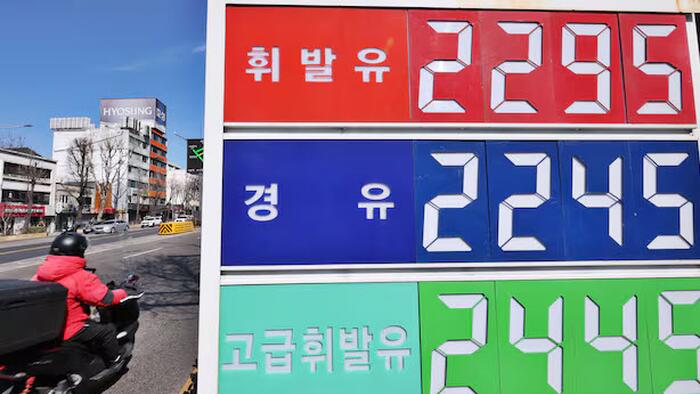
The current crisis has its roots in escalating geopolitical tensions in the Middle East, which have injected significant uncertainty and volatility into global crude oil markets. The conflict has disrupted traditional supply routes, raised fears of broader regional instability, and led to a speculative frenzy that has driven oil prices sharply higher. Brent crude, the international benchmark, has not only crossed the psychological barrier of $100 per barrel but has demonstrated an alarming upward momentum, with analysts warning of potential further increases if the conflict persists or expands.
This sudden and dramatic shift in energy prices has had an immediate and profound impact on financial markets across Asia. Equity markets have plunged, currencies have depreciated, and investor confidence has been severely shaken. The rapid nature of the price surge has left little room for gradual adjustment, forcing governments to react with urgency.
South Korea’s Decisive Intervention
Responding to the intensifying economic pressure, South Korean President Lee Jae-myung announced on Monday that authorities would implement a cap on domestic fuel prices. This marks the first time in nearly 30 years that such a measure has been taken in South Korea, underscoring the severity of the current energy crisis and the government’s determination to mitigate its impact on households and businesses.
Speaking at an emergency cabinet meeting, President Lee articulated the government’s commitment to "swiftly implement and boldly implement" a maximum price system on petroleum products. He stressed that the current crisis poses "a significant burden on our economy, which is highly dependent on global trade and energy imports from the Middle East." The decision to cap prices reflects a strategic move to stabilize consumer costs, prevent runaway inflation, and maintain social stability in the face of rising global commodity prices. This policy, while offering immediate relief, also presents a fiscal challenge, as the government will likely absorb the difference between international market prices and the capped domestic prices through subsidies.
Beyond immediate price controls, President Lee also outlined broader strategies to enhance South Korea’s energy security. He stated that the nation would actively seek to diversify its energy sources, exploring options beyond supplies shipped via the Strait of Hormuz, a critical but geopolitically sensitive chokepoint for global oil transit. This long-term diversification strategy aims to reduce the country’s reliance on a single region and enhance its resilience against future supply disruptions.
The President further emphasized the need for comprehensive economic stabilization. Acknowledging the extreme volatility in financial markets, he called for the potential expansion of an existing 100 trillion won (approximately $75 billion USD) market stabilization program. He urged the government and the central bank to prepare additional measures to respond to the fluctuating financial and foreign exchange markets, signaling a readiness for further intervention to safeguard the economy.
The financial markets reacted sharply to the news and the broader economic climate. South Korean shares slumped 8% on Monday, triggering circuit breakers for the second time within the month, reflecting the profound investor anxiety surrounding the escalating Middle East conflict. The Korean Won also dropped more than 1%, trading near the psychologically significant barrier of 1,500 per dollar, indicating capital outflows and a loss of investor confidence. This followed a period of extreme volatility, where the Kospi index had plunged 12% on the preceding Wednesday before surging by an equivalent 12% on Thursday, illustrating the highly reactive and unpredictable nature of the current market environment. This "cartoonish" market behavior, as some analysts describe it, highlights a dependency on government intervention to prevent further cascading effects, where even small negative triggers can send momentum-chasing investors into a panic.
Taiwan’s Parallel Response
Following closely on South Korea’s heels, Taiwan also moved to implement similar protective measures. The Commercial Times reported that Taiwan would establish a weekly cap on oil-price increases, a move aimed at cushioning its economy from the severe impact of the Middle East conflict. Premier Cho Jung-tai had previously indicated on Sunday that the government had activated a price-stabilization mechanism designed to absorb oil price increases. This came after the Ministry of Economic Affairs had announced the day before that domestic fuel prices would only rise by approximately 5% this week, a figure significantly lower than what market forces would dictate.
Taiwan’s Ministry of Economic Affairs confirmed that under its floating oil-price adjustment mechanism, prices should have climbed by as much as 19.7% this week. However, with the activation of stabilization measures, unleaded gasoline prices rose by a more manageable 5.5%. This intervention demonstrates the government’s commitment to absorbing costs to alleviate the burden on households and businesses, thereby maintaining domestic price stability and preventing widespread economic disruption.
Regarding liquefied natural gas (LNG), another crucial energy import for Taiwan, Economy Minister Kung Ming-hsin assured reporters that the island only needs to secure two more cargoes for March and April. He confidently stated, "We won’t have a power shortage, and no additional coal-fired generation will be needed in March and April. We can proceed as planned and safely navigate the period." This statement aims to reassure the public and industries about the stability of Taiwan’s power supply despite the global energy crunch.
While Taiwanese officials, as cited in the Commercial Times, currently express no concerns about running out of crude oil or natural gas, the long-term sustainability of such price controls remains a subject of intense debate among economists. The government’s strategy includes plans to increase oil and gas purchases from outside the Middle East, echoing South Korea’s diversification efforts. Furthermore, Taiwan is coordinating with regional partners such as Japan and South Korea to explore options for swapping LNG cargoes, a collaborative approach designed to ensure stable supply across the allied economies. This regional cooperation highlights the shared vulnerability and the necessity for collective action in navigating the current energy crisis.
The Broader Implications of Price Controls and Energy Security
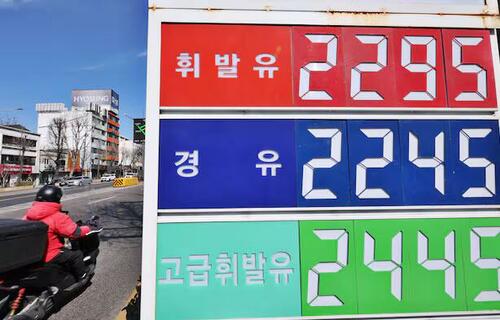
The implementation of fuel price caps by South Korea and Taiwan, and potentially other nations, represents a critical juncture in the global response to the energy crisis. While these measures offer immediate relief to consumers and businesses, mitigating inflationary pressures and preventing social unrest, they also raise significant economic questions. Artificially suppressed prices can distort market signals, discourage energy conservation, and create a substantial fiscal burden on governments through subsidies. The longer these caps remain in place, the greater the potential for misallocation of resources and the more severe the "snapback" effect when they are eventually lifted.
The prudence of such widespread price controls is a subject of intense economic debate. On one hand, in times of acute crisis, governments often prioritize social stability and economic continuity over pure market efficiency. The risk of widespread social unrest, triggered by rapidly unaffordable fuel and commodity prices, is a potent factor that no government can ignore. The "sacking of every incumbent politician" is a very real threat if citizens perceive their leaders as failing to protect them from economic hardship.
On the other hand, sustained price caps can lead to unintended consequences, including potential shortages if suppliers find it unprofitable to sell at capped prices, or if demand remains artificially high. They can also strain national budgets, diverting funds from other critical public services or investments. The challenge for policymakers lies in striking a delicate balance between immediate relief and long-term economic sustainability.
Beyond the immediate crisis management, the current oil price surge underscores the urgent need for enhanced energy security and diversification strategies across Asia and globally. Nations are increasingly recognizing the geopolitical risks associated with over-reliance on a single region or a narrow set of energy suppliers. Investments in renewable energy, energy efficiency programs, and the development of robust strategic reserves are becoming paramount. The coordination among Asian countries to swap LNG cargoes and explore alternative sourcing options highlights a growing regional consciousness regarding collective energy security.
In conclusion, the "bloodbath" across Asian markets is a stark manifestation of the region’s deep vulnerability to global energy price shocks, particularly those emanating from geopolitical instability. While nations like China demonstrate a degree of resilience, others like South Korea and Taiwan are compelled to resort to emergency measures such as fuel price caps, a testament to the severity of the crisis. Unless global oil prices stabilize and reverse their upward trajectory, the world can anticipate similar interventions, including widespread price controls and strategic petroleum reserve releases, as governments grapple with the twin threats of a global recession and widespread social unrest. The current climate serves as a potent reminder of the interconnectedness of global economics and geopolitics, and the enduring challenge of securing stable and affordable energy for sustained growth.