

The landscape of real estate investment is heavily influenced by the regulatory environment, and for property owners, the designation of a "landlord-friendly" state can significantly impact profitability and operational ease. As of 2026, a select group of states consistently emerge as top contenders for landlords seeking a more favorable climate. This investigation delves into what constitutes a landlord-friendly state, the key characteristics that define them, and the potential implications for investors considering these markets. Understanding these distinctions is not merely an academic exercise; it directly affects cash flow, return on investment, and the overall sustainability of rental property ventures.
Defining a Landlord-Friendly State
A landlord-friendly state is characterized by a legal and regulatory framework that generally favors property owners and simplifies the management of rental properties. These environments often feature laws and policies designed to reduce the barriers to entry and operational costs for landlords, while still maintaining essential protections for tenants. It’s crucial to note that "landlord-friendly" does not equate to an absence of tenant rights. Robust tenant protection laws are present in every state, and compliance remains paramount for ethical and legal operation. Instead, these states strike a balance, offering provisions that streamline processes and mitigate risks for those who invest in the housing market through rental properties.
Several key attributes contribute to a state’s landlord-friendly status:
Low Property Taxes
Property taxes are a significant ongoing expense for any real estate owner. In 2026, effective property tax rates across the United States typically range from 0.25% to 2% of a property’s assessed value. While property taxes are often tax-deductible, thereby reducing a landlord’s taxable income, higher tax rates in certain states directly diminish net operating income and consequently lower the capitalization rate (cap rate), a key metric for assessing investment profitability. Furthermore, real estate taxes are subject to annual increases, which can further erode profit margins. Investing in states with lower property tax burdens can therefore lead to greater cash flow retention for landlords.
Absence of Rent Control
Rent control, a regulatory measure designed to stabilize rental markets and protect tenants from excessive rent hikes, can present substantial challenges for landlords. These regulations often limit the amount by which landlords can increase rent, as well as the frequency and timing of such increases. While intended to ensure affordability, strict rent control policies can hinder a landlord’s ability to adapt to rising operational costs. Expenses such as insurance premiums, property taxes, management fees, and maintenance and repair costs can escalate without a corresponding ability to adjust rental income. In extreme cases, landlords may be compelled to defer essential maintenance or major repairs, potentially diminishing the long-term value of their investment. For new investors, states without rent control offer a clearer path to predictable revenue growth and a more robust financial strategy.
Streamlined Entry and Licensing
The process of becoming a landlord and legally operating a rental property business can involve navigating a complex web of licenses and permits. The specific requirements can vary based on property type, rental strategy (e.g., short-term versus long-term rentals), and geographical location. Some states impose stringent licensing requirements that can significantly increase initial setup costs for investors. Landlord-friendly states typically simplify this process, allowing investors to establish their rental businesses with fewer bureaucratic hurdles and lower upfront financial commitments. This ease of entry can be a significant draw for individuals looking to diversify their investment portfolios.
No Caps on Security Deposits
Security deposits serve as a critical financial safeguard for landlords, protecting against potential losses due to unpaid rent or utilities, property damage beyond normal wear and tear, lease violations, or necessary professional cleaning during tenant turnover. When tenant-friendly states impose caps on the maximum amount that can be charged for a security deposit, it can create a mismatch between the potential costs incurred by a landlord and the available funds. Damages may exceed the capped deposit amount, leaving the landlord to absorb the difference. Furthermore, lower security deposits may not adequately reflect a tenant’s financial standing or commitment to the lease agreement. States that do not cap security deposits offer landlords greater protection, though it is generally expected that landlords will set "reasonable" deposit amounts that are commensurate with market conditions and potential risks.
Minimal Notice-of-Entry Requirements
The ability for a landlord to access a rental property without lengthy, legally mandated notice periods is vital for various operational needs. These include conducting routine inspections to ensure property upkeep, performing necessary maintenance and repairs, showing the property to prospective tenants or buyers, and responding to emergencies. In many landlord-friendly jurisdictions, the required notice for entry is typically between 24 to 48 hours, allowing for timely intervention and efficient property management. This flexibility can be crucial in preventing minor issues from escalating into costly problems and in minimizing vacancy periods between tenants.
Efficient Eviction Processes
While the goal for any landlord is to avoid the necessity of eviction, the reality of the rental market means it is an unfortunate possibility for many. Eviction proceedings can vary dramatically in complexity, cost, and duration across different states. In some areas, the process can be protracted, involving multiple court appearances, extensive legal documentation, and significant fees, potentially stretching from a few weeks to several months. During this time, landlords may continue to incur expenses such as mortgage payments, property taxes, and insurance, all while receiving no rental income. Disgruntled tenants might also cause further damage to the property during a lengthy eviction. States that offer a quicker and more streamlined eviction process can significantly reduce financial and emotional burdens on landlords, making them more attractive for investment.

Additional Landlord Protections
Beyond the aforementioned characteristics, some states offer further incentives and protections for landlords. These can include provisions that allow for immediate disposal of abandoned property left behind by tenants or a lack of limitations on late rent fees. State preemption laws, which prevent local governments from enacting rental regulations that conflict with state law, can also contribute to a more consistent and predictable operating environment for landlords.
It is important to acknowledge that no single state perfectly embodies every landlord-friendly attribute. The "top" states are often a result of a favorable balance of these characteristics, rather than an exhaustive inclusion of all possible protections. For instance, Texas is recognized for its no rent control policies and relatively efficient eviction process, but it may have higher property taxes compared to other landlord-friendly states. Furthermore, even within a landlord-friendly state, individual cities and municipalities may have their own distinct ordinances and regulations that can impact rental property operations. Therefore, thorough due diligence at the local level is always recommended.
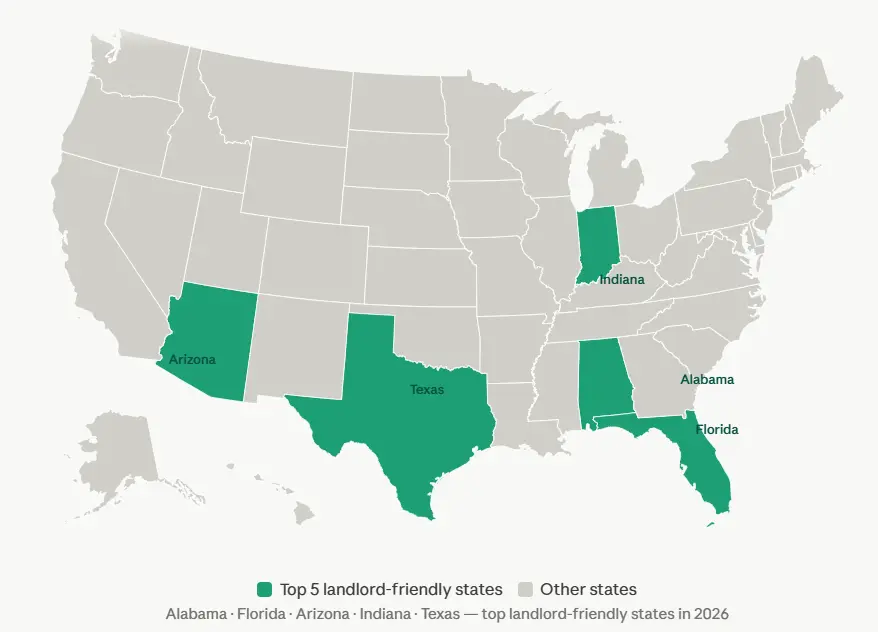
The Top 5 Most Landlord-Friendly States in 2026
Based on an analysis of these factors, the following five states are consistently identified as leading landlord-friendly markets in 2026:
Alabama
Alabama stands out in 2026 as a state with a notably low level of regulatory oversight for individual landlords. This minimal regulatory burden translates into fewer compliance requirements and a generally more straightforward operational environment.
- Property Taxes: Alabama boasts some of the lowest property tax rates in the nation, significantly reducing a major ongoing expense for landlords and boosting cash flow.
- Rent Control: The state does not have statewide rent control laws, allowing landlords to adjust rents based on market conditions and rising operational costs.
- Eviction Process: Alabama generally offers a relatively swift eviction process, which can be crucial for landlords dealing with non-paying tenants.
- Security Deposits: While specific state statutes may apply, Alabama generally allows for reasonable security deposits without strict state-imposed caps, providing a good level of protection.
- Landlord Rights: The state offers a degree of flexibility in landlord rights, including provisions for handling abandoned property.
Top Landlord-Friendly City with High Average Cap Rate: Birmingham, Alabama, often presents attractive investment opportunities due to its relatively low property values and solid rental demand, contributing to higher average cap rates.
Florida
Florida’s robust tourism industry and growing population have long made it a desirable location for real estate investment, and its regulatory climate often favors landlords.
- Property Taxes: While not as low as some other states, Florida’s property taxes are generally considered moderate, and homestead exemptions can benefit owner-occupiers, indirectly influencing the rental market.
- Rent Control: Florida prohibits rent control statewide, providing landlords with the flexibility to set and adjust rents in response to market dynamics.
- Eviction Process: Florida has a well-established and generally efficient eviction process, designed to resolve landlord-tenant disputes in a timely manner.
- Security Deposits: The state allows landlords to collect security deposits to cover potential damages or unpaid rent, with specific guidelines regarding their use and return.
- Landlord Rights: Florida statutes provide clear rights and responsibilities for both landlords and tenants, with provisions that support landlords in managing their properties. The state also has strong laws regarding the recovery of attorney fees in eviction cases.
Top Landlord-Friendly City with High Average Cap Rate: Tampa, Florida, has emerged as a particularly strong market, driven by economic growth, population influx, and a favorable investment climate, often leading to competitive cap rates.
Arizona
Arizona’s business-friendly environment extends to its real estate sector, making it an attractive destination for landlords.
- Property Taxes: Arizona’s property tax rates are competitive, especially compared to some of the higher-tax states, contributing to better net operating income for landlords.
- Rent Control: Similar to Florida, Arizona has laws preventing statewide rent control, empowering landlords to manage rental rates effectively.
- Eviction Process: The state’s eviction process is known for being relatively straightforward and efficient, allowing landlords to regain possession of their property in a timely manner if necessary.
- Security Deposits: Arizona law permits landlords to collect security deposits and outline their usage in the lease agreement, offering a layer of financial protection.
- Landlord Rights: The state provides a clear legal framework that supports landlord rights, including provisions for lease enforcement and property access.
Top Landlord-Friendly City with High Average Cap Rate: Phoenix, Arizona, continues to be a prime market for real estate investors, with its expanding economy and significant population growth supporting strong rental demand and attractive investment returns.
Indiana
Indiana offers a compelling combination of affordability and landlord-favorable regulations, making it a consistent choice for investors.
- Property Taxes: Indiana generally has lower-than-average property tax rates, which can significantly enhance the profitability of rental properties.
- Rent Control: The absence of statewide rent control laws allows landlords in Indiana to set rents according to market demand and operational costs.
- Eviction Process: Indiana’s eviction process is considered efficient, with legal frameworks designed to assist landlords in resolving tenancy issues promptly.
- Security Deposits: Indiana law allows landlords to collect security deposits to cover potential damages or unpaid rent, with specific regulations governing their management.
- Landlord Rights: The state’s statutes provide a clear understanding of landlord rights and responsibilities, promoting a predictable operating environment. Indiana also benefits from strong tenant screening laws.
Top Landlord-Friendly City with High Average Cap Rate: Indianapolis, Indiana, offers a robust rental market with a diverse economic base, making it a strong contender for investors seeking favorable cap rates and consistent rental income.
Texas
Texas, a state known for its economic dynamism and business-friendly policies, also presents a largely landlord-friendly real estate market, albeit with certain trade-offs.
- Property Taxes: While Texas is recognized for its landlord-friendly stance on many issues, it is also known for having relatively higher property taxes compared to some other states on this list. This is a significant factor investors must consider in their financial projections.
- Rent Control: Texas strictly prohibits rent control at the state level, giving landlords considerable freedom in setting and adjusting rental rates.
- Eviction Process: The eviction process in Texas is generally considered efficient and well-defined, allowing landlords to navigate the legalities of tenant removal with relative ease.
- Security Deposits: Texas law permits landlords to collect security deposits, with clear regulations on how these funds can be used and when they must be returned.
- Landlord Rights: The state offers a comprehensive set of landlord rights, including provisions for lease enforcement, property access, and handling abandoned property. State preemption laws also limit the ability of local municipalities to enact stricter rental regulations.
Top Landlord-Friendly City with High Average Cap Rate: Houston, Texas, continues to be a magnet for real estate investment, driven by its diverse economy, affordability, and strong rental demand, often resulting in competitive cap rates.
The Investor’s Perspective: Beyond the Label
While the "landlord-friendly" label offers a valuable starting point for identifying potentially advantageous markets, it is crucial for investors to look beyond these classifications and conduct thorough due diligence. The underlying economic fundamentals of a market are paramount. Factors such as home prices, rent levels, job growth, population migration trends, and long-term demand play a more significant role in investment success than regulatory labels alone.
Daryl Fairweather, Chief Economist at Redfin, emphasizes this point: "Landlord-friendly and tenant-friendly labels can be helpful, but they can be too broad to guide an investment decision on their own. What matters more is the underlying economics (fundamentals) of a market, like home prices, rent levels, job growth, and long-term demand. A landlord-friendly market with weak fundamentals can underperform a tenant-friendly market with strong population growth and tight supply, for example. I would suggest that investors should treat the regulatory environment as just one of many factors."
Indeed, a landlord-friendly market is not inherently risk-free. Rapid investor activity can inflate property prices, compressing yields. Furthermore, risks of overbuilding or economic volatility exist in any market, regardless of its regulatory stance. Fairweather cautions, "Landlord-friendly doesn’t always mean low risk. Typically in some of these markets, rapid investor activity has already driven up prices, which can compress yields. There’s also the risk of overbuilding or economic volatility. Just because regulations are favorable doesn’t mean the investment will perform well. Always start by paying close attention to fundamentals like affordability, migration trends, and local employment."
Navigating Tenant-Friendly Markets
For investors who find compelling opportunities in tenant-friendly states, understanding how to mitigate potential challenges is key. Rent control, for instance, requires strategic planning. Fairweather advises, "In rent-controlled markets, cash flow starts with the purchase price. You need to buy at a basis that makes sense given future rent constraints. After that, focus on minimizing turnover and vacancy, since you might not be able to raise rents between tenants. Keeping units well-maintained and building good tenant relationships can reduce churn. I’ve seen some investors also look for properties where allowable increases like inflation-based adjustments or capital improvement passthroughs can help offset costs over time."
In tenant-friendly states, a conservative underwriting approach and professional operations are essential. This includes rigorous tenant screening, setting appropriate rents from the outset, and budgeting for potentially longer timelines if issues arise. A deep understanding of local regulations—including notice periods, eviction timelines, and rent increase rules—is vital to avoid surprises. Engaging with local property managers or legal experts, especially for first-time investors, is highly recommended.
The Bottom Line: A Holistic Approach to Investment Decisions
In the current real estate climate, the "landlord-friendliness" of a state should be considered a factor, but not the sole determinant of an investment decision. The market dynamics, economic indicators, and specific deal fundamentals are increasingly prioritized by savvy investors. As Redfin’s Fairweather notes, "That’s increasingly true. What we’re seeing now is that investors are prioritizing fundamentals over labels. A market like Milwaukee, for example, may be considered tenant-friendly, but if it offers relatively affordable entry points and stable rental demand, it can still be attractive. Meanwhile, some traditionally landlord-friendly markets—like parts of Florida—have cooled due to rising prices and insurance costs. So today, the more important question is: ‘Does the deal make sense given the local market conditions?’ Regulation matters, but it’s not the whole story."
Ultimately, success in real estate investment hinges on a meticulous examination of the numbers and a comprehensive understanding of local market conditions. By leveraging data and analytical tools, investors can identify profitable opportunities regardless of a state’s regulatory label, ensuring informed and strategic decision-making.

