
Renters insurance, often relegated to a mere checklist item in the lease signing process, remains one of the most widely misunderstood yet critical forms of coverage available to consumers in the United States. A prevalent misconception is that all policies offer a standardized set of protections and a uniform customer experience. This assumption, however, diverges significantly from the practical realities of the insurance market. As the rental market continues to expand and evolve, particularly in urban centers and amidst shifting economic landscapes, a clear understanding of renters insurance options becomes increasingly vital. This comprehensive review aims to dissect the offerings of leading national providers, illuminate the nuances of their services, and ultimately guide renters toward policies that genuinely deliver value in today’s dynamic environment.
The landscape of renters insurance is characterized by a spectrum of providers, from established industry giants with extensive agent networks to agile, digitally native insurtech companies. To provide a robust and unbiased assessment, an in-depth review was conducted on nine prominent national providers. The evaluation focused on several key structural and experiential aspects: how each company designs its coverage plans, its pricing methodologies, and the efficiency and transparency of its claims handling processes. Furthermore, a meticulous examination included the user-friendliness of their quote generation systems, the sophistication of their digital tools, their financial stability, and an analysis of publicly accessible customer feedback and complaint data. The overarching objective was singular: to identify which companies consistently offer the most substantial benefits and value proposition to contemporary renters.
Before delving into the specific rankings, it is imperative to establish a foundational understanding of renters insurance itself, clarifying its core components and why it is an indispensable financial safeguard for those not owning their homes.
Deconstructing Renters Insurance: Essential Coverages Explained
A standard renters insurance policy is a multifaceted financial instrument designed to protect tenants against a variety of unforeseen circumstances. Typically, it encompasses three primary categories of coverage, each addressing a distinct area of risk:
- Personal Property Coverage: This is perhaps the most immediately recognizable component, safeguarding a renter’s belongings against specified perils such as fire, smoke, theft, vandalism, and certain weather-related damages. It is crucial for renters to understand the distinction between "actual cash value" (ACV) and "replacement cost value" (RCV) policies. ACV policies reimburse for the depreciated value of an item, while RCV policies provide the cost to replace the item new. Many policies include sub-limits for high-value items like jewelry, art, or electronics, necessitating optional "scheduled personal property" endorsements for adequate protection.
- Liability Coverage: This critical protection shields the policyholder from financial responsibility if they are found legally liable for injuries to another person or damage to another person’s property, whether the incident occurs within the rented premises or elsewhere. This can include, for instance, a guest slipping and falling in the apartment or accidental damage caused by the renter to a neighbor’s property. It typically covers legal defense costs, medical expenses, and damages awarded in a lawsuit, up to the policy limits.
- Loss of Use (Additional Living Expenses) Coverage: Should the rented unit become uninhabitable due to a covered peril (e.g., a fire), loss of use coverage helps pay for additional living expenses incurred while the home is being repaired or rebuilt. This can include hotel stays, temporary rental costs, increased food expenses, and other necessary expenditures beyond normal living costs, ensuring financial stability during a disruptive period.
Beyond these core protections, many insurers offer optional endorsements to enhance coverage, addressing specific vulnerabilities. These can include protection against water backup from sewers or drains, identity theft restoration services, or coverage for specific valuable items. While the fundamental structure of these policies is broadly similar across carriers, the practical user experience, clarity of policy language, and the efficiency of claims processing vary far more than most renters anticipate, underscoring the importance of a detailed evaluation.
Methodology: A Framework for Comprehensive Evaluation
To ensure a thorough and consistent assessment, each provider was evaluated against a uniform set of rigorous criteria. This methodical approach allowed for a comparative analysis that moved beyond superficial marketing claims to uncover the true operational strengths and weaknesses of each insurer. The evaluation criteria included:
- Coverage Structure and Flexibility: Assessment of the breadth of standard inclusions, availability of crucial endorsements (e.g., scheduled property, identity theft, water backup), and options for actual cash value versus replacement cost coverage. The clarity of policy terms and the ease of customizing coverage limits were also considered.
- Pricing Competitiveness and Transparency: Analysis of how competitive initial quotes are, the availability of discounts (e.g., multi-policy, safety features, paperless billing), and the transparency of pricing models without hidden fees or complex jargon.
- Claims Handling Efficiency and Fairness: Examination of the claims submission process (digital vs. phone), average processing times, communication protocols during a claim, and publicly available data on claim satisfaction and complaint ratios. The role of AI in streamlining simple claims was also noted.
- Digital Experience and Tools: Evaluation of the mobile app functionality, online portal usability, ease of obtaining quotes, managing policies, and submitting claims digitally. This criterion was particularly relevant for modern renters who prefer self-service options.
- Financial Strength: Assessment of the insurer’s financial stability, typically indicated by ratings from independent agencies like A.M. Best. A strong financial rating assures policyholders of the company’s ability to meet its obligations, particularly during large-scale claim events.
- Customer Feedback and Complaint Data: Analysis of aggregated customer reviews from platforms like Trustpilot, as well as official complaint data from regulatory bodies such as the National Association of Insurance Commissioners (NAIC). This provided insight into real-world customer satisfaction and common pain points.
- Customer Service and Support: Evaluation of the accessibility and responsiveness of customer service channels, including phone support, online chat, and the availability of dedicated agents.
This multi-faceted evaluation recognized that different renters have varying preferences. Those who prioritize a fully digital, self-service experience would find certain insurers more appealing, while those who value a dedicated local agent would lean towards traditional carriers with robust agent networks. The ranking reflects this diversity, highlighting the optimal choice for different renter profiles.
The Evolving Landscape of Renters Insurance: Market Dynamics
The renters insurance market is currently experiencing significant shifts driven by technological advancements and changing consumer expectations. According to industry reports, only about 50% of renters in the U.S. carry renters insurance, despite the relatively low cost and high protective value. This gap indicates a vast untapped market and highlights the need for increased consumer education and accessible policy options. Furthermore, the rise of "insurtech" companies has injected a new level of competition, challenging traditional insurers to innovate their digital offerings and streamline their processes. These trends have led to a bifurcation in the market: on one side, legacy carriers leveraging their brand recognition and agent networks, and on the other, digital-first platforms appealing to tech-savvy generations with simplified, app-based solutions.
Leading Providers: A Detailed Analysis
1. Lemonade – Best Overall for Modern Renters
Best for: Renters who prefer a fully digital, self-service experience.
Lemonade has carved out a unique niche in the insurance industry by fundamentally rethinking the traditional insurance model. It emerged as a digital-first insurer, purpose-built with an app-based ecosystem rather than attempting to retrofit legacy systems into online tools. This architectural difference is immediately apparent across the entire customer journey, from the rapid quote generation process to policy management and claims submission. The simplicity and intuitive design were distinctly noticeable during testing. Lemonade’s innovative use of artificial intelligence for underwriting and claims processing allows for remarkable efficiency, with many simple claims approved almost instantly, minimizing the friction often associated with traditional carrier workflows. Its "Giveback" program, where unclaimed premiums are donated to charities chosen by policyholders, also adds a unique social impact dimension, appealing to a demographic that values corporate responsibility.
- Key Strengths: Exceptionally fast quote process, intuitive mobile app, AI-driven claims processing, transparent policy language, and a unique social impact model.
- Considerations: Primarily digital support may not suit those preferring direct human interaction, coverage availability can vary by state, and optional endorsements might be less extensive than some legacy carriers.
- Coverage & Features: Policies include comprehensive personal property, liability, and loss of use coverage. Lemonade excels in presenting coverage limits and deductibles in clear, jargon-free language, significantly reducing confusion for first-time renters.
- Digital Experience & Claims Process: The quote flow stands out as one of the fastest in the industry. Policy documents are readily accessible within the app, and coverage adjustments can be made seamlessly without needing to contact an agent. Claims are submitted digitally through a guided, step-by-step interface, leveraging AI for expedited approvals of straightforward cases.
- Customer Feedback & Positioning: Trustpilot reviews frequently commend Lemonade for its ease of setup, intuitive design, and efficient claims handling. The company positions itself as a modern, transparent, and user-centric alternative to traditional insurers, directly addressing the pain points of tech-native renters.
2. State Farm – Best for Renters Who Prefer Local Agents
Best for: Renters who value face-to-face support and established relationships.

State Farm, with its venerable history and one of the largest networks of local agents in the United States, appeals strongly to renters who prioritize personalized, in-person support over a purely digital interaction. This agent-centric model allows for tailored advice and a dedicated point of contact, fostering long-term relationships built on trust and accessibility. For many, the comfort of knowing they can walk into an office or speak directly with a familiar agent is a significant advantage, particularly when navigating complex policy questions or claims.
- Key Strengths: Extensive network of local agents, strong brand recognition and financial stability, potential for multi-policy discounts (e.g., bundling with auto insurance).
- Considerations: Digital experience may not be as streamlined as digital-first competitors, processes can sometimes be slower due to agent involvement, and customer service quality can vary by individual agent.
- Coverage & Features: State Farm offers standard renters’ protections, including personal property, liability, and loss of use, with customizable limits and endorsements that may vary by state. The depth of coverage is comparable to other major national insurers, providing a solid foundation for most renters’ needs.
- Digital Experience & Claims Process: While online account management and mobile tools are available, the overall experience often integrates or routes back through the local agent. This can be perceived as less autonomous for renters seeking full digital control.
- Customer Feedback & Positioning: On platforms like Trustpilot, reviewers often highlight positive, long-standing relationships with their agents and the dependable support received. However, some complaints mention slower claims communication or difficulties in reaching representatives outside of standard business hours, indicating a balance between human touch and digital efficiency.
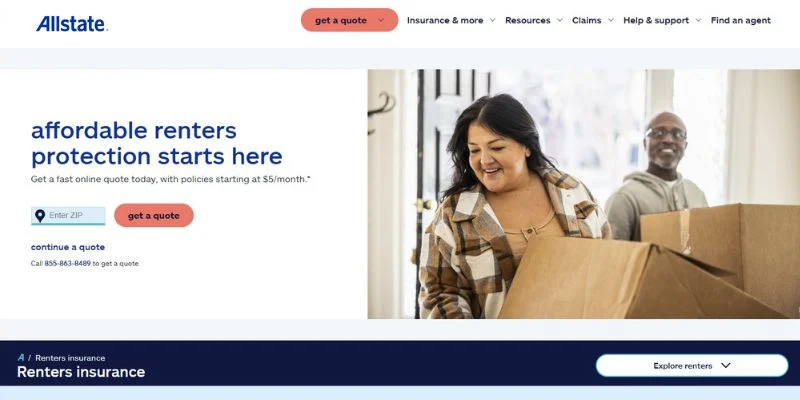
3. Allstate – Best for Renters Bundling Multiple Policies
Best for: Renters already insured for auto or other policies who desire a consolidated provider.
Allstate strategically positions renters insurance as a component within a broader portfolio of insurance products. This approach makes it a particularly attractive option for individuals who already hold auto insurance or other policies with Allstate and seek the convenience and potential cost savings of bundling their coverage. The company leverages its extensive reach and recognizable brand to offer a one-stop-shop solution for various insurance needs.
- Key Strengths: Significant multi-policy discounts, widespread national presence, and a broad range of insurance products available.
- Considerations: Renters insurance may feel like an ancillary product rather than a core focus, digital experience is optimized for managing multiple policy types, and customer service experiences can be inconsistent by region.
- Coverage & Features: Allstate provides standard renters coverage, with optional add-ons such as identity theft restoration and scheduled personal property. Its coverage structure aligns with that of other established legacy carriers, offering comprehensive protection.
- Digital Experience & Claims Process: The mobile app facilitates claims submission and document access. However, its design is generally geared towards managing multiple insurance lines (e.g., auto, home, renters) rather than exclusively renters’ needs, which might make it feel less specialized.
- Customer Feedback & Positioning: Customer reviews on Trustpilot for Allstate frequently reflect regional variations in service quality. While many policyholders appreciate the convenience and savings from bundling, some express frustrations with claim service or communication, indicating that individual experiences can differ widely.
4. GEICO – Best for Auto Customers Adding Renters Coverage
Best for: Renters who currently insure their vehicle with GEICO and seek streamlined integration.
GEICO is synonymous with auto insurance, known for its direct-to-consumer model and competitive pricing. For renters, its coverage is widely available across most states, often underwritten by third-party partners. This underwriting structure can influence the specifics of servicing and claims handling, sometimes introducing an additional layer between the policyholder and the ultimate insurer. The primary appeal for GEICO customers is the ease of adding renters insurance to an existing auto policy, often with a bundling discount.
- Key Strengths: Convenient bundling options with auto insurance, competitive pricing, simple online quoting process.
- Considerations: Underwriting by third-party partners can complicate claims processing, customer service may prioritize auto insurance, and the overall experience might lack renters-specific focus.
- Coverage & Features: GEICO offers the core protections found in most renters’ policies. The exact details and availability of endorsements may vary based on the specific underwriting partner and state regulations.
- Digital Experience & Claims Process: The quoting experience is typically straightforward and quick. However, due to potential third-party underwriting arrangements, the claims pathway may not always be fully integrated or centralized within GEICO’s proprietary platform, potentially leading to varied experiences.
- Customer Feedback & Positioning: Trustpilot reviews for GEICO are predominantly focused on auto insurance. While some reviewers report satisfactory service, others note issues with customer service responsiveness, communication, and claim handling, suggesting a degree of variability that may extend to their renters insurance offerings.
5. USAA – Best for Military Members and Their Families
Best for: Active-duty service members, veterans, and eligible family members.
USAA operates as an exclusive financial services group catering specifically to active-duty military personnel, veterans, and their eligible family members. Within this defined membership base, USAA consistently maintains an exceptionally strong reputation for customer service, competitive pricing, and comprehensive coverage. Its commitment to serving the military community is reflected in its tailored products and highly-rated support.
- Key Strengths: Excellent customer service and satisfaction ratings within its niche, competitive pricing, specialized understanding of military life, and robust digital tools.
- Considerations: Eligibility is strictly limited to military affiliation, which restricts access for the general public.
- Coverage & Features: USAA offers standard renters coverage, encompassing personal property, liability, and loss of use. Optional endorsements are available depending on state regulations, and the policy structure is robust and comparable to other major national insurers.
- Digital Experience & Claims Process: USAA’s mobile app and online account management tools consistently receive high ratings for their functionality and user-friendliness. Claims can be submitted digitally, and the processing timelines are generally efficient, though complexity can influence speed.
- Customer Feedback & Positioning: On Trustpilot and other review platforms, eligible members frequently laud USAA for its responsive claims service, competitive rates, and deep understanding of their unique needs. The exclusivity of its membership, while a limitation, contributes to its ability to offer a highly specialized and satisfactory experience.
6. Nationwide – Best for Renters Seeking a Large National Carrier
Best for: Renters who prioritize brand familiarity, extensive national presence, and a traditional, full-service insurer.
Nationwide stands as a prominent, traditional insurer offering renters insurance across most U.S. states through a hybrid model that includes both agent-assisted and direct channels. It positions itself as a comprehensive, full-service provider, appealing to those who prefer the stability and broad offerings of a well-established company rather than a niche specialist.
- Key Strengths: Widespread national availability, strong financial backing, multiple service channels (agents and direct), and potential for bundling discounts.
- Considerations: Digital experience may not be as agile as insurtech companies, customer service can vary, and policies might feel less tailored to renters-specific needs compared to digital-first options.
- Coverage & Features: Policies include personal property, liability, and loss-of-use coverage. Endorsements such as water backup or identity theft protection are generally available in eligible states, providing a robust, standard offering.
- Digital Experience & Claims Process: Online account access and mobile claims submission are available. However, in comparison to digitally native insurers, the user experience can sometimes feel more procedural and less intuitively app-centric, reflecting a more traditional operational approach.
- Customer Feedback & Positioning: Reviewers on Trustpilot often commend Nationwide for reliable claims support and professional agents. However, some renters report variability in service quality, which can depend on the specific local office or the customer’s contact experience.
7. American Family – Best for Regional Agent Support

Best for: Renters in states where American Family has a strong agent presence and who prefer guided purchasing.
American Family Insurance places a significant emphasis on its agent relationships and regional market presence. For renters who prefer a guided purchasing experience, with personalized advice and a local point of contact, this model can be particularly appealing. The company aims to build long-term relationships through its network of dedicated agents, offering a more consultative approach to insurance.
- Key Strengths: Strong focus on personalized agent relationships, community-oriented approach, and comprehensive coverage options.
- Considerations: Limited national availability compared to some larger carriers, digital experience may be secondary to agent interactions, and service consistency can vary by agent.
- Coverage & Features: Coverage includes personal property, liability, and loss of use protections, with a range of optional endorsements available depending on state regulations. The offerings are competitive within its operational regions.
- Digital Experience & Claims Process: Online account management and mobile tools are provided, but the experience often directs users back to agent support for significant policy adjustments or detailed clarifications, reinforcing its agent-centric model.
- Customer Feedback & Positioning: Reviews on Trustpilot frequently highlight the strength of American Family’s agent relationships and the personalized support policyholders receive. However, some feedback also notes areas for improvement in the digital experience, suggesting a continuous evolution in its technological offerings.
Broader Impact and Implications for Renters
The choice of renters insurance is not merely a transactional decision but a crucial aspect of personal financial planning. The increasing complexity of the rental market, coupled with evolving risk factors such as climate change-related weather events and rising theft rates, makes adequate coverage more important than ever. The emergence of insurtech companies like Lemonade signals a significant shift in consumer expectations, particularly among younger demographics who prioritize digital convenience, transparency, and socially conscious business practices. Traditional carriers, in response, are continually enhancing their digital platforms while simultaneously leveraging their established networks and broader product offerings. This competitive environment ultimately benefits renters, as it drives innovation, offers a wider array of choices, and encourages more competitive pricing. The implications extend to financial literacy, as renters are increasingly empowered to understand and customize their policies, moving beyond the "checkbox item" mentality towards a proactive approach to protecting their assets and liabilities.
Conclusion: Tailoring Insurance to Individual Needs
The review of these national carriers underscores a fundamental truth: not all renters insurance providers are created equal, nor do they approach the product with the same philosophy. In practice, the most significant differentiators boil down to three core considerations for any renter: the preferred mode of interaction with their insurer (digital self-service versus agent-assisted), the desired speed and efficiency of claims handling, and whether renters insurance is viewed as a primary, specialized product or an ancillary add-on within a larger insurance portfolio.
After a comprehensive comparison of seven leading national carriers, Lemonade emerges as a standout for its commitment to delivering a uniquely streamlined, renter-focused experience. Its entirely app-based structure, coupled with transparent policy language and AI-driven processes, creates a distinctly different user journey compared to insurers that treat renters coverage as a secondary offering.
Ultimately, the "right" choice is deeply personal and dependent on individual preferences. If speed, transparency, and comprehensive self-service digital tools are paramount, Lemonade warrants serious consideration. However, if personalized agent support, the convenience of bundling multiple policies, or specialized services for specific communities (like military families) are higher priorities, then State Farm, Allstate, GEICO, USAA, Nationwide, or American Family may prove to be the more suitable option. Renters are advised to assess their own needs and preferences before making an informed decision.
Frequently Asked Questions
What is the best renters insurance company?
Based on this evaluation, Lemonade is highly recommended for its fully digital, renter-specific experience, from quoting to claim filing. Its app-centric design and policy clarity distinguish it from many larger, more traditional carriers. However, the "best" company ultimately depends on a renter’s individual preferences for digital interaction versus agent support, and specific coverage needs.
How much does renters insurance cost per month?
Monthly premiums for renters insurance vary significantly based on factors such as the state of residence, chosen coverage limits, deductible amount, and the specific insurer. While some insurers advertise rates as low as $5 to $10 per month, actual pricing is highly individualized and can range upwards, depending on these personal and locational factors.
Does renters insurance cover theft?
Yes, most standard renters insurance policies include coverage for the theft of personal belongings. This protection typically extends beyond the confines of your rented home, covering items stolen from a vehicle, a storage unit, or even while traveling. It’s important to note that coverage is subject to your policy’s overall limits and deductible, and high-value items like jewelry, art, or specialized electronics often have sub-limits, meaning they may require a separate "scheduled personal property" endorsement for full protection.
Is Lemonade renters insurance legitimate?
Yes, Lemonade is a fully legitimate, publicly traded insurance company that offers licensed renters insurance policies across numerous U.S. states. It is regulated by state insurance departments, just like traditional insurers. Its operations and coverage availability adhere to state-specific regulations and licensing requirements.
Do landlords require renters insurance?
Increasingly, many landlords incorporate a requirement for renters insurance into their lease agreements. This typically mandates a minimum liability limit, often $100,000 or more, to protect the landlord against potential damages caused by the tenant or injuries sustained by guests on the property. It is crucial to review your lease terms carefully before moving in, as specific requirements vary by property management and state laws.
What’s the difference between Actual Cash Value (ACV) and Replacement Cost Value (RCV) renters insurance?
ACV coverage reimburses you for the depreciated value of your stolen or damaged personal property. For example, a five-year-old laptop would be valued at its worth today, not what you paid for it. RCV coverage, on the other hand, pays to replace your damaged or stolen property with new items of similar kind and quality, without deduction for depreciation. RCV policies generally have higher premiums but offer more comprehensive financial protection.
Does renters insurance cover roommates?
Generally, a standard renters insurance policy covers only the named policyholder. If you have roommates, they typically need to purchase their own individual renters insurance policies to cover their personal belongings and liability. Some insurers might offer a specific endorsement or a multi-tenant policy that covers all residents, but this is less common and should be explicitly discussed with your provider.
How can I lower my renters insurance premium?
Several strategies can help reduce your renters insurance costs. These include:
- Choosing a higher deductible: This lowers your premium but means you pay more out-of-pocket if you file a claim.
- Bundling policies: Purchasing renters insurance from the same company that provides your auto insurance often qualifies you for a discount.
- Improving home security: Having smoke detectors, fire extinguishers, deadbolt locks, or a security system can lead to discounts.
- Maintaining a good claims history: Avoiding frequent small claims can keep your rates lower over time.
- Paying annually: Paying your premium in one lump sum rather than monthly installments can sometimes result in a discount.

