
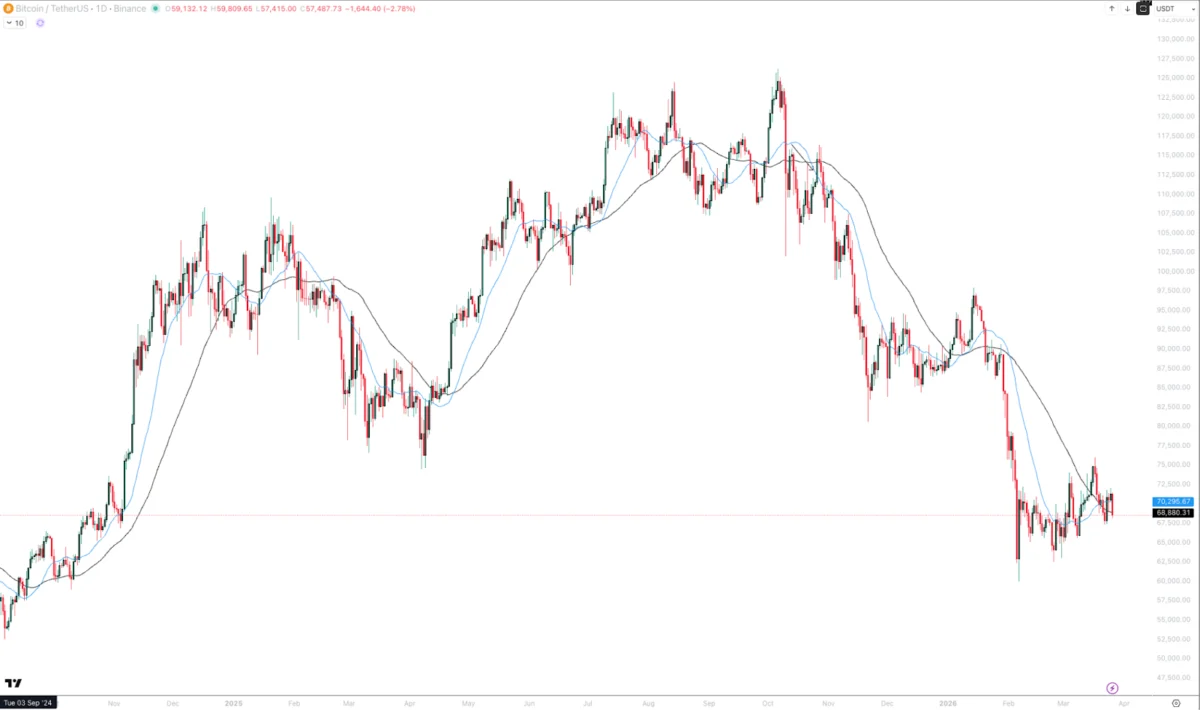
Bitcoin’s (BTC) price action remained subdued on Thursday, struggling to maintain its footing above the critical $70,000 mark. This period of consolidation is occurring against a backdrop of competing narratives: on one hand, mounting evidence of increasing institutional adoption is bolstering bullish sentiment, while on the other, escalating geopolitical tensions and their negative spillover into US equity markets are creating significant headwinds for risk assets, including cryptocurrencies.
The persistent battle to hold the $70,000 support level underscores the current tug-of-war in the market. While analysts like those at Bernstein have projected a $150,000 price target for Bitcoin by the end of 2026, citing strong institutional demand, the broader economic and geopolitical environment is injecting a considerable degree of caution. Bloomberg analysts, referencing Bernstein’s optimistic outlook, pointed to data indicating a significant return of institutional investors to Bitcoin markets. This influx, they suggest, reinforces the notion that BTC may have "reached a floor," implying a solid base for future price appreciation.
The Surge of Institutional Interest: ETFs and Strategic Investments
The first quarter of the year has witnessed a notable uptick in institutional engagement with Bitcoin. In early March, a remarkable seven-day streak of inflows into spot Bitcoin Exchange Traded Funds (ETFs) approached the $1 billion mark. This sustained demand from regulated investment vehicles signals a growing acceptance of Bitcoin as a legitimate asset class within traditional finance.
Further solidifying this trend, Strategy, a prominent investment firm, announced a substantial purchase of 22,237 Bitcoin, valued at approximately $1.6 billion, through its newly introduced perpetual preferred equity, Stretch (STRC). This move not only demonstrates a direct investment in the digital asset but also highlights innovative financial structures being employed to gain exposure to Bitcoin. The firm’s ambitions do not stop there, as Strategy has also outlined plans to raise an additional $44.1 billion specifically to acquire more Bitcoin, signaling a long-term conviction in the cryptocurrency’s potential.
The growing institutional embrace of Bitcoin extends beyond direct purchases and ETF inflows. Morgan Stanley, a global asset management giant overseeing a staggering $10 trillion, has filed documentation to launch its own spot Bitcoin ETF. This action from a mainstream financial institution is a significant indicator of the evolving landscape, suggesting that traditional players are actively seeking to provide their clients with regulated avenues to invest in cryptocurrencies. Morgan Stanley’s recommendation for investors to maintain a 2% to 4% allocation to cryptocurrencies further underscores this growing acceptance within the established financial advisory community.
Adding another layer to the institutional narrative, a proposed rule from the US Department of Labor, which would permit brokerages managing the $10 trillion 401(k) retirement plan market to invest in Bitcoin, has progressed through the White House’s regulatory review process as of March 26. This development, if enacted, could unlock vast pools of capital for Bitcoin investment from retirement accounts, potentially creating a substantial demand driver.

Innovation in Accessibility: Unlocking Bitcoin’s Liquidity
Beyond investment vehicles, innovative solutions are emerging to make Bitcoin more accessible and useful for everyday financial activities. Coinbase, a leading cryptocurrency exchange, has launched token-backed down payments for Fannie Mae loans. This groundbreaking initiative allows Bitcoin and USD Coin (USDC) holders to utilize their digital assets to fund home mortgages. Crucially, this offering enables investors to leverage the liquidity of their Bitcoin holdings without the need to sell their assets, thereby avoiding potential taxable events. This development represents a significant step towards integrating cryptocurrencies into mainstream financial transactions, potentially increasing Bitcoin’s utility beyond its store of value or speculative appeal.
Geopolitical Storm Clouds Gather: Iran-US Tensions and Market Volatility
While the narrative of institutional adoption paints a bullish picture for Bitcoin’s long-term prospects, the immediate market sentiment is being heavily influenced by escalating geopolitical tensions. The ongoing conflict between the US and Iran, coupled with explicit threats from former President Donald Trump regarding potential ground troop deployment to Iran, has cast a long shadow over global financial markets.
On Thursday, former President Trump issued a stark warning via his Truth Social platform, stating that Iran’s negotiators "better get serious soon, before it is too late, because once that happens there is NO TURNING BACK, and it won’t be pretty!" This rhetoric, combined with the visible buildup of US military assets in the Middle East, has fueled market anxieties about the potential for a ground operation to commence as early as the upcoming weekend.
The palpable sense of uncertainty stemming from this volatile geopolitical situation has triggered significant sell-offs in US equity markets. Following the former President’s comments, the Dow Jones Industrial Average shed approximately 400 points, while the S&P 500 and the Nasdaq Composite experienced declines of 1.49% and 2.07%, respectively. In contrast, the geopolitical instability has driven a surge in demand for safe-haven assets and commodities, with WTI crude oil and Brent Crude both rallying by over 4%.
The Impact on Bitcoin’s Price Dynamics
The increased uncertainty surrounding the trajectory of the US-Israel and Iran conflict, coupled with the potential long-term economic repercussions of record-high oil prices on US inflation and the broader global economy, has led investors to reduce their exposure to volatile assets. This risk-off sentiment directly impacts cryptocurrencies, which are often perceived as high-risk investments.

This broader market apprehension helps explain Bitcoin’s recurrent struggles to maintain levels above $70,000 and the ephemeral nature of its rallies into the $71,000 to $76,000 range. The price action suggests that while there is underlying demand at lower levels, broader market fear is preventing sustained upward momentum.
However, a crucial positive takeaway from the current market dynamics is the apparent view held by both institutional and retail investors that prices at or below $70,000 represent an attractive buying zone. This consistent demand at these levels is effectively reinforcing the $70,000 mark as a significant support level. The willingness of investors to accumulate Bitcoin in this price range, despite external pressures, indicates a fundamental belief in its long-term value proposition.
Analyzing the Market Structure and Future Outlook
The current market structure for Bitcoin is characterized by a dichotomy. On one side, the undeniable growth in institutional adoption, evidenced by ETF inflows, significant corporate treasury allocations, and potential inclusion in retirement plans, suggests a robust foundation for future price appreciation. The development of financial instruments that allow for easier and more regulated access to Bitcoin is a testament to its increasing maturity as an asset class.
On the other side, the prevailing macroeconomic environment, dominated by geopolitical instability and the potential for inflationary pressures driven by high energy prices, creates a challenging short-to-medium term outlook. These external factors can overshadow even strong fundamental demand drivers, leading to increased volatility and price corrections.
The interplay between these forces will be critical in determining Bitcoin’s near-term trajectory. Should geopolitical tensions de-escalate, and the broader equity markets find stability, Bitcoin is likely to benefit from the continued inflow of institutional capital, potentially pushing it towards new all-time highs. Conversely, an exacerbation of the current geopolitical situation or a significant downturn in global economic conditions could lead to further price consolidation or even a steeper correction, despite the underlying bullish trends in institutional adoption.
The strategic importance of the $70,000 level cannot be overstated. It represents not only a psychological barrier but also a critical area where buying interest has consistently emerged. The ability of Bitcoin to hold this support will be a key indicator of market resilience. The ongoing developments in institutional adoption, coupled with the increasing utility of Bitcoin through innovations like token-backed mortgages, provide a strong counter-narrative to the immediate bearish pressures. The long-term outlook remains largely optimistic, contingent on the resolution of current geopolitical uncertainties and the continued integration of digital assets into the global financial ecosystem. The market is at a crossroads, with the strength of institutional conviction set to be tested against the backdrop of global instability.

