
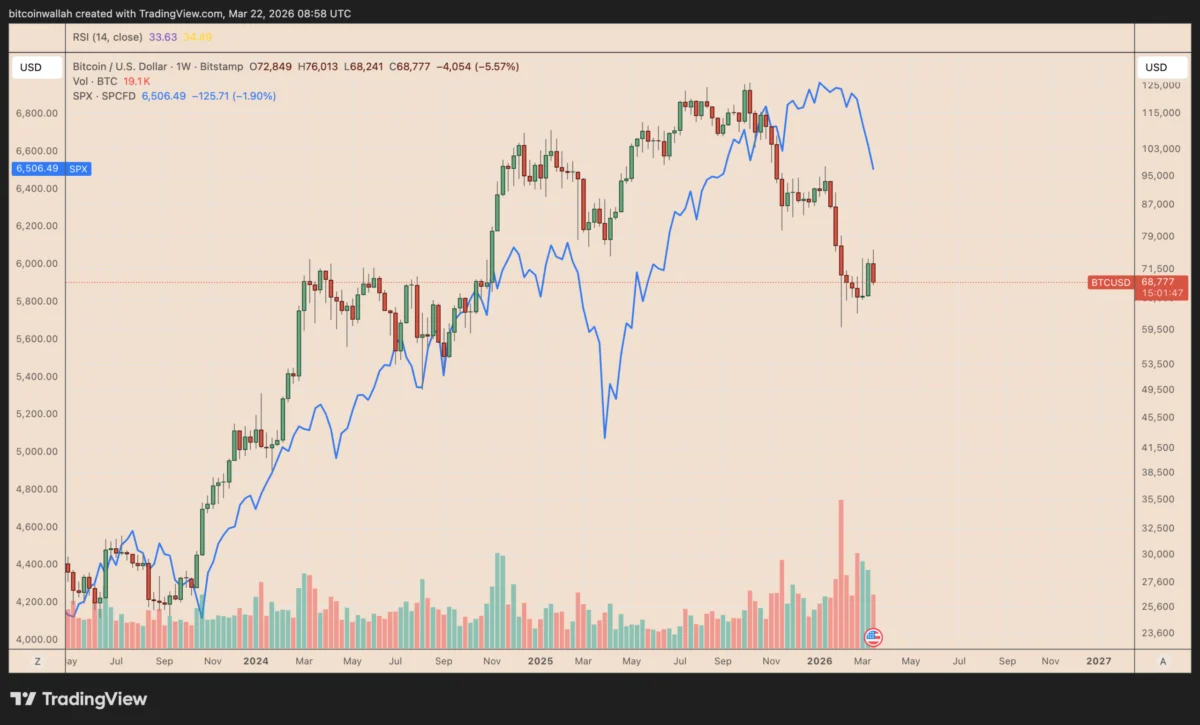
Bitcoin (BTC) has shed a significant portion of its recent gains, which were initially buoyed by geopolitical tensions between the United States and Iran. The digital asset is now exhibiting a renewed correlation with broader risk assets, particularly U.S. equities, suggesting a heightened risk of further price depreciation in the cryptocurrency market. As of Sunday, the BTC/USD pair had declined by 5.65% week-to-date, trading around the $68,700 mark. This movement mirrors the performance of the S&P 500 (SPX), which concluded the trading week down 1.90%.
The re-establishment of this correlation is a critical indicator for market participants, as historical data suggests a strong link between Bitcoin’s performance and that of major stock indices when this correlation strengthens. This suggests that macroeconomic factors and investor sentiment towards riskier assets are once again playing a dominant role in Bitcoin’s price action, potentially overriding its previous narrative as a purely uncorrelated, safe-haven asset.
The Historical Precedent: BTC’s Steep Declines Amidst Rising Stock Correlation
A deeper analysis of the relationship between Bitcoin and the S&P 500 reveals a concerning pattern. A weekly rolling correlation metric, which tracks the co-movement of BTC and SPX, has recently rebounded. As of Saturday, this metric stood at 0.13, a notable increase from its recent low of approximately -0.5. This upward trend in correlation, particularly sharp recoveries, has historically preceded significant downturns in the Bitcoin market.
Since 2018, periods where the correlation between Bitcoin and the S&P 500 has surged have often been followed by substantial price drops for Bitcoin, averaging around a 50% decline. This historical precedent has led analysts to issue cautionary statements. Tony Severino, a certified market technician (CMT), commented on this phenomenon, stating, "It is a warning sign that the stock market is going to collapse and take BTC with it."

If this historical pattern holds true, a 50% retracement from Bitcoin’s current price level would suggest a potential downside target of approximately $34,350. This projection aligns with the views of several market analysts who have previously forecasted Bitcoin’s price to reach between $30,000 and $40,000 in 2026. Such predictions are based on the cyclical nature of financial markets and the interconnectedness of various asset classes.
The historical instances of 2020 and 2022 offer compelling case studies. In both these years, Bitcoin experienced significant declines that lagged behind the initial movements in stock markets. These downturns often occurred after periods of what are termed "bull traps," where Bitcoin would rally in tandem with increasing S&P 500 correlation, only to reverse sharply and erase those gains. These bull traps can lure unsuspecting investors into believing a sustained uptrend is in place, only for the market to pivot unexpectedly.
Macroeconomic Headwinds Fueling Bearish Sentiment
The current market environment is characterized by several macroeconomic factors that contribute to the bearish outlook for both Bitcoin and equities. Elevated oil prices, persistent inflation concerns, and a diminished likelihood of the Federal Reserve initiating interest rate cuts in the near future are all creating a challenging backdrop for risk assets.
Geopolitical Tensions and Initial Bitcoin Surge:
The recent escalation of tensions between the United States and Iran had initially provided a temporary boost to Bitcoin’s price. In times of geopolitical uncertainty, some investors have historically turned to Bitcoin as a potential hedge against traditional financial system instability, akin to gold. However, this narrative appears to be weakening as the immediate shock subsides and broader market dynamics reassert themselves.
Inflation and Interest Rate Policy:
Rising inflation continues to be a significant concern for global economies. Central banks, including the U.S. Federal Reserve, are tasked with balancing the need to control inflation with the objective of fostering economic growth. The persistent inflationary pressures have led to expectations that interest rates may remain higher for longer than initially anticipated. Higher interest rates generally increase the cost of borrowing, which can dampen consumer and business spending, and make riskier assets, such as cryptocurrencies and stocks, less attractive compared to fixed-income investments.

Oil Prices and Supply Chain Disruptions:
Fluctuations in global oil prices have a cascading effect on inflation and economic activity. Geopolitical events can significantly impact oil supply, leading to price spikes that translate into higher transportation costs and increased prices for a wide range of goods and services. This can further exacerbate inflationary pressures and contribute to a more cautious investment environment.
Strategy’s Shift in Accumulation Adds to Caution
The renewed correlation between Bitcoin and equities is occurring against a backdrop of a noticeable pause in corporate accumulation of Bitcoin. MicroStrategy (MSTR), a company renowned for its significant Bitcoin holdings and its strategy of leveraging preferred stock sales to acquire more BTC, has not made any new Bitcoin purchases this week.
According to data from STRC.LIVE, a resource tracking MicroStrategy’s preferred stock activity, the company has not engaged in new Bitcoin acquisitions through this channel in the current week. MicroStrategy’s last major acquisition, announced on March 16, involved the purchase of 22,337 BTC for approximately $1.57 billion. This transaction brought their total holdings to an impressive 761,068 BTC. During the period of this acquisition, Bitcoin experienced a rally of around 10.50%, outperforming U.S. stocks.
MicroStrategy’s strategic use of its STRC preferred stock to fund Bitcoin purchases had been a notable tailwind for the cryptocurrency, particularly during the recent period of geopolitical instability. With this avenue of consistent corporate buying temporarily halted, Bitcoin becomes more susceptible to the broader market sell-off that is being signaled by its increased correlation with equities. The absence of this significant buyer could remove a crucial layer of demand, making the price more vulnerable to downward pressure.
Implications for the Broader Market and Investors
The current market scenario presents a complex picture for investors. The renewed correlation between Bitcoin and U.S. equities suggests that the digital asset may no longer be acting as an uncorrelated hedge. Instead, it appears to be trading more like a high-growth technology stock, highly sensitive to shifts in investor risk appetite and macroeconomic conditions.

Diversification Concerns: For investors who have allocated capital to Bitcoin as a means of diversifying their portfolios, this development raises concerns. If Bitcoin is moving in lockstep with traditional equity markets, its ability to provide diversification benefits during periods of market stress may be diminished.
Potential for Systemic Risk: The interconnectedness of financial markets means that a significant downturn in equities could have ripple effects across various asset classes, including cryptocurrencies. If the S&P 500 experiences a substantial decline, it could trigger a broader deleveraging event, leading to widespread asset price depreciation.
Analyst Outlook and Future Projections: While the current outlook is cautious, it is important to note that market dynamics are constantly evolving. Analysts will continue to monitor key economic indicators, central bank policies, and geopolitical developments for any signs of a shift in sentiment. The historical data on BTC-SPX correlation provides a valuable framework for understanding potential risks, but it is not a definitive predictor of future outcomes. Investors are advised to conduct thorough research and consider their own risk tolerance before making any investment decisions.
The coming weeks and months will be critical in determining whether Bitcoin can decouple from its correlation with equities or if it will continue to be influenced by the broader risk-off sentiment in global financial markets. The interplay of macroeconomic factors, regulatory developments, and the ongoing adoption of digital assets will all play a role in shaping Bitcoin’s trajectory.
The article does not contain investment advice or recommendations. Every investment and trading move involves risk, and readers should conduct their own research when making a decision. While we strive to provide accurate and timely information, Cointelegraph does not guarantee the accuracy, completeness, or reliability of any information in this article. This article may contain forward-looking statements that are subject to risks and uncertainties. Cointelegraph will not be liable for any loss or damage arising from your reliance on this information.

